
Our own Hindufication
We write this not as outsiders pretending to diagnose India, but as people who have undergone a gentler version of the same process. Over fifteen years of family and work on the subcontinent, our own Islamicate inheritance has been quietly sifted. The Persianate was retained. The Arabic was allowed to fall away. The qawwali, the food, the manners, the ghazal, the Mughal grammar of taste. All survived. The devotional Islamicate self did not. We arrived as something close to a Anglo-Islamicate hybrid. We are leaving, slowly, as a Hindu-Persianate one. We did not plan this. We watched it happen to ourselves.
The Persian survives. The Arabic does not. The poetry survives. The prayer does not. This is the formula. Once you see it, you cannot unsee it.
We made this passage with privilege, with distance, with choice, and with somewhere else to be if we changed our minds. The Indian Muslim, the one with no other passport and no other country, is being asked to make the same passage on terms set by people who never had to make it themselves. That asymmetry is this post.
The morning song
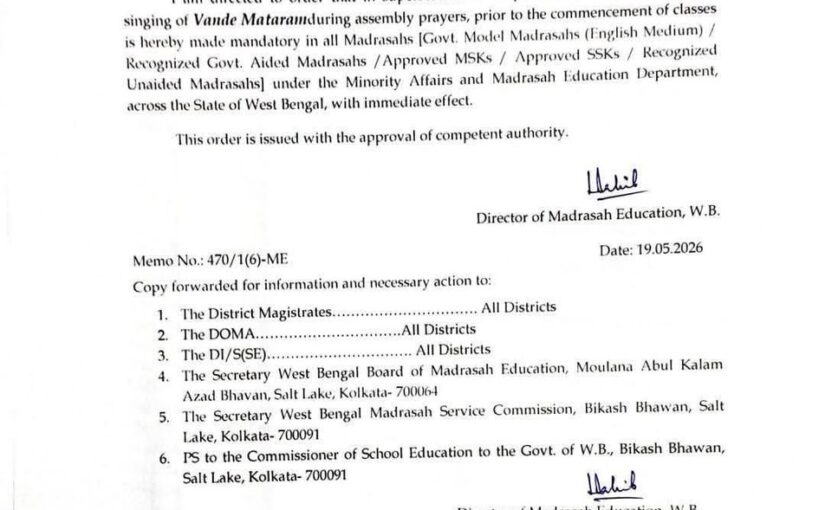
The news this week was Memo No. 470-ME, dated 19 May 2026, signed by the Director of Madrasah Education, Government of West Bengal. The order makes the singing of Vande Mataram mandatory at morning assembly in every state-recognised madrasa: government, aided, unaided, all of them. Immediate effect. Approval of competent authority.
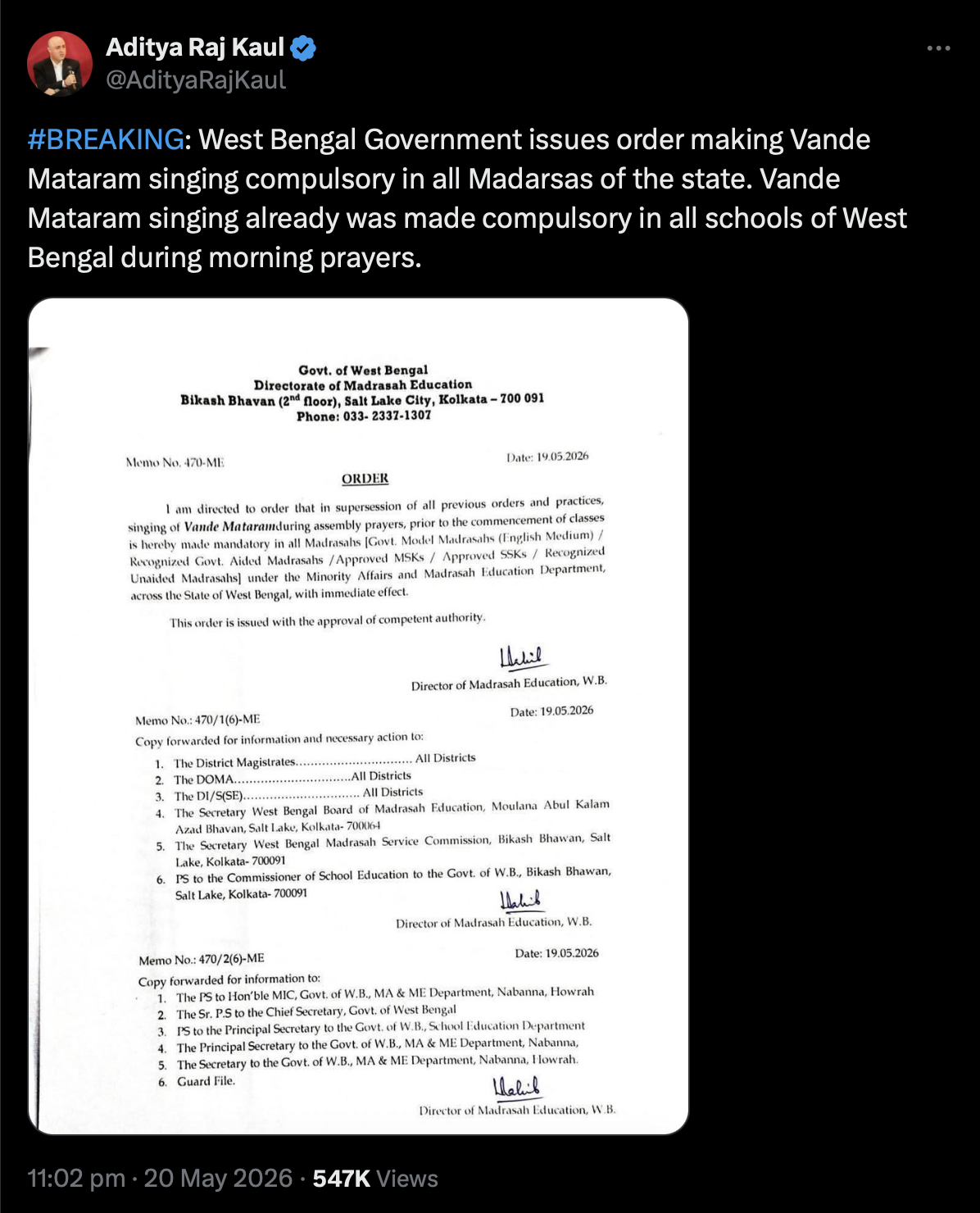
Note the date. Suvendu Adhikari was sworn in as the first BJP Chief Minister of West Bengal on 9 May, ten days earlier, on a 207-seat mandate that ended Mamata Banerjee’s fifteen-year run. The order is ten days into the new government. Of all the actions available to a freshly-installed state administration, this is the gesture chosen. The first major item on the agenda was the Muslim schoolchild’s morning. The signal is the signal.
The Pakistani faction of our commentariat is aghast, and not unreasonably. The song is a hymn to the Great goddess Durga, drawn from a novel that called for war on Muslims, and forcing a Muslim child to recite it is a small humiliation that announces a large arrangement. One of our Pakistani commenters compared it to forcing a vegetarian Hindu to eat beef. The comparison overstates and understates at the same time. It overstates because nobody is forcing food into anyone’s mouth. It understates because food is forgotten by the afternoon, and a song sung daily for ten years writes itself into the spine.
The row is the symptom. The disease is older. Bengal is the latest frontier, not the first.
The Persianate without the Muslim