The Diaspora Saved The Mullahs. Pahlavi Helped.

Farhad’s thesis, delivered without prompting:

during the Woman Life Freedom protests, the Islamic Republic appeared more vulnerable than at any point in a generation. Women had started it, men had joined, opposition-minded Iranians inside the country felt the floor shifting. Then Pahlavi stepped forward, declared himself the advocate of Iranians, launched his petition, and pulled the diaspora’s attention outward at the exact moment Iranians on the ground needed it inward. He picked the wrong time. He saved the IRGC.

The Royal positioned as the alternative to the regime is the man Farhad blames for keeping the regime alive.

We are not endorsing this view. We are reporting that an Iranian who follows the country obsessively, who rallies behind Pahlavi today as the best of bad options, still holds him responsible for a historic missed moment. That is a serious accusation from a sympathetic source.

The Court In Exile

Continue reading The Diaspora Saved The Mullahs. Pahlavi Helped.

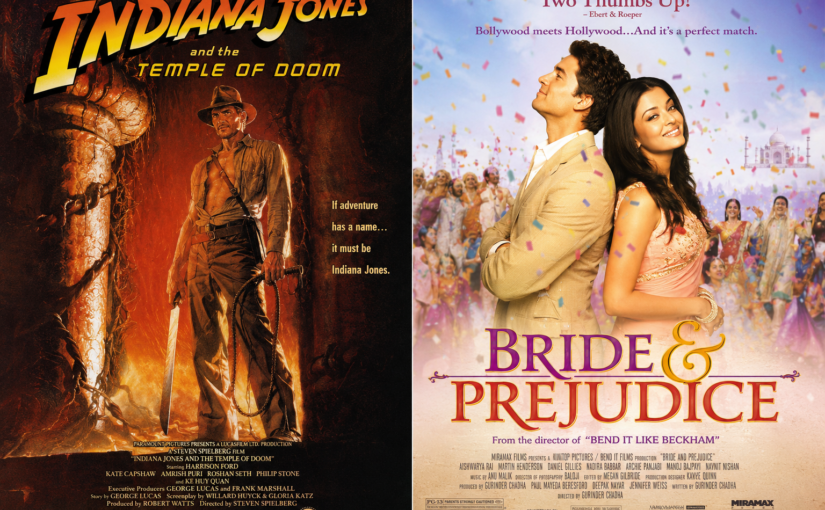
A Comparison of the Representation of India and Indians in Indiana Jones and the Temple of Doom and Bride and Prejudice

To make a change from some heavy topics, here is an essay I wrote during my undergraduate for a course at LUMS entitled “Culture, Media and Representation”. I just found a hard copy of this in my files and re-typed it.  If I recall correctly, the two films under review were chosen by the instructor. 

Cinema is a very powerful medium that can influence how people view the world. However, it is mainly a commercial industry concerned with maximizing profit through entertainment and audience appeal. For this reason, films often do not project a balanced view of reality, relying instead on stereotypes. Stereotype, according to Stuart Hall, reduces people to a few, simple, essential characteristics which are represented as fixed by nature (Hall 257). The two films that I will be reviewing in this paper, Indiana Jones and the Temple of Doom and Bride and Prejudice represent India and Indians in very different ways, neither of which are accurate or realistic depictions.

The particular ways that a film represents its subjects depends on many factors, including genre, creator, time period, and audience. Indiana Jones is an action/adventure movie made in 1984 by Steven Spielberg and George Lucas. One of the main conventions of the adventure movie is that character development and complexity are sacrificed in favor of plot. The conflict often revolves around confrontations between stereotypical “good guys” and “bad guys”. In this film, the good guys include Indiana Jones and his sidekicks, while the bad guys are the Thugees led by the fanatical priest Mola Rom.

The film does not depict all Indians in the same way. Rather, they are presented as two distinct groups, one consisting of dark and evil fanatics, and the other consisting of naive and childlike peasants. The “evil” group consists of Mola Ram and his followers, devotees of the Thugee cult that worship Kali Ma, the Hindu goddess of destruction. Throughout the film, these characters are shown as eating such things as snakes and chilled monkey brains, practicing voodoo and committing human sacrifice. They are also shown as oppressive, having enslaved all the children of a nearby village to dig for sacred stones. The naive and childlike group consists of the villagers who look to Indiana Jones to save them. A scene which typifies the behavior of this group is one that occurs near the beginning of the movie. As soon as Indian Jones steps off his boat and arrives in the village, all the villagers gather around him and hail him as their savior. The priest tells him “You were sent by Shiva to save us from evil.” This relation of the Western man as hero and the natives as supplicants strongly recalls the notion of the “white man’s burden” that obliges the West to civilize and save the natives from themselves. Continue reading A Comparison of the Representation of India and Indians in Indiana Jones and the Temple of Doom and Bride and Prejudice

The Long Dark Night for India’s Muslims

Our own Hindufication

We write this not as outsiders pretending to diagnose India, but as people who have undergone a gentler version of the same process. Over fifteen years of family and work on the subcontinent, our own Islamicate inheritance has been quietly sifted. The Persianate was retained. The Arabic was allowed to fall away. The qawwali, the food, the manners, the ghazal, the Mughal grammar of taste. All survived. The devotional Islamicate self did not. We arrived as something close to a Anglo-Islamicate hybrid. We are leaving, slowly, as a Hindu-Persianate one. We did not plan this. We watched it happen to ourselves.

The Persian survives. The Arabic does not. The poetry survives. The prayer does not. This is the formula. Once you see it, you cannot unsee it.

We made this passage with privilege, with distance, with choice, and with somewhere else to be if we changed our minds. The Indian Muslim, the one with no other passport and no other country, is being asked to make the same passage on terms set by people who never had to make it themselves. That asymmetry is this post.

The morning song

The news this week was Memo No. 470-ME, dated 19 May 2026, signed by the Director of Madrasah Education, Government of West Bengal. The order makes the singing of Vande Mataram mandatory at morning assembly in every state-recognised madrasa: government, aided, unaided, all of them. Immediate effect. Approval of competent authority.
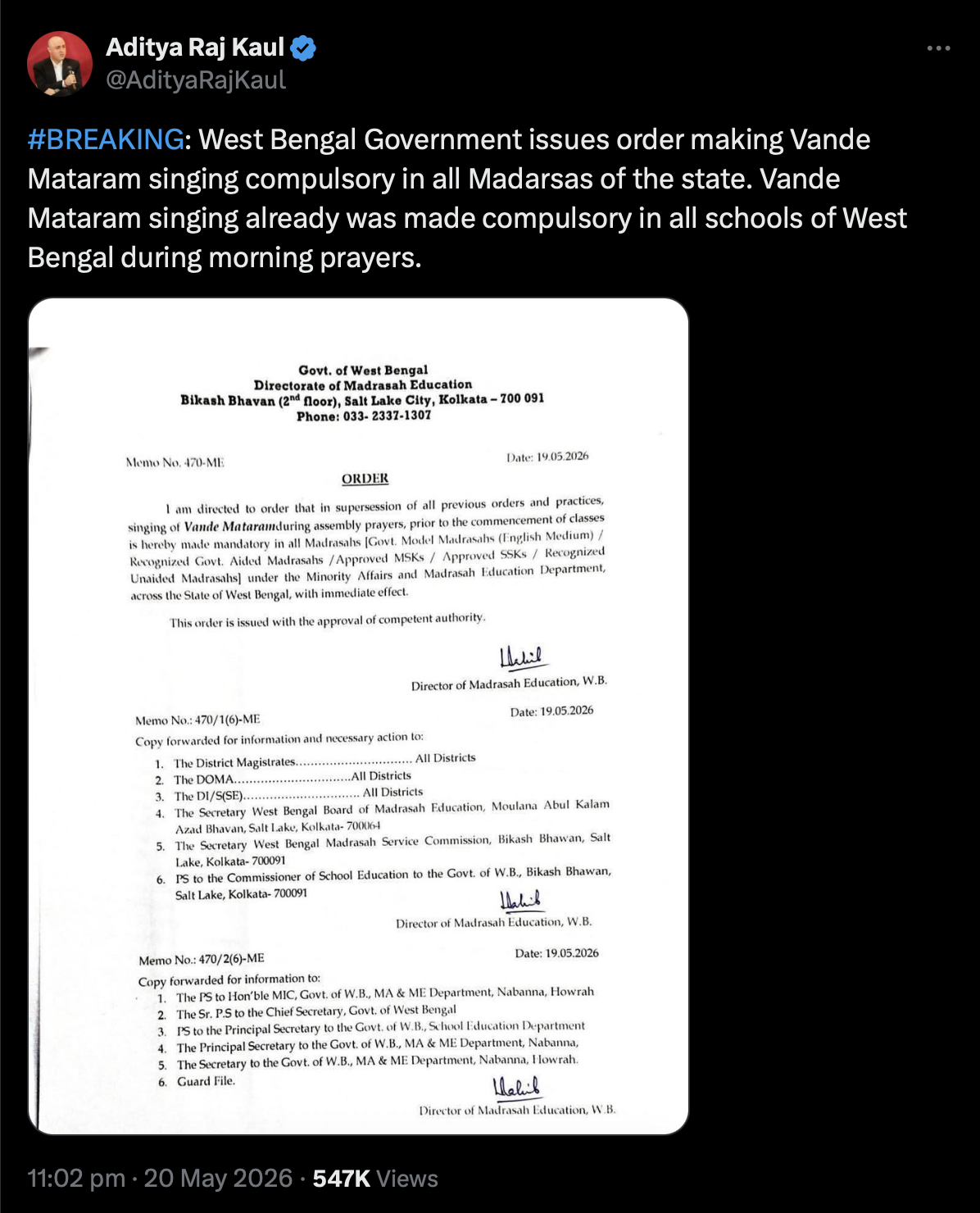
Note the date. Suvendu Adhikari was sworn in as the first BJP Chief Minister of West Bengal on 9 May, ten days earlier, on a 207-seat mandate that ended Mamata Banerjee’s fifteen-year run. The order is ten days into the new government. Of all the actions available to a freshly-installed state administration, this is the gesture chosen. The first major item on the agenda was the Muslim schoolchild’s morning. The signal is the signal.

The Pakistani faction of our commentariat is aghast, and not unreasonably. The song is a hymn to the Great goddess Durga, drawn from a novel that called for war on Muslims, and forcing a Muslim child to recite it is a small humiliation that announces a large arrangement. One of our Pakistani commenters compared it to forcing a vegetarian Hindu to eat beef. The comparison overstates and understates at the same time. It overstates because nobody is forcing food into anyone’s mouth. It understates because food is forgotten by the afternoon, and a song sung daily for ten years writes itself into the spine.

The row is the symptom. The disease is older. Bengal is the latest frontier, not the first.

The Persianate without the Muslim

Continue reading The Long Dark Night for India’s Muslims

The High Signal Mandate

Brown Pundits is not in the news business. We are not in the takes business. We are not in the engagement business. We are in the signal business. This is our creed.

Signal is the mandate. Noise is the enemy. Every piece (like the Prussia of the Ummah) on the blog must clear that bar or it gets rapidly down-posted. We owe the reader nothing less.

The signal compounds.

What does signal mean here? Three things, in order of weight.

Continue reading The High Signal Mandate

The Hijras of India

Note: This is an academic essay originally written for an anthropology course. It is by no means intended to cause offense to anyone.  Rather, it is intended to add to the conversation on gender and sexuality we have been having on BP. 

In the context of this essay “India” refers to the Indian subcontinent. 

See also my review of Queen Zarqa–a novel about a Pakistani transgender. 

In the West, it is generally believed that there are only two sexes, male and female, and that each sex has its own particular role in society. However, in their ethnographic fieldwork across the world, anthropologists have noticed that the roles of men and women vary significantly across societies. This has led them to distinguish sex, which is based on biology, from gender which is defined as “the cultural construction of beliefs and behaviors considered appropriate for each sex” (Schultz and Lavenda 237). In addition, anthropologists have also noticed that several societies around the world have supernumerary (e.g. more than two) sexes. These include the xanith in Oman, the Native American two-spirit and the Indian hijra. Appropriate behavior for these “third-sex” groups is defined by a third gender role, which is distinct from traditional masculine and feminine identities (Schultz and Lavenda 238).

In fact, even the hegemony of the Western “two-sex model” is a relatively recent development. Prior to the eighteenth century, the dominant way of understanding sex was Plato’s “one-sex model” which emphasized the similar nature of men and women’s sex organs and viewed women as “inverted, inferior versions of men” (Potts 4). Thus, it is clear that the “two-sex” model is not unquestionable and is just one out of several possible gender classification systems.

In this paper, I will focus on the Indian hijra. I will be examining various Western constructs such as “homosexuality” and “transexualism” that are used to define hijras and I will contrast these with how the hijras define themselves. Secondly, I will compare the hijras with examples of “third-sex” groups in other societies. Finally, I will discuss the relationship between the hijra community and mainstream Indian society, specifically the two main roles of the hijras as ritual performers at weddings and births, and as homosexual prostitutes. Continue reading The Hijras of India

Dhurandhar, Netflix and the India-Pakistan Asymmetry

Netflix’s analytics for last week are out, including Pakistan. Dhurandhar: The Revenge is at the top of the Pakistan charts. The OG Dhurandhar is at 7th, completing 16 weeks in the top 10.

Even the main Netflix handle (not Netflix India, but the one based in the US) has been openly promoting the release.

Continue reading Dhurandhar, Netflix and the India-Pakistan Asymmetry

CJP and colour revolutions

1) Rashid kidwai writing in ndtv.com, says that the CJP “movement ” might boomerang on opposition and not necessarily on BJP.
2) OTHERS have started seeing a new AAP.
3)The point to be considered is that, there is a generation that is rootless and is not connecting to the main stream parties. Will this turn into votes is still a question mark.
4) while the revolts in Sri Lanka and elsewhere (colour revolution ) succeeded ,it failed in Iran and Bangladesh to change the system.
5) It looks increasingly possible to do a TVK type upheaval with media’s help.

Who Sees? A Caste Audit of an Anonymous Elite Indian Hospital

Excerpt:

We pulled the consultant roster of a leading Indian hospital, well-known, charitable, multiple metros, decades old, and ran the surnames against caste. The institution does not publish anything beyond name, sub-specialty and city. We have anonymised the hospital because the point is structural, not gossip. The pattern here is the pattern at twenty others. What we found will not surprise anyone who has sat in an Indian waiting room, but the numbers are worth tabulating.


The Methodology

This is not a census. It is surname sociology. Indian surnames are imperfect caste signals, especially in Tamil Nadu where initials often suppress jati markers altogether, and elsewhere where regional surnames detach from their origin communities through migration and intermarriage. We are not building a genealogical claim about any individual on the list. We are reading the aggregate. Elite institutional patterns in India are often visible precisely through these imperfect signals: when the noise floor is what it is, a strong signal still tells you something. The exercise is probabilistic, not deterministic, and we have tried to keep the language commensurate with that.

The Numbers

Continue reading Who Sees? A Caste Audit of an Anonymous Elite Indian Hospital

On “Press Freedom” and Prejudice.

This is what Norway’s leading newspaper chose for its coverage of the Indian Prime Minister’s visit to Norway.

https://x.com/_Tracer_Bullet_/status/2056737017460089173

While the usual suspects on BP chose to focus on an aspiring influencer’s stunts and dramatic heckling, I am not surprised that such blatant bigotry in the ‘mainstream’ newspaper of the supposedly Number one ranked Press has not been discussed on BP. Hilariously, a non-trivial subset of the Indian media and political opposition actually supported a rookie aspiring journalist’s publicity stunt.

Its a time-tested pattern. Rage-baiting and attacking Hindus and India earns notoriety, while the pushback and negative consequences if you push the envelope too far into nakedly racist territory, is minimal if there at all.

For all the cacophony and chaos that the Indian media landscape consistently generates, it has yet to demonstrate ability to even capitalize on such low-hanging fruit. A more capable media ecosystem wouldn’t allow such nonsense unpunished.

This is the overton window that needs to be shifted – the coverage ‘rules’ on India allow for a lot more mainstream ‘phobia’ and assault. And we see that on BP as well, the Pakistani tribal ‘patriot’ squad repeatedly find themselves facing pushback which to them is unexpected. After all, why shouldn’t they be allowed free rein in rage-baiting and plying bigoted stereotypes.

Bangladesh whitewash Pakistan again

Bangladesh completed a whitewash over Pakistan yesterday in the test series they were playing at home, winning it 2-0. This follows the 2-0 whitewash they achieved in the test series before this, in Pakistan two years ago (in Rawalpindi, of all places). Bangladesh have also won the last ODI and T20I series between the two sides.

During my vanvaas, apart from enjoying the IPL (on which I will do a post later, maybe after the final) I also watched a decent chunk of the test series. Test cricket has its own flavour of joy, distinct from the more immediate rush of T20 cricket. Its slower and more meandering pace means you can actually put it on the background while tending to other stuff. 

Some thoughts about the series.

Bangladesh has overtaken Pakistan

Bangladesh has been doing economically well over the past few decades and now surpasses Pakistan in most, if not all socioeconomic indicators – higher GDP, higher GDP per capita, higher HDI, lower poverty rate, higher life expectancy, better access to electricity etc.

Diverging HDI between Bangladesh and Pakistan

Diverging GDP pci between Bangladesh and Pakistan

Continue reading Bangladesh whitewash Pakistan again

Brown Pundits