India’s Wealth will not turn Pakistan into East Germany

Our 2026 reader survey is open until 7 June – anonymous, roughly five minutes. Please take a moment.


The Comment thread is afire with the usual (and senseless) India-Pakistan arguments (essentially which of the two is poorer). Q waves the whole question away by pointing at the figure, unimpressed by “an average Indian producing only $2,800 in GDP every year,” and asks what the point even is. There is a point, two in fact.

First: per capita and scale measure different things. Per capita describes the life of a citizen. Scale describes the weight of a state. A single integrated market of 1.4 billion people generates agglomeration, economies of scale, and a pull on capital and talent that no small rich economy can match (India’s ascent in the world of cricket is an extremely interesting meditation). That is why India passed Japan in 2025 to become the world’s fourth-largest economy, why it is the fastest-growing major one, and why it is on course to take third from Germany by around 2028. The market no exporter can ignore, the trade terms a four-trillion-dollar base can lean on, the air defence and roads it can fund: that is concrete power, and it is not nothing. Much of the gain is siphoned by a clutch of oligarchic houses, but the dynamism is real.

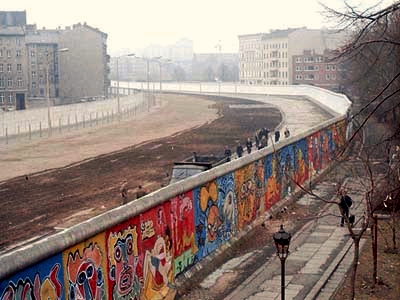
Second: however that same wealth does not buy what BB imagines it buys. India outweighs Pakistan in GDP by something close to eleven to one. It has still not turned Pakistan into its East Germany, a dependent satellite drawn quietly into its orbit and, in time, absorbed. Pakistan remains sovereign, armed, and unbought. Pakistanis are not running across the Punjabi wall to their ethnic kin.

In May 2025, after Pahalgam, the larger economy did not dictate terms: Operation Sindoor ended not in surrender but in a ceasefire announced, awkwardly, from Washington, with both capitals claiming the win.

Look West. Iran is a fraction of the wealth of the United States and Israel, yet it has absorbed the most advanced air forces on earth, kept its regime, and kept the knowledge to rebuild what was struck. The guns fell silent at a ceasefire, not a capitulation. Wealth buys reach. It does not buy outcomes.

BB treats the GDP gap as a deed of ownership over Kashmir, and assumes Kashmiris will swallow their pride for a higher income per head, that prosperity purchases consent. It misreads the Islamicate moral economy entirely. In that ledger ‘Izzat and Deen, dignity and faith, are not line items to be outbid. The Hyderabadi Harvard PhD still sings the song of his lost people.

Peoples who set independence above comfort have done so across the whole anti-colonial century, and no balance sheet has ever talked them out of it. Money may buy luxury but not loyalty.

What price will any Indian or Pakistani nationalist accept for their love and loyalty to their homeland?
The Long Dark Night for India’s Muslims

Our own Hindufication

We write this not as outsiders pretending to diagnose India, but as people who have undergone a gentler version of the same process. Over fifteen years of family and work on the subcontinent, our own Islamicate inheritance has been quietly sifted. The Persianate was retained. The Arabic was allowed to fall away. The qawwali, the food, the manners, the ghazal, the Mughal grammar of taste. All survived. The devotional Islamicate self did not. We arrived as something close to a Anglo-Islamicate hybrid. We are leaving, slowly, as a Hindu-Persianate one. We did not plan this. We watched it happen to ourselves.

The Persian survives. The Arabic does not. The poetry survives. The prayer does not. This is the formula. Once you see it, you cannot unsee it.

We made this passage with privilege, with distance, with choice, and with somewhere else to be if we changed our minds. The Indian Muslim, the one with no other passport and no other country, is being asked to make the same passage on terms set by people who never had to make it themselves. That asymmetry is this post.

The morning song

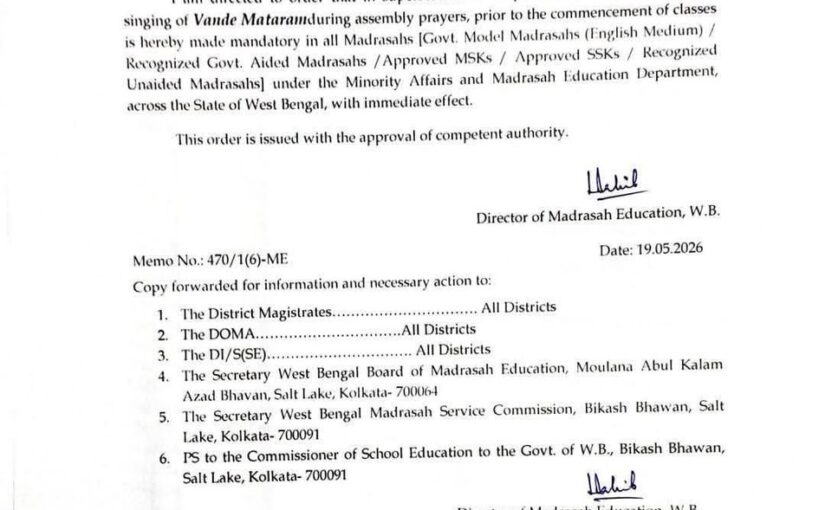
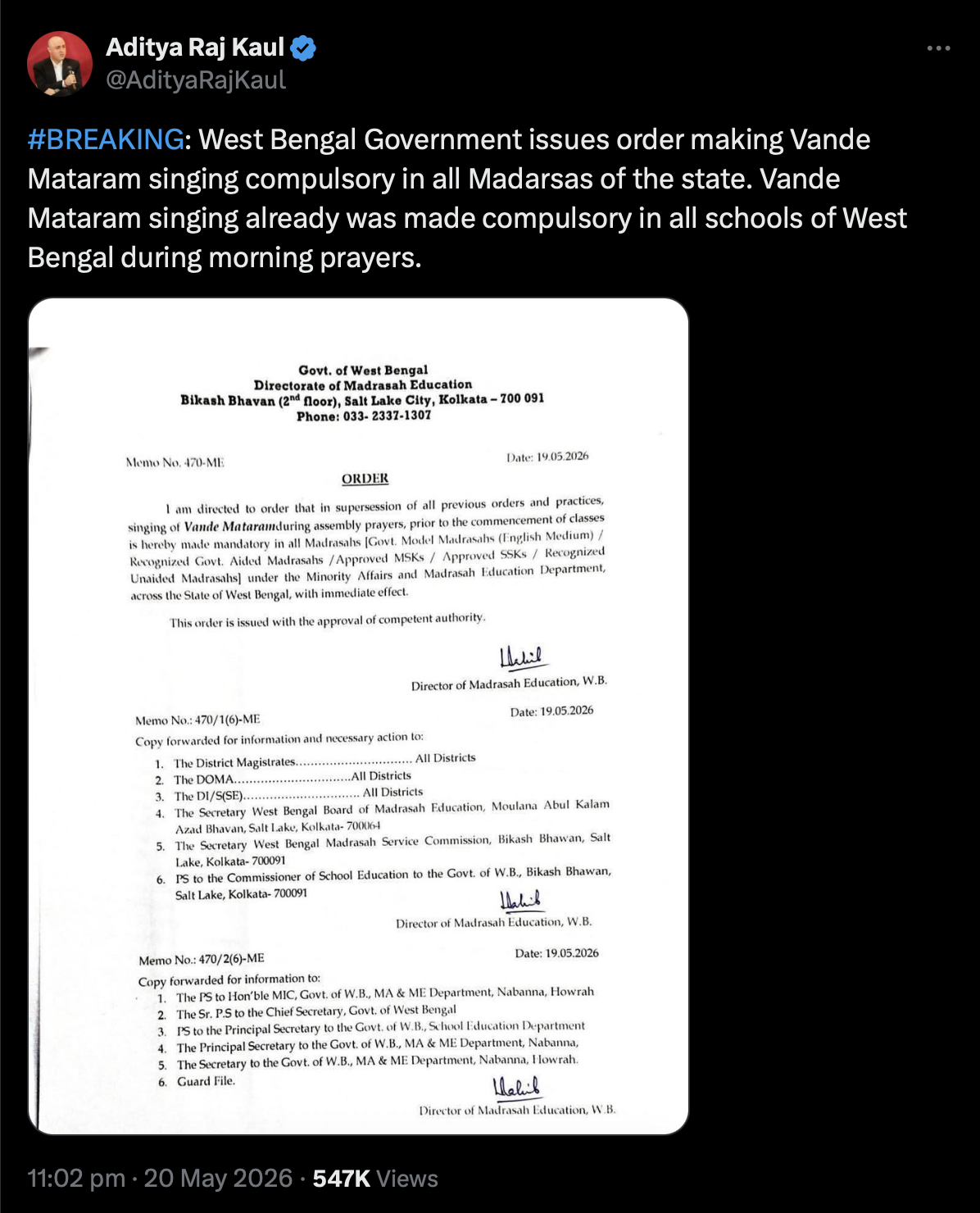
The news this week was Memo No. 470-ME, dated 19 May 2026, signed by the Director of Madrasah Education, Government of West Bengal. The order makes the singing of Vande Mataram mandatory at morning assembly in every state-recognised madrasa: government, aided, unaided, all of them. Immediate effect. Approval of competent authority.

Note the date. Suvendu Adhikari was sworn in as the first BJP Chief Minister of West Bengal on 9 May, ten days earlier, on a 207-seat mandate that ended Mamata Banerjee’s fifteen-year run. The order is ten days into the new government. Of all the actions available to a freshly-installed state administration, this is the gesture chosen. The first major item on the agenda was the Muslim schoolchild’s morning. The signal is the signal.

The Pakistani faction of our commentariat is aghast, and not unreasonably. The song is a hymn to the Great goddess Durga, drawn from a novel that called for war on Muslims, and forcing a Muslim child to recite it is a small humiliation that announces a large arrangement. One of our Pakistani commenters compared it to forcing a vegetarian Hindu to eat beef. The comparison overstates and understates at the same time. It overstates because nobody is forcing food into anyone’s mouth. It understates because food is forgotten by the afternoon, and a song sung daily for ten years writes itself into the spine.

The row is the symptom. The disease is older. Bengal is the latest frontier, not the first.

The Persianate without the Muslim

Continue reading The Long Dark Night for India’s Muslims

The High Signal Mandate

Brown Pundits is not in the news business. We are not in the takes business. We are not in the engagement business. We are in the signal business. This is our creed.

Signal is the mandate. Noise is the enemy. Every piece (like the Prussia of the Ummah) on the blog must clear that bar or it gets rapidly down-posted. We owe the reader nothing less.

The signal compounds.

What does signal mean here? Three things, in order of weight.

Continue reading The High Signal Mandate

The Prussia of the Ummah

Why Munir’s Compromise May Hold

“Pahalgam took place because the PTI anti-military agitation had genuinely shaken the ‘roots’ of Pakistani military’s unquestioned supremacy and popularity domestically. Given Munir’s rapid roll up and consolidation of power, field marshal for life, lifetime immunity, constitutional authority beyond his base tenure, for now the cost-benefit equation even for PakMil does not indicate them risking a round 2. But that calculus can and unfortunately likely will change at some point.”

RNJ’s very incisive comment above is correct on the mechanism but rather conservative on the implication. India still runs Pakistan as a state on the verge of dissolution. However the strategic class has long since moved to “durable but dangerous,” but the public conversation has not caught up.

What Munir has built is not a pause before collapse. It is the consolidation of something more durable, the Prussia of the Ummah, governing through a hybrid in which the boiler vents and the bayonet holds.

Munir’s Compromise

Field marshal for life with constitutional immunity removes the standard succession variable in Pakistani politics. Every previous chief was a hostage to his retirement, every handover a season of conspiracy. Munir has now exited that game. The cost was heavy. PTI agitation in 2023 genuinely shook the army’s domestic legitimacy, the May 9 attacks on cantonments were the most serious internal challenge since 1971, and the suppression has been ugly. But the suppression worked. Imran Khan remains popular and remains in prison. PTI remains the largest party by vote share and remains shut out of power. The constitutional system absorbs the grievance into electoral form, which is to say it diffuses the steam without releasing the pressure.

Factional alignment inside GHQ, the perpetual Punjab-Sindh-KP-Balochistan imbalance, elite exhaustion under chronic fiscal stress, the Baluch insurgency, TTP, all remain live. Munir has fixed the variable he could fix. The others he has merely deferred.

The Raj Continued

Continue reading The Prussia of the Ummah

The “Prakrisation” of Hindi

FlyeDie, presumably not one of BB’s handles, has left an excellent high-signal comment on the Hindification of East India. It posits Prakrit as a Latin analogue that spurred the development of the various Indic languages, and reads modern Hindi as walking the same path.

A wider blog admin note. We have been encouraging the Saint and the Shah to litigate their ongoing duel through the mechanism of high-signal posts, and this is the spirit in which we offer FlyeDie’s theory.

As an aside, there is also a very good comment by Calvin on the segregated political nature of the Indian Muslim community, which we may return to separately.

Brown Pundits exists to advance the bounds of niche knowledge on the Subcontinent. Our specific role is to stimulate excellent conversations, or guftugū as nos ancêtres les Mughalois would have punned it, and the comment below is one such endeavour, the more valuable because so much of our past has been lost or distorted. We reproduce it unedited.

Okay, I think I am going on a weird comment streak and losing my mind. So, I have a weird tin foil theory; it is going to be long, and it is going to sound like bullshit, but please bear with me. Here is my tin foil hat theory: Hindi is the Prakrit of the modern age, and it is destined to follow the same path as Prakrit. To explain what I am trying to say, I am going to talk about my favorite book about Prakrit: “Language of the Snakes Prakrit, Sanskrit, and the Language Order of Premodern India” by Andrew Olett.

Continue reading The “Prakrisation” of Hindi

Brown Pundits