
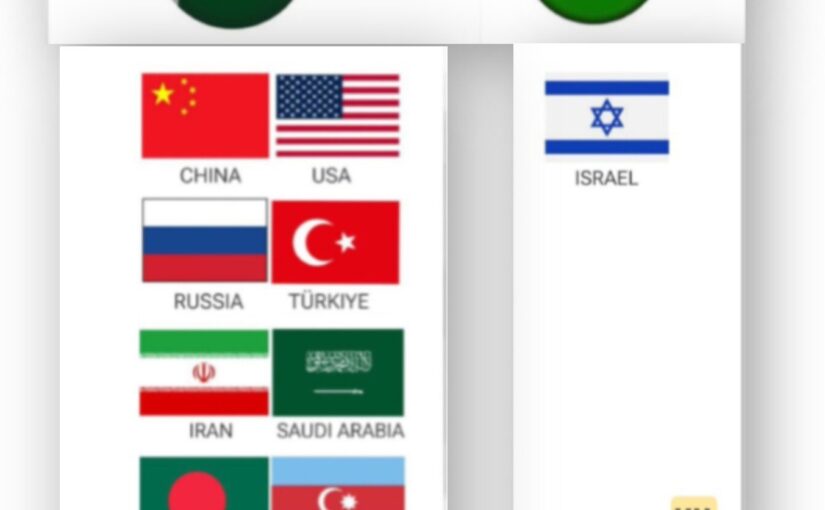
The chart above lays out “strategic partners” for 2025. Pakistan lists China, Türkiye, Iran, Saudi Arabia, and assorted others. India, by contrast, shows Israel. But the real issue isn’t who collects more flags; it’s whether any of Pakistan’s patrons will ever raise its HDI, improve infrastructure, or embed long-term stability.
I’m interested to hear what the commentariat thinks of this moment. India’s foreign policy is already locking it into superpower status. Pakistan remains reactive, borrowing survival from whoever will lend it.
The analogy that strikes me: India–Pakistan resembles Russia–Ukraine, except if Ukraine had kept nuclear weapons. The parallels are strong:
-
Ukraine, like Pakistan, is a breakaway sibling — the “other half” of a civilizational whole.
-
Ukraine, like Pakistan, survives by appealing to larger patrons.
-
And interestingly, the GDP ratio gap between Russia and Ukraine is almost exactly the same as between India and Pakistan (please fact check me).
Just as Ukraine is considered the homeland of the Russian Empire (Kievan Rus’), Pakistan carries the legacy of Partition as the “Indus homeland.” That symmetry makes the analogy more than superficial.
On Kabir: I understand his consistent emphasis on Muslim rights and Muslim nationalism. Readers should be aware of that lens. I’m not moderating him out, but I would caution the commentariat against being gaslit into endless provocations by Kabir. The question here is not identity politics, but the direction of Indian and Pakistani foreign policy in a critical moment in global history (decades are happening in weeks).