
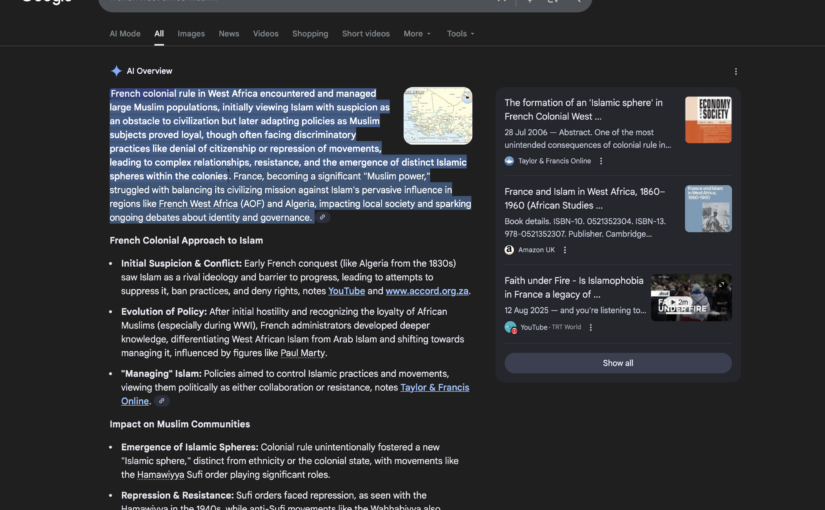
I was not browsing an archive or reading a colonial memoir. I was looking at an AI summary produced by Google’s Gemini system. What stopped me cold was not the history. It was the voice.
Islam was described as an “obstacle to civilisation.” French colonialism was reframed as a “civilising mission.” Muslim societies appeared as a “pervasive influence” to be managed. Colonial domination was softened into administration. Dispossession was translated into balance. This is not neutral language. It is the vocabulary of empire.
“French colonial rule in West Africa encountered and managed large Muslim populations, initially viewing Islam with suspicion as an obstacle to civilization but later adapting policies as Muslim subjects proved loyal, though often facing discriminatory practices like denial of citizenship or repression of movements, leading to complex relationships, resistance, and the emergence of distinct Islamic spheres within the colonies. France, becoming a significant “Muslim power,” struggled with balancing its civilizing mission against Islam’s pervasive influence in regions like French West Africa (AOF) and Algeria, impacting local society and sparking ongoing debates about identity and governance.”
Islam is fundamental to West Africa
Islam was not an intrusion into West Africa. It was a foundational civilisational order, present centuries before France arrived. It shaped law, education, trade, and political legitimacy. To describe it as a problem confronting a civilising project is to invert reality. The coloniser becomes the standard. The colonised becomes the deviation.
What makes this disturbing is not that colonial officials once spoke this way. They had incentives. They needed moral cover. What is disturbing is that a modern AI reproduces the same framing without friction, as if it were fact rather than ideology.
Intellectual Islamophobia
This is Islamophobia by default, not by insult. It is managerial, calm, and confident. Islam is not attacked. It is administrated. Muslims are not hated. They are assessed. The bias hides behind tone. When a system trained on vast corpora still chooses the language of empire, it reveals what has been normalised as “objective.” Colonial grammar passes as summary. Power speaks, and the machine repeats it.
This matters because language sets moral defaults. If Islam is consistently framed as an obstacle, then surveillance becomes “management,” exclusion becomes “balance,” and repression becomes “order.” The past is not merely described. It is justified. Google cannot hide behind neutrality here. Choosing words is choosing sides. When Gemini repeats colonial euphemisms, Google is not observing history. It is endorsing a lens.
Why the AI draws on “neutral colonial” Historiography
A technology marketed as post-human has inherited one of humanity’s oldest prejudices: the belief that empire equals progress, and that Muslim civilisation is something to be overcome. Name it plainly. This is not a glitch. It is Islamophobia encoded as common sense. If Google wants to build intelligence rather than automate bias, it must start by unlearning the language of rule.
The myth of the “neutral” scholar is doing the same work here. As Lady Izdihar puts it, objectivity has come to mean pretending not to feel. Detachment is rewarded; passion is punished—especially when it comes from the marginalised. What is called bias-free analysis is often just power that has learned to speak calmly. When violence is ongoing, demanding neutrality is not rigor. It is discipline. Otherwise, the algorithm will not just summarise colonialism. It will continue it.
Fuck Your Lecture on Craft, My People Are Dying
By Noor Hindi
Colonizers write about flowers.
I tell you about children throwing rocks at Israeli tanks
seconds before becoming daisies.
I want to be like those poets who care about the moon.
Palestinians don’t see the moon from jail cells and prisons.
It’s so beautiful, the moon.
They’re so beautiful, the flowers.
I pick flowers for my dead father when I’m sad.
He watches Al Jazeera all day.
I wish Jessica would stop texting me Happy Ramadan.
I know I’m American because when I walk into a room something dies.
Metaphors about death are for poets who think ghosts care about sound.
When I die, I promise to haunt you forever.
One day, I’ll write about the flowers like we own them.
When Martyrs Are Used Against the Living
Another version of this discipline appears in how past resistance is recycled to shame the present. As this Dulc´é Sloan describes (she’s hilarious), figures like Martin Luther King Jr. are replayed as calm orators, detached from the disruption that made them intolerable in their own time. His words are invoked against protesters, his assassination quietly bracketed off, his radicalism neutralised into tone policing. This is not reverence. It is gaslighting. Power preserves itself by praising the dead version of resistance while criminalising the living one. The lesson offered is always the same: speak beautifully, but do not interrupt. Be moral, but not effective.