
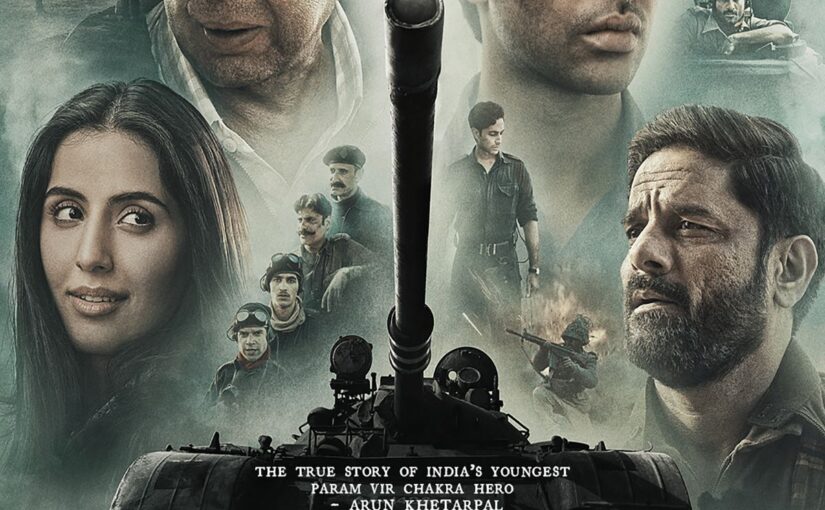
Second Lieutenant Arun Khetarpal is an Indian Army legend. A National Defense Academy (NDA) and Indian Military Academy (IMA) alum, Khetarpal was commissioned into Indian Army’s armoured regiment, Poona Horse and won India’s highest gallantry award the Paramvir Chakra, posthumously, for his heroism in the 1971 India-Pakistan war. Sriram Raghavan’s Ikkis is an autobiographical account of Arun’s life and the Battle of Basantar. A battle where Khetarpal’s Centurion tank took on the Pakistan army’s Patton tanks and fought valiantly before he succumbed to injuries on the battlefield. The movie stars Agastya Nanda, grandson of Amitabh Bachchan, as Arun Khetarpal with Dharmendra and Jaideep Ahlawat. The former plays the role of Brigadier Madan Lal Khetarpal, Arun’s father and the latter plays the role of Brigadier Nisar of the Pakistan army.
The movie recounts the visit of Brigadier Khetarpal, in 2001, to Lahore where he is hosted by Brigadier Nisar of the Pakistan Army. The senior Khetarpal is visiting Lahore for his college reunion and to visit Sargodha from where his family had to migrate in the aftermath of India’s partition in 1947. This story track runs in parallel to the story of Arun’s days at the NDA, IMA, days leading up to the battle and the battle itself. The senior Khetarpal, now in his eighties is all dewy eyed for his roots and the younger one, who has turned 21 (Ikkis is the word for the number 21 in Hindi) is eager and keen to prove his mantle on the battlefield. The retired Brigadier is serenaded by everyone, by his hosts, his former classmates and the family that now lives in his ancestral house. The young second lieutenant is learning the brutal nature of combat and the human cost of war as he rolls on towards Basantar. The dramatic arc of the movie ends with Brigadier Nisar telling the elder Khetarpal that he was the commanding officer of the Patton that shot the lieutenant’s tank and it was his assault that proved fatal.
I am a big Sriram Raghavan fan. His Johnny Gaddar makes it to every list of top 10 Hindi movies that I have ever made. Raghavan has the knack of writing stories and characters that are unconventional for commercial Hindi cinema, his plot twists don’t disappoint and nobody uses songs from Hindi movies of the 1950s, ’60s & ’70s like Raghavan. He eschews over the top dramatics and gets his actors to deliver pitch perfect performances.
Ikkis is handicapped by the fact that it is autobiographical. Raghavan has limited scope for crafting a story that surprises. This is his attempt at making a war movie and the stories of the two Khetarpals is a prop. He wants us to see that Indians and Pakistanis are the same people, there are no winners in a war, soldiers are common folk who pay with their lives for the idea of nationhood, there is common humanity that binds us all and the Pakistan army, just like the Indian army, is a professional force doing what is necessary. He uses all the tropes to make these points. Scenes of the elder Khetarpal with Brigadier Nisar’s family, his former classmates, the joyous outdoor dinner organized by the occupants of his ancestral home, the bullets ridden, lacerated bodies of soldiers and the depiction of Brigadier Nisar as an honorable gentleman who represents the best of Pakistan army.
Raghavan is let down by the performances and the writing. Young Nanda is earnest and energetic but needs to hone his skills. Dharmendra is a bona-fide legend of Hindi cinema and this his last movie. Age had really caught up with our beloved Dharam Paaji by the time this role came around. Ahlawat does the heavy lifting, it is a measured performance and he is let down by a unidimensional character. A Raghavan movie with not one song that stays with you, well here is a first. In the end I was neither invested in the characters nor was I numbed by horrors of war.
I did take away the stereotypical take on India and Pakistan that Hindi cinema is mostly known for- India and Pakistan are the same. Raghavan adds to this mix the professionalism and humanity of the Pakistan army. Ikkis was released within a month of another Hindi movie Dhurandhar. Dhurnadhar takes a wrecking ball to this stereotype and the image of Pakistan’s armed forces and then does some more. In India Ikkis, by a section of the media, was considered an antidote to Dhurandhar’s ‘jingoism’. Dhurandhar we were told is the ruling government’s attempt to spread an insidious agenda and paint Pakistan as enemy. Ikkis, we were told, paints a more nuanced, realistic picture and brings out the horrors of war. Dhurandhar we were told is state propaganda and Ikkis is what art is meant to be.
If Ikkis is not meant to make a political point/ is not propaganda then I have a Mughal monument south of Delhi to sell you. Cinema in India has always been a propaganda tool. From Do Beegha Zameen to Home Bound. Its leading lights have never shied away from using it to communicate an ideology. Here’s the great Utpal Dutt making my case.
Yes, he is talking of theater but you can easily replace theater with cinema. The leading lights of Hindi cinema in the years after independence were members of India People’s Theater Association (IPTA). Here is the wikipedia entry on IPTA
What is Pakistan and what is its army like ?
Pakistan was created in 1947 when the British ended their colonial rule over the sub-continent and split on religious lines. It is a culmination of Muslim League’s campaign for a separate Muslim nation. The league and its supporters considered Hindus and Muslims incapable of living together in harmony. It is a well thought out idea of a nation for Muslims. Here are links to two podcasts that will tell you more about the idea of Pakistan.
Omar Ali on Pakistan Myths and Realities
The founders of Pakistan and those who have followed them have kept their word. Non-Muslims cannot hold top constitutional positions. Religious minorities make up for less than 5% of Pakistan’s population and the non Islamic parts of its history are absent from its cultural milieu. It has a blasphemy law on its statutes and in a 2010 Pew Poll 87% Pakistanis identify as “Muslims First” over nationality.
The highest amongst surveyed Muslim countries. Its 1973 constitution declares Islam as state religion. Pakistan is and for Islam. Pakistan frames its identity against ‘Hindu India’. Individual acts of graciousness that one may have encountered or heard of, do not change this reality.
Pakistan’s army is its foremost institution. Its outsized role in running the country is well documented. The saying- Pakistan is an army with a country attached to it exists for sound reasons. What was this army up to weeks and months before Brigadier Nasir’s exchange with Lieutenant Khetarpal? It was slaughtering Bengali Hindus in East Pakistan. Pick up this book, it is essential reading on Pakistan army.
Next time you hear the dialogue “Kaun Dushman” spare a thought for parents of Captain Saurabh Kalia
The motto of the Pakistan army is Faith, Piety, and Fighting in the way of Allah. Its role in fomenting Jihad in Kashmir and birthing and nurturing the Taliban is well documented. An individual officer’s behaviour is not what the institution stands for. Here is its chief laying out its vision and its core ideology.
It is the gap between the reality of India and Pakistan and what its army stands for that makes Ikkis a failed propaganda tool. In the age of social media, it is impossible to hide the truth and talk of Aman ki Asha. Raghavan is not helped by the caricaturesque nature of other characters in the movie and the mediocre performances of actors portraying those characters. Shri Raghavan if you want to make a war movie, don’t let your politics overshadow it. Just give us its brutality and futility. If you want us to join the Aman ki Asha write a more believable story.
If you want us to believe India and Pakistan are the same, do pass on whatever you are smoking.