
There is a desert in the southern Punjab of Pakistan that does not quite belong to Pakistan. Administratively it sits in Bahawalpur Division. In practice, it is shared with Abu Dhabi. Deep in the Cholistan, there is a private airstrip, Al Habieb, also known locally as Sheikh Zayed Airport II, with a runway long enough to receive the world’s largest cargo aircraft. Each winter, C-17s and Antonov-124s arrive from the Gulf loaded with vehicles, staff, telecommunications equipment and falcons, depositing the UAE president and his court into what is effectively a private desert palace. The Houbara bustard, an endangered migratory bird that Bedouin tradition prizes above almost any other quarry, is hunted here under special permits issued by the Pakistani government to Gulf royalty. The airport at Bahawalpur proper was financed by Dubai. The international airport at Rahim Yar Khan, 200 km away, is named Sheikh Zayed International Airport after the UAE’s founding father, who considered this corner of Pakistan a regular retreat.
This is not a footnote. It is a civilisational signature. The Khaleeji sheikh pursuing the Houbara across Cholistani sand dunes is, without knowing it, re-enacting something very old: the desert as a shared zone, unbounded by the nation-states that nominally contain it. Cholistan does not belong to Pakistan. It does not belong to India, or Sindh, or Rajasthan. It is a seam; and seams, by definition, belong to no single side.
The Hinge of Seraikistan
The name Cholistan derives from the Turkic chol, sands, and the Persian suffix -istan. Both layers arrived later than the place itself. The culture that defines Cholistan is Derawali: the Seraiki dialect of the encampment, the dera. It is nomadic speech in the most literal sense. Its richness is not courtly but ambulatory.
Seraiki itself is one of South Asia’s underappreciated civilisational languages. For centuries it served as the lingua franca across the interface zones of the northwest, among Baloch, Sindhi, Pashtun and Punjabi speakers, as the language of trade and movement. Cholistan sits at the heart of Seraikistan, flanked by Sindh to the south, Rajasthan to the east, and greater Punjab to the north. It is not peripheral to these zones. It is where they meet, and where, historically, what they share becomes visible.
That structural position, edge as synthesis, is the key to understanding what Cholistan is.
The Dead River and the Living Civilisation
The Hakra River, the Sarasvati of Vedic memory, once flowed through Cholistan, fed by the Sutlej and the Yamuna. It sustained dense settlement from roughly 4000 BCE until 600 BCE, when it changed course and the floodplain became desert. Along its dried bed, over 400 Harappan archaeological sites have been catalogued; among the highest densities in the entire Indus Valley civilisation.
The people who now pursue camels across that same terrain, collecting water in seasonal pools called toba, are the cultural descendants of one of the ancient world’s great urban traditions. What looks like marginalisation is, on a longer view, adaptation. The civilisation did not collapse. It reconfigured.
This matters because it frames the deeper question: who were these people, before the Hakra died?
The Dravidian Puzzle
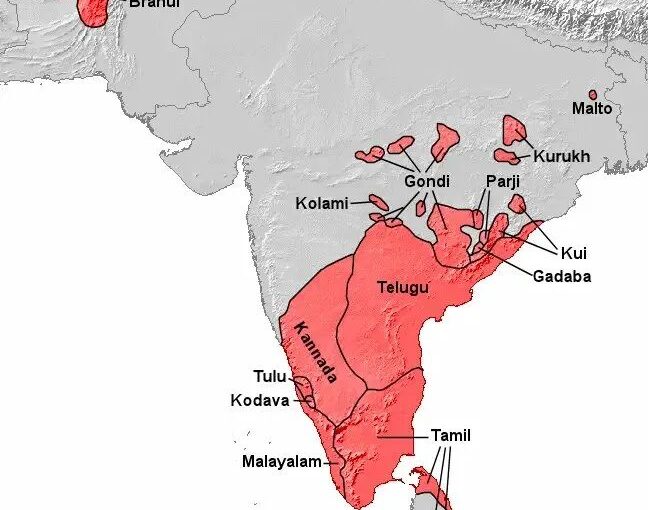
The map that accompanies this piece is one of the most quietly extraordinary images in South Asian studies. It shows the distribution of Dravidian languages today: a vast bloc across peninsular India, with isolated remnants in central India, Gondi, Kurukh, Malto, and then, stranded alone in Pakistani Balochistan, 1,500 km from its nearest linguistic relative: Brahui.
The scholarly consensus is that this map records the aftermath of Indo-Aryan expansion from the northwest after roughly 1500 BCE. Before that expansion, Dravidian languages were far more widely spoken across the subcontinent; including, most plausibly, across the Indus Valley civilisation zone that includes Cholistan. The central islands visible in the map, Gondi in Madhya Pradesh, Kurukh and Malto in Jharkhand and Odisha, are not coincidences. They are survivors.
Brahui is the most striking survivor of all. Its very existence in Balochistan suggests that something Dravidian persisted in the northwest long after Indo-Aryan became dominant; whether as a remnant population, a linguistic relic, or evidence of a deeper pre-Aryan substrate that stretched from the Indus to the Persian Gulf.
That last possibility is what the Elamo-Dravidian hypothesis proposes: a family linking the extinct Elamite language of ancient Khuzestan to Brahui and the Dravidian south. It remains a minority and contested position in linguistics, and should be read as such. But the geographic intuition behind it is not unreasonable. Khuzestan, now the Arab-majority southwestern province of Iran, was the heartland of Elamite civilisation. If Elamite and Proto-Dravidian shared a common ancestor, the implied civilisational corridor runs from the Persian Gulf coast through Makran and lower Balochistan, through Sindh and lower Punjab, and south into the peninsula. Cholistan sits directly in that corridor.
This is not established fact. It is a live and serious question, which is exactly the kind of question Brown Pundits exists to think about.
The Roma: The Longest Migration
One further thread, less speculative. The Roma, Europe’s largest ethnic minority, numbering somewhere between 10 and 15 million, originated in precisely this northwestern zone of South Asia. Genetic and linguistic evidence converges on Punjab and Rajasthan as the ancestral homeland, with significant shared ancestry also traceable to Sindhi, Balochi and Brahui populations in Pakistan. The Romani language is Indo-Aryan at root but carries innovations from the northwestern branch, Punjabi, Sindhi, consistent with an origin in the transitional zone between dialects, which is exactly where Cholistan sits.
The proto-Roma began their westward movement around the first millennium CE, passing through Persia and Armenia before entering the Byzantine world and eventually reaching Europe by the 13th century. They are the longest-range migration in South Asian history, and they began from the desert margin that Pakistani administrative maps label, prosically, Bahawalpur Division.
What Cholistan Teaches
Pakistan is discussed, almost always, in terms of its political present: the civil-military axis, the question of democratic consolidation, the India relationship, the nuclear deterrent, the IMF programme. These are real. They are also thin.
Cholistan is a reminder of the depth beneath the thinness. A Seraiki-Derawali nomadic culture whose civilisational roots predate Islam, predate the Indo-Aryans, and reach into a pre-Aryan substrate that may connect, linguistically and geographically, to the first cities on earth. A desert from which Europe’s most persecuted people likely began their diaspora. A terrain now seasonally occupied by Gulf monarchs pursuing an endangered bird across the ruins of a Harappan settlement.
The Hindu Presence
One further detail that the administrative map of Pakistan obscures: Cholistan retains a significant Hindu population. They are classified, in the caste framework, as Shudra; the lowest varna. But that classification tells you almost nothing about how they actually live.
In villages where Muslims and Hindus exist in roughly equal numbers, the communities are functionally indistinguishable by appearance, dress, or manner. Muslim neighbours organise protection for Hindu households during fairs and festivals not because there has ever been cause for alarm, but as a matter of custom and solidarity. Full social interaction is the norm. Intermarriage and commensality, sharing food across the line, are not. The boundary is observed without hostility.
What this means is precise: the racial and demographic integrity of the region is intact. These are the same people, shaped by the same desert, the same Hakra basin, the same pre-Aryan substrate. The religious difference arrived later than the people themselves. In Cholistan, you cannot tell a Hindu from a Muslim by looking. That is not erasure of difference. It is evidence of a shared civilisational root that predates the categories imposed upon it.
The Crescent and the Saffron are medieval categories imposed on a Neolithic reality. Cholistan predates both, and will outlast the argument.