Open Thread: Nepal Floods + 20 months since Assad

It seems to be a new and very pragmatic Middle East. In a way the hybrid regimes, who don’t necessarily have democratic mandates, are able to be wily and nimble actors, who can balance the Great Powers.

So they need to integrate their economies into the Global, not antagonise either China or the US, and somehow weave in traditionalism.

Israel, India, which have very long democratic traditions and also see themselves as “Great Powers” seem to have a more grandiose foreign policy. Israel seems to have swung, reputation wise, in a single generation.

I’m just spitballing here. Of course India is on the scale of the EU, US, China & Russia in terms of geopolitical heft but as girmits says, India also *sees* itself that way.

The comment thread went bezerk after last night’s post but I guess the Commentariat enjoyed themselves?


“Tamil” CMs

Many chief ministers in the past have been of Andhra descent, representing the borderless existence of the Telugu and Tamil speaking people under the broad umbrella of Madras (presidency and then state) for generations. In fact, even today, those living on the border of Andhra and Tamil Nadu speak both languages, allow marriages between them and share several customs and rituals.

The first chief minister of Madras Presidency was Agaram Subbarayalu Reddiar (1920-21). He was born in a Telugu Reddy family domiciled in South Arcot district of Madras Presidency. He was succeeded by the Raja of Panagal Rajarayaningar, from a zamindari in Kalahasti in Andhra Pradesh. It is not clear if he was a pure Tamil, though he was associated with Tamil institutions.

https://www.news18.com/blogs/politics/vvp-sharma/after-series-of-outsider-chief-ministers-sasikala-to-be-first-tamil-cm-after-29-years-14329-1345645.html

It’s fascinating that India’s most “distinct” state has a very strong history of having non-Tamil leaders. It reminds me of Scottish or more saliently “Catalan” nationalism (without the political aspects). Highly civil and linguistic, with a very strong socialist element. The amount of Telugus in Chennai is pretty incredible though they’ve become a blended people.

Telugus from Rayalseema and Coastal Andhra were part of the Madras Presidency while the Telugus of Telangana form a very significant component of the diaspora of Indians in the US.

The Italian of the East: Is It Language or Music?

Why Can’t South Asia Move On?

South Asia, for the most part, makes the young old. The West keeps the old young.

In the East, life is fairly intergenerational. A boy grows up at the same table as his grandfather, so he inherits the old man’s quarrels whole. In the West, people live in age cohorts. The old are left to be old, and everyone else tries to stay young. Hyper-individualism has its costs, but it does one thing well. It lets the past rest.

I had forgotten this. My own context is selectively Western. My motto ordinarily is let ideas procreate, let them battle and let the best one win. This is what I try to apply in my daily life. Then I look at Brown Pundits and watch our conversations litigate events from 200 years ago as though they happened yesterday. Why can’t South Asia move on? Because almost nothing is lost between generations. The old wound arrives in each new mind at full strength.

It does not follow that the future-facing West wins. Forever young is the vanity of youth, furthermore weaker emotional health is a by-product of the intense loneliness prevalent in the West. One side cannot let go of the past and the other cannot remember it. Each is certain it is right, and that certainty is what makes these conflicts intractable. Nobody allows for the possibility of being wrong.

Jordan Peterson says that when you realise mid-argument that you are wrong, you dissolve in tears, because “the tears are grief for the part of you that has to die.” Tears reset the brain. For a moment it is plastic again, a child’s brain, and a child can still learn. You accept that some of what you believed was wrong.

That is the skill, and it belongs to no single culture. The values can stay eternal, rooted in divine law if you like. Everything else must stay nimble, soft enough to be rebuilt. The old ways are welcome to stay. They only have to be willing to weep every now and then.

3 Graphs of Karnataka

Image

It seems that many South Indian Muslims are “Urdufying.” It’s interesting to reflect that if Partition hadn’t happened; the same thing might have happened to East Bengal.

The Muslims of India rallied under the banner of Islam, which was a catch-all term, but instead they could have easily made a linguistic argument for Urdu & Persianate culture.

Continue reading 3 Graphs of Karnataka

Thoughts That Shape Power

This is an essay written by Varun (Bone of Empire @BotE85371688 on Twitter), an Indian-American friend who asked me to share it on brownpundits. I think it starts an important conversation..

Thoughts that Shape Power 

Once upon a time I worked in a defense think tank in New Delhi. It was a fun, fresh-out-of-college job. The pay sucked, but the conversation was always rich, and we had tea time twice a day. 

Every Friday morning we were encouraged to sit through a Research Briefing by one of our colleagues. Presentations lasted an hour and were divided into two parts – the presentation itself, and the question/critique period. Everyone — from fresh-faced interns (myself) to retired professionals — was encouraged to present their research or some other topic of interest and receive audience feedback. The variety of personal backgrounds at the institute guaranteed a range of quality for the presentations. What was most shocking to me, as an intern, was that senior researchers were often the sources of tremendous bullshit. 

One Friday, a scholar — whose name I will not mention — gave a presentation on the Indo-Bangladesh border. They offered detailed recommendations for securing the region, including drones, CCTV cameras, electrified fencing, checkposts, watchtowers, and more. The presentation lasted a full 30 minutes; the question period, which had been allotted the same amount of time, lasted only five.  Continue reading Thoughts That Shape Power

South India funds India?

For every Rs 100 paid in direct tax, how much each state gets back : r/india

It’s pretty astonishing to see that it’s the Southern fringe (and the erstwhile Punjab) that’s subsidising the rest of India. There is the Southern coastal theory that AASI moved via Sindh, Gujarat and then the Deccan-Dravidian spaces.

Furthermore what’s fascinating is that Partition, outside of South India, really was a contestation of some of the richest bits of the Subcontinent (Punjab and Bengal).

It would have been good to see the numbers for J&K but it’s fairly apparent the NorthEast aren’t going to see such a sweet deal. It’s tough being a Southerner these days (whether the US, India or even Iran). In Iran, it’s South Iran and her oil & gas fields, which subsidises the rest of the country.

my 7,000th comment on Brown Pundits

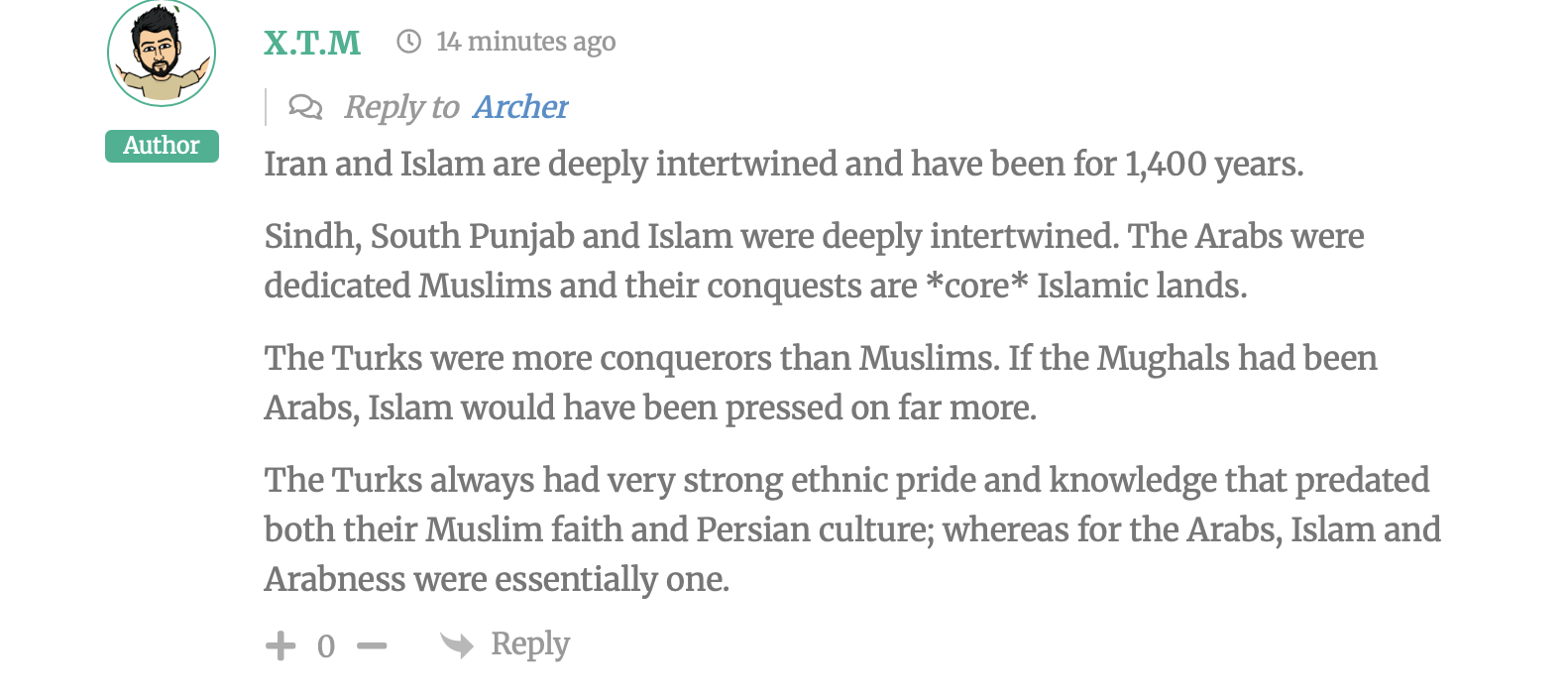
I believe the number 14 is associated with Lord Ram so this is a fortuitous comment (7, 14, 1,400). I have’t written as much since the Comments have been on fire so it becomes a little difficult to write on new topics but I’m 66 posts (65 after this one) from my 1,000th post on BP.

After the jump Omar’s interesting take on whether the Mughal’s were colonisers.

Continue reading my 7,000th comment on Brown Pundits

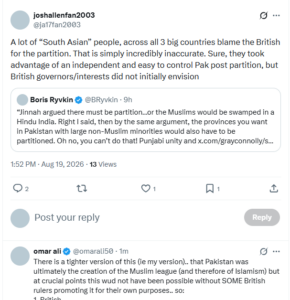
Did the British Divide India?

This comes up all the time, and i happened to write a long tweet about this today> As usual, no time to fix into a real article, but I am posting the whole thing here for discussion.

My version is that Pakistan was ultimately the creation of the Muslim league (and therefore of Islamism) but at crucial points this wud not have been possible without SOME British rulers promoting it for their own purposes.. so:
1. British imperial officials were very conscious of the need to divide and rule (they were all trained on the Roman empire, they understood these things, they were not dumb), so they relentlessly promoted local divisions (Muslim vs Hindu, Sikh vs Hindu, Upper caste vs Lower caste etc), that does not mean they CREATED those divisions, but they definitely had an interest in promoting them and did so.. That contributed to the rise of the Muslim league.
2. In 1939, INC failed to support them in an existential war. This led the viceroy to promote a relatively small party (the muslim league) to counter them. The viceroy’s favorite (sir zafrullah) wrote the Pakistan resolution. Then gandhi doubled down on his errors with the Quit India movement and that gave loyal Muslims another leg up. Pakistan propaganda operated unhindered while INC had 1000s in jail. Advantage Muslim league.

Continue reading Did the British Divide India?

The Stans

@DailyTurkic  Percentage of adults who pray five times a day in the “Stan” countries, according to the Pew Research Center.

Image

Pakistanis of course, being good Hindus, are careful to do daily Puja. Namaz of course has the same cognate root as “namaste.”

The Persianate inflected cultures (Tajikistan and Afghanistan) are far more religious than the Turkic kin.

Brown Pundits