
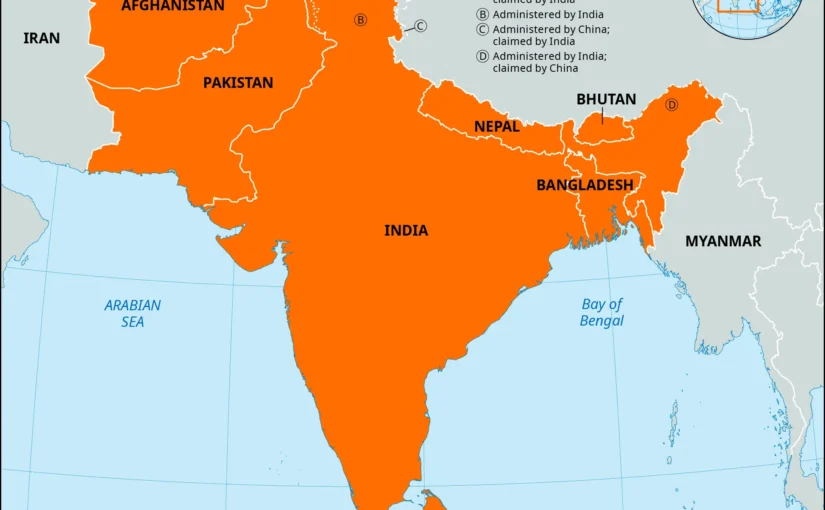
There is something faintly ridiculous about how often educated people insist on using the term South Asia as if it were a neutral, hygienic improvement on an older and supposedly “problematic” word. It is neither neutral nor an improvement. It is a bureaucratic euphemism invented to manage post-Partition discomfort, and it collapses the civilizational reality of the region rather than clarifying it.
The Indian subcontinent has had a name for millennia. It was called India because it lay beyond the Indus. Greeks used it. Persians used it. Arabs used it. Medieval Muslims, early modern Europeans, and the British all used it. The word survived because it described a geographic and civilizational unit, not because it flattered any modern state. The fact that the Republic of India later adopted the name does not retroactively invalidate its older meaning. Belgium did not abolish the word “Europe,” and Serbia’s existence does not make “European” offensive.
South Asia, by contrast, is not an ancient term misused by a nation-state. It is a late–Cold War academic construction, popularised by American area studies departments that were uncomfortable saying “India” once India no longer meant a single polity. It is a word designed to avoid an argument, not to resolve one. Like “Middle East,” it describes nothing from within the region itself. No one historically lived in “South Asia.” No one spoke “South Asian.” No one cooked “South Asian food.”
The irony is that the people most eager to insist on the term South Asia often claim to be resisting erasure, when in fact they are participating in it. The civilizational unity of the subcontinent long predates 1947. Punjab was Punjab before Pakistan. Bengal was Bengal before Bangladesh. Kashmir was Kashmir before Line of Control maps. None of these regions stopped being Indian in the civilizational sense when new borders were drawn by the British on their way out.
This is where the food argument collapses under its own weight. Biryani did not become less Indian because Muslims carried it to Karachi. Wazwan did not cease to be Indian because Kashmir is disputed. Kabuli pulao being Afghan does not negate the fact that Afghanistan itself was historically part of the Indic cultural zone, just as Greece is part of Europe whether or not it sits inside every political union. Cuisine, like language and myth, follows ecology and history, not passports.
What really animates the demand to replace “Indian” with “South Asian” is not accuracy but resentment. The modern Indian state inherited the civilizational name, the branding, and the global recognition. Pakistan and Bangladesh inherited sovereignty but not symbolic capital. That imbalance is real, but pretending the civilization itself never existed does not correct it. It merely replaces history with administrative vocabulary.
The claim that calling something “Indian” delegitimises Pakistan is false. Pakistan’s legitimacy rests on political sovereignty, not on owning or rejecting a civilizational label. Turkey does not deny being part of the Mediterranean because Greece exists. Iran does not deny being Persian because Tajikistan speaks Persian. Only in the Indian subcontinent has postcolonial anxiety become so intense that people feel compelled to dissolve a civilisation into a compass direction.
Nor is South Asia analogous to East Asia, a comparison often made lazily and incorrectly. East Asia is held together by a recognisable Confucian civilizational inheritance, despite political fragmentation. China, Korea, and Japan were never part of a single continuous civilizational space in the way Punjab, Sindh, Bengal, and the Deccan were. The Indian subcontinent shared scripts, epics, pilgrimage circuits, trade routes, and court cultures for over two thousand years. Sanskrit, Persian, and later Urdu functioned as transregional languages precisely because the space was coherent. The term Indian named that coherence. South Asian denies it.
The ugliest part of this shift is that it accepts the British partition as the final arbiter of meaning. It quietly treats 1947 as the start of history, rather than a violent administrative rupture imposed on something far older. It asks the region to rename itself in order to accommodate a wound, instead of acknowledging that the wound exists within a larger body.
If anything, the honest position for Pakistanis and Bangladeshis is not to flee from the word India, but to insist on its civilizational meaning while rejecting its monopolisation by a single state. India is the continent. The Republic of India is one country within it. This distinction is not radical. It is normal. It is how Europe works.
South Asia is not precision. It is evasion. It is the language of people who confuse naming with healing and think that changing the label on a menu will repair a historical trauma. It won’t. It only makes the past smaller, uglier, and harder to see.
Call the food Indian when it is Indian. Call the regions by their names when they matter. And stop pretending that an ugly administrative term invented in the late twentieth century is somehow more authentic than a civilizational name that survived Greeks, Persians, Muslims, and Britons alike.
The Indian subcontinent has had a name for millennia. It was called India because it lay beyond the Indus. Greeks used it. Persians used it
There was no India in pre European History. Hindustan yes for Northern India.
South India was a whole different entity,
Daksina Desa in historical texts meaning Southern Lands. (the word Deccan originates from Daksina)
Carnatic, derived from “Karnāḍ” or “Kanāḍ” meaning black country, has also been associated with South India. (Nad means land, country like in Tamil Nadu(
what is the name of the book that Megasthenes wrote Barr?
indica
Indica, Iranica, Turan are the right phrases
So essentially another name used by a foreigner, just like.the Europeans used India
I find it hilarious Indians disparage foreign influence but proudly embrace foreign names.
so essentially you made yet another false claim that
>There was no India in pre European History. Hindustan yes for Northern India
when this was demonstrated to be false, you have now tried to move goalposts on to ‘why do Indians disparage foreign influence’
>South India was a whole different entity,
Daksina Desa in historical texts meaning Southern Lands. (the word Deccan originates from Daksina)
When Rome traded with Muziris Barr, why did Roman senators bitterly complain about Roman wealth being ‘spent on Indian goods’? The port of Muziris is in south India. If you haven’t heard of it, maybe you should google it.
Its one thing to have a constant anti-Indian hate boner and post based on that, quite another to repeatedly get caught with your pants down, and just have no guts to acknowledge it.
when this was demonstrated to be false,
I did not know about indica, The English in Public Schools (exclusive private like Eton and Harrow) learnt Greek and Latin in the middle and upper classes. They would have been familiar with Megasthenes and used that name for the country they conquered
nb: I too learned Latin (no Greek) as our school was modeled on English Public school.
The port of Muziris is in south India.
In Kerala to be exact the multi cultural part so unlike rest of India
Plenty of Trade with Greece and Rome even in Sri Lanka.
There is a Map in Ptolemy’s book Geography. To quote “peninsula is much shortened. Instead, Sri Lanka (Taprobane) is greatly enlarged. The world Tabrobane entered Greek via the Sinhala word for Lanka Tambapanni meaning copper colored
Another world Serendipity comes from the Arab name for Sri Lanka (Sihala Dipa). The world Serendipity came from a Poem (I think by Milton) called the Three Princes of Serendib
Sri Lanka has been called many name, but we know the Sinhala origins of those names
Its one thing to have a constant anti-Indian
Somehow you and many Indian seem to think facts are hate. Do you want to me to list out the FACTS that gets Indians all worked up
Bottom Line Indians are called by a name that Originated from the Greeks (indica) and then the British. What can I say Indians love to think themselves like European (white/Aryan) and proudly use a name given by English and Greeks for themselves (indica and India)
Sindhu is an indigenous name?
Maybe.
In Sinhala the Indus is called Sindhu.
And Sindhi people
yes, samskrutam.
as long it is ‘ white foreign’ it is ok.
You are absolutely correct that there was no one “India”. This is an Indian nationalist belief and is a-historic.
“Hindustan” specifically was the core area of the Mughal Empire. The Mughals were very clear that the Deccan was not part of Hindustan.
“Indian subcontinent” and “South Asia” are terms used in different contexts. It’s not an either/or choice. “Indian subcontinent” is a geographic term. “South Asia” is a geopolitical term. Afghanistan is not on the Indian subcontinent (this is simply a geographical fact). Half of Pakistan is not on the Indian subcontinent but on the Iranian Plateau.
1947 was not the start of history but it was the beginning of the existence of India and Pakistan as modern nation-states. British India was not a nation-state. Neither was the Mughal Empire. This is not a matter of opinion but a settled academic consensus. The concept of “nation-state” means something specific.
Pakistanis have an aversion to the word “India”. This is simply because the word is associated with a modern nation-state which is hostile to Pakistan. So we don’t speak of “Indian” Music. Anyway, the correct term is Hindustani music since the music is common to North India, Pakistan and Bangladesh. South India has its own musical system called Carnatic music. In English, they are often referred to as “North Indian” and “South Indian” music respectively.
Indian.
India is as much a continent as Europe for what it’s worth.
I don’t think we can just make up definitions as it suits us. Asia is a continent. Europe is a continent (technically Eurasia is actually one continent). India is a subcontinent.
The point is the confusion only arises because the modern nation-state of India appropriated the name of the entire region. Had QeA’s suggestion of “Pakistan” and “Hindustan” been followed or had India chosen to call itself “Bharat”, we wouldn’t be having this conversation.
Anyway, I already made my argument a few months ago. So I’m not going to belabor the point here:
https://kabiraltaf.substack.com/p/in-defense-of-south-asia
India is as much a subcontinent as Europe is (within Eurasia).
As usual, you miss the point. Don’t be disingenuous.
“Indian subcontinent” is a geographic expression. I really don’t care if you want to use it but the appropriate context is geographic not geopolitical.
Half of Pakistan is on the Iranian Plateau and not on the “Indian subcontinent”. Afghanistan is not on the Indian subcontinent. These are actual objective geographical facts not a matter of Pakistani bias.
Of course, Pakistanis will not use a phrase that implies that the entire subcontinent is India’s property. Just as Arab countries will not use the phrase “Persian Gulf”. Some countries also refuse to use the phrase “South China Sea”. Nothing unusual in this.
South Asia is the accepted analytic term academically. I will always defer to the academic consensus. Your mileage may vary.
Finally, if many Indians would stop referring to “Akhand Bharat”– a concept which de-legitimizes Pakistani and Bangladeshi nationhood– Pakistanis would also relax about “Indian subcontinent”. It takes two to tango.
I’m finding this entire debate tiresome. Feel free to continue making inane points.
Its interesting how a feudal mindset operates in response to essentially the same comment, from 2 different contributors on the blog. Where greater authority is perceived, there is no…. ill-mannered ad hominem to be seen.
“2 different contributors”–
Ah yes! Do equate yourself with the person who is the blog’s admin! This is a delusion of grandeur on your part.
Please introspect. You have rubbed me the wrong way ever since day one when you used the words “taqqiya” in regards to me. That is absolutely unforgivable.
You are an anti-Pakistan troll. Not only that you get pleasure in specifically trolling me and my academic background. You have repeatedly mocked my center-left credentials. Of course, I’m going to respond differently to you than to XTM.
As for “ill-mannered ad hominem”– someone who uses the phrase “hate boner” towards another contributor really has no business commenting on anyone else’s manners. I have never used rude sexual terms towards anyone. You need to introspect.
uses the phrase “hate boner” towards another
US Motel or 7-11 owners son type with minimal education
I can’t say anything about his education but certainly his lack of class is evident. Using crass language like that in the public sphere is not evidence of good manners at all.
At this point, it’s clear that RNJ and bombay badshah come to BP only to troll Pakistan and Pakistanis. They have nothing useful to add to any conversation.
“Rioters destroyed federal vehicles and stole firearms, ammunition…”
8 months more of ICE. Enough time for full fledged Riots
From Occupy Democrats
BREAKING: Newly leaked ICE documents show that Enrique Tarrio, the leader of the Proud Boys white nationalist militia who attacked the Capitol on January 6th, is now an ICE OFFICER!
After the shooting of Renee Good, an anonymous whistleblower from the Department of Homeland Security (DHS) allegedly leaked the personal data of 4,500 ICE and border patrol agents.
https://www.zerohedge.com/political/left-wing-chaos-continues-minneapolis-federal-vehicles-looted
So looks like Pakistan is winning the war at least in the near term.
Excerpts
Several Muslim-majority states are in talks with Pakistan to acquire the JF-17 fighter jet, co-produced with China, as they scramble to upgrade their air forces amid shifting regional security dynamics.
According to multiple reports from Reuters, Pakistan is in talks or has reached preliminary arrangements with Libya, Sudan, Saudi Arabia, Indonesia, Azerbaijan, and Bangladesh over fighter jets, drones, and related defense systems, with negotiations at varying stages.
During a flash war with India last year, Islamabad showcased the battlefield performance of Chinese-made aircraft.
The battle involved more than 100 fighter jets, with Pakistan claiming it shot down five Indian aircraft, including three French-made Rafales. At the same time, US officials later confirmed that at least two Indian jets were lost, before a US-brokered ceasefire took hold.
https://www.zerohedge.com/military/muslim-nations-scramble-acquire-pakistans-jf-17-fighter-jet
I have been saying for months that “Operation Sindoor” did not go well for India. This deeply upsets the Indian nationalists on this blog but too bad. The evidence is that Hindu Hriday Samrat will not be messing with the Islamic Republic of Pakistan any time soon.
Our Field Marshal has been good for Pakistan’s national security (which is his one and only job).
Brother, BLA and TTP say otherwise.
Get ready for a new 1971.
“Get ready for a new 1971”–
Good luck with that. You are dealing with a nuclear power. The territorial integrity of the Islamic Republic of Pakistan is a red line.
Do you seriously have nothing better to do with your life than troll Pakistan? How pathetic.
Pakistan didn’t have nukes in 1971.
@XTM: Threatening another 1971 is a deeply anti-Pakistan comment. This kind of rhetoric should have no place on this forum.
They still don’t have working nukes.
how does Pakistan not have working nukes?
Meanwhile India which placed Bets with West Is Best is Getting Egg on its face. SAD
France’s refusal to transfer Rafale source codes forces India to choose between rapid airpower expansion
Collectively, these factors transform the Rafale debate from a conventional procurement discussion into a broader test of India’s willingness to accept short-term capability gains at the expense of long-term strategic autonomy, especially at a moment when indigenous programmes such as the Tejas Mk-2 and AMCA are explicitly designed to avoid precisely the kind of software dependency now confronting the Defence Ministry.
India’s USD 36 Billion Rafale Expansion Faces Strategic Roadblock as France Refuses Source Code Transfer, Triggering Sovereignty Concerns
….
https://defencesecurityasia.com/en/india-rafale-source-code-dispute-36-billion-deal-air-force-sovereignty/
All these divisions of the world–including “South Asia”– are at some level arbitrary.
Historically, Russia was not considered part of Europe. Turkey is not considered part of Europe even though geographically at least some part of that country is in Europe.
They’ve both been considered part of Europe in the past. Turkey today kind of isn’t considered part of Europe because it’s lost almost all of its European territory and the Europeans didn’t want to allow it in the EU (’cause it’s Muslim).
But the Ottoman Empire was always thought of as a European power. There’s a reason it acquired the moniker “sick man of Europe”.
And the notion that Russia, whose cultural and dynastic beginnings were Scandinavian and Slavic (and Christian), was not considered European is just false. Europe has conventionally always been the land west of the Urals, north of the Caucusus and the Mediterranean. Sure, the Russians may have looked somewhat distant culturally after their “Mongol Yoke”, but their rulers continued to have relations with other European countries, following the established European diplomatic niceties. From the time of the Peter the Great, they were very well-integrated with the rest of Europe, diplomatically and demographically (lots of German immigration there.)
Neither Russia nor Turkey have been considered Western, but that’s a different category than European.
Anyway, this has nothing to do with “South Asia”, but I just had to post corrections for the record.
The point remains that all these divisions of the world are inherently arbitrary. They are manmade not geographical.
The primary reason Turkey was not allowed in the EU is that it is a Muslim majority country. Please remember Turkey is technically a secular state. Even today, there is an underlying assumption that Europe is Christian.
On Russia:
https://europeanreviewofbooks.com/the-wests-west-and-the-rests-west/
The ‘south asia’ thing is just yet another instance of big brother syndrome and a political desire to be ‘not Indian’. Rest all is noise. That’s why in one breath the argument shifts to ‘geography’ and when that’s exposed, it seeks solace in a chosen ‘historical’ narrative. The gymnastics will continue until there is a ‘great reset’. But that can only happen if India manages to get its act together over the next 20 years and sustains current trajectory.
India is only one nation-state in South Asia. Yes, it is the largest and most powerful nation-state in the region but it is still only one stakeholder.
Nepal was never part of “India”. Neither was Sri Lanka. Neither was Afghanistan. The sooner you get over these delusions of grandeur, the better it will be for India. No one likes a country that tries to play the hegemon.
You don’t have to use the term “South Asia”. But not recognizing that the academic consensus is that this is the preferred analytic term is just absurd.
It’s not a Pakistani term that you can reject as being inherently biased.
.
@XTM: This kind of personal trolling is not acceptable.
let me catch up. Comment edited, sorry!
Thanks.
isn’t Jamdudvipa, the island of jambul trees more geographically apt for the Indian plate?
Jamdudvipa, the island of jambul trees more geographically apt for the Indian plate?
Jambu in Sri Lanka means Rose Apple (Syzygium jambos). It is not native to Sri Lanka, from South East Asia. Jambudvipa in Pali and Sinhala refers to India
WikiJambudvīpa (Pali; Jambudīpa) is a term for the Indian Subcontinent, often used in ancient Indian sources.
The term comes from ancient Indian cosmogony and is based on the concept of dvīpa, meaning “island” or “continent”. The term Jambudvipa, was used by Ashoka to describe his realm in the 3rd century BC The same term is also found in subsequent texts, for instance the Kannada inscriptions from the 10th century CE, to refer to the region, presumably ancient India
The word Jambudvīpa literally means “the land of jambu trees”, with jambu being the Sanskrit term for the Syzygium cumini tree.
There is a lot more in Wiki
https://en.wikipedia.org/wiki/Jambudv%C4%ABpa
Jambul is native to the entire Indian subcontinent which includes Sri Lanka. https://en.wikipedia.org/wiki/Syzygium_cumini#Distribution
beautiful term
I see where the confusion arises for me.
In SL Syzygium cumini is called Ma-Dan. Grows wild in the dry zone jungles. Favorite food of bears when in season.
I have 4 fairly big trees which I planted when I came here. Plenty of fruits in in season. Dot get to eat even one. Monkeys eat all.
We also have another fruit tree. Jambola, eng Pomelo (Citrus grandis) . South East asian origin
A BIG Thank You. Was always confused about the origins of the word JambuDvipa
To add
In the villages the ripe fruit is made into a syrup. Sweet and tastier than Maple Syrup. Eaten in SL with Roti
To clarify Roti as in SL Coconut Roti
Wheat flour and scraped coconut mixed. Thih like a biscuit
In rural Sinhalese village they also have Kurrakan Roti (Finger millet, i think Raghi in India). Not sure if they add coconut.
Formely village and considered “low class” now kurrakan is becoming the cultur food in Colombo. Low glycemic Index, so good for diabetics.
First I’ve heard of this!!
this term is invoked in every homa, puja, rudra abhishek etc. tbh vakibs@ was the twitter handle who rekindled in my memory.
Jambudipa is the word used in the Mahavamsa and other ancient chronicles to refer to the Indian Sub Continent.
So written text in Sinhala and Pali that is over 2,000 years old
On the topic of Jambudvipa, it’s also notable how late the term Bharatvarsha or Bharatakshetra appears for the first time in epigraphy or literature, after the 11th century in most regions of the Deccan, probably correlated to vernacularization of the epics.
I have never seen the the word “Bharat” used in Historical Sinhalese texts.
I guess because much of what was written in history came from Pali Buddhist texts. The nearby regions did undergo name changes.
eg
Chera became Kerala
Soli (Chola) did not change.
Pandu became Pandya.
Pandya was always allied to the Sinhalese sine the Vijaya myth. He and followers married women from “Pandu Desya”
One of the first recorded Kings (pre Buddhist) was PanduVasuDeva. A city built (now a village) is PanduWasNuwara
Better people than me have devoted time to deconstructing another example of the Pakistani sleight of hand called “South Asia” so I will leave this here for the benefit of the viewership. Incidentally, from what looks like an old commentator on this forum.
https://theemissary.co/south-asia-as-a-pakistani-fantasy/
good piece
You are really giving Pakistanis too much importance.
“South Asia” is a term invented by the US State Department post-WWII. You can’t seriously believe that Pakistanis had so much power in the 1950s that we got the whole world to use this term? If only we were actually that powerful!
Your real issue is that South Asia is the accepted term in academia worldwide.
Incidentally, the Urdu term is “bar-e-sagheer” which I guess translates to subcontinent.