
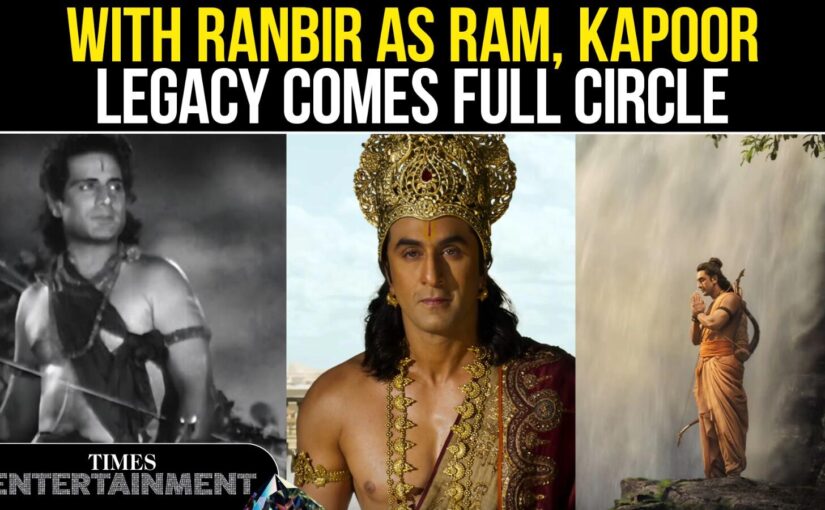
The riveting Ramayana teaser dropped today, and Ranbir Kapoor looks the part. Imperial, restrained, emotionally loaded. But the casting raises a question Bollywood won’t ask aloud.
The male axis of Hindi cinema runs through the Indus, not the Gangetic plain. The Khans, Aamir (Afghan UP-origin), Salman (Hindu, Pathan), Shah Rukh (Delhi, Hindko-Deccani stock), are Musulman. Their anointed successors, Ranbir (Kapoor lineage from Peshawar) and Ranveer (Bhavnani, Sindhi), are Hindu but Indus-blooded all the same (Hindus of the Indus are 99.9% genetically identical to Pakistanis apparently). The geography of stardom in Bollywood is the geography of Partition.
A Kashmiri nationalist once told me, Srinagar-bred, Ivy-educated, who sang Pakistani ghazals with more feeling than most Lahoris, that Ranbir and Ranveer were being aggressively promoted to eclipse the Khans.
Of course the connective tissue of the Ranbir-Ranveer rivalry is Sonam Kapoor. She is third cousin to Ranbir through the Punjabi mafia, and second cousin to Ranveer through their Sindhi mothers. The Sindhi presence in Bollywood runs deeper than most realise; Karan Johar, Kareena Kapoor, Kiara Advani all carry it. The two men being positioned as Bollywood’s future are bound into a single pre-Partition Hindu kinship network. The contestation isn’t just cultural. It’s familial.
The man cast as Maryada Purushottam, the ideal Hindu man, the conscience-keeper of a civilisation, descends from Prithviraj Kapoor of Peshawar; a Hindu Pathan (his kinsman Anil Kapoor states on record that he is the son and grandson of a Pathan). Bollywood’s Ram comes from the other side of the Wagah.
Ranbir versus Ranveer is the wrong frame. The real question is what it means that Hindu epic cinema, ₹4,000 crore, Hans Zimmer and A.R. Rahman, DNEG VFX, global IMAX release, chose a Kapoor. The answer is that Bollywood has always understood something the BJP perhaps never quite has: the cultural power of the Subcontinent flows from its Mleccha western rivers, not its sacred eastern ones.
P.S. A note on the phenomenal aesthetic. This has Game of Thrones and The Crown written all over it; the visual grammar is unmistakably Western prestige television, with a touch of Greek mythology in the costuming and scale. That is not a criticism. It is the evolution of Indian mythology into the global cinematic idiom, and Bollywood is almost certainly the first non-Western culture to make this translation successfully at this budget level.
This defies economics entirely. China’s film industry, backed by the second-largest economy on earth, has never come close to Bollywood’s global cultural footprint. India, by contrast, punches so far above its GDP that it forces a rethink of what drives soft power. It is not money. It is civilisational depth. The Ramayana has been retold across 300 versions in dozens of languages over three millennia. No amount of Chinese state investment can manufacture that inheritance.
BB used to say economics is everything. The Kapoors of Peshawar making Ramayan for a global IMAX audience suggests otherwise.
1)this will be compared with ramanand sagar’s work. although the new generation has no memory of it.
2)putting ramayana ‘s age as 5000 years ago will be questioned. the popular belief is that it is more ancient.
3) the rivers of Sindhu and saraswati are not mlechha. it is sacred and still invoked ever day here like asiknia, marudhwada, vitasta etc.
4) having helicopter sound for pushpaka vimana is quite hilarious.
5) for the BJP world any Hindu is good, better that this shows hinduness, of now Pakistan.
Side note: karishma kapoor has a christian Sindhi mother.
Ranbir Kapoor’s regalia seems inspired by the hackneyed post-Gupta sacred iconography. The silk brocade fabric and ornaments. Would have been interesting to see an unexpected, but more deeply imagined bronze age culture. It could have complimented the devotional sensitivities by grounding it more authentically.
no, I don’t think so. making these figures more ‘ human physically ‘ will not be pleasing the masses.
Like wise a , pale skinned, blue eyed blonde Jesus is accepted all the way up to Japan and attempts to portray the real Jesus as a dark haired, dark brown skinned Middle Easterner is bound to fail. Agreed, there are black Jesus icons in Ethiopia but…
the accepted image of the gandharan buddha, with curly hairs is also a similar case.
Hollywood films about Jesus like passion of the Christ and son of god have moved towards a decidedly brunette Jesus. They also seem to make a reasonable attempt to portray what the early roman empire in the levant might have been like. Pandering to the expectations of the intellectually lazy may be safe , but people know schlock when they see it. The 4000 cr budget is clearly aspiring for prestige.
more Spanish than Palestinian looking..
the curly hairs are the snails that sacrificed themselves to protect Lord Buddha from heat stroke?
also apparently the Buddha had blue eyes?
not that I know. however, the more east Asian images have a slightly Mongolian eyes.
Source? I’ve only seen this claimed by white nationalists, who frequently try to separate well-known or high-achieving Indians from the rest of our pack by claiming that they were actually the few “Nordic”-like exceptions among a degenerate population. They also claim he had blonde hair.
Konrad elst’s slide show and presentation arguing that buddha was very much a ‘hindu’, gives views of early orientalists who thought that buddha tries to give a pure ‘Aryan’ path away from the polluted Hindu way.
Oh really it’s not the 32 characteristics?
I mean the original epic was fully finished somewhere around the late Kushan to early Gupta period between 2nd to 5th century AD. The many authors that composed the text probably intended to the clothing to be reflective of their time period when it was written rather than original setting. Similar to Homer’s works that supposed to be set in the Greek bronze age, but the clothing, geography and weapons are homer’s contemporary dark age objects.
Ironically enough the very botched gupta/post-gupta look is more reflective of final authorial intent in addition to the fact that we literally have cotton fabrics and colored paintings from Ajanta caves depicting the type of clothes worn during the Gupta period. Hence an accurate depiction of kushan/gupta period is easier, while the iron age kosala kingdom didn’t leave any material to determine clothing and it would be mostly guessing.
Nonetheless, I don’t think the film makers even care to make it accurate to the post-gupta period even. They literally use the stereotypical crowns, clothing and architecture design found in old televison soap operas. Muti-million dollar VFX with cheap soap opera level everything else.
The cultural power of the Subcontinent flows from its Mleccha western rivers, not its sacred eastern ones.
Completely wrong.
If this were true, would not Lollywood from 250m strong Pakistan be the dominant movie industry of the subcontinent? Instead it is a pale shadow of even Mollywood from 40m strong Kerala both in terms of commercial and critical output (If any Malayali cinema recommendations needed, ask).
All those people mentioned are Indians, who were born and brought up in India. Their families might have lived in the Indus region when it was India but the moment it wasn’t, they left.
The magic isn’t in the INDUS, it is in INDIA.
The magic left the Indus region the day the “mlecchas” left.
Compare Karachi and Lahore from where Sindhi and Punjabi Hindus left to Mumbai and Delhi, the cities where they went to.
With all due respect to the Pakistani cities, they look like Tier II/Tier III cities compared to the Indian ones.
EDIT: “non-mlecchas” left
Not sure what Mollywood is but the Pakistani movie industry (Lollywood) does well given the market size, economic issues, political and security constraints it faces. We could definitely do better, there’s certainly a lot of potential and they’re clearly making strides this past decade. Pakistan does pretty well in art, music, poetry and television – movies on the other hand are not an easy industry to dominate and usually every language has like one major movie industry and then complimentary industries in smaller markets. Bollywood already fulfills that role for Urdu-Hindi, Hollywood does that for the English language.
That’s why television has been Pakistan’s forte, it’s financially lower risk and higher reward but is able to produce a high quality produce and showcase Pakistan’s acting and screenwriting talents. Comparing the movie industry of a country to some regional movie industry in a smaller language where they have the monopoly of content, is it not a smart comparison.
The last part of your comment claiming Karachi and Lahore look like “tier 2 and 3” cities in India is quite laughable and rooted in ignorance.
Mollywood is the Malayali movie industry.
“Market size, economic issues, political and security constraints” are very much a “you” problem and supports my initial point.
Also presence of Bollywood to justify Lollywood’s mediocrity is a cope. The UK has a very good film industry and many of its products like Harry Potter have been worldwide successes.
And even television Pakistan is stuck in “saas-bahu” style over the top cousin marriage dramas.
There is no prestige TV comparable to international standards. Still no Pakistani Netflix or Prime original like Sacred Games, Delhi Crime (won International Emmy) etc.
Karachi and Lahore do look like “Tier 2 and Tier 3” cities in India though. Maybe you are unaware but India has opened up a gap with Pakistan which is growing faster and Pakistan is being left behind further.
Let’s do a comparison of metros
Karachi – no metro
Lahore – 27.1 km
Nagpur – 38.22 km
Pune – 31.25 km
Noida – 29.70 km
Kochi – 27.96 km
Mind you these cities are not even state capitals and still have lines under construction compared to Lahore/Karachi.
I wonder what that Kashmiri nationalist friend of yours thinks about the rise of Aditya Dhar, a fellow Kashmiri in Bollywood.
Recently saw Article 370 and Baramulla from Aditya Dhar’s stable. Really good genre pieces – an action thriller and a horror movie.
Both set in Kashmir and with extensive Kashmiri cast members.
With regards to China vis a vis India – The biggest impediment to Chinese soft power is lack of English and unfamiliarity with the white elite. Compared to Indians where the top x % (whatever that is) is very attuned to Anglo-American culture/mentality.
That is why Indians seem so much more prominent in USA/Canada compared to Chinese even though numbers are the same.
As India grows richer and this “Indo-Anglian” class grows India can just leverage the existing Anglo-American world order to spread soft power instead of doing it from scratch. Both Varanasi and Ramayana are doing extensive promotions in the west using American channels which Chinese never do, even though they have actually become very technically slick with their movies with good VFX etc (The Wandering Earth is an example).
As more big ticket Indian movies release in the future I expect this “global marketing” trend to continue.
Another reason is the assimilationist nature of the diasporas.
Indians retain their names and partake in Indian cultural stuff like music, dance etc. The Brit-Indian wave of the late 90s early 2000s was second/third generation Indians making pop using Indian music. Current Canadian Punjabi wave is also very integrated with both Canada and Punjab.
Chinese take on Anglo names and western cultural stuff like piano etc so they become more generic “Asian American” than Chinese. Also you never see them partaking in Chinese cultural stuff.
Also the animosity between the CCP and their home western countries does not help. Chinese diaspora actively go out to distance themselves from the CCP (and many are actually people who fled the CCP). No such problem with India where some of the biggest Indian nationalists live outside India and openly support Indian political parties.
Check out this year’s box office revenues.
https://www.boxofficemojo.com/year/world/
Dhurandhar 2 is the 10th highest grossing movie of the year and has made $26 million (as of now) in USA/Canada accounting for 17% of its total revenue.
The highest grossing movie of the year is the Chinese Pegasus 3 which has made only $1 million in USA/Canada accounting for 0.2% of its revenue.
Chinese diaspora in USA/Canada is on par with India but they are simply not interested in Chinese stuff.
This comment alone is evidence that you’re not very attuned to “Anglo-American culture/mentality” yourself. One of the key reasons for the growing racism and backlash in America and across the west against Indian immigration is because of the culture clash and how different Indian culture is to western culture and how to a lot of people in America and the west in general, they feel like Indian immigrants as well as other South Asians don’t really understand western culture. The reason why Bollywood movies make a lot of money in America isn’t because they appeal to Americans or even American raised South Asians, they make money because of the massive new immigrant population, there has been a huge influx of recent Indian immigration over the past 20 odd years and mainly from specific parts of India and they’re the main consumer base for Bollywood and Indian cultural exports otherwise no non south asian (in meaningful numbers) cares about Bollywood and when it comes to propaganda movies like Durdinder, that audience shrinks even more as it only appeals to the Indian immigrants and within that subset the primary Bollywood moviegoers are what we call “FOBs” (for lack of a better term) and there are many of them here cause of the large number of Indians that have come here through the notorious visa programs.
Chinese culture, cuisine and history is definitely more popular in the west. Movies and music may not appeal but that’s more so because of the Chinese diaspora being a lot older, they haven’t had this recent massive influx that the Indian diaspora has experienced. They’ve been in this country for well over a century and recent immigrants have come in smaller numbers compared to Indians. So while the overall population numbers are similar, you need to factor in that the diaspora is mostly recent immigrants – many who aren’t even permanent residents or citizens yet while the Chinese American community is more diverse and older and has a good mix of different generations that were born and/or raised in the US.
From my observation, a lot of whitewashed Indian-Americans that have lived their whole lives in America also do not seem to care about Indian stuff either and Bollywood and cricket are seen as fobby interests that are some of the easiest things to shed if you’re trying to ascend and assimilate into White America. Usually by the 3rd-4th generation, everyone is essentially American, so Bollywood’s cashcow – the indian diaspora, won’t last for a very long as time goes on, younger generations assimilate and work visas come to a halt.
Blah blah blah blah.
Aren’t you the one who said he avoided the forum because he was afraid of me?
Pleased to meet you.
There has been no growing “backlash/racism” in USA/UK/EU vs Indian immigration other than in extremely online wignat circles.
You are talking of “whitewashed” desis when actual white people are now having an interest in Indian pop culture lol.
Why does Bon Appétit have a section dedicated to Indian street food?
Why are there Michelin starred Indian restaurants opening up all over the west with primarily white clientele?
Why are western publications like Variety, Collider etc interviewing the cast/crew of Varanasi/Ramayana?
You have made the BIGGEST mistake in your assumptions and I understand why.
Because Pakistan has not economically grown much and remained the same, you assume India will be too.
But here is the kicker – India will keep growing richer and the pop culture will keep becoming more “first world” and thus appeal to global audiences like it did for the Japanese and Koreans before and if you go far back enough, Americans.
“Whitewashed” Indian Americans are a very tiny demographic and unimportant – similar to Korean and Japanese Americans.
Indian pop culture will grow big in the west due to the same way Japanese and Korean pop culture did – it will become popular among the whites.
And just like Asian Americans are now into K-pop, anime, manga etc Indian Americans will be into Indian pop culture as their white peers are into it too.
Check this screening of RRR out in the LA Chinese Theater. Completely non desi audience.
https://www.youtube.com/watch?v=Fh4s2TZARrs
It even made a lot of money in Japan where there is hardly an Indian diaspora.