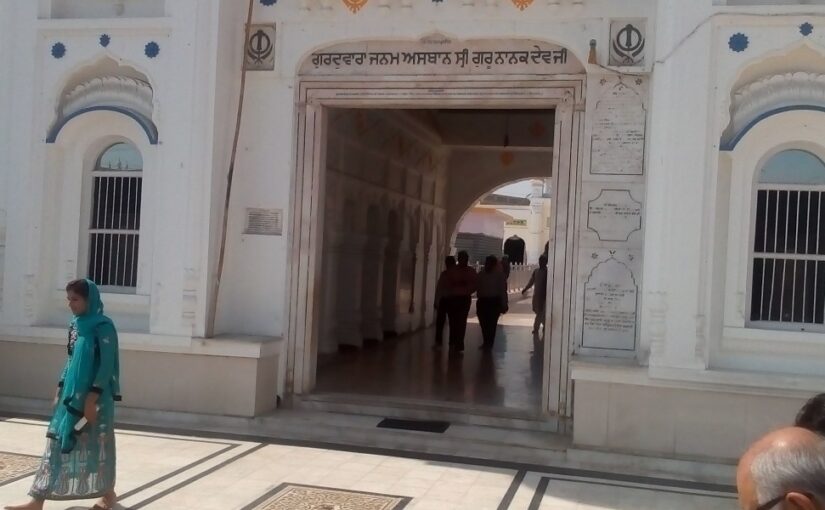
Nankana Sahab and Gurdwara Janam Asthan

On the occasion of Vaisakhi, I want to share this travelogue of my trip to Nankana Sahab a few years ago.  This is completely an apolitical post and should be treated as such. Going forward, I have decided to restrict my contributions to BP to non-political subjects such as Hindustani Music.  I would appreciate if the Indian nationalists also do not write about the internal affairs of Pakistan (This is only a request).

According to Wikipedia, Vaisakhi was historically North India’s most important annual market.  Wiki notes: “Although Vaisakhi began as a grain harvest festival for Hindus and its observance precedes the creation of Sikhism , it gained historical association with  the Sikhs following the inauguration of the Khalsa”.

Recently, efforts have been made to revive Vaisakhi in Pakistan. An event was held in Lahore this past weekend hosted by THAAP (The Trust for History, Art and Architecture in Pakistan) in which I was invited to perform bhajans and shabads.

The event was reported on in DAWN:

World Heritage Day marked with Vaisakhi celebrations 

The travelogue is below

Continue reading Nankana Sahab and Gurdwara Janam Asthan

Review: The Scattered Court: Hindustani Music in Colonial Bengal by Richard David Williams

In an attempt to shift the focus from geopolitics, I am sharing this review of a book by Richard David Williams (my professor at SOAS). 

This piece was originally published in South Asia Multidisciplinary Academic Journal (SAMAJ) in January 2025. 

Richard David Williams’s The Scattered Court: Hindustani Music in Colonial Bengal examines the Calcutta-based court-in-exile of Nawab Wajid Ali Shah (1822-1887), the last ruler of Awadh who was deposed by the British in 1856. The book is based on Williams’s doctoral thesis “Hindustani music between Awadh and Bengal, c. 1758-1905.” It develops a social history of how Hindustani classical music and dance responded to the transition from the Mughal Empire to British colonialism. Using previously unexplored sources in Urdu, Bengali, and Hindi, Williams aims to demonstrate the importance of Wajid Ali Shah’s exile in Calcutta in enabling the rise of that city as a celebrated center of Hindustani music. As he writes in the introduction:

Establishing the connections between Lucknow in Hindustan and Calcutta in Bengal challenges the notion of distant, regional performance cultures, and underlines the importance of aesthetics and the performing arts to mobile elite societies. Since Lucknow is associated with late Mughal or nawabi society, and Calcutta with colonial modernity, examining the relationship between the two cities sheds light on forms of continuity and transition over the nineteenth century, as artists and their patrons navigated political ruptures and social transformations (p. 3).

Most previous studies of Wajid Ali Shah treat his thirty years of exile as a footnote to the culture of Lucknow.1 In contrast, Williams focuses on the court-in-exile at Matiyaburj (located in southwestern Calcutta) in order to examine the impact of the nawab’s presence in Calcutta on the development of Hindustani music in Bengal. He examines the circulation of musicians between the transposed court and musical soirees in North Calcutta. Through his reconstruction of musical life at Matiyaburj, Williams demonstrates that the nawab’s musical innovations continued in Bengal and that he was engaged with his surrounding environment—for example, by composing lyrics in a mixed Bengali-Hindustani register. Continue reading Review: The Scattered Court: Hindustani Music in Colonial Bengal by Richard David Williams

India is Not a “Muslim Power”

In the comments on “Pakistanis=Indian Muslims With Sovereignty”, BB argued that India is a “Muslim Power”.   This is a patently ridiculous argument but it merits a full rebuttal.

The simple fact is that India is NOT a Muslim country.  India is 80% Hindu. Muslims are a minority (approximately 15%).   India is a constitutionally secular state. So under no reasonable definition is India a “Muslim Power”.

Pakistan is the world’s second-largest Muslim-majority country. It is projected that within five years it will overtake Indonesia to become the world’s most populous Muslim country.  Additionally, Pakistan is the only Muslim-majority nuclear power.  Finally, Pakistan is an “Islamic Republic”.

This argument is so blatantly ridiculous and disingenuous that I can’t believe this clarification is even necessary. But here we are.

I’d also like to take this opportunity to clarify my exchange with El Khawaja.  He argued that “Pakistanis are Pakistani and that’s it”.  I disagree with this position.  I am as patriotic as the next Pakistani but this quote expresses the belief of the State — a belief I argue is fundamentally wrong.

Post the loss of East Pakistan in 1971, the Pakistani State has doubled down on the belief that we are all “Pakistanis first”.  The argument goes that if people are allowed to identify as “Punjabi”, “Sindhi” etc this may lead to secession. This is obviously a red line for the State.  Thus, the introduction of “Pak Studies”, a course that all students must take from primary school through their undergraduate studies.

However, this indoctrination has not served to lessen people’s feelings of being “Punjabi”, “Sindhi” etc.

It would be much healthier if the Pakistani State accepted that Pakistan is a multi-ethnic–NOT multinational– country.

Seccession is not a realistic possibility since Pakistan is a nuclear power. So I think the State’s worries on this ground are overblown.

The efforts of BB (and to some extent RNJ) to undermine the Pakistani identity and classify us as “Indian” are patently obvious and not intellectually tenable.

However, I do believe that my compatriots also go too far and try to downplay the links that Pakistan has with the “Indian subcontinent”.



Overzealous Pemra

A few days ago RNJ had referred to Pakistani TV channels being issued show-cause notices for airing Indian content in connection with the passing of Asha Bhosle.

This is one of the rare occasions when RNJ and I actually agree on something.  Though there is a judgement of Pakistan’s Supreme Court that bans the airing of Indian content on TV–and this is what PEMRA relied upon in their arguments–I personally think that this law is counterproductive. Art should transcend borders.

Mirza Moeez Baig explains in DAWN:

The decision in Human Rights Case No 22753-S: In 2016, Pemra issued a circular banning all private TV channels from airing Indian content. The circular was assailed before the Lahore High Court, where Justice Mansoor Ali Shah declared that Pemra’s ban was unconstitutional. In 2018, however, the apex court suspended the LHC judgement. In keeping with the jurisprudence that characterised his tenure, then chief justice Saqib Nisar, while suspending Justice Shah’s well-reasoned judgement, thundered, “They are trying to obstruct the construction of our dam and we cannot even ban their channels.”

And:

The right to free speech includes the right to receive ideas, facts, knowledge, theories, creative and emotive impulses through theatre, da­­-nce, music and film. Critical to the foundation of an independent and free media is creating an environment co­­n­ducive to the widest possible dissemination of informa-tion from diverse and antagonistic sources.

Unsurprisingly, Pemra’s show-cause notice would only pass muster if the content celebrating Bhosle’s musical journey (i) offended Pakistan’s ideology, (ii) was immoral, (iii) or jeopardised Pakistan’s security and integrity. Needless to say, Bhosle’s music posed no such existential threat.

I will end this post with a clip of Asha ji and Ustad Ali Akbar Khan’s piece “Khayal in Gaud Sarang”


Prominent lawyer Raza Kazim passes away at 96

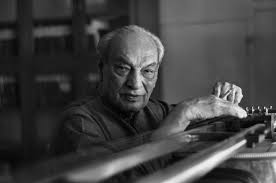
More importantly (for me) Raza developed the “Sagar Veena”–a plucked string instrument.  His daughter, Noor Zehra Kazim, is the foremost exponent of this instrument.  His grandson, Rakae Jamil (a personal friend of mine) is a sitarist who trained at the Sangeet Research Academy in Calcutta.

From DAWN:

Continue reading Prominent lawyer Raza Kazim passes away at 96

Brown Pundits