Down with eggs?


I don’t have a big personal issue with vegetarians, though I really enjoy ribeye and you’ll take shrimp from my dead hands. My daughter has been a vegetarian since she was five due to ethical concerns about animal cruelty.

But every now and then I hear that BJP-aligned governments or officials are removing eggs from school meal programs due to cultural sensitivities. I get that, but is there a good argument from this from a utilitarian/nutritional angle? Children at critical ages need protein and fat, and perhaps I’m wrong, but India still seems to have a lot of nutritional issues in a lot of is population. These kids are the future, and honestly, this seems like the cultural forces are shooting society in the face.

If Marin county or the Irvine School District unveiled this I wouldn’t care. With enough money and care you can design a vegan diet with balance and supplementation to be healthy. But this requires care and execution, and I see many American with lots of money who don’t pull it off well judging by their physique and fatigue.

What’s the deal? It’s true that the Chinese eat everything, but sometimes I wonder if the Indians eat nothing.

(this matters to all of us because a massive number of working age people in the next few decade are going to be Indian, and we need them to be as healthy as possible)

Division

One of the things that has saddened and frustrated me on this weblog over the last 12 years has been the tendency of brown people, Indian subcontinentals, South Asians, etc. to engage in differentiation. As a geneticist, I am aware of differences, and I accept and admit it candidly to an extent that is rare in an open manner in the West. Also, some ribbing and joking is normal, and I am not offended.

But Pakistanis vs. Indians, Southies vs. Northies, Bangladeshis vs. Indians. High caste vs. low caste, vegetarian vs. non-vegetarian.

Our cultural differences are striking. Our diversity of form, belief and practice is mind-blogging. But we come from the same roots. The rest of the world looks at us, and recognizes the kinship. We? Not so much. Muslims claim Arab or Iranian heritage. Jats and northwest Indians distinguish themselves from the lower and dark races. Southerners express contempt for the barbarism of BIMARU. BIMARU claims that they are the font of culture. And so forth.

This is not to end with a resounding assertion. But sometimes, I wonder if the silent majority is not like this, and we hear the prattling of the minority?

South Asian nations

I dislike the “GDP wars” that sometimes crop up on this message board. Comparing India to Bangladesh or Pakistan is apples to oranges. India is economically a collection of nations, and the average can be misleading. That being said, a lot of the Indian commentators also seem to engage in a lot of cope when it comes to GDP comparisons between Bangladesh and India; on the whole I often agree with them…but the fact that there can be a comparison despite India having relatively dynamic economies in Gujarat, Maharashtra, and around Delhi, Bangalore and Hyderabad, should lead to some soul-searching about inter-regional inequalities, rather than arguing about statistics.

But, as a biologist I like looking at health indicators. Harder to fake (thought not impossible), and clearer in interpretation.

First, let’s be honest: Pakistan is now the “slow kid” in the subcontinent. Mind you, many South Asians will admit that they are more handsome people because they are taller and lighter skinned (let’s be frank here), the advantages Pakistan accrued through its Cold War alliance with the US and less strident adherence to socialism than India have been frittered away. Anytime India sees itself clustering with Pakistan, it has to wonder “what are we doing wrong???” (again, the story in India is inter-regional variation). Despite over a generation of war and strife, Sri Lanka still had a lead in these indices, but the other nations are catching up. Finally, Bangladesh’s status is a basket case still shadows some of the numbers, like the number of physicians per thousand and age at teen births and motherhood. All that being said, what’s the good of having physicians if your life expectancy isn’t that great?

Merry Christmas!

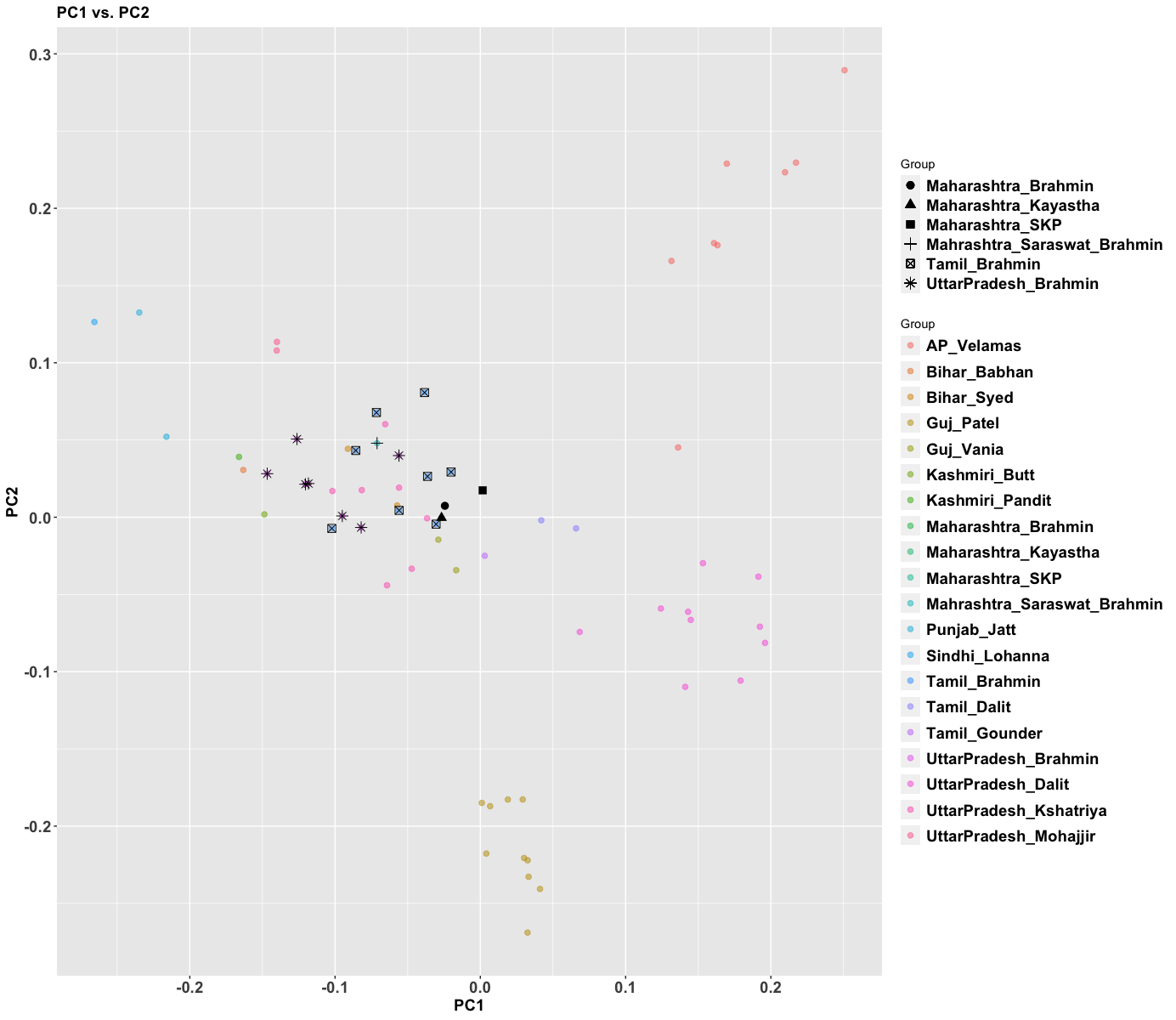
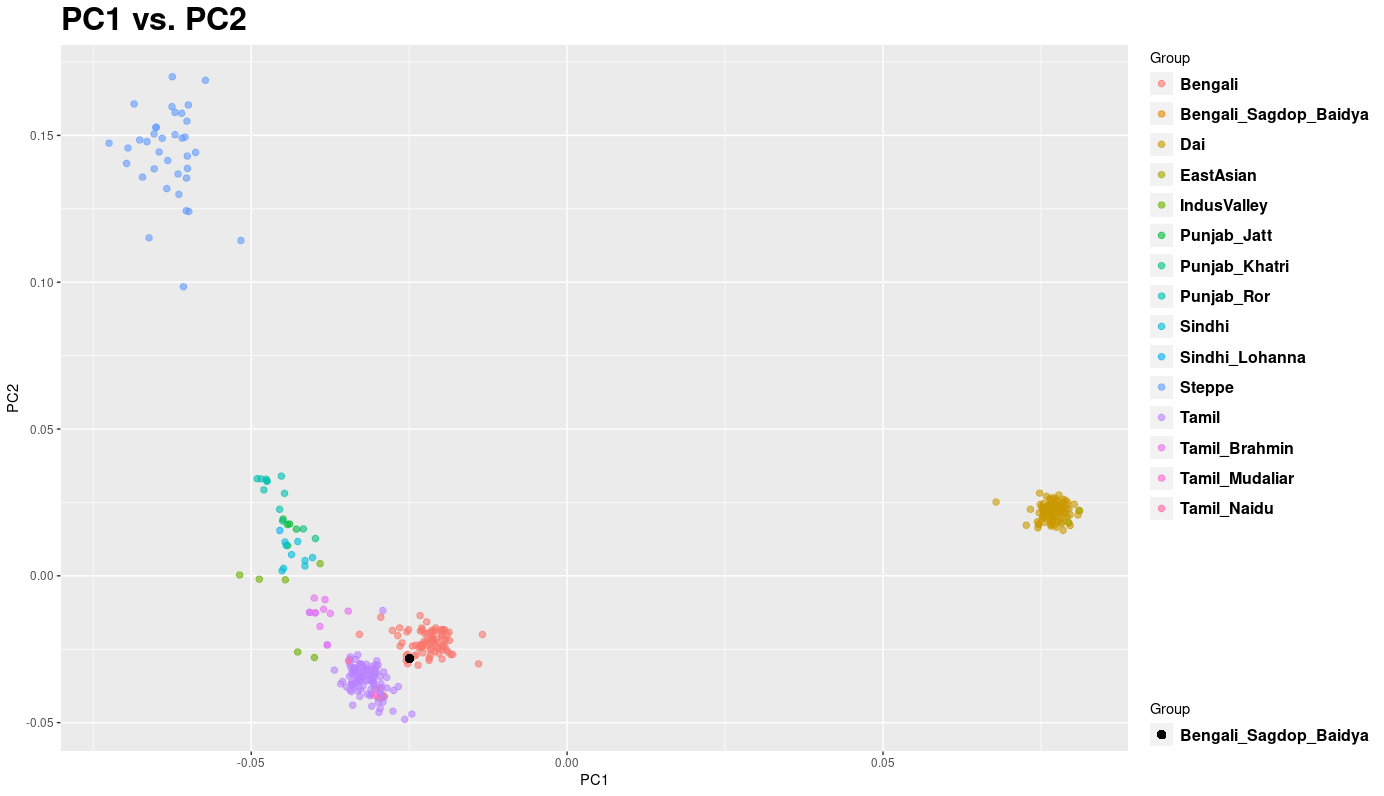
I got a sample from someone where one parent was a West Bengal Sadgop, and another parent a Baidya with family origins in East Bengal. One hypothesis that I’ve see is that Baidya are basically Brahmins who lost their caste. Genetically this does not seem to be the case. Bengali Brahmins shift considerably toward the steppe samples compared to average Bangladeshis, and this individual does not. Rather, their uniqueness is that they have very little East Asian ancestry compared to the median. This is typical of non-Bramin West Bengalis. It is plausible to me that this individual’s Baidya parent, from East Bengal (Bangal), had more East Asian ancestry than their West Bengali (Ghoti) parent, so you see an average.

Though there are some exceptions, it seems that the non-Brahmnin bhadralok castes did undergo ritual uplift from that of conventional peasant cultivators at some point in Bengal. This seems similar with regard to Kayasthas in UP, but not in Maharashtra, where CKPs seem to have an affinity with Brahmins distinct from the Maratha cultivators.

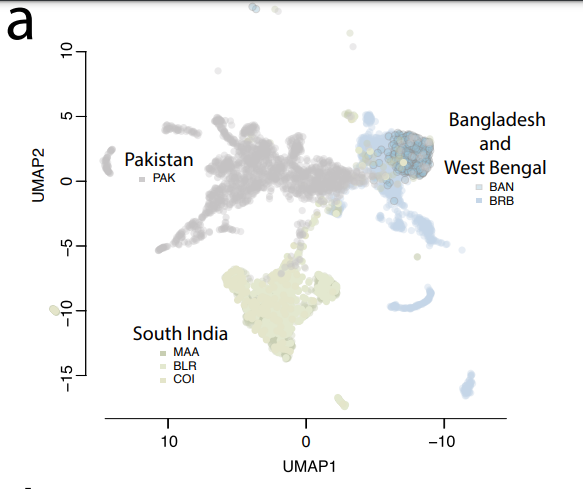
Update: I found a preprint that pretty much answers all the questions re: Bengalis.

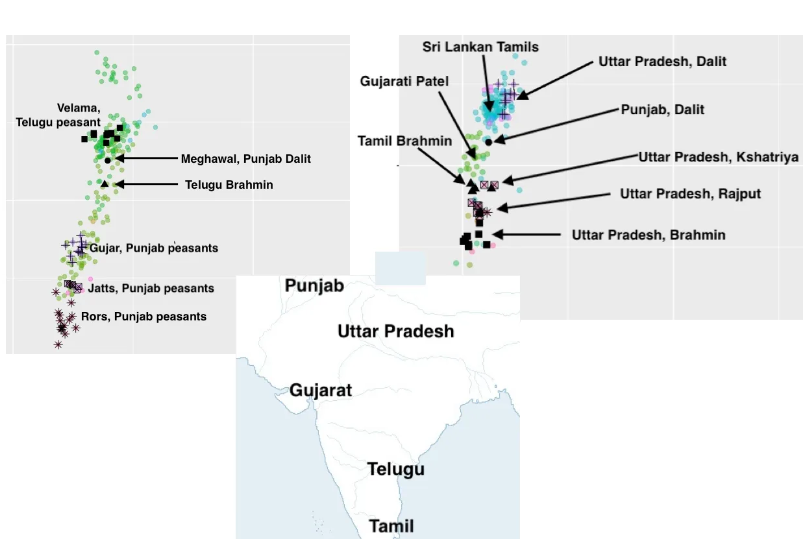
Here is a panel with a UMAP representation of genetic distance, and you see West Bengal is adjacent to Bangladesh. But there is a “tail” of individuals that are parallel to South Indians.

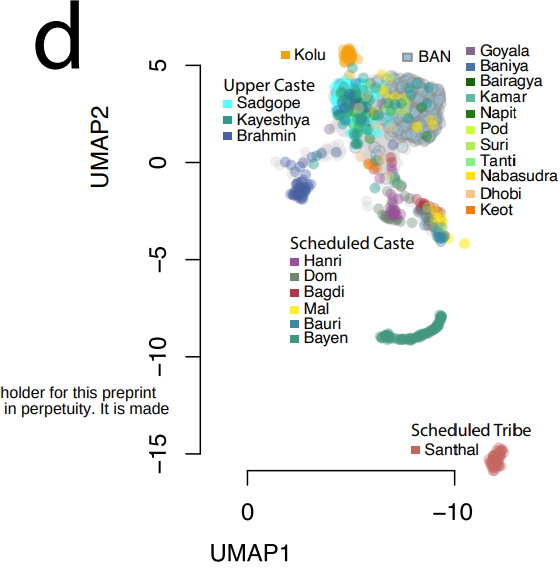
This UMAP makes clear Bengali Brahmins are distinct from Kayasthas and Sadgop. These populations seem roughly similar to most Bangladeshis except they are shift over, and I assume this means less East Asian ancestry, as PCA seems to how:

A vision for solving India’s caste social crises

My personal belief is that jati-varna was one of the major reasons that India did not Islamicize more than it did. These sub-elite solidities “absorbed” external shocks and mediated individual relationships with the world. Collective entities like this are common across the world, but the genetic distinctiveness of these groups is like nothing you see elsewhere (with the possible exception of endogamous isolation like premodern Ashkenazim). I also believe that the jati in particular predates the arrival of the Aryans 3,500 years ago. Varna-like concepts exist in other Indo-European societies, but only jati exists in India, and I believe that genetics will uncover jati-like stratification in the IVC over time. Jati may be one reason that the IVC seems archaeologically to be an “anarchistic” society in terms of governance and politics insofar as they can infer anything from material remains (there seem to be no grand public buildings as in Mesopatamia or Egypt).

But, today, in 2022, the jati-varna system is a problem for India. In particular, I think the reservation system is socially toxic and economically inefficient. Because I have libertarian conservative viewpoints, I have always opposed caste-based reservations, just as I oppose affirmative action in the USA. This has little to do with empirical or utilitarian calculus and everything to do with deontological principles. But, from a utilitarian perspective, I believe that reservations result in the misallocation of talent, as well as emigration.

How to fix this problem? The genetics indicates endogamy rates of 99% or less for possibly a thousand years or more. Today, the jati-varna endogamy rate is lower. Perhaps 95% is the high bound from the estimates I’ve seen. This means within several centuries jati-varna as we understand it will not be viable.聽 The rate of genetic/social/cultural exchange will be too high to maintain traditional solidities. This will not mean that all castes will disappear; some will likely persist, but many societies have endogamous minorities. The way India is unique is that it is a whole civilization that is built around endogamous minorities. This does not scale as well to a modern economy and unitary society, and it is cannot persist if current social trends continue.

This problem will “naturally” take care of itself in both India and Pakistan (two countries where endogamous communities are ubiquitous), but, there are possible social and cultural movements that can accelerate or retard this process. The transformation of Hinduism into a more cohesive and confessional religion will probably be part of this. Like jati-varna, Hinduism’s strength was its fractious decentralization, as it absorbed and flexed in various directions to maintain its integrity in the face of proselytization. But in the world of 2022, the strategies of survival and persistence in the face of five hundred years of Muslim domination (in North India) are not appropriate; cultural involution and retreat simply invite defeat. The extremely diverse and almost contradictory nature of Hinduism allowed it to be a catchall system that integrated many jati groups with idiosyncratic beliefs and customs. The two reinforced each other as parallel institutions. Arguably, the weakness of jati will be the weakness of Hinduism unless the latter evolves and changes. One primary reason that non-Hindus never convert to the religion is that conversion still puts one outside of the jati-varna social networks of other Hindus while ostracizing oneself from one’s birth community.

Of course, some Hindus like the system the way it is. Some of these go by the term “trads,” but these types simply say out loud what the revealed preference shows is the majority viewpoint of most Hindus in India. What do they worry about? Higher-status groups do not want to become lower-status. Also, some high-caste Hindus believe they are more beautiful (lighter-skinned) and intelligent than lower-caste Hindus, and they do not want to dilute their human capital advantage. Objectively, it seems clear that many high-caste Hindus are indeed lighter-skinned and have facial features considered more beautiful than that of other Indian castes (I’m talking about Indian preferences on the whole). Additionally, whatever you may think about the heritability of intelligence, this is also certainly a possibility for differences between the groups.

But there doesn’t need to be such a great concern. Most societies have intelligent and beautiful subgroups, but they are not restricted to a particular social or political element. Restricting these traits to a particular social and political group causes problems, as you can see in India. The reality is there are beautiful/handsome and intelligent Dalits, so why not marry them if you are a Brahmin? These characteristics will persist, and the upside is that the social divisions between the jatis will diminish, and India can have a cultural matrix that’s more amenable to economic growth and individual liberty.

As someone with a conservative bent, there are natural hierarchies and status differences in any society. This is normal, and total leveling will never be possible, nor should we even aspire to it. Difference is worth appreciating. But the system of jati-varna in India as it is operationalized today is not conducive to human flourishing because it retards the development of broader social and cultural institutions that allow for national collective action. This is not abstract. China is a perfect example of a society with class status, but never has it had jati-like endogamy. Radically different dialect groups, like Hakka and Cantonese, freely intermarry with minimal conflict or controversy, so long as socioeconomic status is this. This is the future. You can delay it or ride the tiger.

The the origins of the false moral panic about caste in the USA

Caste discrimination in the US, again…Brown University bans caste discrimination throughout campus in a first for the Ivy League.

These stories are strange and silly on some level. But they are serious on another level. Multiple young brown American men have told me that they have been asked about their caste by white colleagues, usually social justice-oriented聽women. More recently, I was having beers with a friend who works at Google, and he mentioned offhand “I heard caste discrimination is a big problem in American tech.” Context on him: he’s American-born, his father is from China, his mother is a white New Englander, and he’s not religious, but he’s center-right politically.

Very few people in America know anything about caste. So they rely on a small group of activists to inform them. Additionally, the American elite is very worried about structural oppression, and jati-varna certainly fits that bill. So they are attracted to regulating and eliminating it.

The problems:

– Most Indian Americans don’t care about caste, and 1.5 and 2nd generation are very fuzzy on it

– Most Indian Americans who are 1.5 and 2nd generation do marry other Indian Americans, but they seem to marry outside of their caste

– Very few Indian American Hindus, about 1%, are Dalit. About 20% would be “OBC” in India, and 80% are “upper caste.” So there aren’t many “low caste” people to discriminate against

– Very few Indian Americans exist in a predominantly Indian milieu, so caste as a discriminatory framework can never operationalize

The final issue is that of course, the ancestors of Indian Americans on the whole did benefit from literal structural privilege in a broad sense, even if they came from a poor or uneducated background. Usually, on a relative scale, the people who arrived in America had resources or skills compared to the average Indian. In agreement with Greg Clark, I think this human capital persists; Indian Americans are not regressing back to a very lower socioeconomic median. Instead, they are becoming part of the American overclass.

I believe that the new salience about caste in America has less to do with caste and more to do with grappling with a dark-skinned nonwhite population that clearly has high levels of persistent and structural human capital advantage. American elites, and especially white American elites, have a very difficult time intellectually conceiving of the idea that nonwhite people can overcome discrimination and succeed because of the privilege of high endogenous human capital.

Brown Pundits