Open Thread – Brown Pundits – 3/18/2022

A comment on the earlier open thread:

Interested to know what Razib and Omar sahab think of Holi, any experiences Razib?

I don’t have any experience and did not know it was Holi. Thanks for telling me!

I was going to visit India for business in 2020, but then COVID-19 happened, so I have never been to India. I have only been to Bangladesh twice in the last 40 years, so it did not overlap with Holi.

Friendship in a time of evil

The shooting of this family in Ukraine is all over the front pages. Many Americans bemoan the humanitarian disaster. Russian restaurants are being boycotted in the US (many of the staff and owners are Ukrainian!).

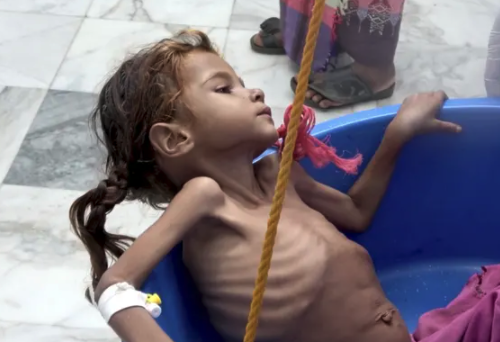
Below is a photo of a starving Yemeni child:

A bit under 100,000 children have starved in Yemen in the last 4 years due to a civil war, fueled in part by tacit American backing of the Saudi regime, which has been exacerbating and intervening in the conflict.

Why do we pay attention in one case and not the other?

  1. Nuclear war risks
  2. The Russian invasion of Ukraine violates longheld post-World War 2 norms
  3. Ukraine is in Europe, and the West cares about the West (or the aspirant West)

This is all fine. I’m very scared of #1 and horrified by the existential risks and economic havoc that Putin’s choice to actually invade has wrought on the world. But I find the arguments of a sui generis or exceptional humanitarian situation in Ukraine implausible. People don’t want to admit that their feelings are shaped by cultural or racial affinity, or that it is pure self-interest in relation to nuclear war or maintenance of world order. So they make this the “next Holocaust.”

A lot of non-Europeans are skeptical of this posturing. At my other blog, I put up a post about why Bangladeshis have a soft spot for Russia, which might explain their reluctance to condemn the invasion of Ukraine. The same obviously applies to India to a great extent.

The brown immigrant vs. the brown American

Colleges and universities across the US are moving to ban caste discrimination:

Another time, Pariyar brought up his experiences with caste discrimination during a classroom discussion about the trauma of racism and sexism. Some South Asian students in the class, he said, reacted as though caste discrimination was completely foreign to them. He felt they were effectively gaslighting him. And when he tried to organize a conference on issues of caste, Pariyar said he got little support from other South Asians.

The story starts out with the experiences of a Dalit from Nepal who seems to have immigrated to the US. Many of the instances of caste discrimination in the US seem to be from fellow Nepali immigrants. It is possible that immigrants from Nepal bring some caste attitudes? Obviously. But when you switch to the context of talking about caste with Indian Americans born or raised in the US, they may actually honestly not understand much what it means. The piece is flattening the experience of a recent immigrant with Indian Americans, and this flattening and conflation is what’s going to happen if caste becomes a protected class more broadly.

Later on in the piece:

The opponents, who included alumni, professors and community members, argued that discussions about caste unnecessarily divided South Asians and that caste discrimination no longer existed. They claimed that caste was a construct of British colonialism, even though it had existed for millennia, and insisted that the resolution would instead provoke hate against Hindus on campus.

Krystal Raynes, a student at Cal State Bakersfield who currently serves as a CSU student trustee, wasn’t familiar with caste and caste-based discrimination before that meeting. But the language and line of reasoning she heard that day rang familiar.

“It reminded me so much of the discrimination happening against Black people in America,” she said. “Black students being gaslighted, [being told] your experience isn’t discrimination, your experience isn’t oppression.”

There are a few issues here. Indians quite often engage in what we’ll call “denialism” about caste and how it shapes Indian society. When you go around claiming caste was a construct of British colonialism, and discrimination no longer exists, you’ll seem crazy to people. Even though the reality is that in the US making caste a protected class cause huge problems, obfuscating or whitewashing the reality of caste in India does not help your argument in America.

Second, Americans are really just reinterpreting caste in the context of black-white relationships in this country. It’s not about India, it’s about America, and some Indian Americans (the founder of Equality Labs) are engaging in “cultural arbitrage” to to provide a “product” that American administrators can “consume.”

Allies on the Right

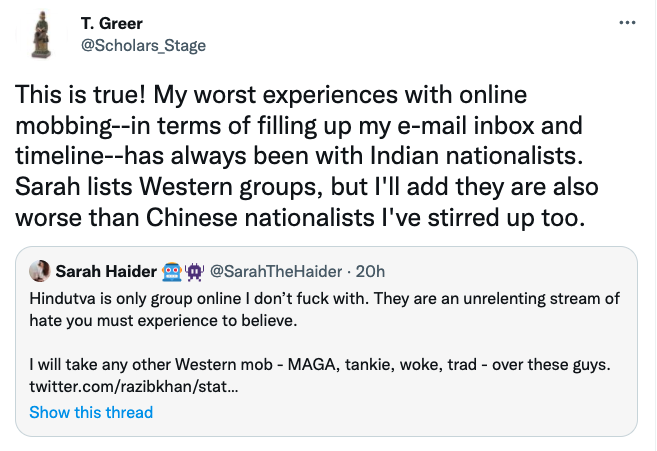
Sarah Haider and Tanner Greer both responded to my “disavowal” of sorts of the online Hindu Right. The constitutive unpleasantness is just structurally unappealing. Some reasonable Hindutva people have messaged me that “well, you can’t really be surprised they’re triggered by you, your name is Razib Khan.” My response is of course simple: if you are against me, I am against you. That is all.

(I know Tanner and he has never expressed anti-Hindu views, and his anti-China position should clue you into possibilities of coalition. Sarah has personally expressed curiosity about Hinduism when we’ve talked online)

Amy Wax on “Asians”

Amy Wax Redux – Another round in the immigration and culture debate. Glenn Loury hosts a debate that has gotten some attention because Amy Wax said something in relation to “Asians.” Her interlocutor is an East Asian American, and Wax’s original comments were particularly targeted at Indian women. So this has spun a bit out of control.

I’ll say some quick things.

In Amy’s favor:

– Many people have noticed the overrepresentation of “market-dominant minorities” in particular activist groups, and the visible presence of South Asian (Indian, Bangladeshi and Pakistani) women is hard not to notice. Joe Biden’s statement that “Indians taking over” reflect Indian American power in Democratic politics in particular.

– Nations have a right to determine what they want to be. At least in theory. This is most explicit in Israel, founded as a homeland for the Jews. Hindu nationalists want India as a homeland for Hindus. While many Muslims view Muslim-majority nations as societies organized around Islam, and so they believe law and tradition should favor that religion. In the USA this was clear as well, with a 1790 law that allowed only for the naturalization of whites, later expanded to blacks and eventually other non-white races. The National Origins Act of 1924 aimed to keep the US a mostly Northwest European nation. And so forth.

The idea that America, or any nation, exists simply as an institutional transaction device between consenting adults and organizations that are bounded by particular borders is not realistic, though sometimes open and open borders adjacent people talk like that. American is a nation. A people. It will change. But how?

– Americans are going to be uncomfortable when “visible minorities” take all leadership roles due to their educational success. That’s a fact. I think people should get over it though. But that’s my opinion. Most people care a lot more about race and visible phenotype than I do from what I can tell.

– Immigrants bring their culture. Their culture impacts our culture. Sometimes good, sometimes bad. We can make decisions.

Against Amy:

– She talks about it like a Boomer who doesn’t really understand the landscape. She was born in the early 1950s in a black and white America, so when talking about Asians and Latinx she’s encountering new things to her experience.

– She elides in a sloppy way different groups of Asians. Indian Americans are politically very different than Vietnamese Americans. They are socially very different. Arguably Amy should want more Vietnamese Americans, who lean Republican and are educationally more similar to the average American. 30-40% of Vietnamese are also Catholic. Who are these “Asians” she speaks of? Not people she knows personally from what I can tell (I’ve met Amy, she’s charming and blunt at the same time), so she should read more stats.

– She elides the distinctions even among “Indians.” Most of the obnoxious woke Indians are 1.5 and 2nd generation people born and raised in the US. And yet 90% of Indian Americans are foreign-born immigrants, more than 50% arriving after 2000. Perhaps these new immigrants will also have woke children, or perhaps they won’t.

– Amy’s generalizations of Asian, and Indian, cultures is weird, and not too scholarly. If she’s going to offend (I know about this), you need to know your shit.

On the Hindu contradiction of intents

A few days ago some Indian politician was making the case for ghar wapsi (conversion of non-Hindus of Hindu ancestral background to Hinduism). Of course, he had to withdraw the comments due to an uproar. Myself, I’m American, and people convert from religion to religion all the time. It’s a bit tasteless for a public official to engage in this, but it happens.

India’s a different country, so I understand that this official had to be prudent.

That being said, these calls to bring non-Hindus back into the fold are in my opinion kind of a joke. Yes, if someone is born a Hindu, or if someone’s family converted a generation ago, perhaps ghar wapsi is feasible. One can slip back into the social network that one was born into, or that is accessible in cultural memory. But outside of particular sects, like Hari Krishna, Hinduism is too “community-oriented” a religion to accept large numbers of converts. Perhaps if a whole community converts back all at once, that’s possible then, but there won’t be the low-level social-network-based conversions that drive a lot of the constant defection or adoption (e.g., it is well known among Mormons that most converts come through friendship networks between Mormons and non-Mormons, as well as marriages between Mormons and non-Mormons, not door to door conversion).

Calls for ghar wapsi are just rhetorical. If large numbers of Indian Muslims began to convert to Hinduism would they be accepted with open arms? I doubt it. The social system is just not set up for that (again, outside of sectarians like Hare Krishna).

Consider the fact that on social media Hindu nationalists (some) routinely refer to me as a Muslim. I am not someone to patrol what terms people use to refer to me as (you can use any pronoun, I don’t care), but it seems weird to call me a Muslim when I’m an atheist that has drawn and posted a photo of a drawing of Muhammad getting sodomized by a camel (on this weblog), something most Hindu nationalists would never do out of religiosity or cowardice. But it’s not about my identity (I don’t socialize with any Muslims nor do my children even know anything about the religion, so I’m not one of those “atheist Muslims”), it’s about the fact that many Hindus reflexively view religion as ascriptive. Something like race, an identity that you’re born with.

With that in mind, Hindus should work on their birthrate. Most Indian Muslims that convert to Hinduism will have Muslims who hate him, and Hindus who will still think of them as Muslim.

Note: Obviously, my generalizations apply to a particularly low IQ set. I actually know Hindu nationalists or fellow travelers in that movement who don’t have this sort of collective/ethnic mentality. But it’s a minority position from what I can tell.

Brown Pundits