AOC’s brain has gone and done it now!


I call Saikat Chakrabarti “AOC’s brain.” I think it is likely that he is responsible for her tweet’s that mention prescriptivism:


Chakrabarti went to Harvard, studied computer science, then Wall Street, before becoming a founding engineer of Stripe. Stripe is valued north of $20,000,000,000 right now, so his paper wealth is likely putting him in the 0.1% or more (unless he cashed out early, which would mean he’s more liquid, though less wealthy).

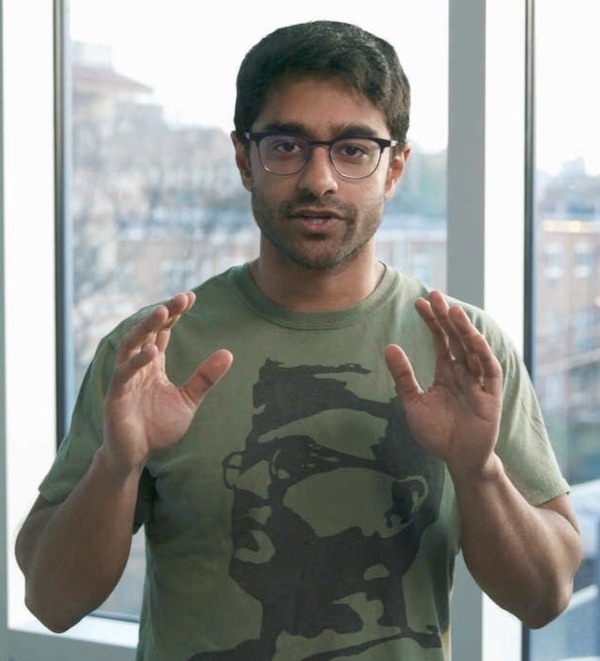
In addition to his far-Left politics, professional and financial successes, he seems to lift judging by the photos. So good for him!

Today he got in trouble for wearing a t-shirt with a photo of Subhas Chandra Bose. Bose was a radical nationalist, but complex otherwise. Today he is being reduced to his alignment with the Axis-powers a meeting with Hitler (after all, in the West, all that matters is your meeting with Hitler during World War II, not what was going on in far off Asia).

The weird thing is if Chakrabarti wore a Che Guevera t-shirt I don’t think it would be a major issue. But to me, that would be worse, because Che acted with brutality in favor of international Communism of his own free will. Bose’s alliance with the Axis-powers was clearly driven mostly by pragmatic concerns. An analogy here might be Finland’s alliance with Nazi Germany, so as to fend off absorption into the Soviet Union.

Of course, the online Left has never been much for subtly. Do unto them, as they would do unto you. I hope Chakrabarti gets what he deserves, but I doubt he will. Blue-checks take care of their own kind…
Browncast Episode 54: Sojourn in India as a international Parsi

Another BP Podcast is up. You can listen on LibsyniTunesSpotify,  and Stitcher. Probably the easiest way to keep up the podcast since we don’t have a regular schedule is to subscribe at one of the links above.

You can also support the podcast as a patron. The primary benefit now is that you get the podcasts considerably earlier than everyone else. I am toying with the idea of doing a patron Youtube Livestream chat, if people are interested, in the next few weeks.

Would appreciate more positive reviews!

On this episode, we talk with Iona Italia about he experiences a returning Parsi (she was raised in Europe) to the Indian subcontinent. She is the host of Two for Tea podcast, an editor of Areo Magazine, and a contributor to Letter Wiki.

The end of the European age

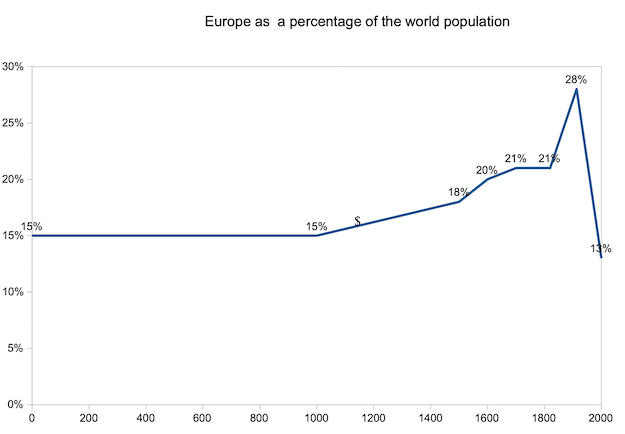
I made the above chart for a presentation I’m working on. You notice that in 1913 Europe is 28% of the world’s population. In 2000 it is 13% of the world’s population. In 2019 Europe is almost certainly closer to ~10% of the world’s population (the above estimates for Europe include Russia).

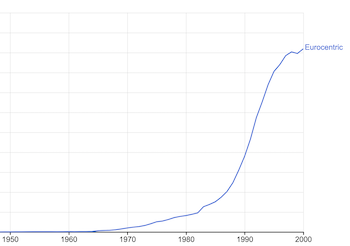
To the right, I’ve posted the screenshot of an Ngrams search of books with the term “Eurocentric.” Notice that that term shoots up just as European hegemony went into freefall.

Today there is a lot of talk about postcolonialism, “colonizers,” “white supremacy,” and whatnot. And yet what else is this but a shadow of ages gone by?

We as humans are always fighting the last war. European societies are geriatric. They are wealthy, healthy, and have great aesthetic qualities. Many people would love to live in Europe. But unless you are an acolyte of Madison Grant, who believes in the peculiar and unparalleled genius of European peoples, the numbers are telling a story you can’t avoid.

Brown Pundits Browncast episode 52: Sahil Handa, National Review intern and cosmopolitan conservative

Another BP Podcast is up. You can listen on LibsyniTunes, Spotify,  and Stitcher. Probably the easiest way to keep up the podcast since we don’t have a regular schedule is to subscribe at one of the links above.

You can also support the podcast as a patron. The primary benefit now is that you get the podcasts considerably earlier than everyone else. I am toying with the idea of doing a patron Youtube Livestream chat, if people are interested, in the next few weeks.

Would appreciate more positive reviews!

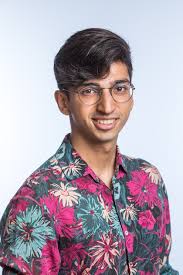
On this episode, we talk about cosmopolitan conservatism with Sahil Handa, a writer at National Review. Sahil is a student at Harvard. As such, I had assumed he was American before he got on the call…but it turns out he is from the suburbs north of London! His father is a Punjabi from Kenya, while his mother is a Sindhi from Gujarat.

Generations don’t exist, and neither do “immigrants”

Don’t mess with Razib

I have heard it stated by some scholars that generations don’t exist, but cohorts do. That is, our bracketing of ranges of people into particular generations is artificial and bins what is truly a more continuous variable into a few categories. The same criticism applies to the Myers-Briggs typology in personality (the main reason psychologists prefer the “Big Five”).

But the flip side of this issue is that to talk reasonably about some phenomenon you have to bin and categorize continuous variables. Human races may not have hard and fast boundaries, but human genetic variation is difficult to talk about unless you use some categorical shorthand.

Some of the same applies to the term immigrant and native-born. The reason I’m putting up this post is that there was a discussion online about whether there can be something called a “second generation immigrant.” That is, someone whose parents were born abroad, but they themselves were born in the country of their citizenship. Myself, I think the term immigrant should only apply to those who were born abroad. Native-born and immigrant are disjoint distributions.

But, there are more than a few categories here within the dichotomy. When you arrive in your life, and where you arrive, matters a great deal.

Continue reading Generations don’t exist, and neither do “immigrants”

No honor among brownz

Subway Got Too Big. Franchisees Paid a Price: Sabotaged meatballs. The wrong soap. Franchisees say supervisors manipulated inspections — then took their stores. A company ‘hit man’ says it’s true:

That was when Ms. Greco took over Subway, and the company’s store count began to shrink. In the East Bay, Mr. Tripathi was under the jurisdiction of a development agent named Chirayu Patel, known as Akki. He oversaw a huge, choice territory that included most of Northern California and western Nevada. Mr. Patel also owned dozens of Subway stores.

I was curious about this story because when I was in college Subway was my “fast food” of choice. But it was interesting to see that under the surface of a story about corporate malfeasance was another about South Asian (Indian) petty corruption. There are whole entrepreneurial subcultures in the USA which are highly South Asian, and conventional business reporters are probably missing some dynamics.

Here is another about Sikh truckers in California.

Brown Pundits Browncast episode 51: Scratching the surface on Sri Lanka

Lord Ravana

Another BP Podcast is up. You can listen on LibsyniTunes, Spotify,  and Stitcher. Probably the easiest way to keep up the podcast since we don’t have a regular schedule is to subscribe at one of the links above.

You can also support the podcast as a patron. The primary benefit now is that you get the podcasts considerably earlier than everyone else. I am toying with the idea of doing a patron Youtube Livestream chat, if people are interested, in the next few weeks.

Would appreciate more positive reviews!

Today I talk to my friend “Nan”, who is a Sri Lanka Tamil American. We talked a bit about his own background, growing up in a lower SES household in the American South, but mostly about why and how Sri Lankans think they are distinctive from “mainlanders.”

This is just the beginning of trying to understand this issue in my opinion. Ergo, “scratching the surface.”

A darker shade of brown

Sharon Muthu

On the individual level who you find attractive and what you find attractive is your own deal. I’m not one to go exhorting anyone to anything. To be frank I find “campaigns” to make x more attractive a bit cringe. It’s like the joke about having to explain to someone that actually you are very attractive!

That being said, it’s interesting to observe cultural patterns, differences, and trends. I do not, for example, perceive women with natural epicanthic folds to be less attractive in any deep sense. But the surgery to create folded over eyelids is a “coming of age” practice in much of Northeast Asia, especially South Korea because it is seen as more aesthetically pleasing. This is a new trend triggered by Western norms, as prior to the past century the more common Asian look with epicanthic folds was considered more beautiful.

This brings me to South Asians, and beliefs, attitudes, and opinions about skin color. Years ago I read that Indian (Tamil) American actress Sharon Muthu was lost a part where she would be playing an Indian character “because she didn’t look Indian.” The director, in this case, was a white American. He admitted she nailed the audition, but optically he didn’t think she’d be plausible as Indian to the audience.

This goes to show that the Bollywood aesthetic has come to define what “Indian” looks like even in the West! Muthu is on the darker side, but not anymore atypical than may lighter-skinned Bollywood celebs.

Sendhil Ramamurthy

I am very jaundiced about many aspects of South Asian (which means mostly Indian American really) American culture, but one thing that is striking in contrast to the culture of their parents is that there is little attention to skin color. In fact, there are multiple instances where I’ve heard people say that the parents thought someone they were dating was too dark.  This is probably a function of the fact that in an environment where all brown people of various shades are bracketed together, it’s a little ridiculous to make the sort of distinctions that are common in the Indian subcontinent.

Speaking as an outsider to brown culture (my wife is white, most of my close friends are not brown, my children are mixed, etc.) and community, so often when I see an Indian or Pakistani actor or actress they look like older versions of Zayn Malik, the half-Pakistani and half-English teen idol, or an Italian actress with a bigger nose. In general, I laugh, and a lot of American-born/raised brown people I know laugh too.

On the other hand, American South Asians are among the most privileged in the world. The people consuming Bollywood, and Tollywood and all the other woods, are the broad middle and lower classes of India, and their choices do shape what gets put on the screen.

When I was visiting Bangladesh in 2004 many of the posters of actresses I saw were notable for two things:

  • They were fairer than the average young Bangladeshi woman
  • They were plumper than the average young Bangladeshi woman

My prediction is as Indian audiences get more affluent, and self-confident in themselves, the actors and actressse will start looking more and more like better look versions of the average Indian, rather than cut-rate Jaggus and Jagginas.

Brown Pundits