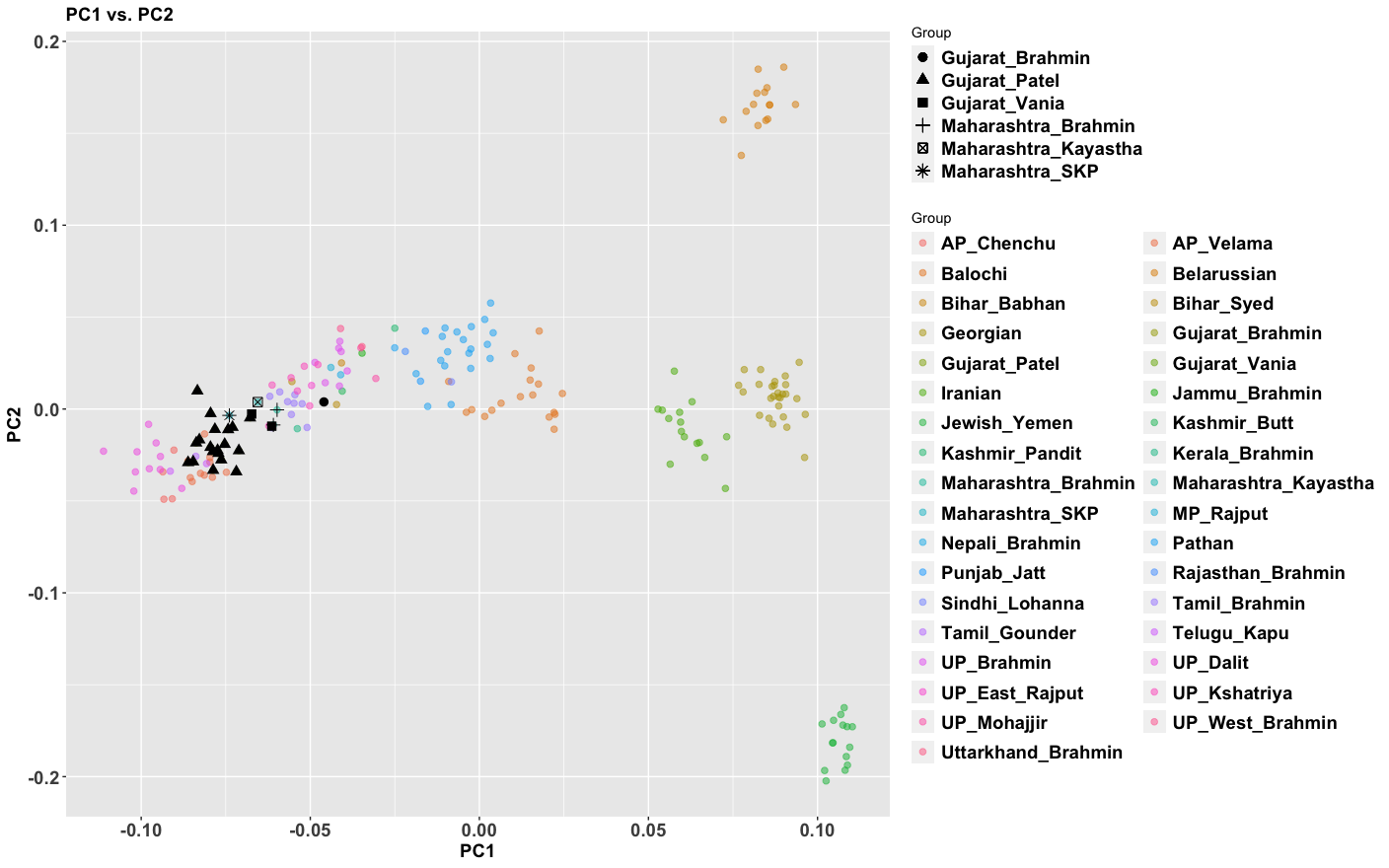
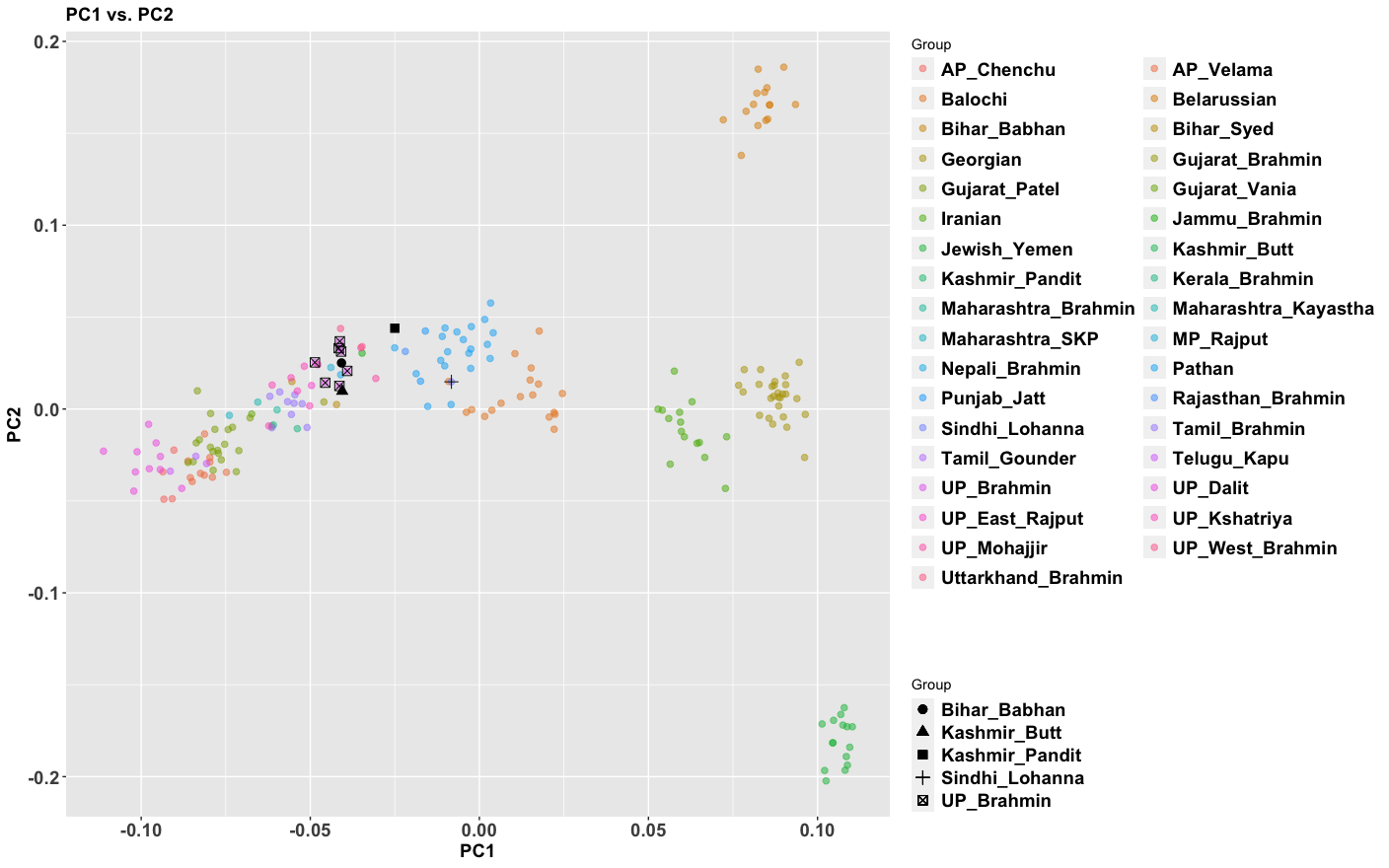
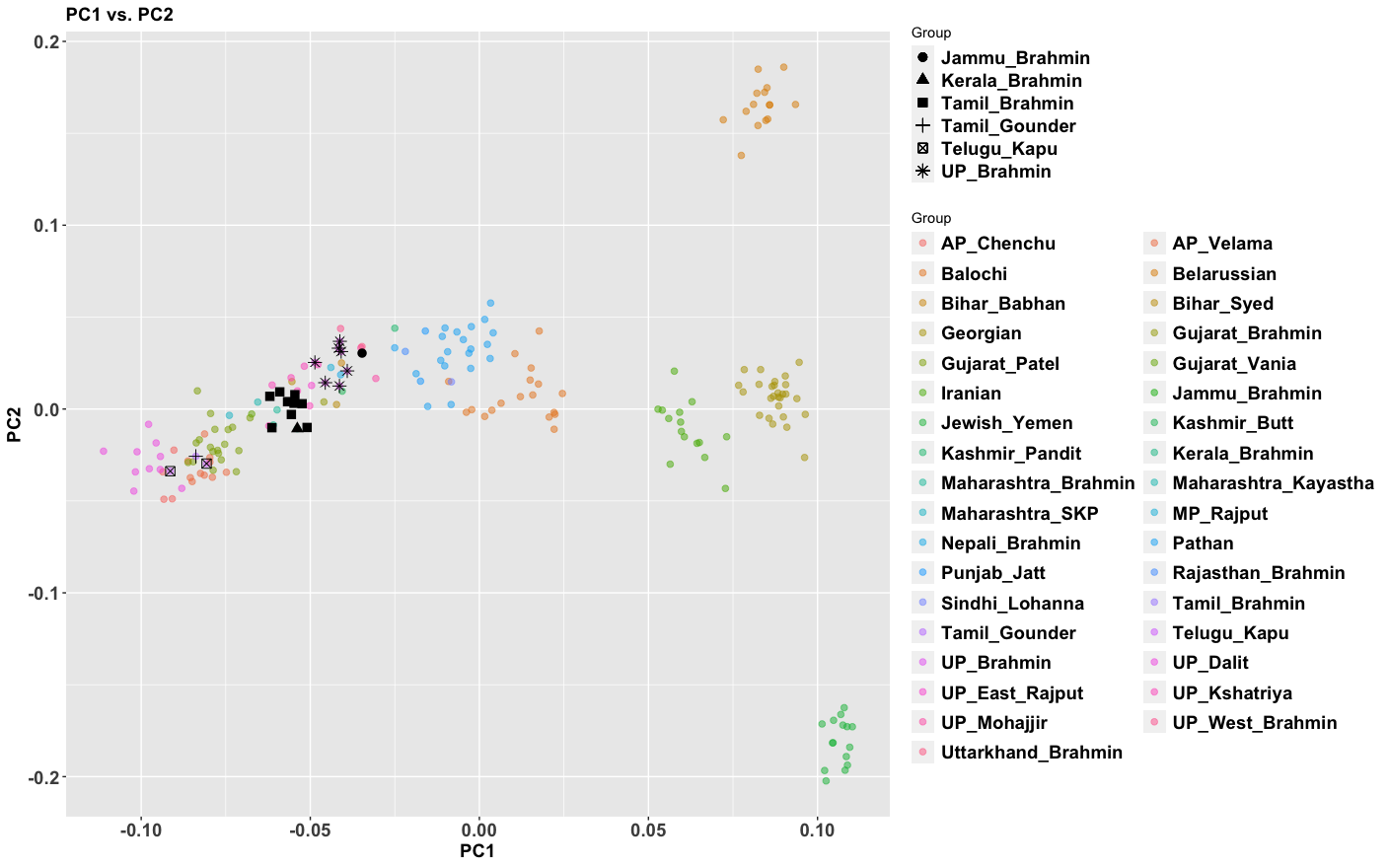
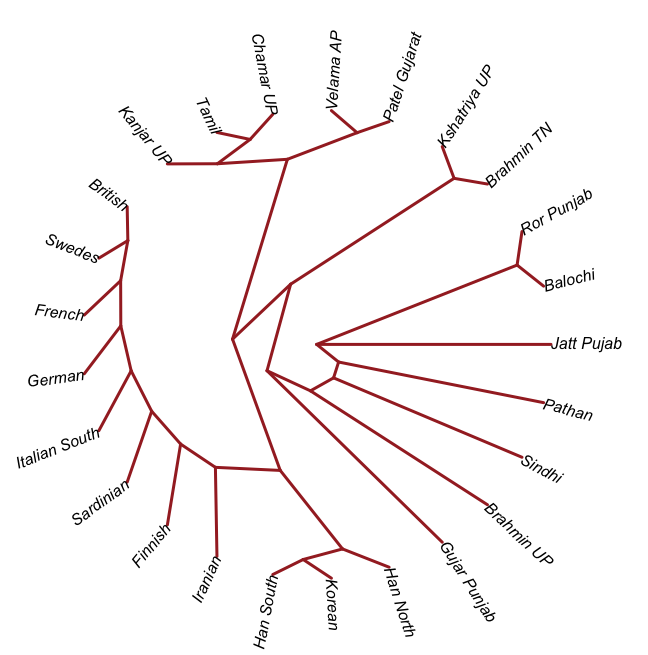
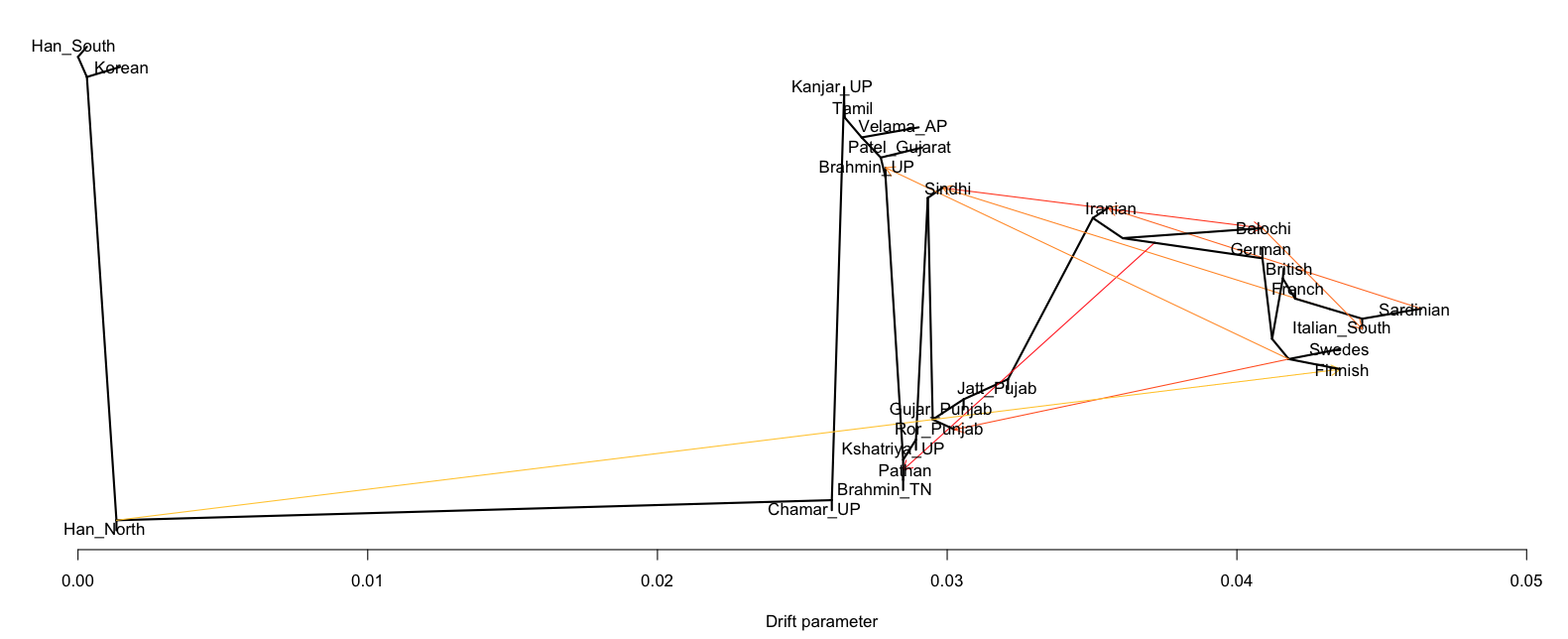
Sometimes people pass me data. Turns out Rajasthani Brahmins are quite different from UP Brahmins (more northwest-shifted). In this, they are like Pandits. In contrast, Bihar Babhans are just like UP Brahmins, who don’t seem to have much structure. Gujarati Brahmins are between South Indian Brahmins and North Indian Brahmins, and closer to the latter, while Maharashtra Brahmins seem more like South Indian Brahmins.
Category: Razib Khan
Adivasis are just like everyone else…sort of…but not
My previous post on Adivasis was not totally clear. So I’m going to try in shorter fragments and outline things so I’m more clear. I am not 100% correct with the model below (we’ll know more later), but this is my best current conception.
- 10,000 BC, end of the Ice Age, NW quadrant of the Indian subcontinent inhabited by a West Eurasian associated hunter-gatherers, related to the hunter-gatherers of the Zagros mountains in Iran, with some Siberian ancestry. The other three quadrants are dominated by hunter-gatherers with deep (40,000 years diverged) associations with East Eurasians and Australo-Melanesians. These “Ancient Ancestral South Indians” (AASI) seem to have separated from the Andaman Islanders (AI) more than 30-35,000 years ago, but the AI are their closest current relatives (AI-related populations were dominant in mainland Southeast Asia until 4,000 years ago, when rice farmers from southern China migrated into the region).
- Between 7,000 and 4,000 years ago extensive admixture occurred within the IVC zone in the NW between the IVC-Iranian-related population and AASI groups moving northwest. The resultant population was far more Iranian-related than AASI (say 10-20% AASI), and these people eventually became the “Indus Valley Civilization.
- To the south and east the AASI populations probably did experience reciprocal gene flow at the same time, as Iranian-related populations spread south and east
- Why this distinction? I believe during the late Pleistocene the Thar desert was larger and more forbidding and blocked gene flow between the easternmost West Eurasians and westernmost East Eurasians.
- Steppe ancestry likely does not show up until after 2000 BC.
- I believe there was a Dravidian language spoken in Sindh, and later Gujarat and Maharashtra. These populations spread southward before and after 2000 BC, and eventually, they mixed with all the AASI groups in the same.
- In the period between 2000 and 1 BC there is more and more mixing and the arrival of steppe populations that become culturally ascendant across the subcontinent. In the south, the Dravidian-speaking zone, there is a distinction between post-IVC populations that engage with the expanding Indo-Aryans and those that do not engage with the Indo-Aryans
The period between 2000 and 1 BC is essential. In some areas, like the NW, large numbers of steppe people settled, and imposed their language and culture, albeit in synthesis with the local populations, who would be mostly IVC. While the IVC seems to have expanded only gingerly into the upper Gangetic plain and Gujarat, the Indo-Aryans pushed into the eastern zones, and parts of the south. The fact that Adivasi in the south have the canonically Indo-Aryan R1a-Z93 indicates that young bands of Indo-Aryan men penetrated all across the subcontinent. Their genetic imprint is clear in non-Brahmin southern groups like the Reddys, so they were ubiquitous.
But it is culture that matters more. The synthesis that developed in Punjab and Upper Gangetic plain eventually spread across the whole subcontinent and explains why Sangam literature has Sanskrit loanwords. The distinction between Adivasi and caste Hindu emerges from the distance to the expanding proto-Hindu culture based on a core of Aryan culture with indigenous accretions. This was a diverse religious and cultural matrix, but there were broad family similarities, and again, the Sangam literature alludes to “brahmins,” indicating that there was an early penetration of Aryan ritualists in the south. The Adivasi emerges not as a relict or the remnant of an early population, but as a set of societies at one of the spectra of the Aryan-indigenous synthesis that characterized the subcontinent.
The Aryan can become an Adivasi, as is attested by the Aryan men who clearly integrated themselves into those communities and lost their cultural distinctiveness. Similarly, Adivasis can become caste Hindus by adopting the norms of caste Hindus.
Adivasis are not really more indigenous than most other Indians; they are marginalized

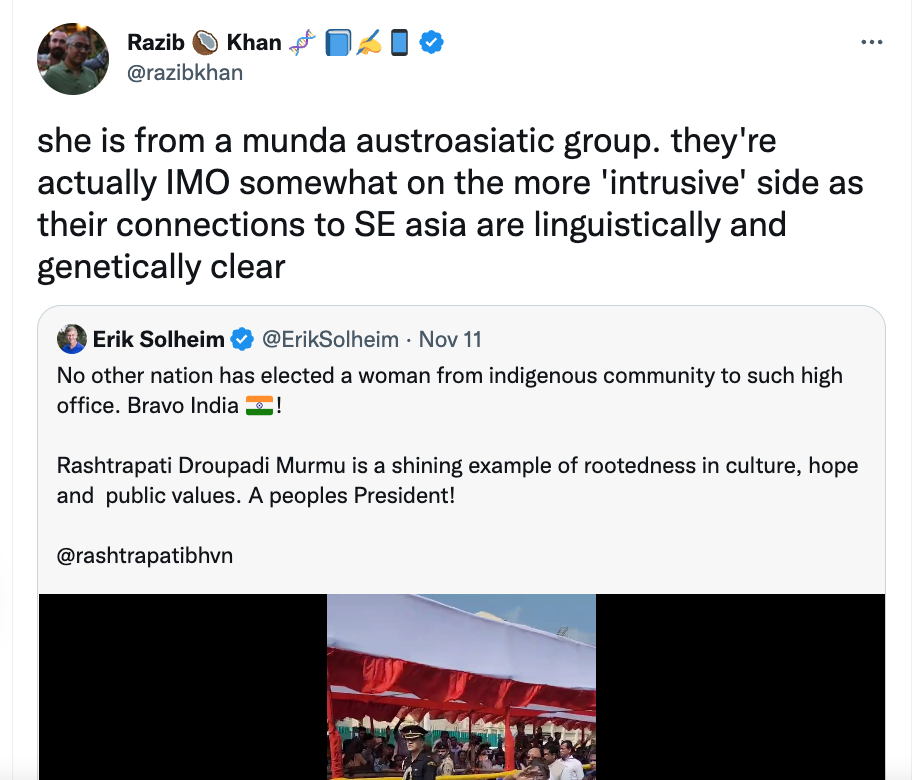
Periodically I get questions about whether the Adivasi are the “indigenous” people of the Indian subcontinent. The short answer is that they are not distinctive or more indigenous than most of their non-Adivasi neighbors. The President of India is from a Munda-speaking community, and these populations are arguably more culturally intrusive than Indo-Aryan or Dravidian-speaking populations.
More concretely, between about 4000 BC and 1 AD mixing occurred between many populations in the continent. Populations with West Eurasian affinities, with their closest relatives being the indigenous peoples of western Iran, expanded south and east from the Indus Valley zone. Meanwhile, populations with deep East Eurasian affinities, with the closest ties to the people of the Andaman Islands, seem to have pushed north and west. The Swat Valley transect shows increased steppe and “Ancient Ancestral South Indian” (AASI) ancestry over time, pointing to the integration of the subcontinent genetically and culture before 1 AD.
The highest proportion of the AASI ancestry in the mainland can be found among the Paniya and Paliyan tribes of the south, at about 75%. But even here 25% of the ancestry is attributable to the Indus Valley people. The Adivasi are not relict populations but emerge out of the same synthetic forces that resulted in groups like the Reddy or Patidar. Genetically they tend to have more AASI ancestry, but the same is true of many other groups.
Rather, the uniqueness of Adivasi seems to be their distance and marginalization from the Indo-Aryan-inflected societies that developed after 2000 BC. This includes the Dravidian-speaking cultures of the south, as even early Tamil had Sanskrit influences. In contrast, the Adivasi remained more insulated from these influences. The Munda in particular are distinct because not only do they speak a language that is more similar to Austro-Asiatic peoples of Southeast Asia, but their paternal lineage tends to be Southeast Asian. And, it is notable to me that Munda is almost entirely absent in Y chromosomal lineage R1a-Z93. I think this indicates that not only were they marginalized from broader Indic civilization, with distinct mythologies and folkways, but they marginalized and excluded outsiders as well from their solidities.
What is Islamophobia?

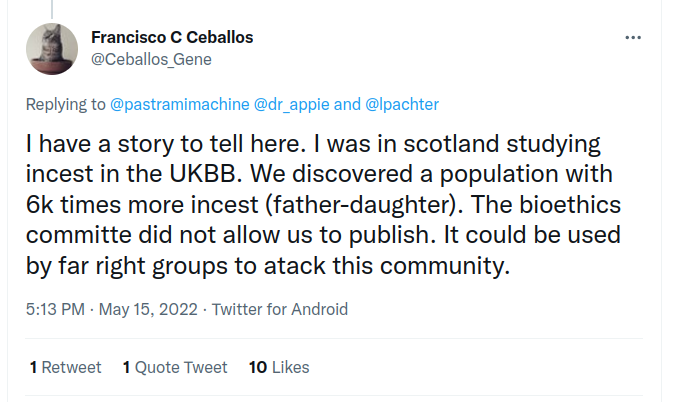
One of the problems with “traditional” familial and cultural systems is the level of depravity they can mask. This is not a “slam dunk” argument against them, but it is a real thing. The suppression of the evidence of clear sexual abuse in a certain community in the UK in the service of preventing negative stereotypes seems to be a case where the lives and misery of young girls in these communities are not accounted for in the same way as those from more mainstream subcultures. You can see exactly how Rotherham happened, though in that case, the girls targeted were explicit outgroups.
(this not even an explicitly communal point, as Hindu women have routinely complained about the “perverted uncle” problem in joint-families)
Bangladesh and West Bengal genetics
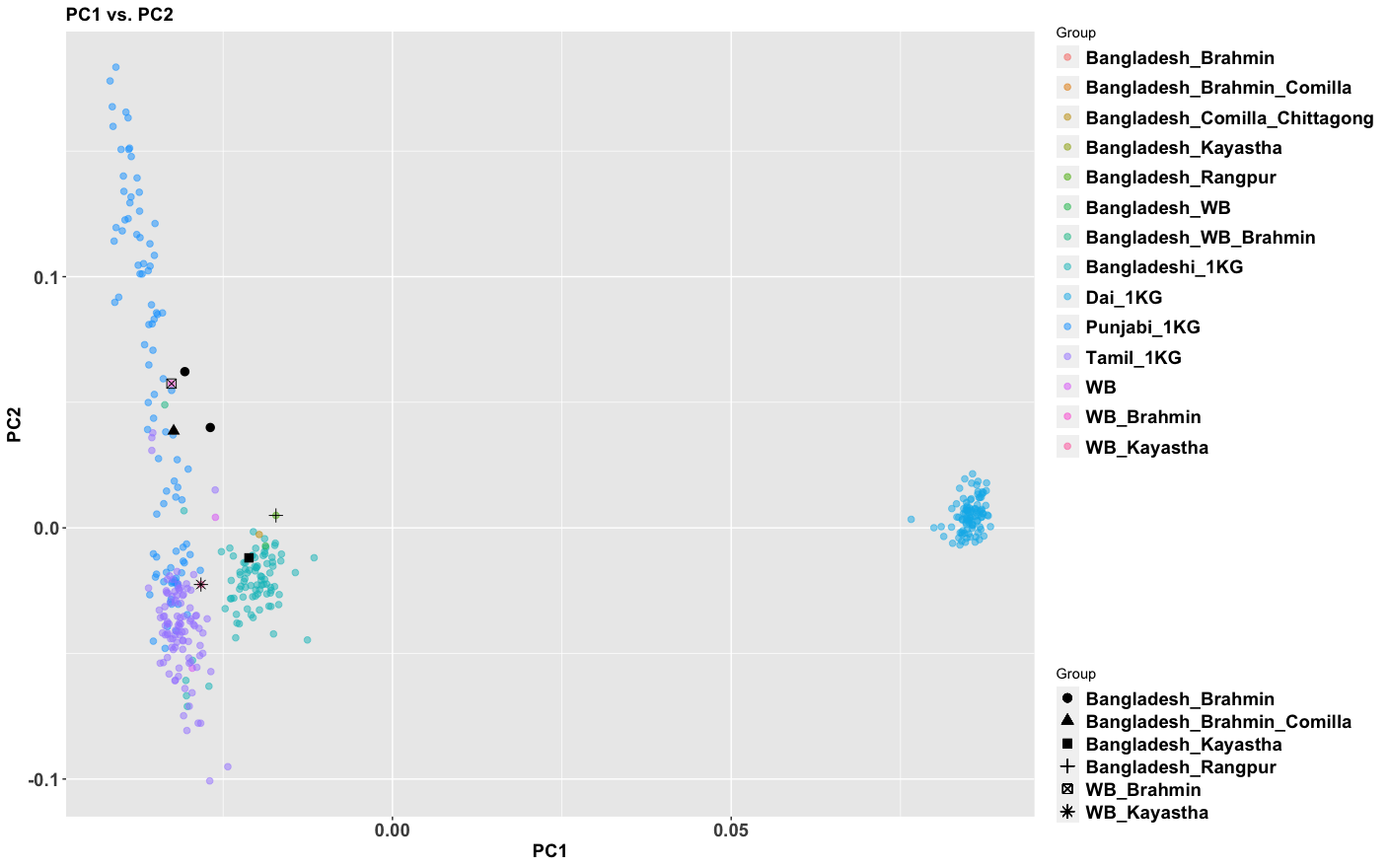
I got a few more samples with provenance. The Bengali Brahmins are shifte the way you would expect. The Bangladesh Kayastha (someone from a Hindu background) is in the cluster with generic Bangladeshis from Dhaka. The West Bengali Kayastha is far less East Asian. My current model right now is that the Kayasthas are basically peasants that engaged in uplift, as in general they don’t seem so genetically distinct from other Bengalis, in contrast with Brahmmins. Though Bengali Brahmins do exhibit admixture with Bengalis with East Asian ancestry, they are very different overall.
Usha Vance “hit piece”

The New York Times has a quasi-hit piece out on Usha Vance, From Yale to Newsmax, Usha Vance Has Helped J.D. Vance Chart His Path – The Ohio Senate candidate’s wife, an accomplished lawyer, remains ensconced in the milieu he now rails against. I say quasi because there’s nothing bad they could really find except that she’s helped her husband along on his political career, and seems to have tacitly shifted her own views.
This part about untouchability was pretty amusing:
That world has, in turn, started to reject Mr. Vance. Ahead of the September 2021 wedding of Sophia Chua-Rubenfeld — a daughter of Ms. Chua — multiple guests requested not to be seated next to the Vances, according to two people who attended the wedding. (The couple did not attend, in the end, because their children had the flu and Ms. Vance was soon to deliver their third child, according to two people close to the Vance family.)
I guess they were worried about losing caste!
Being anti-Brown is anti-Hindu
In one section of the Washington Post piece Cal State banned caste discrimination. Two Hindu professors sued an activist professor states:
Sundaram, who supports making caste a protected characteristic, said critiquing Hinduism — even in a country where Hindus are a minority — is not akin to promoting Hinduphobia. She said most discrimination against Hindus is based on the fact that many are South Asian, rather than on their religion, and that Hinduphobia is not a widespread problem.
There are two issues I have with this assertion.
As a person of non-Hindu background and upbringing, I can tell you that prejudice against the Hindu religion is tightly coupled with “anti-South Asian” bigotry. The number of times people made fun of me for “worshipping cows” or “elephants” and “monkeys” was frequent. I actually learned about Ganesh and Hanuman due to this mockery as I had to look up what people were making fun of.
If someone screams “go back to Mecca” at a bunch of Hindu Indian Americans is that not Islamophobia because they’re not Muslim and they are being targeted for being vaguely brown? Similarly, non-Hindu brown people are bracketed into the same category and subject to discrimination because of widespread prejudices against Hinduism. In fact, despite my clear Bengali non-ashraf appearance online Indian Leftists now call me an “upper caste Muslim” to insult me. Bangladesh, unlike Pakistan, does not have caste-like stratification (look at my genetics, my ancestors were clearly from many castes), so that’s wrong, and I’m not a Muslim by belief or frankly even much upbringing (I’ve always been an atheist or agnostic and was not raised in a Musim community). But even these secular online Indian Leftists deploy tropes and insults that draw on our South Asian ancestral culture, which is broadly Hindu, even if not always orthodox Brahmanically sanctioned Hinduism.
Second, it’s pretty apparent there is an anti-Hindu streak in American society simply because of its Christian (and Abrahamic) cultural basis. Sometimes it is hateful, sometimes it is mean. Many conservative Christians, including some Hindu converts to Christianity, believe that Hindu gods do exist, but that they’re devils and demons. I once asked a friend who is from a Hindu background but converted to Christianity in college if he believed his ancestors worshipped the devil, and he pretty much admitted he believed this to be the case. Some of the same apply to Islam, but most Christians outside of the fundamentalist fringe generally concede that Allah (Arab Christians use this word for God) is the same God that they worship.
This Hinduphobia is broad, but shallow. It doesn’t effect most peoples’ lives deeply, but that doesn’t mean it doesn’t exist. Many, though not all, Indian American Hindus are clearly embarrassed by their religion because of the mockery. This is obvious when I hear young Indian Americans emphasize that “actually our religion is monotheistic just like yours.” This is the Hindu version of Muslims saying “actually Jesus is a prophet.” Both of these assertions might be true, but the impulse behind them is to mitigate marginalization and pull themselves back to the center and normalcy.
Note: I dislike terms like “Hindophobia” and “Islamophobia,” and the stance of becoming a victim to win an argument. But this is how the game is played in America now.
Caste and California: the lawsuits are in!
Cal State banned caste discrimination. Two Hindu professors sued:
Two Hindu professors are suing the head of their university system to oppose the addition of caste to an anti-discrimination policy amid a broader battle over whether colleges should explicitly call out caste-based bias.
The California State University System professors argue that naming caste as a protected characteristic unfairly targets Hindus and wrongly suggests that oppression and discrimination are among Hinduism’s core tenets. Sunil Kumar and Praveen Sinha contend in the complaint, filed Monday, that Hinduism is about compassion and equanimity — principles directly opposed to a discriminatory caste system.
Here are some things I believe
– This law is impractical and wrongheaded. There are very few Dalits in the US, so there is by definition very little discrimination against Dalits (even if you grant that individual Dalits experience pervasive discrimination, which I honestly do not grant). Additionally, most Americans cannot tell different types of brown people apart, so its impact is not religious-cultural but racial.
– Hinduism has a strong connection with the caste system because Hinduism, as it exists today, developed out of the indigenous religious systems of the Indian subcontinent, and those religious systems are inextricably connected to Indian culture, which is riven with caste.
– Caste consciousness also seems pretty pervasive among many Christians and Muslims in the subcontinent.
– If you view religion as a bundle of characteristics that change over time, there’s nothing fundamental to Hinduism, or any other religion. This is my personal belief. For most of its history, Islam and slavery were closely connected because slavery is addressed in the sharia. That ended in the 20th century for historically contingent reasons. Though some level of varna awareness seems to exist in Bali and among the Chams of Vietnam, the elaborate jati system does not. Probably because here Hinduism is unmoored from its Indian matrix.
Some interesting quotes…
But Sundaram said many younger Hindus have formed alliances with other affinity groups, such as Black Lives Matter, and are more inclined to call out caste discrimination.
Young American Hindus are the least likely to care, or even know, much about caste. But they are the ones worried about it and engaging in activism. This is performative because they are progressives searching for a problem that is fading and diminishing before their eyes.
Most importantly, she said, she disagrees with the Hindu American Foundation’s argument that caste is not foundational to Hinduism.
“You absolutely can acknowledge this as part of the tradition and fight back against it, but to argue that it doesn’t exist in the tradition, it’s just false,” Sundaram said. “There’s just no way to really make that case.”
Foundational and traditional are distinct. Is the reporter engaging in manipulation, or did the activist professor consciously misunderstand?

Rishi and the past
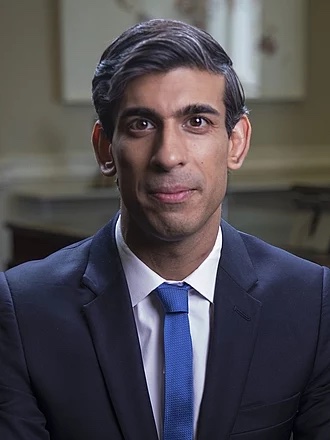
Rishi Sunak will lead the nation just below India in the world GDP nations. Racial or cultural triumphalism is gauche, so nice to see that that’s low-key so far. But I personally hope that this will be an opportunity for Indian elites to fixate less on the British past and engage more forthrightly with their Asian future.
The Conservative party looks to be in serious trouble, and Britain looks to be in for a rough few years. Good luck to him, he’ll need a lot of it.
Genetic distances across the world
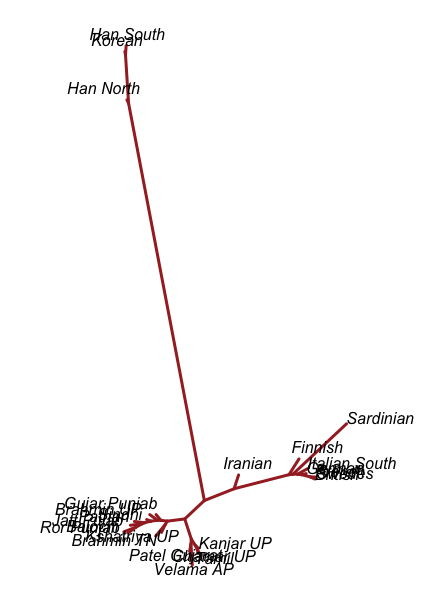
There was some discussion online about variation among South Asians. I decided to compute a few pairwise Fst statistics (measures between population variation) with some South Asian, European and East Asian populations (along with Iranians). I plot them below in two graphs. Also I ran Treemix.
I don’t have any major conclusion, just draw your own conclusion.
Here is a Google sheets with Fst values in a matrix.