Suno Punjab

We’ve been watching the excellent Suno Chanda. It’s the story of a respectable Muhajir industrialist family in Karachi but features some ethnic characters as well (a Punjabi mother in law and a Pathan Uncle).

Even though I spent formative years in Islamabad the only ethnic language I was exposed to was Pushto, which was the domain of the labourers, house help and security guards. Punjabi was simply non-existent and Urdu & English were the dominant languages. So I haven’t heard much Punjabi and to be honest growing up all the Punjabi neighbours were the “Pakistanis” while the Sindhis, Pathans were the exotics.

So for the first time I’ve really been listening to the Punjabi language in sustained doses.

Udaari and Dastaan also had Punjabi speakers but in Dastan the Muslim Punjabis spoke chaste Urdu while it was the Sikh kidnappers who lapsed into comical Punjabi.

What is rather shocking to me is how Punjabi sounds like a rustic version of Hindustani. A sort of Braj Brasha for the East?

The diminishing writ of Punjabi?

What makes Sindhi a teachable language but Punjabi a foul one?

Little did the opposing party know that this could be expected of any language spoken in Pakistan but Punjabi, for it is considered by our beau monde to be an illiterate version of Urdu owing to the likeness of the two languages. Speaking Punjabi in public is frowned upon and is not used by our nonpareil A-list to even communicate with servants. The current status of this 14-centuries-old language can be gauged by the simple inclination of Asif Ali Zardari to deliver at least some part of his speeches in Sindhi, but the smirks and guffaws that erupt in assemblages of the Pakistan Tehreek-e-Insaf when Imran Khan utters a single phrase in Punjabi.

Something has happened in the history of Punjabi whereby Hindustani speakers pushed Westward into the Lahore region (Amritsar is essentially a Lahori suburb). As an aside in the “Sacred Geography” of India; are there any Hindu holy sites in present-day Pakistan?


What is interesting is that all the “Lahnda” (Western) dialects of of Punjabi are in Pakistan and all the Eastern dialect (except for the prestigious and no doubt Hindustani influence Majhi) are in India. Continue reading Suno Punjab

Quick Thoughts-

  • Vajpayee has passed away and my thoughts on him is that he is the “loveable loser.” A bit like Advani & Rahul Gandhi; these philosophical Brahmins are really no match for the Modi phenomenon. Vajpayee is a remnant of a simpler gentler India; Modi is Hindustan’s future. As we much as we are mourning a Nehruvian relic. Modi’s India is rapidly wisening up to her world role.
  • As an aside I’m just increasingly shocked by how breathtaking the pace of change in India is. In the Pakistani higher circles there was always this assumption that the liberal elite of Pakistan (the 1,000 families) were the most Westernised (but Urduphile) segment of South Asia. That is rapidly beginning to change and huge swathes of the Indian upper classes are becoming “tanned white people.” Their accents, family structures, cultures are just Westernising and a good example is the Priyanka Chopra-Nick Jonas engagement. They probably represent this segment while Virat Kohli and Anushka Sharma are the more desi side (the Khan-Kapoor family are somewhere in the middle, Kareena has just gone off on another jaunt with her besties).
  • I’m just a Damad to Indian culture but I hope India doesn’t lose her soul in this rapid transformation (she has the highest growth rate in the world at 7.2% edging out Bangladesh at 7%).
  • I am very passionate about Imran’s Khan need to redistrict Pakistan. We need a Pakistan of the Provinces. We have strong ethno-linguistic regions like the Punjab, Pashtunistan but we also have very strong provincial identities (Karachi must be set free from Sindh to become another Dubai) and Bahawalpur-Multan (one of the great tragedies of Independence is what happened to the Principalities of the Sub-continent and their ignominious fate by Indo-Pak).
  • Sharing some trailers:

Nawazuddin Siddiqui is one of India’s best actors (it’s usually the case in Bollywood where the traditional Bollywood looks & acting ability are inversely correlated; Radhika Apte, Kangana Ranaut, Irfan Khan – Tabbu is probably an exception) and is such a strong reason as to why Sacred Games was the blockbuster as it was.

I have a mixed feelings on Shahid Kapoor as an actor but I guess this movie will be alot like Akshay Kumar’s film, Toilet. Bollywood’s increasingly important tradition of social film-making (Padman, Aamir Khan’s films) is welcome. I guess it’s also a way for aging actors to regain moral legitimacy and cultural relevance..

I’m a fan of Varun Dhawan, he seems to have completely eclipsed Sid Malhotra. However I see his acting style to be somewhat typecast as the spoilt Punjabi kid with comic overtones; he belongs in a joint family. Again I welcome any film that has a made in India message.

Finally if there are any Indian readers who are looking for good Pakistan dramas, I would recommend Suno  Chanda. It’s a light-hearted fare about the Pakistani family and the attendant complications. Much as India is transforming; Pakistan takes pains to preserve the idealised Hindu-Arab cultural mix that is our wonderful Mughal-Muslim Republic.

The idea of foreigness in the Indian Muslim narrative

Happy Independence Day to India. Jai Hind and I will share Vidhi’s important tweet-thought on it:

Otherwise I was reading this article How the Tricolour and Lion Emblem Really Came to Be and then looked at another article, Growing Up in a Muslim Family That Didn’t Fit Any Stereotypes,  by the same author, Laila Tyabji. She’s a proper Nehruvian (like Maulana Azad) but this passage struck me:

The khandaan she came from comprised the huge, extended clan of Futehallys, Hydaris, Alis, Latifs, Fyzees and Tyabjis – convolutedly inter-related in the best multiple Muslim tradition, all part of the same vast Suleimani Bohra tribe from North Yemen. Liberal, emancipated, proudly Indian – rather unconventional, given the times. Even in the late 19th century, all the women were educated and at least bilingual. Love marriages were the norm, often to similarly brought up cousins. Despite the khandaan’s standing and wealth, they were not in demand as daughters-in-laws. Perhaps, because their outlook and upbringing were so different from more conventional Muslim families.

Though different branches of the family prided themselves on their distinctive characteristics, (the hawk-nosed Alis versus the pakoda-nosed Tyabji’s) they agreed utterly on the really important issues. Opting for secular, multi-cultural India, for instance, rather than the monotheistic claustrophobia of Pakistan. My mother’s branch of the family included ‘bird man’ Salim Ali and the Hamid Alis – he, one of the early Indian civil servants, she, (Sharifa), a redoubtable social worker; both central figures in UP cultural and intellectual circles.

The author is distantly related to actress Aditi Rao Hydari. The status of Indian Muslims is fantastic since they simultaneously occupy the under class and upper class; I can’t think of a similar social-religious class anywhere else in the world.

People often compared my mother’s fine-boned delicate looks to a Mughal miniature. But she was also brave, resolute and principled. Married to a charismatic forceful personality 11 years her senior, she held her own and became his moral compass, the moving centre of our home. When my parents’ house was attacked and ransacked during the Partition, she sent us children away, but herself refused to leave my father, going off every day to work in the refugee camps at Red Fort.

Our ancestors had arrived in India three centuries ago, landing in Cambay from Yemen in search of religious freedom. The women never wore burkhas, though they covered their heads with lace or embroidery edged chiffon.

My great-grandfather Badruddin Tyabji the first, who later became the first Indian chief justice of the Bombay high court and third president of the Indian National Conference, and his brothers, sent all their children to either the UK or Europe to study, including their daughters. There are lovely pictures of them in hats, voluminous Edwardian skirts and leg of mutton sleeves in London, not a burkha or hijab in sight! Returning to India, they readily gave up their elaborate ornamented satin lehenga ordnis for khadi sarees at Gandhi’s call, joining the freedom movement, taking up social and political activism.

Also I have noticed that most “pro-Indian” Muslims have always been the ones that were most sure of their foreignness. It’s a bit like Parsi Privilege the Parsis will crow about being Indian because in a very fundamental way they are not Indian. In the same way it’s always been the convert classes that are the most keen on Muslim identifiers to mark them off from their origins.

I can imagine in an alternative reality if the Indian Muslim population was merely made up of the “foreign class”, which would have been a few million at best, they would have been as treasured and fawned up as the Parsis.

Finally:

As I was leaving for the colloquium on Muslim women, my goddaughter Urvashi asked where I was going. When I told her, she said, “Why do we have to give people labels and divide them up into communities? I think it’s so unnecessary.” She has a point. Hopefully, as typecasting stops, the relevance of labeling us by communities too will become a thing of the past.

Urvashi sounds like a Hindu name and this idea of why can’t we simply be one community sounds like majoritarianism. It’s a bit like the civil code; drowning the minorities into the national framework. I have no real thoughts but simply notice the patterns.. Laila Tyabji sounds like an interesting chick and reminds me of that upper-class girl who chooses the unorthodox route but gains respectability with age.

The unsex appeal of Asian Men..

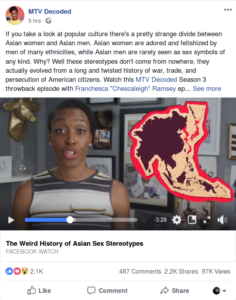
https://www.facebook.com/MTVDecoded/videos/219325512085012/

I was going to write on Pakistan at 71 but sex is always an interesting topic. This part struck me as I was listening to the video:

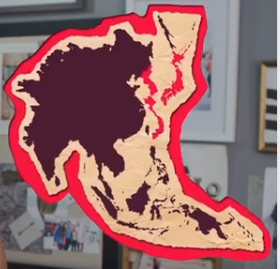
More specifically the Map of Asia used:

The video basically blames white people/power for over-fetishising Asian women and de-masculinising Asian men. Franchesca makes a good point about “sexual prejudice” towards the end of the video.

At 1:15 she goes to the shirtless Asian chap and tells him that she finds him hot However what she doesn’t include is that the chances are that he won’t find her attractive simply because of her race.

So alot of Asian male dissatisfaction is really about gaining purchase in the “white” dating market rather than the wider market.. I do believe the trials & tribulations of Black Women though are more serious since they suffer on a broader scale.

Nipple & Button – the decline & fall of the American Empire

Ahead of a meeting with India’s prime minister, Trump mispronounced Nepal as “nipple” and laughingly referred to Bhutan as “button”, sources told Politico. He reportedly didn’t realise what Nepal and Bhutan were. One person familiar with the meeting said: 

He didn’t know what those were. He thought it was all part of India. He was like, ‘What is this stuff in between and these other countries

Trump ‘needs reminders about how time zones work’, according to White House aides

President Trump is single-handedly hastening the end of a unipolar world. The deft Obama-era diplomacy where the former President reached out to recalcitrant nations (Iran, Cuba) is swiftly coming to an end.

The world is shaping along the lines of a Hindutva-Zionist wet dream. The Anglospheric nations (Britain firmly at the centre because of Brexit) along with India & Israel. What prompts this vision of a Eurasian entity is the sudden collapse of Turkey by a single Trump Tweet.

This isn’t to say that Turkey didn’t have pre-existing political and economic issues but when the US is trying to twist the knife; well nations have very long memories. The US has antagonistic relationships with Iran, Russia and China; to add Pakistan and Turkey to the mix is to essentially recreate the Ghost of the Gunpowder Empires.

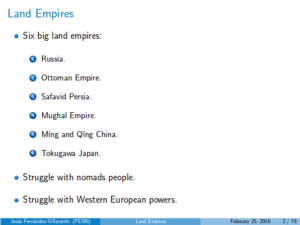
I was looking for Macaulay’s essay on Land Empires and came across this:

Of these 6 Empires; 5 will be firmly in an anti-Western anti-American camp. The other Great Powers are the EU, India, Israel (an important minor power) and Japan (and the Koreas).

Happy 71st birthday to the Mughal-Muslim Republic that is Pakistan. I would consider it to be the inheritor of the Land Empire of the Mughals whereas I see the modern Indian Republic to be more of an Indian Ocean Entity connected to the rest of the Anglosphere and more attuned to the time of the Mauryas. The level of animosity towards the Mughals in modern day India is reaching such histrionic levels that histories as well as geographies must now be partitioned.

Pakistan’s geopolitical importance can never be overstated and it will be interesting how India will be managing an intense relationship with Iran/Russia and a growing friendship with the US. For the US to lose Turkey is simply a strategic blunder because the latter is probably the most important Islamic country and the Turks are a generation ahead of the rest of the Muslim world. If in the medieval era the three great Islamic Imperiums (the Ottomans, Safavids & Mughals) had formed a stable alliance there probably would have been able to beat back any outsider power..

Let us see now how King Khan will navigate an increasingly interesting yet turbulent world.

Has Manish Malhotra jumped the shark?

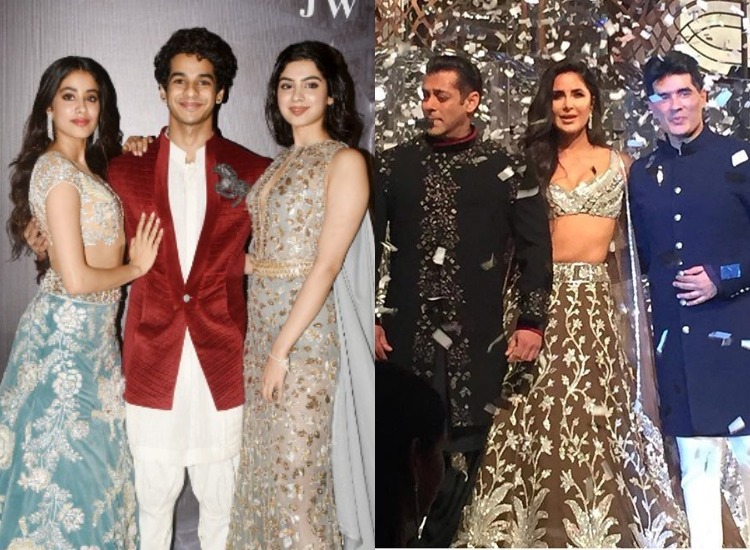
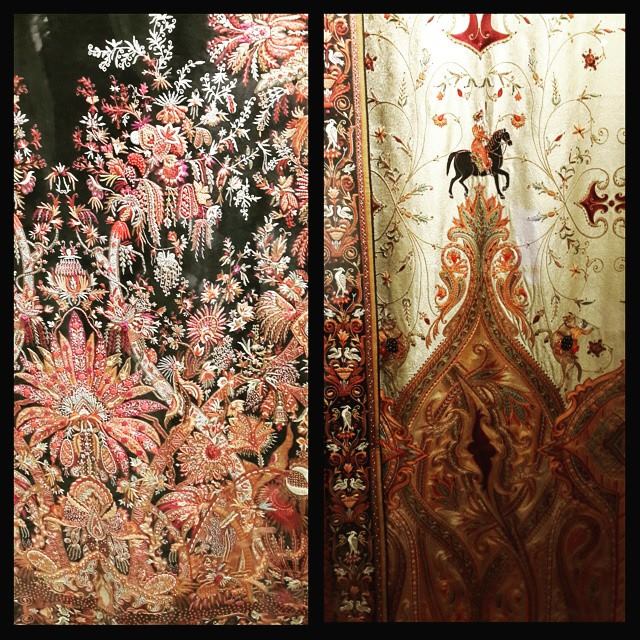
Manish Malhotra has come out with a new “Indo-Persian” collection called “Zween.” I had never heard of the word before but apparently it’s Arabic and means beautiful.

Image result for zween arabic

Image result for zween arabic

I thought I would share some pictures from an actual “Indo-Persian” culture since I can’t find Iran in the above pictures; just Bollywood wearing a few floral motifs..

Image result for bunto kazmiImage result for aarij hashmi

Image result for bunto kazmi

Manish should have simply titled his exhibition; “back to Pakistan” or something such rather than unnecessarily exotify it with “Zween” and Indo-Persian. Like any good Delhite Punjabi he feels the tug of that hypnotic rich Mughlai high culture that has miraculously endured in Karachi..

However unfortunately Pakistan has failed as a country  and is rightfully perceived as a basket-case. On the hand the rise and rise of India continues..

https://www.facebook.com/India.usembassy/videos/1844235619025792/


Short Thoughts –

White people are not gods, they bleed: Razib makes important points about class and race.

In contrast, even South Asians who grow up poor in the United States, usually have an ancestral class background which is somewhat elite. While black Americans and South Asians may share common physical features as dark-skinned people of color, most black Americans descend from slaves, while most South Asian Americans are more likely to either be the scions of a genuinely elite family or a prosperous lineage from a rural backwater. If you buy Greg Clark’s argument in The Son Also Rises: Surnames and the History of Social Mobility, then you know that he makes the case that social status is highly heritable when you look across many generations, as opposed to focusing on single generation correlations.

The Universal Law that differentiates an Immigrant from an Expat. An Immigrant goes one social class lower when moving to a new country and an Expat goes one social class higher upon moving to a new country.

So an office worker in the US will be an office manager in Uganda. An office manager from South Asia won’t hold the same position upon emigrating to the US because the cultural adjustment will have to take place (unless it’s Facebook or Googles which is essentially Indian).

At BP our world is very narrowed back to the Desh but Diaspora issues are extraordinarily important. Race intersects with class and the non-Muslim Asian minority is rapidly ascending the ranks. Even among the Muslims one can distinguish certain sub-ethnicites (Mirpuri, Sylethi) as being the more backward variants.

As a final thought privilege can have a deadening effect on the soul. When I contrast myself to my white friends of a similar background; I notice the speed, grit and alacrity which I have is a gift of my immigrant background. The 9-5 paradigm and pub after work paradigm simply does not apply to my life and that’s a big asset. I’m constantly “on” all the time as opposed to alot of my white friends who seem addicted to leisure..

Mind you I don’t know if it’s a good thing that I don’t have an off button.

Other Links: Continue reading Short Thoughts –

Sons of Pakistani Bus Drivers

How ‘ministerial flop’ became favourite to succeed Theresa May as PM

It’s an interesting article about Sajid Javed and the fact that he is the favorite to succeed TM as PM.

Of course I’m dismissing the hype but the battle between the sons of the Pakistani Bus Drivers is going to be an interesting feature in British Politics. Even though my politics are quite Tory I’m quite sympathetic to Sadiq Khan as I find him more “authentic” than Sajid Javid.

I am of course at risk of hypocrisy because I’m suspect of assimilation while I welcome integration.

As an aside both Sadiq Khan and Sajid Javed were favourites of the Chancellors, Brown and Osborne. Sajid Javed was arm-twisted by David Cameron and George Osborne into supporting the Remain while he was a Eurosceptic but they guilted him into the fact that he owed his political career to them. Mind you Sajid Javed’s last paycheck in the private sector was apparently £3mn and he is self-made (unlike most Tory Politicians) so he’s probably talented than most but there is this earnestness to fit in that is very typical of coloured Tories (to be whiter than white).

They deeply relied on the patronage of wily white men to get through the party and the dramatic ethnic shifts we are seeing in the West must seem like something out of the Roman Empire.

I do remember that there were an astonishing high number of Pakistanis who were interested in politics (both parties). It does make sense Pakistani culture is very extroverted, loves to network and we are usually able to do it without drinking (heavily). Not drinking in a culture drenched in alcohol has distinct advantages..

Lawyer Asama Javed is ‘fixer for forced marriage’

Lawyer Asama Javed is ‘fixer for forced marriage’

The video in the link is 5 minutes long and worth seeing. This is pretty shocking since the lawyer, Asma Javed, is (and I’m excerpting):

On the surface Asma Javed 44, appears to be an upstanding member of her community, a political career with the Labour Party, now a partner in a law firm, a governor at a local primary school and on the fostering panel at Bradford Council. Yet her ‘marital advice’ exposes a complete disregard for basic human rights and utter contempt for British values.

What struck me is that Ms. Javed is obviously British born & bred since she easily slips into the Bradistani patois. But her Punjabi/Mirpuri is at native levels; this wasn’t supposed to happen after so many generations in the UK.

Since I’m a BritPak I’m quite the integrationist but in this case something’s got to give.  My thoughts on integration versus assimilation are mainly concerned with High Culture; even though I can understand Shakespeare and actually like it, I’ll ultimately still identify with Ferdowsi & Ghalib (probably the two poster boys for Turanistan)

The Augean Stables that is the British Muslim community needs to be cleansed. This is not a “Pakistani” issue but a Muslim one as we can see in this bit of news as well. Teenager jailed for life over British Museum bomb plot. When did Muslim culture in Europe become so degenerate?


Brown Pundits