Why do Muslims React More to France Than to China?

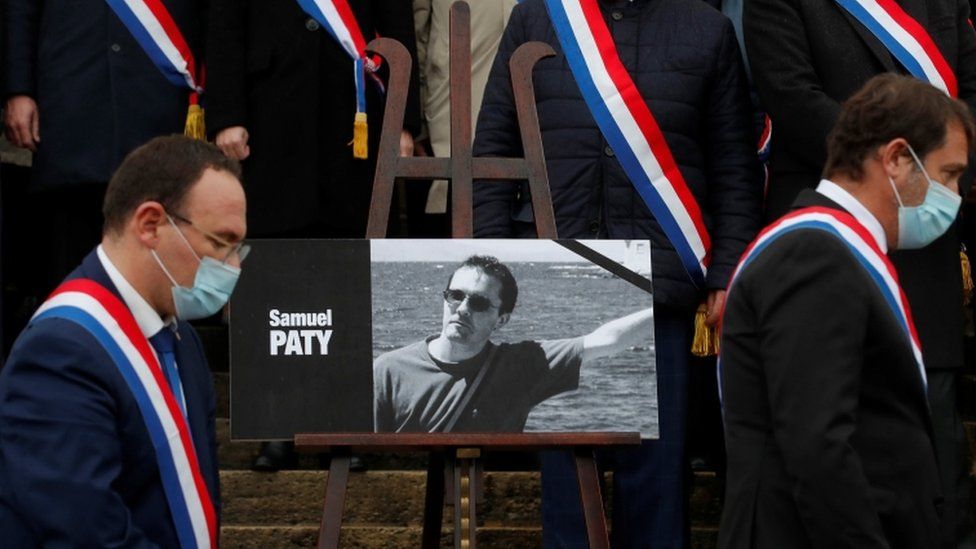
The last few days have seen two separate terrorist incidents in France, both involving Muslim youth (both refugees, not French-born Muslims) beheading (or trying to behead) French civilians because of perceived outrage over blasphemy. In the first shocking incident a teacher named Samuel Paty tried to do what good teachers do; he was teaching about freedom of expression and wanted to show the cartoons that led to the murderous assaults on the satirical magazine Charlie Hebdo. He told his Muslim students that if they felt uncomfortable seeing those cartoons, they could step outside the class. There is no indication that he himself said anything that could be construed as an attack on the prophet. But the very fact that he showed the famous cartoons in his class was enough to rile up at least one of the Muslim student’s parents, who started to outrage on social media, which led a Chechen youth named Abdullah to travel a 100 km, find the teacher by paying his students to point him out and then beheaded him on a public road before being shot dead himself.

France teacher attack: Seven charged over Samuel Paty's killing - BBC News

If this was not bad enough, today another “refugee” (this one from Tunisia) went on a stabbing/beheading spree at the basilica of Notre Dame in Nice and killed 2 women and a 55 year old sexton. Another person, this time in Saudi Arabia, stabbed a guard at the French consulate before being arrested. At the same time there have been massive protests in Bangladesh, a mock beheading at a girl’s school in Pakistan, official protests from Pakistan and Turkey and boycotts of French products all across the Muslim world. Continue reading Why do Muslims React More to France Than to China?

Book Review: Friendly Fire by Ami Ayalon

From Dr Hamid Hussain

Book Review – Friendly Fire by Ami Ayalon

Hamid Hussain

“As you prepare your breakfast, think of others
(do not forget the pigeon’s food).
As you conduct your wars, think of others
(do not forget those who seek peace).
As you pay your water bill, think of others
(those who are nursed by clouds).
As you return home, to your home, think of others
(do not forget the people of the camps).
As you sleep and count the stars, think of others
(those who have nowhere to sleep).
As you liberate yourself in metaphor, think of others
(those who have lost the right to speak).
As you think of others far away, think of yourself
(say: “If only I were a candle in the dark”).”                   
  Mahmoud Darwish

Ami Ayalon’s book is a compilation of an autobiography including his own personal journey from a warrior to a peacemaker and a review of Israeli-Palestinian conflict.  He narrates his adult life fighting for Israel’s security as naval and internal security officer.  He builds his case to his country men that he is not advocating two state solution as a favor to Palestinians but sees this as the only solution to preserve Israel as a Jewish democratic state.  He fears that continued occupation of Palestinians will end up Israel as ‘a dystopian society that is tyrannical for those under our boots, and toxic and self-defeating for all’.

Ami has the audacity of hope in a very depressing situation.  My own two trips to Israel and Palestinian territories were focused on visiting Crusader era and First World War era landmarks related to Indian army.  However, I interacted with number of Israelis and Palestinians and found hardening of attitudes on both sides.  Tech savvy Israeli youth are focused on advancing their careers and number of young Palestinians making every effort to get away from what to them is a large prison and seek a better life away from their homeland.  Both these groups don’t care much about everyday politics. Israeli society and politics have taken a sharp right turn.  They are using a single verse of Bible in the Book of Genesis 15:18 ‘To your descendants I give this land’ as a property deed for Jewish people and view Palestinians as mere squatters and holders of a stolen property.  If this is the basis of the claim then they have to quote the whole verse that “On that day the Lord made a covenant with Abraham and said, “To your descendants I give this land, from the Wadi of Egypt to the great river, the Euphrates”.   Will they simply be happy with the half of the covenant and not go for the whole inheritance from Nile to Euphrates?

Palestinians are rapidly losing the hope of a two state solution in view of expanding Jewish settlements and rest of the Arab world moving on with their lives.  This impasse has given rise to many trends, but two prominent ones are two extremes of a single state where they will try to get their rights based on universal democratic principles and the other extreme of a continued war until final victory over Jews.

In 1981, when Ami was attending a course at US Naval War College, a Pakistani Colonel approached him and told him that ‘Don’t permit the Israeli-Palestinian conflict to become a contest between Judaism and Islam.  Don’t lift the lid off that Pandora’s box.  We can live with Israel, and your fight with the Palestinians is of no interest to Pakistan.  Just don’t fool around with the Islamic holy sites or use religion to justify your claims.  That would tear apart the entire world”.  Thirty years later, Ami saw both sides taking refuge in religion from their fears. As head of Shin Bet, for the first time, Ami had to run informants among hardline religious settlers and haul them in for interrogation.  Ami has understood this dilemma that ‘the way we understand our history is the barrier to a real compromise because it controls our actions and fears, and therefore our future”.  The religious right of Jews and Muslims are thumping their scriptures to claim holy land.  Jewish Rabbis and Muslim Imams are arguing about who are the chosen people of the Lord and resigned to the coming Armageddon.  I reflected on these claims when I was visiting Megiddo; the place where this Armageddon is supposed to take place.

Ami is not a leftist or a peacenik.  He is a realist who is willing to sit with opponents whether right wing religious fellow Israelis or Palestinians to understand their point of view.  He comes on the peace table with stellar credentials.  His whole life was spent as a warrior.  He was a naval commando and commanded elite naval commando force Flotilla 13, served as chief of Israeli navy and head of internal security Shabak (Shin Bet).  Later, in pursue of peace, he joined politics and became member of Israeli parliament Knesset.

He brings hope to his people as well as Palestinians.  He is not alone in this endeavor. In 2012, he helped Israeli documentary film maker Dror Moreh that was considered as coup when five former Shin Bet heads sat in front of camera and reviewed the policies of internal security.  They concluded that continued occupation of Palestinian territories was bad for Israel.  The film The Gatekeepers was the best documentary film in Academy Awards nominations.  Over two hundred former senior security officials from Israeli Defence Forces (IDF), Mossad, Sin Bet and police have formed an organization named Commanders for Israel Security.  They see two state solution as a guarantee for Israel security. Ami has made the correct diagnosis that ‘We’re so trapped behind our own walls; we can’t see what seems obvious to outsiders’.  Israelis don’t’ need goyim (non-Jew) to tell them what is good for them? They need to listen to fellow Israelis who spent their lives defending the country.

“Tombstones break,

words pass, words are forgotten,

lips that uttered them turn to dust,

languages die like people, and other languages are resurrected,

gods in the heavens change,

gods come and go.

Prayers remain forever.”                               Yehuda Amichai


Ami Ayalon with Anthony David.  Friendly Fire: How Israel Became Its own Worst Enemy and the Hope for Its Future (Lebanon, New Hampshire: Steer Forth Press), 2020

Hamid Hussain

coeusconsultant@optonline.net

25 October 2020

Defence Journal, November 2020

Run up to the Kashmir War of 1947-48, Pakistani POV

From Major Amin.

  • There was duplicity on Pakistan side in not agreeing to simple formula proposed by Lord Mountbatten that Muslim majority states join Pakistan and non-Muslim majority states join India-Thus Pakistan was unrealistically hoping to get Hyderabad Deccan , Jodhpur ,Bikaner and Junagadh–
  • Thus technically and legally Maharaja of Kashmir’s joining India was legitimate
  • Nehru’s agreement to plebiscite in Kashmir was the most stupid blunder of the whole
  • Ideally Kashmir should be demilitarized and made independent after a plebiscite but this is not acceptable to Pakistan, India or China.

Also for general interest an extract from my book HISTORY OF PAKISTAN ARMY VOLUME ONE

History is made by those who seize fleeting opportunities in the critical time span in any particular situation and relentlessly execute their plans without second thoughts, subduing inner fears, overcoming procrastination and vacillation, and above all by those who are propelled by the burning desire to defeat the enemy rather than any halfhearted judiciousness and timidity. Ninety years of loyalism and too much of constitutionalism had however made the Muslims of 1947 slow in taking the initiative and too much obsessed with consequences of every situation. This attitude was excellent as long as the British were the rulers, but not for a crisis situation, in which geography, time and space, alignment of communications and weather temporarily favored Pakistan, in case initiative and boldness was exercised and simple but audacious plans were executed in the shortest possible time! Today, it is fashionable to blame the Indians, Mountbatten, Gracey etc. as far as the 1947-48 War is concerned. A dispassionate study of the events of 1947-48 clearly proves that victory was closer in 1947 than ever again as far as the Pakistan Army was concerned. Opportunities were lost because very few people who mattered at any level apart from Mr. Jinnah, Brigadier Akbar Khan and some others were really interested in doing anything! Continue reading Run up to the Kashmir War of 1947-48, Pakistani POV

Browncast: Ruchir Sharma, Marxian Hindutva

Another BP Podcast episode is up. You can listen on LibsynAppleSpotify,  and Stitcher (and a variety of other platforms). Probably the easiest way to keep up the podcast since we don’t have a regular schedule is to subscribe to one of the links above!

You can also support the podcast as a patron. The primary benefit now is that you get the podcasts considerably earlier than everyone else. This website isn’t about shaking the cup, but I have noticed that the number of patrons plateaued a long time ago.

In this episode we talk to Ruchir Sharma,   an international affairs and social entrepreneurship expert who also writes in some Indian publications and used a good deal of “woke” terminology in his writings and has talked of something he describes as “Modian Socialism” (as opposed to Nehruvian Socialism). Check it out. Comments welcome as usual.

PS: just to be clear, this is not the Ruchir Sharma who works in NYC in the finance “industry” and writes in various well known publications..

Rape Culture, Indian Edition

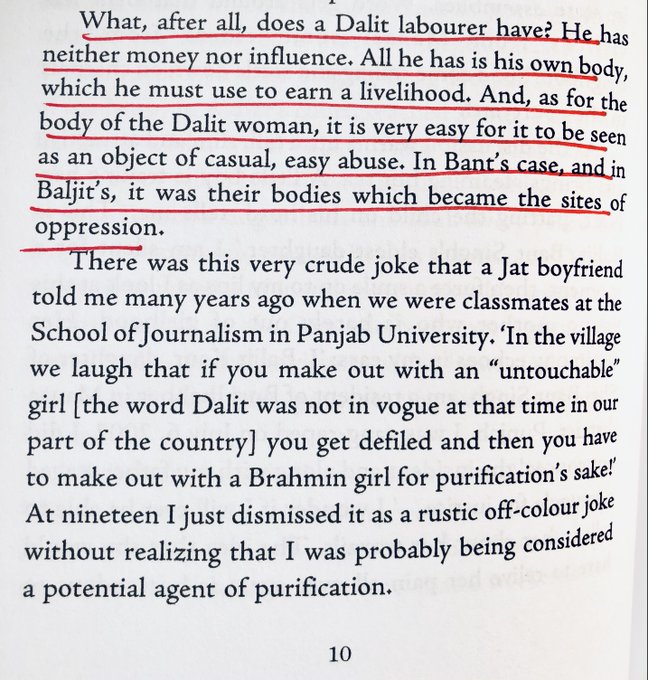
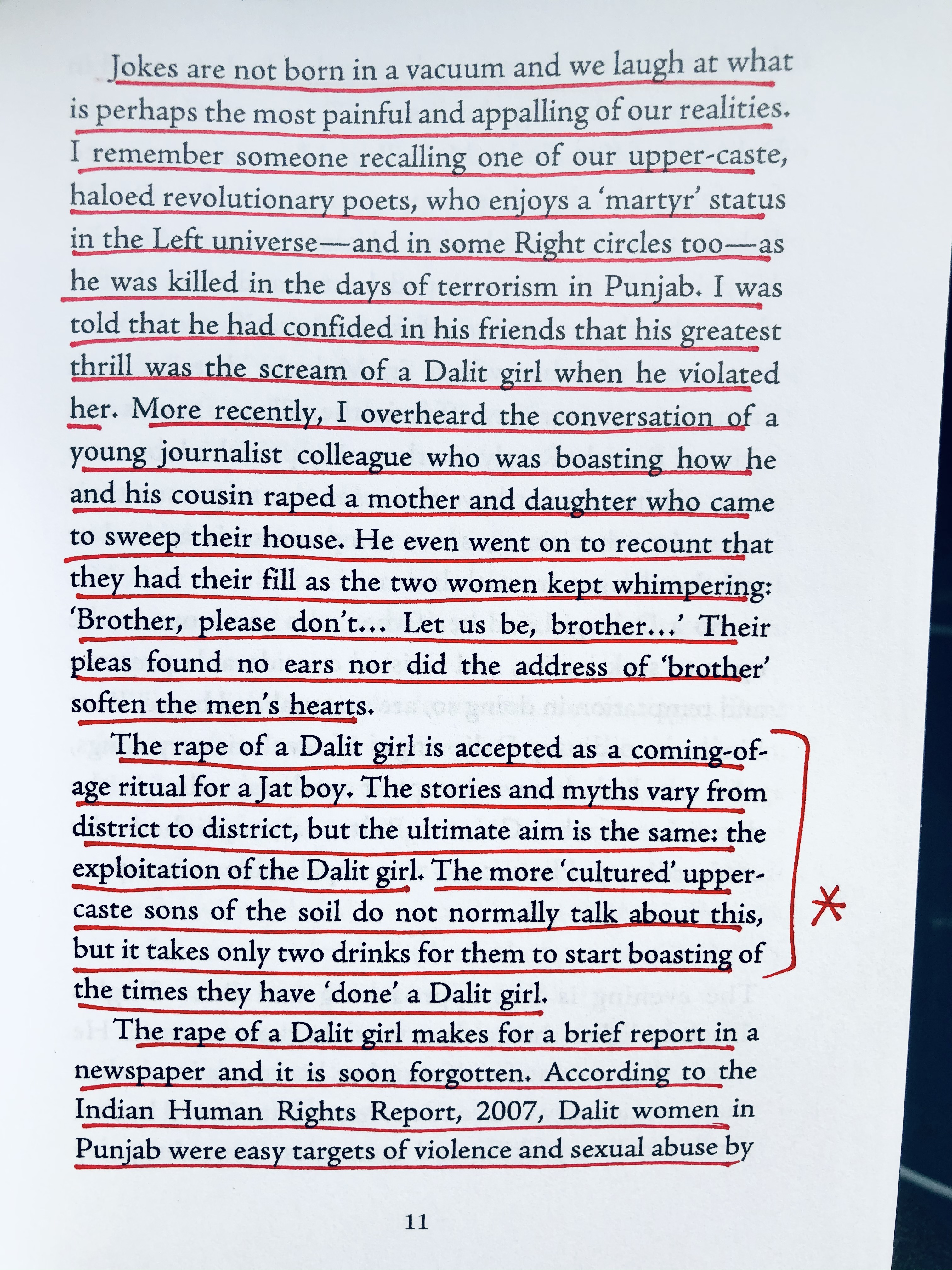
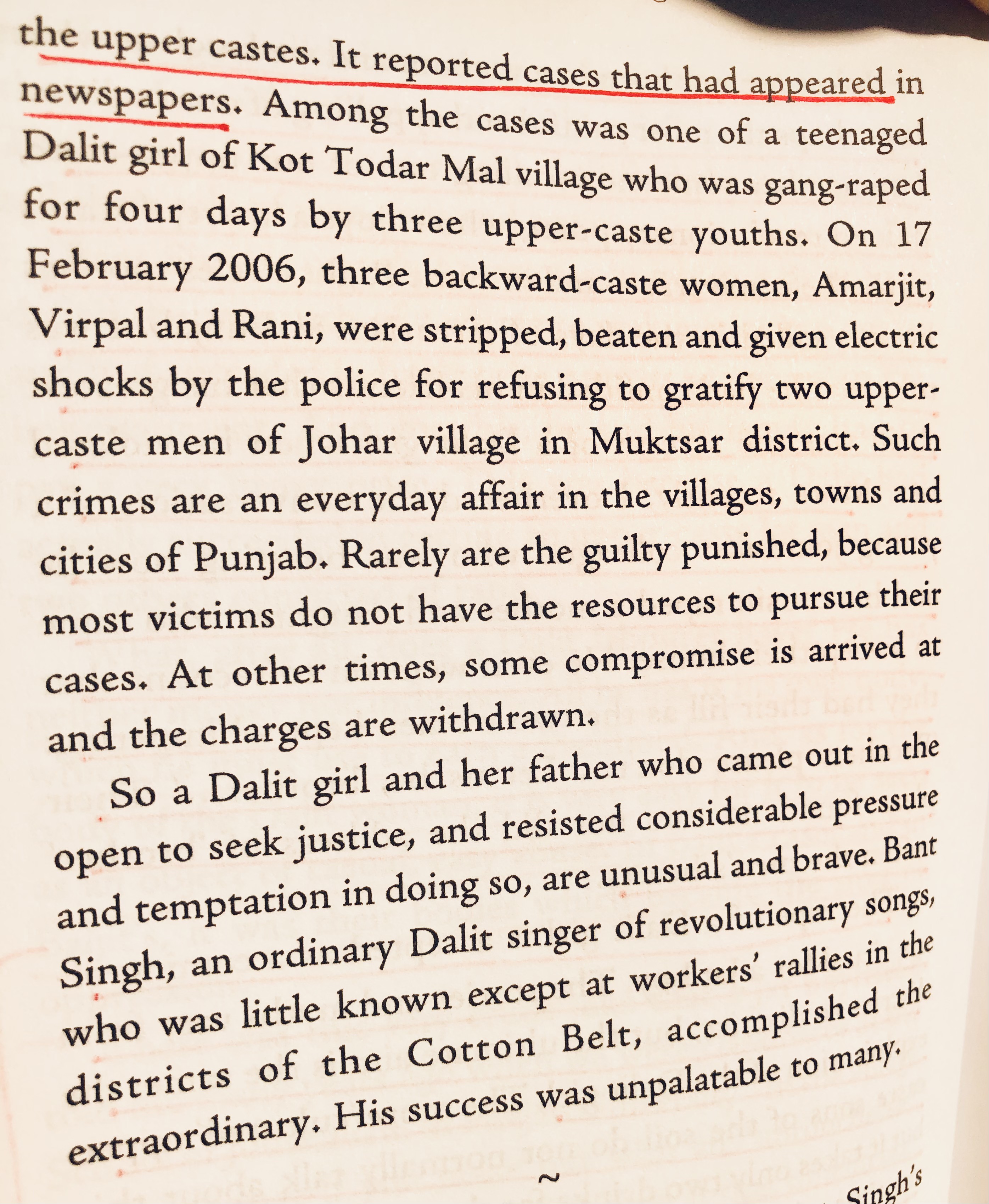
There is news about another rape case (alleged rape case?) making wavers in India and Twitter regular @conradkbarwa posted some excerpts from a book by poet and journalist Nirupama Dutta that you can see below:


Image

Image

Image

The anecdotes listed in these pages are obviously very disturbing and shocking, and I have no doubt that even if Nirupama moves in unusually nasty company, many such cases do occur across the Indian subcontinent and in most of them the police are yet another source of oppression (and sometimes even a second rape in the police station). The excerpts above are from East Punjab, so from a land that we are not entirely unfamiliar with (apart from whatever similarities exist across east and west Punjab, my in-laws are from villages near Ludhiana). It made me think about our own Punjab and the various anecdotes I have heard about rape of lower class women in villages as well as the use of sweepers and servants for sexual favors in urban areas. And of course, about the well publicized recent rape cases in Pakistani Punjab and about Razib Khan’s comment somewhere that “THIS is what a real rape culture looks like”. Which led to a tangential question in my mind: what are the similarities and differences between rape culture in Pakistani Punjab and Indian Punjab? 

  1. Differences in terms of actual prevalence and mechanics? Is such rape more common? less common? about the same? What figures do we have? How reliable are they? What is the trendline? How does this compare to other societies? 
  2. Differences in how it is framed: rapes in Pakistan tend to be framed as either class oppression (mostly by leftist/liberal commentators) or as “declining morals due to Indian movies, western influence, modernization, etc” (Islamist and/or traditional commentators). Rapes in India tend to be framed as class oppression too at times, but it seems that liberals and even traditional leftists in India (or about India, this is also true of most sympathetic Western commentators) seem very likely to blame “Brahminism” and the caste system as very specifically Indian forms of rape culture, not comparable to similar atrocities that happen to lower class populations in other countries (though I assume that population numbers being what they are, most actual rapists in East Punjab are  likely to be Jats or other local elites, Sikhs rather than Hindus, and rarely Brahmins). There is also a traditionalist view in India (that “lax morals, westernization, bollywood ” etc are to blame) and of course Hindutva types will add “love jihad” or “Muslim/Turkic colonization” to the list of putative causes. What are the most important causes in your view? 
  3. Which brings me to the real trigger for this post: Do you think the focus on caste in East Punjab (as in Nirupama Dutta’s book) and its relative absence in Western Punjab stories reflects a real difference in how easy it is to rape poor girls and get away with it? I know most Pakistanis will say this is exactly the case and that we are much better off since we are Muslims and any caste-ism that exists in us is a legacy of Hinduism, is less than it is in East Punjab, is fading fast and is the reason we have less rapes already, while Indian society will remain stuck in rape culture because of “Brahminism”.  Of course this is a question that in principle can be answered. What is the prevalence of the rape/sexual abuse of lower class women in Pakistani Punjab vs East Punjab? If it is really lower, then it needs an explanation. If it is not lower, then it may be that the focus on Brahminism is taking the public discussion (and possible solutions) into unhelpful areas? Or is it Pakistan that needs to talk more about caste rather than class to catch up to the reality? 
  4. I am not revealing any secrets by adding that this is connected to a personal feeling that left/liberal discourse is focused on political needs (defeating BJP/Hindu revivalism in this case)  and when you add that the usual human thing of finding a convenient narrative and beating it to death, it is possible that Pakistanis are actually a little better at analyzing their own society because they don’t have to carry this burden. But I am aware that this may be an extension of “grass is greener on the other side” on my part, and it is in fact the case that conversion to Islam (or “Indus man superiority”) has made Pakistanis less rapey than Indians. But if this is the case, why are Sikhs still rapey? does Brahminism work on them more than it does on Punjabi Muslims? (I am also aware that 6 out of ten readers will misunderstand what I am trying to ask here, but that is par for the course and I am more interested in the 4 who do get the question).

Fire away…

Afghan Conundrum

From Dr Hamid Hussain. 

“A real friend is one who takes the hand of his friend in times of distress and helplessness’.  Afghan proverb

 In September 2020, Afghan government and Taliban representatives met for the first time publicly in Qatar to start intra-Afghan dialogue.  There were lot of hurdles between the first step of signing of agreement between United States and Taliban in February 2020 and start of intra-Afghan dialogue in September 2020.

 All parties are asking Taliban for a ceasefire during intra-Afghan dialogue.  Taliban are not agreeing to this condition and violence has escalated in the last few months.  Taliban leadership is concerned that if it agrees to a ceasefire then foot soldiers and local commanders will head back to their homes.  This will weaken Taliban negotiation position and it will require some effort to re-mobilize foot soldiers.  In addition, there is also fear that hardline Taliban may break away.  The price that Taliban are paying is negative public opinion inside Afghanistan.  Large number of Afghans are angry that Taliban have signed a truce with foreign troops; the very rai-son d’etre of Taliban fight while shedding the blood of fellow Afghans with impunity. Continue reading Afghan Conundrum

Will the Sikhs Save India?

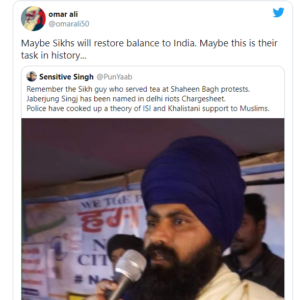
This topic came up a few days ago on Twitter because I happened to tweet:


The original tweet I was quoting is about the arrest of a Sikh leader who had gone to express solidarity (and serve tea) with the Shaheen Bagh protesters. I know nothing about him and have no idea if he is a Khalistani or a leftist or just a random guy who wanted to be nice to the protesters, so my tweet was not about him, but what was it about then? Several friends asked me this question (and others jumped in with their own theories, as expected on twitter), so i thought i would write a quick post to try and explain my quip.. Continue reading Will the Sikhs Save India?

Pakistan and India: Why Did They Diverge?

@FrankBullit67 is a well-read Rajput from India, and an active presence on Twitter. He composed a thread on partition and his view of why India and Pakistan have diverged in many ways since independence. I tweeted it with the comment that it was interesting, but I may not agree with all of it. Which led to several people asking me “what do you disagree with?”. I had not really thought it through, but here is what I came up with; Frank’s tweets are combined into paragraphs and any comment I may have is under the tweet in red. (1. that India and Pakistan have not diverged as advertised here is another possible argument, I skipped that for now, and 2. everybody forgets Bangladesh, which fact was nicely summarized by @shivamsethi01 and i have attached a screenshot at the end of this post).

Frank: I was going to do a thread on Partition in the form of a historical chronology – I think that can wait. I’ve decided to do a thread which is more “philosophical” and on “principles” about Partition. So here goes. As we know, “partition” carved two countries out of one in 1947. One with a Hindu majority (~85% Hindu in 1947 but now 79%). The other with a Muslim majority (over 90% Muslim in 1947 – even more skewed now).

The process was extremely bloody resulting in over a million deaths (some think the figure could be two million).

For those who are unfamiliar with the scale of the carnage, it is worth Googling Margaret Burke-White’s pictures of partition for LIFE Magazine (see here).

Indians, Pakistanis and Brits can keep arguing for centuries about who was responsible for what but that’s another subject. The purpose of this thread is to concentrate on what I think is the key philosophical divergence between Hinduism and Islam which made violent conflict or a “partition” unavoidable. Although one can write an encyclopaedia on the theological differences between the two Faiths, the key difference to me is on the question of “Blasphemy”. Broadly, Hinduism has had atheists in the mix for millennia (or those with a weak adherence to faith or those who have created new sects). This was never punished. As a result, Hinduism, Jainism, Buddhism and later Sikhism lived next to each other for millennia or centuries despite enormous theological differences. Continue reading Pakistan and India: Why Did They Diverge?

Covid Lockdown. Some Questions

When the novel Coronavirus started its spread outside of China very little was known about it and it is no surprise that countries acted to slow or stop the pandemic by locking down their citizens to various extents. Some countries (most notably UK and Sweden) tried to “push through” to herd immunity but then had a LOT of cases and transitioned to various degrees of lockdown. Others like the US tried a “worst of both worlds” response, with the President being skeptical of lockdowns, but reluctantly going along with them for a while  before shifting back to passive-aggressive sabotage of whatever his science advisors were telling him (whether they were correct or not is a separate issue). Pakistan’s PM had Trump-like instincts in this matter and unlike the US, his lockdown did not last long and was never very effective. This led to an early surge of cases and deaths (after Ramadan, when lockdown first failed) but to the surprise of most observers (including me), this outbreak then seemed to slow down and now there are ongoing cases, but the health system is definitely NOT being overwhelmed and the worse seems behind us. Meanwhile India continues to have varying degrees of lockdown (and because Indian officialdom has relatively more ability to enforce such things, these  also seem to have been more real than any Pakistani lockdown ever was) and is seeing a major increase in cases. When people talk about this they frequently bring up the fact that testing and tracking are not necessarily at “first world” levels in either country, so real numbers may be very different from what is being reported. This is true, but we do see what is happening in hospitals, so the fact that the system has not been overwhelmed is still something we can say.  Beyond that, I have no special knowledge or data. So I thought I would put up a post and get some answers from the hive mind:

  1. Where can non-experts like us find the best data on Covid? There are many sites, which ones do commentators prefer and why?
  2. Why is Pakistan NOT experiencing a dramatic health emergency due to Covid in spite of having given up on lockdowns? Is there pre-existing immunity? something else? Or just fewer old people? is there more to come?
  3. IF Pakistan is not seeing a major increase in deaths, should India continue its current level of lockdown? Do we expect Indian immunity and spread characteristics to be very different from Pakistan?
  4. What is the expert consensus now on various details such as “doing X is cost-effective, but Y should be abandoned”.. I mean what is the best source (sources) for answering such questions? One assumes that the “authorities” spend a lot of time analyzing information to determine what worked and what was just a waste of effort? Are the detailed recommendations evidence-based? Should any of them be changed? (for example, why is my dentist open for cleanings, but my barber is not? things like that, are they evidence based? and what does the evidence say?)

I look forward to being enlightened. Meanwhile, stay safe and happy.

Why Did the Indian and Pakistani Armies fail in 1965?

This is a chapter from Major Amin’s history of the Pakistani army. It is a very long post and there is a lot of repetition (do keep in mind that he wrote it mainly for a Pakistani audience, who may need convincing on some of the points) but I wanted to post it as a historical document and as something  people who are interested in military history may want  to read at leisure. As with any such analysis, there will be no many different opinions.. feel free to add yours in the comments.. Major Amin’s book has some excellent maps and tables that I was unable to transfer successfully. My apologies for that, but the points are pretty clear even without those.

CHAPTER FOURTEEN ANALYSIS – 1965 WAR by Major Agha Humayun Amin

Havelock said that ; “In philosophy, it is not the attainment of the goal that matters, it is the things that are met with by the way”. So it is with war. The most important thing for the student of military history or the art of war is not whether a country lost or won the war but how it was fought, how units performed in action, how decisions were made in face of the stress and strain of battle, the difference between practice and precept in short all matters pertaining to strategy tactics leadership equipment etc. In other words to simply analyze the war to answer the questions like “Whence”? “Whither” ? “Why”? and “How”?

In this analysis of war we have to go beyond probabilities and examine various facets of a particular situation and arrive at conclusions that will assist us in face of a similar crisis situation in future. War is the final audit of an army in which unit efficiency as well as higher and lower leadership is gauged and no book on an army is complete without analyzing in detail the qualitative efficiency of an army in actual War. Unfortunately most books written on both Pakistan and Indian Armies by foreigners and therefore meekly accepted by the subcontinentals who suffer from a subtle inferiority complex; as the final authority; do not discuss the qualitative efficiency of both the Pakistan and Indian Armies in any actual war; both as British Indian Army and as two different armies after 1947!

Instead these books beat round the bush discussing vague and largely irrelevant issues which their authors have decided to highlight, merely because they have decided to write a book and want to write their book without going into the subtleties of actual wars fought by the Indo Pak armies.

In the following paragraphs an attempt has been made to analyze the conduct of 1965 war and to answer certain questions about the qualitative efficiency of the Pakistan Army in a detached manner separating myth from reality and fact from fiction. This analysis is important because a considerable part of Pakistani military history has been deliberately or inadvertently distorted based on nationalistic parochial personal and inter arm prejudices and jealousies.

THE BRITISH COLONIAL LEGACY

We have already discussed in detail the impact of the British military tradition on the Indo Pak armies in our earlier chapters dealing with the armies of the English East India Company and the pre 1947 British Indian Army. This was not something confined to Indo- Pak subcontinent alone but an all Asia trend. From the late eighteenth century the “European Way of Warfare” was generally borrowed and follow as the gospel truth by many East European and Afro-Asian armies. The trend of “importing the European way of war” started around 1600 when the Ottoman Turks came into contact with the European powers in Eastern Europe and Russia.

Till 1500 the Europeans who had as a matter of fact military failed in the Crusades against Asia enjoyed no significant military advantage over Asia. Till the invention of gunpowder the cavalry remained the dominant arm in battle and the infantry was relegated to a secondary role. The ascendancy of European methods of warfare starts with the advent of Gustavus Adolphus(1496- 1560) of Sweden who introduced a renaissance in the art of warfare by “harnessing modern technology to a practical military philosophy” . (1)

Gustavus principal contribution was the introduction of a relatively superior conceptual framework of integrating military organization with weapons and tactics. He created an infantry organized in brigades of two to four regiments each of which had eight battalions of four companies etc. He introduced similar reforms in cavalry and artillery integrating artillery with infantry and cavalry in battle and restructured infantry formations in such a way that their firepower was enhanced. One of his most important reforms was employment of cavalry as a “shock weapon”.

Gustavus’s methods were copied by the French and the British. Gustavus ‘s tactics were improved by Turenne of France and Cromwell and Marlborough of England and were further improved by Napoleon who was able to benefit from the analytical studies of great military thinkers like Gribeauval Maurice de Saxe Bourcet Joseph Du Teil and Guibert. Formal military schools were organized in France where the art of war was studied while similar institutions were founded in Prussian and Sweden.

By 1600 Russia was the first country outside mainland Europe to realize that there was something conceptually and organizationally superior in the West European way of warfare which enabled them to defeat numerically superior but more primitively organized armies. lt may be noted that as late as 1592 the Russians were no match to the Muslim Tartars of the Golden Horde who sacked Moscow in 1571 and managed to penetrate into suburbs of Moscow as late as 1592. 1t may seem unbelievable to many but as late as 1660s the Crimean Muslim Tartars were one of Russia’s most feared enemies.(2)

A similar pattern of imitation was followed in the Ottoman Turk Army fromapproximately 1750 to 1914 when the Ottomans discovered that medieval tactics of cavalry assault were of little utility against relatively numerically superior or equal strength European armies with superior organization’.(3) Continue reading Why Did the Indian and Pakistani Armies fail in 1965?

Brown Pundits