Why did Bhutto Select Zia as Chief

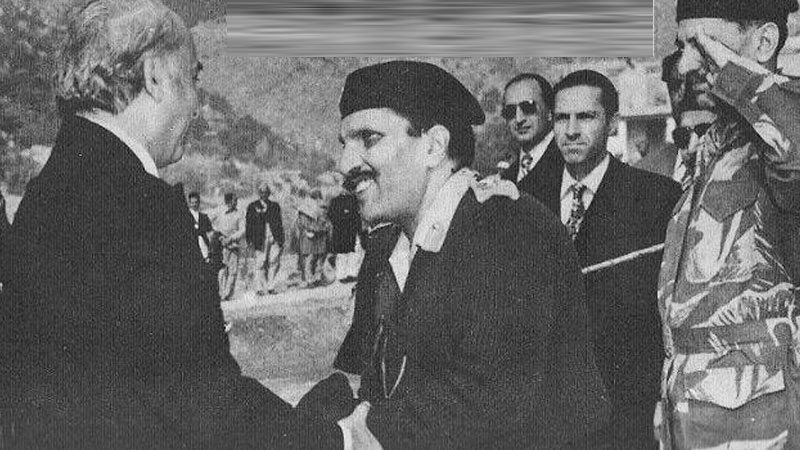
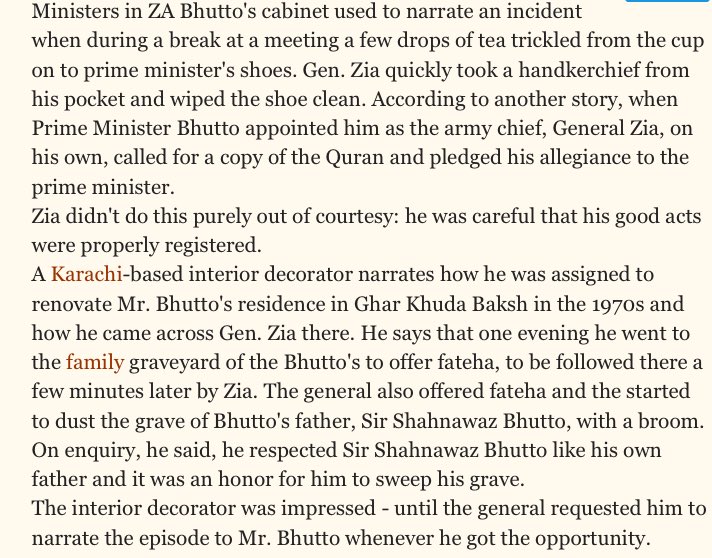
Because Zia was a world champion at sucking up to him.

An interesting snippet from Major Agha Amin

FROM MY MARCH 2001 INTERVIEW WITH MAJ GEN NUK BABAR SJ AND BAR —-Why did Mr Bhutto select Zia as a coas?

There were a number of reasons and these were discussed with me personally by Mr Bhutto, while in detention at Murree. One was the pretended humility and this disarmed Mr Bhutto into the belief that he would pose no threat to the nascent democracy. Secondly, his performance when he invited Mr Bhutto to the centenary celebrations of 11 cavalry at Kharian. He took pains to ascertain Mr Bhutto’s tailor in Karachi (Hamid Khan) and had a Blue Patrols as Colonel-in-Chief of Armoured Corps. On entering the room, Mr Bhutto found a suitcase on his bed and on inquiry was told that it contained the Blue Patrol. The next day, Mr Bhutto was requested to climb a tank and engage a target. Quite obviously the target was hit. Then was his performance while on deputation in Jordan, where he killed a large number of Palestinians (Black September), Mr Bhutto was led to the belief that if he was so loyal to Jordan, he would be even more loyal to Pakistan. His prime performance came at Multan, where he invited Mr Bhutto as Colonel-in-Chief. After the function, when Mr Bhutto had barely returned to Mr Sadiq Qureshi’s house, when he was informed that General Zia requested to meet him. Mr Bhutto was surprised, having met him in the mess a little earlier. However, he called him into Mr Sadiq Qureshi’s study/library. Gen Zia on entrance went round the Almirah, looking for something and on inquiry he revealed that he was looking for a copy of the Holy Quran. On finding a copy he placed his hand on and addressing Mr Bhutto he said, “You are the saviour of Pakistan and we owe it to you to be totally loyal to you”. Then was the fact that there was little to pick and choose amongst the other aspirants. The only other suitable candidate was General Majeed Malik who was Mr Bhutto’s favourite as a sound professional. Unfortunately was involved in the International Hotel Scandal where he was caught with Mustafa Khar. He was sent as Ambassador to Libya. Finally, of course was the American angle. They had picked Zia as suitable material at Fort Leavenworth, followed his career progress and possibly lobbied in his favour. They made it known to friends months in advance that he would be appointed coas. Zia’s obsequeous behaviour made Mr Bhutto think that he was a non-political man. Pakistani democracy was at an infant stage and could not afford an Army Chief with political ambitions. Then there was not much choice. Gen Sharif was considered politically unreliable since he had been very close to Ayub Khan. Jillani had no command experience and was the head of isi. Akbar Khan had not performed well as a goc 12 Division in Kashmir in 1971 war. Gen Aftab and AB Awan had no command potential and were not suitable.

Image

Image
From @takhalus

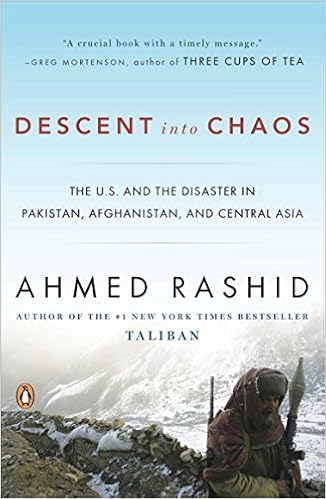
Book Review: Descent into Chaos

An old review from Major Amin, it remains topical.

Descent into Chaos , Ahmed Rashid, Allen Lane,2008.ISBN No .978-1-846-14175-1

Book Review

Major A.H Amin (Retired)

11 October 2008

Ahmed Rashid acquired fame and became darling of the west when his book on Taliban was published in 2000 or so.Descent into Chaos is another bestseller as far as publishing statistics is concerned.It is a tragedy that the West,guardian of the present worlds intellectual property projects what suits its political and social interests and stifles what it finds “ politically unacceptable”.Seen in this background what Ahmed Rashid writes is acceptable to the west.Possibly because what he says fits hand in glove with western perceptions about how to shape the future.

As normal the book has some factual errors.Some insignificant some not so insignificant and some which not have escaped the sagacity of a known Afghanistan hand like Ahmed Rashid. Continue reading Book Review: Descent into Chaos

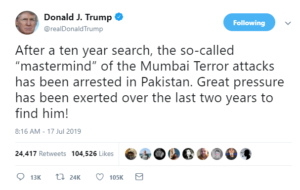
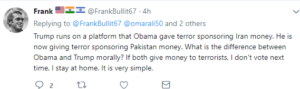
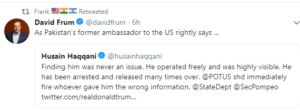
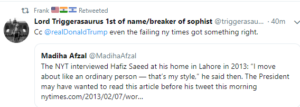
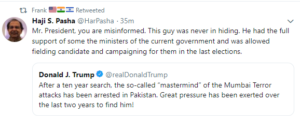
Trump Finds Hafiz Saeed..

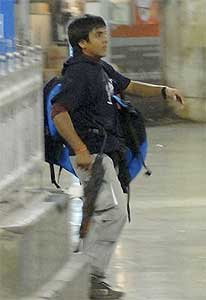
Pakistan has (once again, for the nth time) arrested Hafiz Saeed . This time the charge is “terror financing”. It should be clear to anyone who bothers to read a few newspapers that he was not hiding anywhere and did not need to be “found”. He has always lived and worked openly in Pakistan and this is not the first time he has been arrested (and may not be the first time he is let go after the dust settles and the IMF funds arrive). It is also worth noting that the charges have nothing to do with the Mumbai attacks and that the current military regime in Pakistan will not even admit that those attacks came from Pakistan. In fact their vast PR apparatus has successfully convinced many educated Pakistanis that the whole thing was an Indian (or Israeli) false flag operation and the attackers did not even come from Pakistan. While this is not the official stance of the government of Pakistan (which actually investigated the attackers to some extent under international pressure, and produced detailed evidence linking the attackers to Pakistan, including details such as where the boat was purchased and such like, and several people have been in jail at some point for their involvement in this attack), the domestic propaganda and management of witnesses etc  has been so effective that I regularly get whatsapp messages from friends “accusing” some Pakistani journalist or TV station of being Indian agents because they have said at some point that the sole surviving terrorist (Ajmal Kasab) was a Pakistani. As an aside, it would be interesting if someone can ask a senior member of the current military regime to publicly state on record that Ajmal Kasab was Pakistani. I doubt that anyone (except maybe Trump) can actually do this (i.e. I doubt that any senior official can come on TV and admit this.. it would be too far at variance with the domestic propaganda that ISPR has put out).

Mohammed Ajmal Kasab.jpg
Ajmal Kasab shooting civilians in Shivaji Train station

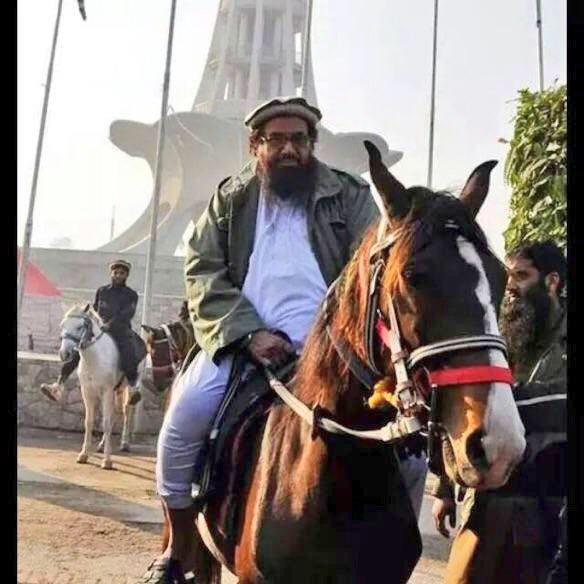
In 2014 Hafiz Saeed actually held a conference of his (renamed) Jihadi organization at the “minar e Pakistan” (Pakistan memorial) in Lahore and rode around on a horse to feel close to the spirit of the original Arab conquerors he idealizes.

Image result for hafiz saeed horse
Hafiz Saeed riding a horse at the JUD’s convention in Lahore in 2014

So anyway, everyone knew where Hafiz Saeed was, and even this latest arrest does not mention the Mumbai attacks, so either Trump is remarkably ignorant (possible) or he is just playing to his base, who love the whole “Western” movie ethos of wanted posters, dead or alive, manhunt, etc and finally, Sheriff Trump riding to capture the “bad guys”.  I find it hard to believe that even Trump can be ignorant enough to not know all this, so I vote for “bullshitting his base” as the most likely explanation for this tweet.

But while all this may be just show to get Pakistan off the FATF hook and to get some much needed cash (and maybe even weapons) from Trump, it is still hard to say who is conning who here. At one level Pakistan has “successfully” conned the US for 17 years and received billions in aid while supporting the Taliban and hosting multiple other Jihadi organizations. But it is hard to see this as a “win” for Pakistan. While Pakistan’s military regime (and this issue has ALWAYS been handled by the army, no civilian was allowed to butt in.. Mian Nawaz Sharif lost power for trying to minimally rein in this policy) has played these games and thinks it is winning, it has actually presided over Pakistan falling steadily behind India and even Bangladesh in every economic and social indicator. It would have been much better to swallow the bitter pill in 2001 and actually switch sides and give up on Jihad. By now Pakistan would be outperforming rickety India and even “rising star” Bangladesh in many areas. Instead, we have wasted a generation trying to play these games and may not have anything to show for it if this round of show arrests does not even get us off the FATF grey list (or worse, gets us on the blacklist).
Indians are (unsurprisingly) not delighted with this latest show of successful Pakistani conmanship (or even genuine change of heart), but in the proverbial long run, who gets the last laugh? India, a rising economic power in the world, or Pakistan, playing strategic games with multiple sponsors and just staying half a shaky step ahead of its multiple creditors?


Prime Minister Imran Khan on Pakistan National Day, in March.

Browncast Episode 53: Memories of partition: Amrik Chattha

Another BP Podcast is up. You can listen on Libsyn, iTunes, Spotify,  and Stitcher. Probably the easiest way to keep up the podcast since we don’t have a regular schedule is to subscribe at one of the links above.

You can also support the podcast as a patron. The primary benefit now is that you get the podcasts considerably earlier than everyone else. I am toying with the idea of doing a patron Youtube Livestream chat, if people are interested, in the next few weeks.

Would appreciate more positive reviews!

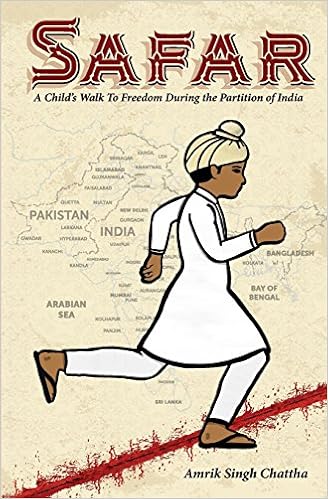
On this episode, we talk with Dr Amrik Chattha. Dr Chattha is the author of “Safar: A Child’s Walk To Freedom During the Partition of India“, available on Amazon. He talks about life in a Punjabi village before partition and the horrors that followed partition.

Pakistan’s Pseudo-Revolution Marches on..

Pakistan is at an interesting (and dangerous) juncture today; in 2018 the military used the many levers it has at its disposal to get Imran Khan elected as Prime Minister and GHQ continues to strengthen its grip on power, but that is not the interesting part. That is just the normal Pakistani cycle of semi-civilian rule followed by a phase of more direct military rule, followed by another attempt at civilian government; what is interesting is that a significant section of the emerging Pakistani middle class (“Mehran Man”) has managed to convince themselves that this time there will be a revolution: the violent overthrow of one social order and its replacement by a very different order.

GHQ probably had no such revolution in mind when they promoted Imran Khan and made him prime minister. Some civilian leaders were to be sidelined and some military leaders planned to acquire more direct power, and in order to do this they activated their vast public relations apparatus and talked of revolution and grand transformations, as one does, but no Bolshevik or Chinese revolution was actually in the works. There was probably some fear that the “war on terror” dividend is over and hard times lie ahead, so the state should be prepared for a period of harsher authoritarian rule (i.e. the opposite of a revolution; not a desire to change things but a desire to harden the existing order to meet anticipated challenges). Of course every time GHQ think tanks notice that Pakistan is facing a crisis, they tend to revert to the old “Chakwal solution” paradigm all officers apparently learn during basic training. This PMA version of “how to fix Pakistan” has not changed since the 1950s and includes ideas such as :

  1. Pakistan needs a firm hand (“shoot 5000 people and the country will become an Asian Tiger”)
  2. Presidential system
  3. 22 provinces (to break up existing pre-Pakistani identities such as Pakhtoon, Sindhi, Baloch etc)
  4. Get rid of corrupt politicians (ALL politicians are corrupt, but some join military regimes and are therefore excused)
  5. Technocrat government, etc

So I do not doubt that some of the planners at GHQ did have such “reforms” in mind and just as the cart follows the horse, new policy disasters will no doubt flow from the naive implementation of such “reforms”, but even so, no real revolution was intended, just some “tweaking” of the system.

But while the planners at the top may not have intended more than that, their propaganda seems to have created a number of excited middle class social media warriors who sincerely believe a revolution is in progress. They are cheering every extra-legal step, every fake drug bust and every suppression of dissent. And because the geniuses at GHQ are also human, some of this excitement is filtering back to the bosses and even they may get carried away and imagine they are leading the 1949 Communist revolution in China and not some Sisi-level military coup.  Which will be a tragedy because this is not a revolutionary party, this cannot BE a revolutionary regime; the same elite that was ruling the country yesterday is ruling it today. The social media warriors screaming for a revolution and “across the board” cleanup are not interested in seeing Uncle Jimmy or cousin Mithoo go to prison; they expect the revolution to hit other people (preferably “corrupt politicians”, i.e. politicians who have not thrown in their lot with GHQ), they do not expect their own friends and family to face some revolutionary tribunal in D-chowk. The status quo is meant to be improved, not replaced.

But humans can get carried away and this lot may have misunderstood their own position rather comprehensively. They may imagine they really ARE carrying out a revolution: the violent overthrow of one class by another. Some of them are surely sane enough to know this is just one more round of military rule and after it fails (as it inevitably must) they will have to compromise again with “dirty politicians” and restart the merry go round at 1988 or 2008, if not at 1970 (i.e. controlled democracy, with continued military domination of the heights of the state), but some of them do seem to be getting carried away. We may end up with the worst of both worlds.. The viciousness and disruptive destruction of an attempted revolution, without the creative energy and opportunities created by any genuine overthrow of an ossified ruling elite..
And if that is the case, then the corrupt status quo will evolve into something even worse: a corrupt narrowly based authoritarian regime that has destroyed existing politics (corruption ridden, but still somewhat responsive to public pressures) and replaced it with naked military rule over an unhappy population with no political safety valves and a worsening economic crisis.  They may then find themselves facing an attempt at real revolution.. and that will not be good for anyone.

There is still time. They can step back and let politics take its course and maybe a slightly more competent regime can come into power once PTI crashes and burns. But just writing this sentence is enough to make one realize that they are not going to allow any such soft landing. This time, we will get the full Monty, the chakwal solution in all its glory. It will fail amidst much pain and suffering; you know this, I know this.. but they don’t know this and they will not learn until things fall apart.
Sad.

Image result for rana sanaullah
Rana Sanaullah, PMLN Punjab Chief, in prison

By the way, here is Brigadier Ijaz Shah, GHQs main enforcer in the Imran Khan regime, giving his side of the story.

And here is the full ISPR version of recent events:

Browncast Episode 43: Indian Elections, the Aftermath, with Kushal Mehra

Another BP Podcast is up. You can listen on Libsyn, Apple, Spotify, and Stitcher. Probably the easiest way to keep up the podcast since we don’t have a regular schedule is to subscribe at one of the links above.

You can also support the podcast as a patron (the primary benefit now is that you get the podcasts considerably earlier than everyone else).

In this episode we discuss the outcome of the Indian elections with Kushal Mehra, host of the Carvaka Podcast (and a BJP supporter, albeit not exactly a traditional one). Kushal thinks Modi’s sweeping victory had more to do with his ability to deliver real benefits to the poorest Indians. Feel free to disagree and post your opinions in the comments. We talk about the failure of the Left’s dream scenario of “dalit-Muslim unity” as a counterweight to Hindutvadi politics (at least in this election), what this means (or does not mean) for Indian democracy, the role of Indian Muslims, and so on.


Nasim Zehra’s Book on Kargil. Review by Maj Amin


Review from Major Amin. 

NASIM ZEHRAS TOO LATE AFTER THE EVENT KARGIL BOOK ANALYSED

Agha H Amin

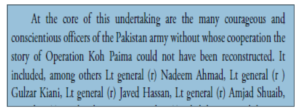
My first issue with this book is that analysis delayed is analysis lost and Nasim Zehra is guilty of publishing this analysis some 20 years late. Before that she was in the good books of many culprits of Kargil who 20 years later are fired cartridges with near zero nuisance value. More seriously, I take analytical as well as conceptual dispute with her in regarding characters like Lieutenant General Javed Hassan as “ courageous and conscientious”

Continue reading Nasim Zehra’s Book on Kargil. Review by Maj Amin

Browncast episode 37: Arabian Linguistics, pre-Islamic Arabia

Another BP Podcast is up. You can listen on Libsyn, iTunes, Spotify,  and Stitcher. Probably the easiest way to keep up the podcast since we don’t have a regular schedule is to subscribe at one of the links above.

You can also support the podcast as a patron (the primary benefit now is that you get the podcasts considerably earlier than everyone else
).

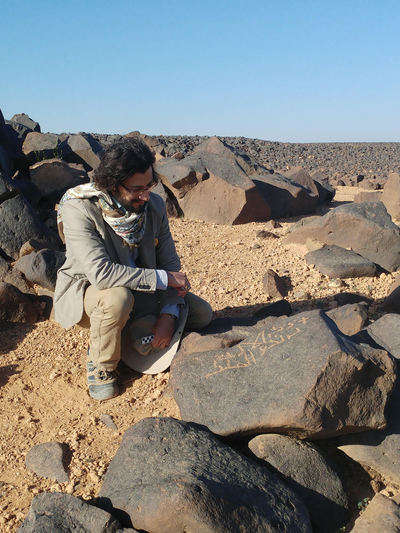
Picture for al-jallad.1In this episode we talk to Dr Ahmed Al Jallad, Sofia Chair of Arabic Studies at Ohio State University. Dr Jallad is an expert on the languages and scripts of pre-Islamic Arabia. We talk about the origins of Arabic (most likely in the Northwest of the peninsula and not in the South as previously believed), the development of the Arabic script (most likely from Nabatean Arabic) and the inscriptions of the region (In the 6th Century CE the ones that do reference a religion mostly reference Christianity, not the pagan gods of pre-Islamic Arabia that dominate our vision of the “era of Jahiliya”..
Browncast Ep 35: Tahir Andrabi on Primary Education in Pakistan

Another BP Podcast is up. You can listen on Libsyn, iTunes, Spotify,  and Stitcher. Probably the easiest way to keep up the podcast since we don’t have a regular schedule is to subscribe at one of the links above.

You can also support the podcast as a patron (the primary benefit now is that you get the podcasts considerably earlier than everyone else
).

Tahir Andrabi

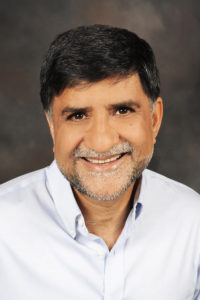
This week we have a twofer about education in Pakistan. In part one we talked to Dr Sohail Naqvi about higher education, and in this episode Omar and Zachary talk to Professor Tahir Andrabi. Tahir is the Stedman-Sumner Professor of Economics at Pomona College and is currently working as the founding dean of the school of education at the Lahore University of Management Sciences. He has a professional interest in primary education and public policy and has written extensively on these topics. He shares his views about primary education in Pakistan. I was especially taken by his observation that the 10th grade examination (the “Matriculation” examination) in Pakistan is one of the reasons why primary education in Pakistan is so sub-par. And that the entire colonial era educational system is meant to identify “winners” (the top 1 % of the students) instead of meeting the needs of the majority of students (the modal student in Pakistan is headed for failure). His points about educated girls having sparked a revolution in (private) primary education in the rural areas, and lax enforcement being the reason (onerous and useless) state regulation of education has done relatively little damage in Pakistan, are also spot on. I hope we get Dr Andrabi on again to discuss some of these topics in greater detail.

We would definitely appreciate more positive reviews. Many of you listen to us, but don’t leave any reviews!

Browncast Ep 34: Sohail Naqvi on Higher Education in Pakistan

Another BP Podcast is up. You can listen on Libsyn, iTunes, Spotify,  and Stitcher. Probably the easiest way to keep up the podcast since we don’t have a regular schedule is to subscribe at one of the links above.

You can also support the podcast as a patron (the primary benefit now is that you get the podcasts considerably earlier than everyone else
).

Related imageThis week we have a twofer about education in Pakistan. In this episode Omar and Zachary talk to Dr Syed Sohail Hussain Naqvi. Dr Naqvi is currently the Rector of the University of Central Asia. Prior to that he has been vice chancellor of the Lahore University of Management Sciences, executive director of Pakistan’s Higher Education Commission and Dean of electrical engineering the Ghulam Ishaq Khan institute of technology. He shares his views about higher education in Pakistan and his own experiences in that field. In the next episode, we speak to Dr Andrabi about primary education.

In the next episode, we talk with Professor Tahir Andrabi about primary education.

We would definitely appreciate more positive reviews. Many of you listen to us, but don’t leave any reviews!

Brown Pundits