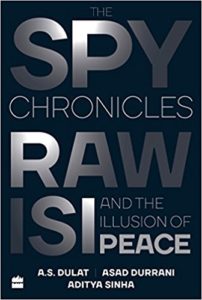
Review: The Spy Chronicles

This is a review of “The Spy Chronicles” (not by me, but by our regular contributor Dr Hamid Hussain), a recent book co-authored by two former chiefs of ISI (the Pakistani intelligence agency) and RAW (the Indian intelligence agency). The book has generated some controversy (a lot of it far-fetched and irrational) and the Pakistani author (Retired General Asad Durrani) has been called to GHQ to provide an explanation and has been barred from leaving the country until an enquiry (conducted by a 3 star general) has been conducted.

The review is by Dr Hamid Hussain.

The full title is: Spy Chronicles: RAW, ISI and the Illusion of Peace. A. S. Dulat, Assad Durrani and Aditya Sinha (Delhi: Harper Collins), 2018.

This book is neither a memoir nor an organized attempt to explain a theory. It is essentially a transcript of conversations. It covers India Pakistan relations, Kashmir, Afghanistan and other general regional and international topics. Two informed individuals from rival countries engaged in a candid conversation and some of their views are not fully in line with the official stance of their respective countries.
In view of unresolved issues between India and Pakistan, there have been several international attempts to bring high former officials of both countries together for dialogue. One effort was to bring former intelligence officials of both countries together. This effort called ‘Intel Dialogue’ was organized by the University of Ottawa. Dulat and Durrani met each other during these ‘Track II’ efforts and developed a kind of friendship. Continue reading Review: The Spy Chronicles

Drinking (alcohol) During Ramadan

The Washington Post has an article by Khalid Diab about the complications that arise around the issue of obtaining alcohol during Ramadan. Excerpts are posted later. As Shahab Ahmed points out in his magnum opus (What is Islam), drinking alcohol is prohibited in Islam, but it is also an established feature of Islamicate culture; i.e. not only is it regularly used (by a minority), it is celebrated in poems and songs, there are rituals associated with its use, everyone knows someone who drinks and drinkers have their own (albeit not always comfortable) place in society. In some countries (Saudi Arabia, Iran) it is strictly prohibited and users can expect serious penalties if caught, but even in those countries a great deal of regular communal drinking does go on. A few more countries (like Pakistan) have prohibition, but with more exceptions than exist in Iran and Saudi Arabia (non-Muslims and foreigners can buy alcohol, some high end hotels have bars, and so on). In several other countries (Egypt, Tunisia, Indonesia, etc) alcohol is widely available and can be purchased in supermarkets and even in small roadside kiosks (what would be called a Khoka in Pakistan). But in all these countries, there is a visible change during Ramadan: many regular drinkers voluntarily give up alcohol for the month and those who continue to drink may go deeper underground than usual. I have friends who cannot go to sleep without one (or several) nightcaps, but who will not touch  drop during Ramadan. They invariably get drunk on Eid.

Some excerpts from Khalid Diab’s article follow:

Although alcohol is considered haram (prohibited or sinful) by the majority of Muslims, a significant minority drinks, and those who do often outdrink their Western counterparts. Among drinkers, Chad and a number of other Muslim-majority countries top the global ranking for alcohol consumption.

Have a Murree with your curry.. Beer from Pakistan

Continue reading Drinking (alcohol) During Ramadan

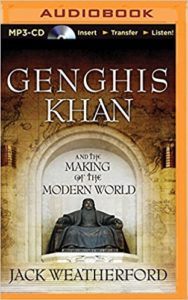
Book Review: Genghis Khan and the Making of the Modern World

Jack Weatherford is an anthropologist who has spent many years researching the Mongols in general and Genghis Khan in particular. The book is a very sympathetic portrayal of Genghis Khan and his descendants and their impact on world history. It is a very easy read and is an excellent summary of the rise of this amazing man and his (relatively few; a total population of less than a million) people to greatness. And there can be no doubt that Temujin is one of the most remarkable characters in world history; one of those (few) heroes about whom you can confidently say that without them, the history of his people would have been VERY different indeed. He is a one-man refutation of the idea that individuals, no matter how prominent, do not really matter and all we need to study are the aggregate/impersonal/stochastic processes that drive history. Continue reading Book Review: Genghis Khan and the Making of the Modern World

Political Engineering in Pakistan. The Military View

From our regular contributor, Dr Hamid Hussain

Following piece about recent clouds on Pakistan’s scene was mainly for non-Pakistani audience as many questions/confusions came my way. 

 This is an attempt to understand the view from barracks although I strongly oppose such moves from military.  This is first of two part. Second part will deal with modus operandi.

 Hamid

Political Engineering – View from the Barracks

Hamid Hussain

In July 2017, disqualification of Pakistan’s Prime Minister Mian Nawaz Sharif by Supreme Court again opened the debate about the role of country’s powerful army.  This was one of the most politicized decision of country’s Supreme Court.  In April 2017, Supreme Court not only ordered formation of a Joint Investigation Team (JIT) but went ahead and nominated its members.  It included a serving Brigadier Kamran Khurshid of Military Intelligence (MI) and a retired Brigadier Nauman Saeed of Inter-Services Intelligence (ISI). Supreme Court disqualified Sharif based on JIT investigation.  In the aftermath of Sharif disqualification, many political changes including change of provincial government in Baluchistan achieved by defection of several members, defeat of government’s nominee for Senate chairman position and defection of many politicians from ruling political party Pakistan Muslim League (Nawaz) (PML-N) to rival Pakistan Terek-e-Insaaf (PTI) were alleged to be orchestrated by the army brass.

Continue reading Political Engineering in Pakistan. The Military View

Kargil War

This topic comes up every once in a while on twitter, so I am reposting an old post with a few new links and videos added at the end.. The main point is simple: Musharraf and a few of his cronies (Javed Hasan, General Aziz, General Mahmood), without having thought it through, conducted a foolish operation in Kargil that cost hundreds of lives on both sides and set back (perhaps destroyed forever) the chances of peace between India and Pakistan (set in motion by Vajpayee’s historic bus journey to Lahore). The operation was not only a strategic disaster, it was a tactical disaster..

First, some links with details about the operations: Continue reading Kargil War

For “Strategic Reasons”, Did Britain Want Pakistan in 1947?

I got these via an email from an author who apparently wishes to remain anonymous. Since any post about partition gets a lively debate going, I though I would put these up (again, I did not write these points, I am just the messenger 🙂 ):

Continue reading For “Strategic Reasons”, Did Britain Want Pakistan in 1947?

Review: 12 Rules for Life (Jordan Peterson)

This is not the sort of book that usually interests me, but what with the controversy surrounding this man, I decided to look it up. To my surprise, when I requested it at my local library I discovered that I was 67th on the hold list! The man has clearly struck a chord; I have never seen a hold list that long in our (rather small) library. Luckily the system seems to have bought more copies, so I only had to wait a couple of months to get my copy. The book lists 12 rules that are an “antidote to chaos”. Somewhat to my surprise, they are generally good rules, though some of them are rather obvious, and even a bit hokey. Since many of you are not going to read the book, I will list them here:

  1. Stand up straight with your shoulders back
  2. Treat yourself like someone you are responsible for helping
  3. Make friends with people who want the best for you
  4. Compare yourself to who you were yesterday, not to who someone else is today
  5. Do not let your children do anything that makes you dislike them
  6. Set your house in perfect order before you criticize the world
  7. Pursue what is meaningful (not what is expedient)
  8. Tell the truth – or, at least, don’t lie
  9. Assume that the person you are listening to might know something you don’t
  10. Be precise in your speech
  11. Do not bother children when they are skateboarding
  12. Pet a cat when you encounter one on the street

Continue reading Review: 12 Rules for Life (Jordan Peterson)

Pressure on Social Media in Pakistan

A recent BBC report discussed how contractors employed by ISPR (Inter-Services Public Relations, the media arm of the Pakistani armed forces) monitor and harass people who are perceived as being disloyal or anti-military. Today I saw an email from a friend who is a very patriotic Pakistani with mainstream (pro-democracy) views, who was just kicked out of an “elite” Whatsapp group because the group admin was under pressure from “sources”. I am excerpting the relevant part of the email here with his identity removed; to me the interesting part is that this is a relatively small group of people, and they are not Left wing activists or ethnic nationalists or starry eyed peaceniks, they are mostly bankers and Westernized members of the elite, deeply committed to Pakistan and the idea of Pakistan.. that someone was looking at them and making specific requests to remove members is a new and rather extreme step in the spread of XiJinping thought in Pakistan..

“Yesterday, this member-moderator along with two others became its victims when we were unceremoniously removed from a so-called “prestigious” WhatsApp group of “who’s who” by its moderator without notice or assigning any reason. Our sin? Arguing against the Miltablishment’s policies in the context of Nawaz Sharif’s interview. One member out of 250 in this WhatsApp group took a principled stand by voluntarily opting out in our support. Some other members I understand are writing in our defense. Surprisingly, those Miltablishment supporters who had initiated the debate on this issue (Nawaz Sharif’s interview) and had used the filthiest and most polarizing of languages against the group’s stated policy were neither touched nor even reprimanded.

The moderator of this WhatsApp group subsequently and reportedly explained to someone that “continuous bashing of military (sic)….was landing the group in trouble” and that “he was under pressure from some quarters” to take action (remove the members) – this could be a reference to outside monitors (intelligence agencies) or inside die-hard supporters of Miltablishment. Either way, the thought-police is out in full force. If a WhatsApp group of 250 is monitored, the power of the Miltablishment is complete and total.

Having come back to the country after X-years, I have been incredibly saddened and depressed at the strident polarization one is a witness to. No one is listening to the other side and temperatures are as high as I clearly remember they were at the time of military action in Bangladesh in 1971, when a brother was pitted against a brother..”

An extract from the BBC report (which is worth reading in its entirety):

By establishing the email address associated with the metadata of the document, Amnesty researchers traced it to an Islamabad-based cyber security expert, Zahid Abbasi.

When confronted by the BBC, Mr Abbasi confirmed he had previously worked for a year for the Pakistani military’s public relations team (ISPR) and that the document was genuine.

He admitted his role included tracing the IP addresses of “people abusing institutions” online and “compromising their accounts” by, for example, sending them fake Facebook login pages.

Review: The Reconstruction of Religious Thought in Islam

Allama Iqbal

In the late 1920s the Indian Islamist and poet Mohammed Iqbal delivered six lectures at Madras (to the Madras Muslim Association), Hyderabad and Aligarh, in which he set out his vision of the reconstruction of religious thought in Islam. Apparently Iqbal himself intended to write a second, larger book to be called “The Reconstruction of Legal Thought in Islam”, to which these lectures formed a sort of philosophical prelude.  That second book was never written, but the lectures were combined with a seventh lecture (“is religion possible”) that was delivered to the Aristotelian society in England, and published as a book “The Reconstruction of Religious Thought in Islam”.  By the time the book was published (first in Lahore in 1930, by Kapur Art Press, then with the seventh lecture included, by Oxford in 1934), Iqbal had been knighted for his services to the crown and was already a famous poet (in both Urdu and Persian) and was being honored by the Islamicate elite of India as their philosopher and thinker par excellence. Since this is the only work of philosophy that he ever composed after his PhD thesis, his status as a philosopher is heavily dependent on this slim volume.

The book is primarily targeted at contemporary Muslims, who were keenly aware of their weakness vis-a-vis Europe, as well as of their historic role as a “worthy opponent” that at some point in the past held the upper hand against Western Christian competitors. Iqbal’s primary mission here is not some open ended search for philosophical truth, it is the revival of Muslim greatness, the basic fact of which is taken for granted and is an element of faith. In his own words:

“I have tried to meet, even though partially, this urgent demand by attempting to reconstruct Muslim religious philosophy with due regard to the philosophical traditions of Islam and the more recent developments in the various domains of human knowledge.”

Like many other religiously minded thinkers of the day, he was also quite taken with modern physics and believed “the present moment is quite favorable for such an undertaking. Classical Physics has learned to criticize its own foundations. As a result of this criticism the kind of materialism, which it originally necessitated, is rapidly disappearing; and the day is not far off when Religion and Science may discover hitherto unsuspected mutual harmonies.”

In terms of his education and training, Iqbal was firmly in the Western philosophical tradition (tending mostly towards its German, orientalist, idealist and romantic currents) and like other Islamist modernizers, he took it for granted that the “Muslim world” has to come to terms with modern knowledge, but this was to be done from within the Islamic tradition and while maintaining the distinctive character of Muslim society. His grandfather may have been a Kashmiri Hindu (his son claims the conversion happened 400 years earlier) and it has been claimed that there were branches of the family that remained Hindu, but either because of this relatively recent conversion, or because of his mother’s strong Muslim faith, his commitment to Muslim separatism and supremacism was strong and unbending. He was willing to admire other traditions (including the learning of the Brahmins, about whom he has interesting things to say elsewhere) and learn from them, but they are always “other” traditions, about this there is never any doubt.

Iqbal’s (supposed) Hindu cousins
Mom and dad

The books is interesting, especially if you are philosophically inclined towards the “spiritual” and the mystical; on the other hand, if you are somewhere on the “new atheist” spectrum then the book can only be of historical interest. Even those who are willing to entertain metaphysical speculation should be aware that this is not a systematic philosophical text. All the central claims of the book are simply asserted (there is rarely any detailed argument showing why they are correct) and the historical views are very early 20th century, with the ghosts of Spengler and countless lesser writers hovering in the background. Entire cultures and historical epochs are summed up in ex-cathedra pronouncements of the sort that were popular in that age but seem to have fallen out of favor since then. For example  “the cultures of Asia, and in fact, of the whole ancient world failed because they approached reality exclusively from within and moved from within outwards. This procedure gave them theory without power, and on mere theory no durable civilization can be based”.

Always hovering in the background is his (not so original) view that history is progressive and something is gradually unfolding and developing as we move from ancient cultures (India, Greece, never China) to Islam to modern Europe. In this great drama, the “spirit of Islam” is essentially anti-classical and empiricist and it is Islam that created the foundations of modern science by introducing this attitude into humanity (“European culture, on its intellectual side, is only a further development of some of the most important phases of the culture of Islam”). This basically Hegelian view of history was all the rage in the circles that Allama Iqbal frequented (its echoes survive to this day), and if this is still your cup of tea, jump right in, Iqbal will not disappoint you. Continue reading Review: The Reconstruction of Religious Thought in Islam

Brown Pundits