Iranic if by Land, Indic if by Sea – Explorations in R1a

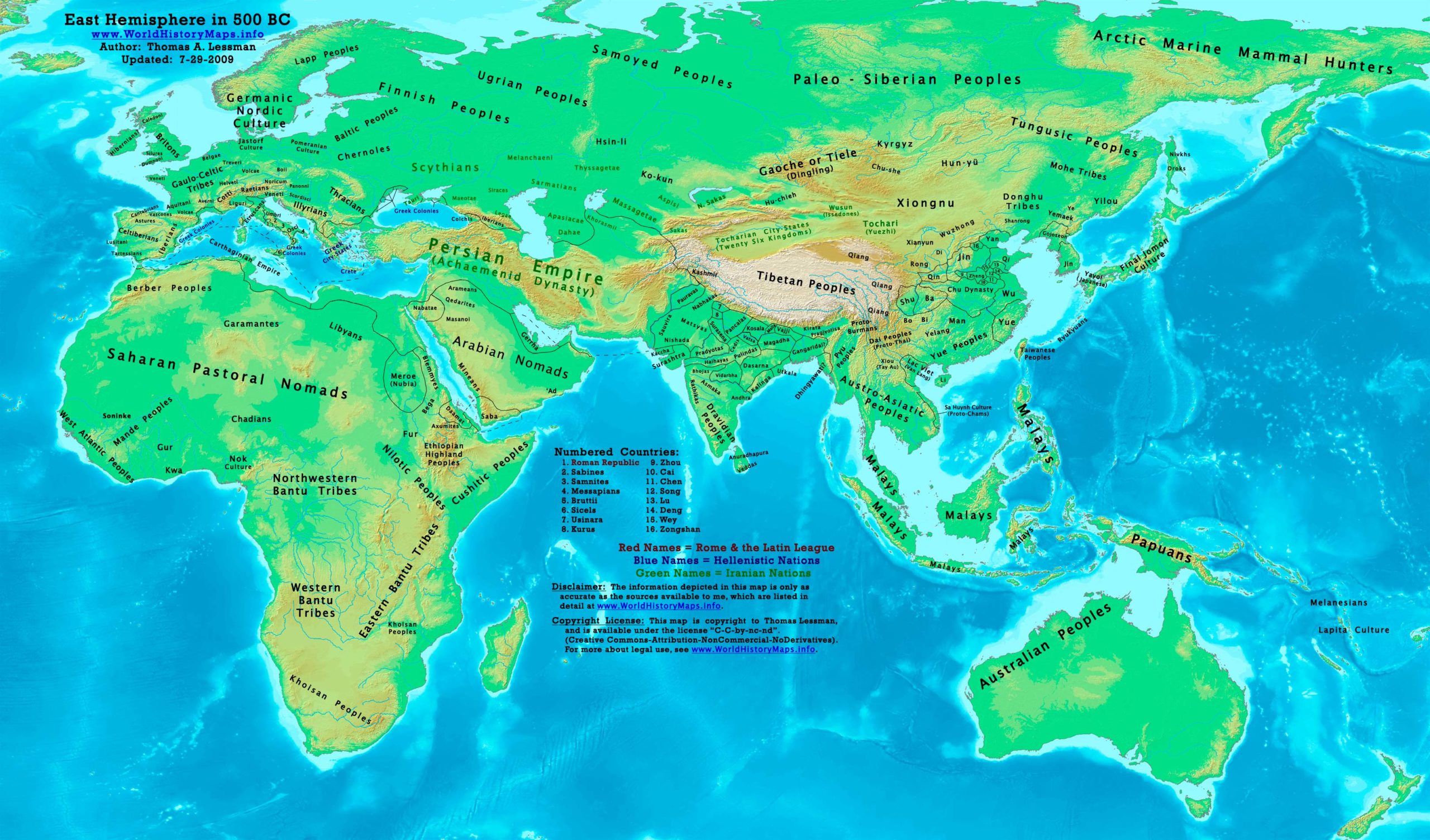
Source: www.WorldHistoryMaps.com from “Talessman’s Atlas of World History”.

YFull has amassed an extensive database of modern and ancient Y-DNA samples and computed time estimates for the formation of various branches. This post will outline some important observations from looking at the page for R1a-Z93, which arose in the steppe and became the dominant Y haplogroup in Fatyanovo culture and its descendant Abashevo and then the Sintashta culture, from which steppe ancestry in India and Iran ultimately originates.

Indic Lineages

Examining lineages with samples found almost exclusively in South Asia is instructive, especially when we look at formation dates of the lineages.

Dates

Consider the famous R1a-L657. The estimated formation date and TMRCA for it is ~2100 BCE.

That could of course be a fluke defined by some sort of later founding effects. But we can consider the other major subclade of R1a-Z93, namely R1a-Z2124. This is sometimes assumed to be an Iranic clade, but it contains Indic sub-branches as well, such as R-YP523 with a formation time of ~2100 BCE and TMRCA of ~1700 BCE, and R-Y46 and R-Y43743 both with formation time and TMRCA of ~1800 BCE. A little messier but also likely originally Indic is R-Y37 with a formation time of ~2500 BCE and a TMRCA time of ~2000 BCE.

Based on these, we can estimate that the main steppe migrants into India branched off from the rest of the steppe ~2100-1800 BCE. A plausible scenario is that at the same time that many Sintashta clans were spreading out and establishing the cultures of the Andronovo horizon as well as related cultures like Tazabagyab, one or more clans chose to travel past them into the Hindu Kush and the Indian subcontinent, contributing the bulk of steppe ancestry seen in modern day Indians. This is backed up by the fact that the Indian lineages seem to split off close to the time of expansion of R1a-Z93 into star like phylogeny, which is a tell-tale sign of rapid population expansion and migration of the kind observed archeologically in the Andronovo horizon.

Indic Samples in Arabia

What’s interesting is when we take a look at sublineages of these that have ended up in the Arabian peninsula, where modern Arabs have apparently been enthusiastic adopters of genetic testing services. There are some lineages from recent centuries (especially related to Pakistani lineages), but also many that go back significantly further.

These include one with formation time ~1800 BCE and TMRCA ~450 CE, another with formation time ~900 BCE and TMRCA ~1050 CE, one with formation time ~1100 BCE and TMRCA ~1450 CE, and one with formation time ~200 BCE and TMRCA 1450 CE.

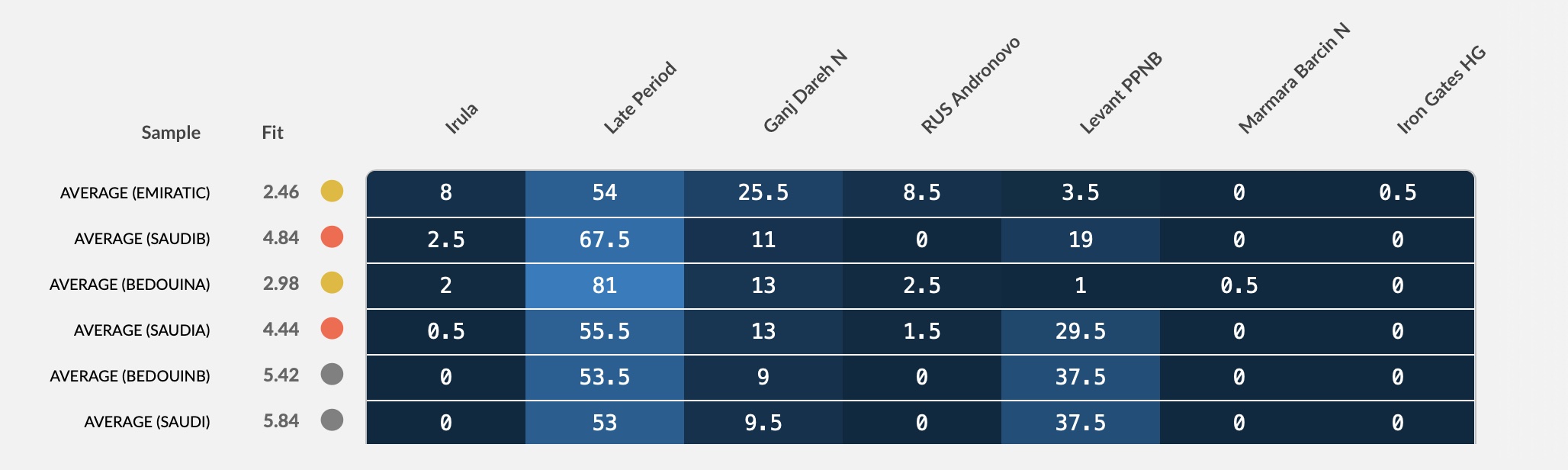
Likely all of these (or at the very least the first two) entered the Arabian peninsula via medieval, early historic, and protohistoric Indian Ocean traders. These samples are found across Arabia, including in Qatar, Bahrain, Oman, and western Saudi Arabia. In fact, we can see that there is some AASI admixture (using Irula as a proxy) in some modern populations in the Arabian peninsula.
Iranic Lineages

Russians

Unfortunately, very few samples from Iran are available, and they do not allow us to make meaningful conclusions. Fortunately, we have many samples available in Russia that are surviving descendants of Sintashta / Andronovo lineages, both in Z2124 and R1a-Y3 (from which L657 descends on the Indian side).

Both R-Y75187 and R-S23592 exhibit a mix of old (dating as far back as Andronovo) and modern samples in the Central Steppe in Turkic-speaking places like Bashkorstan, Tatarstan, Kazakhstan, and Kyrgyzstan. Another that shows modern samples in Russia (as well as an Azeri Iranian sample) is R-Y38987.

It should be noted that these R1a lineages are cannot be from any outflux from India – both their ancient and modern samples remain in the steppe, and no samples in these lineages are found in India. Additionally, the lineages were not spread by Buddhism, as the various Kipchak Turks such as Bashkirs and Tatars that settled this region of Russia practice Tengrism (or previously practiced Tengrism for those that have since adopted Islam), and never practiced Buddhism, unlike Turks and Mongols further to their east who adopted Buddhism.

Iranic Lineages in Arabs

What about Iranian influence in and near the Arabian peninsula? Well, R-BY149647 has both an Andronovo and modern Russian steppe sample as well as descendants in Arab countries. R-F1417 shows a lineage in Russia, another lineage in Arabs, as well as a sample in an Iranic tribe in ancient Kyrgyzstan.

Notably though, nearly all these samples are located in Kuwait or Ash Sharqiyah Province of Saudi Arabia. These likely originate with Iranian settlement and rule of modern day Kuwait under the Persian Empires. As such, though we don’t have many direct samples from Iran, neighboring Kuwait provides a useful source of data for Iranian lineages. Iran was not historically known as a major participant in the Indian Ocean trade, and this distribution of Iranic lineages appears to reflect that.

Conclusion

In summary, we’ve found that Indian R1a lineages from the steppe date to the early 2nd millennium BCE, consistent with a migration into India simultaneous with the Andronovo horizon. We’ve also found that we can observe surviving Iranic lineages in the Central Steppe in Russia, and that Iranian lineages to Kuwait and Ash Sharqiyah by land, while Indian lineages appear in the entire Arabian peninsula via ancient and medieval sea trade.
History and Evolution of Malayalam Cinema


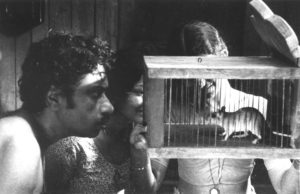
Arun talks to Maneesh on the history and evolution of Malayalam cinema.

What makes Malayalam cinema different from Tamil and Telegu cinema, the influence of communism on its early years and how the OTT phenomenon is helping a generation of film makers take Malayalam cinema to a new audience.

1IndiI. A Hindu Business Line article, which, while trying to explain why South Indian cinema has box office muscle also shows an excellent visualisation that explains the limitation of Kerala’s screen real estate
2. An Economic times article lamenting the lopsided economics of Malayalam cinema
3. Whitepaper from Kannur University talking about the conscious role of Communism in shaping Malayalam cinema
4. Screenwriter Joh Paul talks about the environment of early Malayalam cinema of the 50s

Modinomics: Why India is Rising

India is changing. For years the BJP has been banging drums, tolling bells, and blowing conches to signal a New India. A mammoth mandate in 2019 was an early smoke signal for the fire that had erupted in the Indian market, but now a flurry of foreign praise answers the call of the drums, bells, and conches previously labeled as empty and enemy propaganda. Ironically, the newly found foreign admirers just a few years back cried wolf as they predicted India to turn into a hellscape due to what they saw as economic mismanagement, not listening to “experts,” religious tensions, some random picture they saw on the internet, or any other reason a comprador elite would pass on from the home country. What changed?

There are plenty of articles about India’s rise, but very few about why. The reason for this is that they would have to associate with someone untouchable in their ivory towers. The government primarily responsible for this rise is not only the arch-nemesis of the narrators of India to the West but also has a terribly difficult time presenting their case in a manner that doesn’t involve frothing at the mouth. There have been many mistakes made along the way. There are many critiques worth their weight. But one has to start acknowledging that something special is occurring in India. Let’s explore why.

Continue reading Modinomics: Why India is Rising

On Centenarian Kissinger

Author’s Note: This is not an academic or objective essay; rather a personalised opinion on the soon-to-be centenarian former secretary of state.

On one occasion, a joke was made on television about how Fidel Castro survived attempts to have him removed by US presidents as well as the  downfall of USSR, who served as his main supporter. In 2023, a soon-to-be centenarian Dr. Henry Kissinger would be grinning and telling Castro’s soul to, as they say, “Hold his beer.” If the AI generator were asked to picturise “American foreign policy”, it would not be shocking if Henry Kissinger’s portrait or painting appeared. 

For decades, he was open and honest about his opinions on American foreign policy based on the pursuit of both national interest and power. In his own words: “A country that demands moral perfection of itself as a test of its foreign policy will achieve neither perfection nor security.” Kissinger has proven to be rich ground for historians and publishers. Along with business books about him as a deal-maker, there are also personality studies, tell-alls from former coworkers, and collections of his quotes.

Simultaneously, Kissinger had long been criticised by many as a ruthless realist. The critics would often quote Kissinger’s own words “when policy becomes excessively moralistic it may turn quixotic or dangerous”. Those words don’t seem all that offensive in retrospect after seeing so-called American moralist decisions made in places like Libya, Syria, Iraq, and Afghanistan. The critics would respond by citing Bangladesh and Chile as examples of how Kissinger was no better.

Weimar-Chile Connection 

For the last few years, Kissinger seems to no longer arouse widespread contempt. Instead, some individuals have since expressed some sympathy for him, tying Kissinger’s ruthlessness to his status as a former resident of Weimar Germany. Born Heinz Kissinger on May 27, 1923, to an Orthodox Jewish school teacher in Fürth, Bavaria. In 1938,  shortly before Kristallnacht, Kissinger and his family escaped to America, as did several German Jewish families.  Continue reading On Centenarian Kissinger

A Sojourn to Swades

For a foreigner, India is an assault on the senses. A land of every extreme you can imagine, every data point you can parse, and every anecdote you can hazard is found in this heterogenous homeland. An opulent ancient structure makes way for decrepit shantytowns which morph into a 21st-century skyscraper. Blaring horns that find a home on every road transform into the blowing of a conch and eternal songs. Pollution stings your nose and strangles your throat until you find refuge in the appetizing aroma of an eatery. Every flavor is expressed in a single bite of a chaat, akin to instruments combining in an orchestra of taste. An omnipresent dust travels across your skin as you hold the hands of a loved one not seen in ages. At this point, I feel a bit like Rupi Kaur narrating a diaspora novella about a visit to the homeland, but I’m guessing you get the point.

Continue reading A Sojourn to Swades

A Conversation on Caste with Dr. Prakash Shah

Postscript from Omar Ali: My apologies to Maneesh and Gaurav, who got very little air time. And my apologies to listeners. I think Prakash and I should have explained more clearly what his argument is. I can see that many listeners expected a description of caste oppression in India, not a discussion of why this description is itself problematic or at least, incomplete..

We may have ended up with a discussion that will fail to get past the existing beliefs of most listeners. I hope we will try again in the future and as is the case with all complicated arguments, it may become clearer with repetition and rejigging. For now, take my advice from late in this podcast and see what happens if you suspend judgment and give the arguments a chance… Also see the articles and books linked at the end.

Another Browncast is up. You can listen on LibsynAppleSpotify, and Stitcher (and a variety of other platforms). Probably the easiest way to keep up the podcast since we don’t have a regular schedule is to subscribe to one of the links above!

Dr Prakash Shah, Reader in Culture and Law at School of Law Queen Mary University of London, talks to Dr Ali on the framework of studying caste in India and it’s colonial antecedents.

A list of publications from Prakash Shah and associates can be found here. 

A long talk from Prakash Shah on this topic may give more background:


Conversation with Chitra Iyer: Founder- Space2Grow a Social Impact Firm

Another Browncast is up. You can listen on LibsynAppleSpotify, and Stitcher (and a variety of other platforms). Probably the easiest way to keep up the podcast since we don’t have a regular schedule is to subscribe to one of the links above!

Chitra Iyer, Co-founder and CEO of Space2Grow, talks to Maneesh about Anti Child Trafficking, Digital Safety and making  Indians employable.


You can read more about Space2Grow on:

Website : www.space2grow.in
LinkedIn  – Space 2 Grow (https://www.linkedin.com/company/space-2-grow/)
Facebook – Space2grow (https://www.facebook.com/profile.php?id=100064233876263)
Twitter – space2grow_llp (https://twitter.com/space2grow_llp)


Critical Caste Theory: A Dubious Discourse

As a tsunami of social justice sweeps across the world today, the roots of traditions are uprooted in an unrelenting furor. In India, the axe of modernity grinds against the caste system as caste, the primary identity of many Indians, now faces pressure from more cosmopolitan identities such as political ideology and class. While many see this as a positive development, some seek not only to entrench these age-old divisions but also enflame the trenches with the kerosene of hate. Building upon and going beyond colonial caste activists such as Ambedkar and the Phules, modern sociologists devise a theory designed to shatter Indian society and grant deliverance to the lower castes of India. While much of this theory is plagiarized from the infamous Critical Race Theory of America, caste is not race and race is not caste. You cannot tell someone’s caste by the color of their complexion or the features of their face. With the rise of Hindutva attracting a rainbow coalition of castes granting a decisive mandate to the BJP in India, the opposition seeks to break this coalition by inciting caste tensions, and it is in Critical Caste Theory that they find a prophetic message to part the saffron sea.

Critical Caste Theory does not seek the annihilation of caste no matter how much it harps on this talking point. Rather, it seeks the annihilation of Brahminism, a polemic and deceptive term for Hinduism originally used by Jesuit missionaries and colonial scholars. It is in the rigid contours of caste that CCT activists see the opportunity to exploit and shatter the cultural and religious body of India and Hinduism. Upper castes must be made aware of their ancestral penalties of the past, privilege of the present, and penance of the future. The lower castes must be made aware of the oppression of the past, discrimination of the present, and revolution of the future. The cloak of caste must smother all discourse surrounding politics, economics, and culture. And most of all – caste must be framed as a simple, homogenous concept that conquers time and space; heterogeneity is heresy.

Continue reading Critical Caste Theory: A Dubious Discourse

Did Hinduism Spread to South East Asia Via Missionaries – Response to The Print Article

On the 32nd Episode of The Indic Explorer Show, I spoke to Jeysundhar on How Did Hinduism Spread to South East Asia.

This is a response video with full historical sources on the Original Article written in The Print by Anirudh Kani titles ‘India’s Hindu preachers — How Shaiva monks converted Cambodia.’

Link Here-https://theprint.in/opinion/indias-hindu-preachers-how-shaiva-monks-converted-cambodia/1097764/

All Historical Sources used in this video are cited in the link of the Video Description.

The Indic Explorer YouTube channel focusses on the interplay of Indic culture with modernity explored through different facets in the socio-cultural sphere.

Do subscribe to the channel at https://www.youtube.com/theindicexplorer

and follow me here

Twitter- https://twitter.com/theindicexplor1

Instagram- https://www.instagram.com/theindicexplorer/

Substack-https://digitaldharma.substack.com/

Episode 21: South India Post Vijayanagar Empire till 1857


Another Browncast is up. You can listen on LibsynAppleSpotify, and Stitcher (and a variety of other platforms). Probably the easiest way to keep up the podcast since we don’t have a regular schedule is to subscribe to one of the links above!

Shrikanth talks to Maneesh about the History of South India post Vijayanagar kingdom till the year 1857.  He talks about the varies polities, their interactions and the Europeans among other facets that shaped the history of Deccan.

He wraps up the episode with the socio-cultural legacy of this period.


Sources and References:

1. History of the Nayaks of Madura : R Sathianatha Aiyar
2. The Nayaks of Tanjore : V. Vriddhagirisan
3. Textures of time : Writing history in South India – 1600-1800 – Sanjay Subramaniam, Velchuru Narayana Rao, David Shulman
4. Haidar Ali and Tipu Sultan : Lewin Bowring
5. Symbols of Substance : Court and State in Nayaka Period Tamil Nadu – Sanjay Subramaniam, Velchuru Narayana Rao, David Shulman
6. Thomas Munro : The Origins of the Colonial State and His Vision of Empire – Burton Stein
7. Why Europe Grew Rich and Asia Did Not? Global Economic Divergence, 1600–1850 – Prasannan Parthasarathi

8. India, Modernity and the Great Divergence: Mysore and Gujarat 17th to 19th c – Kaveh Yazdani

9. History, Institutions, and Economic Performance: The Legacy of Colonial Land Tenure Systems in India – Abhijit Banerjee and Lakshmi Iyer


Brown Pundits