Perhaps India is not special in resisting Islamicization

I have posted my thoughts as to why India, unlike Iran or Central Asia, resisted total Islamicization, before. It seems to be a phenomenon that demands an explanation.

And yet does it?

As I read F. W. Motte’s Imperial China 900-1800 I am struck by Han civilization’s resilience and absorptive capacity. What does that remind us of?

With some hindsight, perhaps I was asking the question because I constrained my dataset to West and South Asian societies, where India, in particular, seemed exceptional. But if you add China to the mix, then India’s robustness seems less incredible.

Timur died en route to China because he was keen on invading it. Many Muslims believe that Timur’s death prevented the Islamicization of the Han. After reading Imperial China I believe that this is false. Even if Timur conquered China, the Chinese would be resistant to Islam, and likely throw off the conqueror’s successors in short order.

Those conquest dynasties, such as the Manchus, who were successful in China underwent total assimilation. Those, such as the Mongols, who ultimately refused to kowtow to the verities of the Chinese, were expelled.

Taking this comparative perspective it is less surprising that so many South Asians became Muslim. Indians, “Hindus”, were ethnoculturally diverse and distinctive from each other in a way that Han Chinese never were. Muslim conversion of some elites and the targeting of oppressed castes was possible because Indian society was fractured in a way that the Han never were.

Of course, the Persians become Muslim in toto. But the Persians never had an identity to match the Han.

What the f*ck is Pakistan/PTI doing

https://www.facebook.com/photo.php?fbid=2059375517426582&set=a.181753635188789&type=3&theater

Image may contain: text

Vidhi pointed me to this but I am simply shocked by the f*cked up PTI agenda. Yet again Pakistan is treading on the path of self-destruction.

I have noticed that Sunoo Chanda is a bit “fast”; bit of touching by Farhan Saeed and Iqra Aziz, some simmering moments.

This is what happens when a culture starts defaming its martyrs to freedom like Qandeel Baloch.

I’m shocked and angry with the retrograde, shitty attitude by the Pakistani authorities. ISI have really let the Ummah down; we might just get kicked out of Turan because of this!

Thoughts on Section 377

I don’t usually like to type out posts on my cell but I’ll make an exception this time.

I first came to know about this on Karan Johar’s Instagram Feed then all the celebs followed.

India and Pakistan are going off on different trajectories. I do generally applaud the Indian model but does one have to be Western to be wealthy?

As a personal aside I’m generally in favour of licentiousness but I find the perennial identity wars in the West to be tiresome. It’s probably a side effect of the intense loneliness that liberal hyper capitalism brings about.

Culture can be more powerful than biology

An interview with the author of I Should Have Honor: A Memoir of Hope and Pride in Pakistan. It’s a difficult listen. Basically illustrates how in some “traditional” cultures women are treated like disposable and fungible property.

As a geneticist and a father, one thing about “honor killing” that always strikes me is that it illustrates the power of environmental and cultural pressures in comparison to biology and genetics. When a father, or a brother, kills a daughter or a sister, they kill a part of themselves. Additionally, I don’t think the love and affection that fathers have toward their children is a culturally learned artifact, though some fathers are quite busy, with large broods, and distant.

And yet despite the reality of fatherly or brotherly affection, because of the cultural conditioning and incentive structures in extended family kinship networks, they still murder their daughters and sisters.

Human plasticity trumps biology!

Turan seeks peace..

ISLAMABAD, Pakistan — Concerned about Pakistan’s international isolation and faltering economy, the country’s powerful military has quietly reached out to its archrival India about resuming peace talks, but the response was tepid, according to Western diplomats and a senior Pakistani official.

The outreach, initiated by the army’s top commander, Gen. Qamar Javed Bajwa, began months before Pakistan’s national elections. Pakistan offered to resume on-and-off talks with India over their border dispute in the Kashmir region, which stalled in 2015 as violence flared up there.

A key objective for Pakistan in reaching out to India is to open barriers to trade between the countries, which would give Pakistan more access to regional markets. Any eventual peace talks over Kashmir are likely to involve an increase in bilateral trade as a confidence-building measure.

Pakistan’s Military Has Quietly Reached Out to India for Talks

Takeaways from the golden age of Indian population genetics

There are lots of strange takes on the India Today piece, 4500-year-old DNA from Rakhigarhi reveals evidence that will unsettle Hindutva nationalists. I’m friendly with the author and saw an early draft. So I’m going to address a few things.

The genetic results are becoming more and more clear. A scaffold is building and becoming very firm. In the 2020s there will be a lot of medical genomics in India. But before that, there will be population genetics. Ancient DNA will be the cherry on the cake.

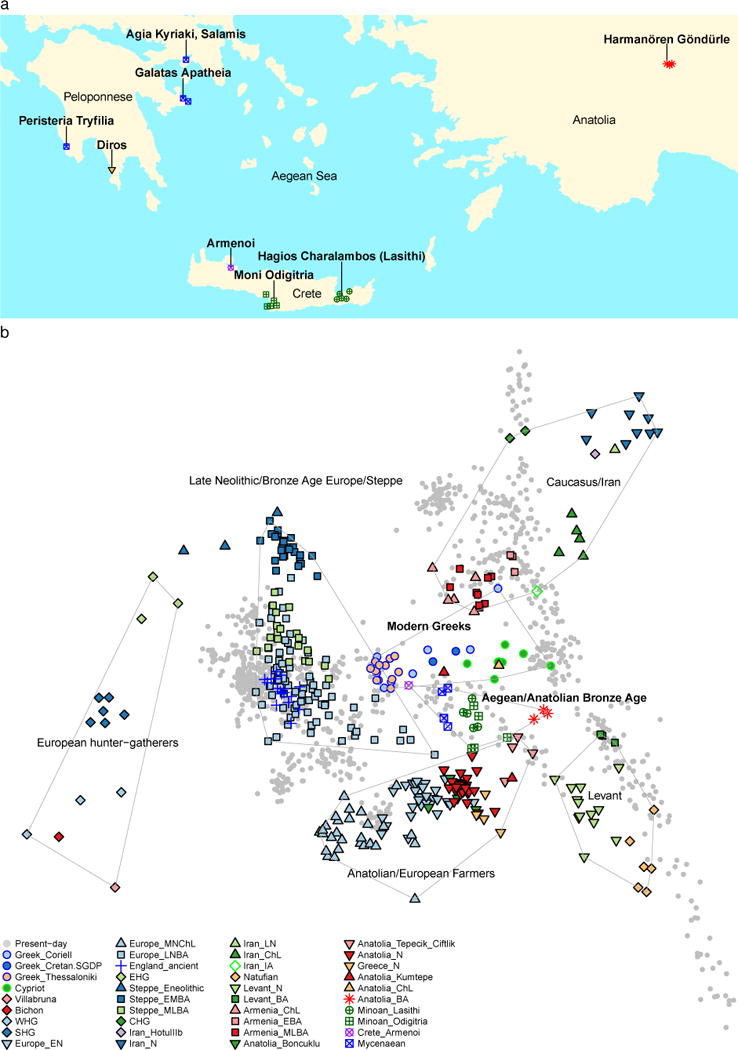
Here’s what genetics tells us. First, a component of South Asian ancestry, especially in North India, and especially in North Indian upper caste groups, seems to be the same as ancient agro-pastoralists who ranged between modern Ukraine and modern Tajikistan. Genetically, these people are very similar to certain peoples of Central and Eastern Europe of this time, though there is a varied dynamic of uptake of local Central Eurasian elements as they ranged eastward.

This ancestral component is often called “steppe.” This ancestral component is a synthesis of ancient European hunter-gatherer, Siberian, and West Asian. The steppe component seems to arrive in Central and South Asia after 2000 BC.

Second, another component of South Asian ancestry is very distinctive to the region. It is deeply but distantly related to branches of humanity which dominate Melanesia and eastern Eurasia, up into Siberia. The magnitude of the distance probably dates to ~50 thousand years ago, when the dominant element of modern humans expanded outward from West Asia, east, north, and west. These people are called “Ancient Ancestral South Indians,” or AASI. Their closest relatives today may be the natives of the Andaman Islands, but this is a very distant relationship.

AASI is the dominant component of what was once called “Ancestral South Indians,” or ASI. It turns out that “ASI” themselves were a compound synthetic population. This was long suspected by many (e.g., David W.). What was ASI a compound of? About ~75 percent of its ancestry was AASI, but the balance seems to have been a West Eurasian component related to farmers from western Iran. We can call this group “farmers.”

With a few samples from outside of the IVC region, and one (or two) samples from within the IVC region, geneticists are converging upon the likelihood that the profile in the greater IVC region before 2000 BC was a compound of these farmers with the AASI. But even within the IVC region, there seems to have been a range of variation in ancestry. The IVC was a huge zone. It may not have been dominated by a single ethnolinguistic group (even today there is the Burusho linguistic isolate in northern Pakistan). Note that the much smaller Mesopotamian civilization was multiethnic, with a  non-Semitic south and a Semitic north (Sumer and Akkad).

The key point is that it is very likely the IVC lacked the steppe ancestral component. That it did have AASI component. And, it did have a farmer component with likely ultimate provenance in western Iran. Additionally, there were smaller components derived from pre-steppe Central Eurasian people.

While the steppe people arrived in the last 4,000 years, and at least some of the ancestors of the AASI are likely to have been in South Asia for 40,000 years, the presence of the AASI-farmer synthesis genetically is conditional on when a massive presence of western farmers came to affect the northwestern quarter of South Asia. It seems unlikely to have been before Mehrgarh was settled 8,500 years ago. The genetic inferences to estimate the time of admixture between AASI and farmer are currently imprecise, but it seems likely to have begun at least a few thousand years before 2000 BC.  range of 8,500 and 6,000 years ago seems reasonable.

So 4,000 years ago the expanse of the IVC was dominated by a variable mix of farmer and AASI. One can call this “Indus Valley Indian” (IVI).

Just like ASI, there was an earlier abstract construct, “Ancestral North Indian” (ANI). Today it seems that that too was a compound. To be concise, ANI is a synthesis of steppe with IVI. The Kalash of northern Pakistan are very close genetically to ANI. This means that while ASI had West Eurasian ancestry, albeit to a minor extent. And ANI had AASI ancestry, albeit to a minor extent. The main qualitative difference is that ANI had a substantial minority of steppe ancestry.

To a great extent, the algebra of genetic composition across South Asia can be thought of as modulating these three components, farmer, steppe, and AASI.* Consider:

  • Bhumihar people in Bihar tend to have more steppe than typical, but not more farmer than typical, and average amounts of AASI.
  • Sindhi people in Pakistan tend to have lots of farmer, some steppe, and not much AASI.
  • Reddy people in South India have lots of farmer, very little steppe, and average amounts of AASI.
  • Kallar people in South India have some farmer, very little steppe, and lots of AASI.

For details of where I’m getting this, you can look at The Genomic Formation of South and Central Asia for quantities. But as a stylized fact farmer ancestry tends to peak around the Sindh. In Pakistan steppe ancestry increases as you go north. As you go east and south AASI increases pretty steadily, but there are groups further east, such as Jatts and Brahmins, who have a lot of steppe, almost as much as northern Pakistani groups. And curiously you get a pattern where some groups have more steppe and AASI, and less farmer, than is the case to the west (you see this in the Swat valley transect, as steppe & AASI increase in concert).

Going back to the history, by the time the steppe people arrived in South Asia, in the period between 2000 BC and 1000 BC, it may be that the IVI ancestry is what they mixed with predominantly. Though it is likely that the southern and eastern peripheries had “pure” AASI, by the time steppe people spread their culture to these fringes they were already thoroughly mixed with IVI populations, and so already had some AASI ancestry.

In contrast, the farmer populations likely mixed extensively with AASI in situations where the two populations were initially quite distinct.

Please note I have not used the words “Aryan” or “Dravidian.” The reason is that these are modern ethnolinguistic terms. Genetics is arriving at certain truths about population changes and connections, but we don’t have a time machine to go back to the past and determine what language people were speaking 4,000 years ago.

Our inferences rest on supposition, and a shaky synthesis of historical linguistics and archaeology and genetic demography, a synthesis which is unlikely to ever be brought together in one person due to vast chasm of disciplinary method and means.

It is highly likely that the steppe component is associated with Indo-European speaking peoples. Probably Indo-Aryan speaking peoples. The reason is that by historical time, the period after 1000 BC, Iran and Turan seem to already have been dominated by Indo-Iranian peoples. But, in the period around 2000 BC, western Iran was not Indo-Iranian. People like the Guti and the Elamites were not Indo-European, and they were not Semitic. We have some genetic transects which show that steppe ancestry did arrive in parts of Turan and Iran in the period after 2000 BC.

Where did the Dravidian languages come from? We don’t know. They could have been spoken by an AASI group. Or, they could be associated with farmers from the west. We don’t know. Ultimately, we may never know. Unlike Indo-European languages, there are no Dravidian languages outside of South Asia.

Various toponymic evidence indicates that Dravidian languages were spoken at least as far north and west as Gujurat. And Brahui exists today in Balochistan. Though I don’t have strong opinions, I think Dravidian languages probably are descended from a group of extinct languages that were present in Neolithic Iran.

Though unlike Indo-Aryan languages, Dravidian exploded onto the scene after a long period of incubation within South Asia, as part of at least one of the language groups dominant with the IVC and pre-IVC societies.

At least that’s my general assessment. I have strong opinions about the genetics. But am much more curious about what others have to say about linguistics and archaeology.

* Some groups, such as Munda and Indo-Aryan groups in Northeast India, have East Asian ancestry. Some groups in coastal Pakistan have African ancestry.

Why this kolaveri di on Indian genetics

I perused through the article linked in Razib’s previous post. I stumbled on this caption embedded in the beginning of the article:

NOT THE SAME: The Indus Valley people lacked the steppe and ancestry that marks many North Indian high castes today (Photograph by Bandeep Singh, for representational purpose only)
I find the association that the prototypical Indian is a high-caste Hindu to be in poor taste.

Genetics stories in India Today

4500-year-old DNA from Rakhigarhi reveals evidence that will unsettle Hindutva nationalists:

The ‘petrous bone’ is an inelegant but useful chunk of the human skull — basically it protects your inner ear. But that’s not all it protects. In recent years, genetic scientists working to extract DNA from ancient skeletons have discovered that, thanks to the extreme density of a particular region of the petrous bone (the bit shielding the cochlea, since you ask), they could sometimes harvest 100 times more DNA from it than from any other remaining tissue.

Now this somewhat macabre innovation may well resolve one of the most heated debates about the history of India.

And, from me, 3 strands of ancestry.

Nothing new for close readers. I would caution

1) Many Hindu nationalists really don’t care and are not perturbed by these findings. I know, because I know them.

2) I don’t know if the paper is going to be published soon. It may, but we’ve been waiting two years now.

Brown Pundits