When writing about India is actually just writing about America

The web magazine Slate posted a piece, Friends From India which I had initially thought was a parody. Its subtitle is: “I grew up watching the show in Mumbai. I worry about the damage its gender stereotypes still do there.”

It’s really bizarre. The author is Indian, and supposedly is making a comment about India. But the piece isn’t about India at all, but the worries and concerns of a liberal person in the West. Friends isn’t that important in driving social views in India, and gender relations and attitudes toward homosexuality in India have little to do with Friends. But, today Friends seems retrograde to many American liberals, because of its attitude toward gender relations and gayness, which were mainstream in the 1990s.

So it seems here that to get another piece on Friends and social justice into Slate, they just commissioned a piece that was officially about India, but quite obviously wasn’t.

This gets to a major dynamic in American society today which worries me somewhat: foreign affairs being filtered through purely American concerns and perceptions. Americans care so little about the rest of the world that they turn the rest of the world into the United States in substance, if not exterior styles.

The problem is that we are living through a great transition in the world. America is no longer as much the center, and economic, social, and political, power will rebalance toward Asia. In such a multipolar world pandering to purely American preoccupations will lead to gross misunderstandings and likely catastrophe.

India as the hydra against Islam

In some versions of the legend of the Hydra, every time you cut off one of the heads of the monster two more grow in its place.

I have been thinking about why and how India remained predominantly non-Muslim despite most of the subcontinent being under Muslim ruling for 500 years (dating from 1250 to 1750 approximately). The contrast here would be most stark with Iran and Turan. While the zone of the Islamic Empire between Mesopotamia and the Maghreb was dominated by a Christian populace which spoke an Afro-Asiatic language, Iran and Turan retained their language and their cultural distinctiveness, as evidenced in the nationalism clear in the Shahnameh.

There was a comment on this weblog that implied India was unique because of violent resistance to Islamicization. This is patently false. To give a concrete example, the region of Tabaristan in northern Iran was dominated by warlords and dynasties which adhered to the Zoroastrian region until the 9th century, 200 years after the Arab defeat of the Sassanians. Despite the inroads of Islam in the 9th century, after more thorough integration into the Abbassid Caliphate, Tabaristan was still throwing up Zoroastrian anti-Muslim warlords into the 10th century.

But most attempts to infer the religious demographics of Iran, which are to a great extent guesswork, suggest that it was in the 10th century the region became majority Muslim. One indication of this that this is so is that this period correlates with a more muscular and resurgent Iranian high culture and reemergence of political non-Arab political power. As Zoroastrianism was no longer seen as a threat to Islam, Persian cultural identity could reassert itself without a non-Islamic connotation (there is in the 10th century a shift away from ostentatiously Arab names by Persian Muslim elites).

Basically, it seems that it took about 300 years for Iran to become majority Muslim. I’ve seen similar numbers for Egypt and the Maghreb, though in the latter region indigenous Christianity became extinct by the medieval period.

There are two related issues that I want to suggest for South Asia: scale and complexity. Though the Indian subcontinent is geographically smaller than the Arab Caliphates as their height on paper, the reality is much of the Near  East and North Africa are empty of people. Islamic rule really consisted of a string of cities and fortifications interlaced over broad swaths of the territory occupied by pastoralists, as well as a few regions of dense cultivation.

Iran, Turkey, and the Arab world consist of between 400 and 500 million people. The Indian subcontinent has 1.7 billion people. The population in the past may have been different, but I think it gives one a rough sense of the differences in magnitude over the long-term.

Second, the social complexity of South Asia is astounding. I say this as a geneticist: the differences between different castes in the same region are hard to believe. Though there is a great deal of ethno-religious diversity in the Middle East, they are not surprising. Arabs engage in a consanguinity. Ethno-religious minorities such as Copts or Assyrians have less cosmopolitan ancestry than their Muslim neighbors. This is all to be expected.

In contrast, any analysis of ethnic “Telugus” has to take into account local structure because it is so extreme. Dalits are different from middle castes are different from Brahmins. Some of this is due to genetic drift, but much of it is due to continental-scale differences in genetic admixture.

The genetic differences tell us something us deep about the nature of South Asian social relations. Defection to Islam occurred on the individual scale, but generally, quantity could only be had by mass conversions. Even when groups of people of the same community are of different religions it was probably through mass conversion of particular subsegments.

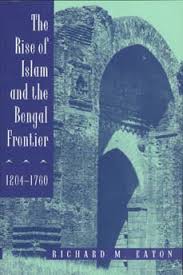
Which brings me to Bengalis. The Rise of Islam and the Bengal Frontier was written many years ago, and I read it long before I ever knew much about the genetics of South Asians. In it the author explains that the dominance of Islam on the eastern march of Bengal was due to the fact that it was a frontier society that emerged during the period of Islamic rule. Meanwhile, western Bengal was a culture which was in a stationary state.

The ability of Islam to penetrate into the Bengali-speaking peasantry was due to its fluid and unordered character. In contrast in western Bengal, a more traditional South Asiab society with well-delineated caste boundaries had already crystallized by the time of the Muslim conquest.

So here’s the thing that genetics adds: the topology of genetic variation of Bangladeshis is totally different than what you see in other South Asians. There’s very little structure. Basically aside from a few half-Brahmins and a small community of Dalits, the 1000 Genomes sample from Bangladesh shows none of the genetic variation partitioned by the community you see in most Indian samples. Or, that you see in the Indian Telugus, Gujuratis and Pakistani Punjabis (the Tamils from Sri Lanka are somewhat less structured, but still have more than the Bangladeshis).

To me, this confirms the thesis of The Rise of Islam and the Bengal Frontier. As a frontier society, eastern Bengal was mixed in a way where the structure socially and genetically that was the norm in most of South Asia by the time the Muslims arrived simply wasn’t present. Without the powerful collective substructure, Islam was able to swallow up the rural society in toto. Perhaps the best analogy might be to Indian communities in Trinidad, where caste has mostly disappeared, and Christianity has made extensive inroads.

So why didn’t India become Muslim? What is this “India” of which you speak?

Note: I moderate comments, please don’t stupid spam me.

You the Marathas, we the Mughals & Dalrymple the Coloniser

As an aside I wanted to say that Dalrymple is a joke and an appropriator. Even though I am a Mughalist I do not wish to be lectured on my history by a coloniser, who somehow claims distant Indian+Persian ancestry. If you coast on White Privilege then don’t expect to be an authority on Colored Topics. That’s appropriation simple as!

Now back to my original post. Bharata wrote:

“Right after british conquest, whose real victory was over marathas, it removed them, their soldiers had no employment, they became the thugee cult.”

I may not be an expert in Indian history but I think it is a bit of a stretch to claim the British won India from the Marathas or from Ranjit Singh.

Sometimes traditional history does make sense and while there is an element of “history being written by the conquerors” we must also avoid extreme revision.

I’m not personally invested either way; maybe the Mughal Empire had crumbled to that point of nothingness but to somehow constantly impugn it strikes me as somewhat undignified. If Indians/Hindus hate that aspect of their history so much, which we love so much; how can we really hope to bridge the divide.

In fact in that case it’s far easier for the two countries to look elsewhere because on the most basic existential issue we back different sides (we the Mughals, you the Marathas).

Somehow I don’t think history was that way; the Mughals had Hindu nobles and the Marathas had Muslim generals.

But I couldn’t give up on Akbar or even Aurangzeb; one can’t betray one’s ancestor and the Pakistani psychosis conditions us to see them as so regardless of the facts of the matter.

Unless there is true acceptance of the Mughals (look at the late 19th century butchery of the Urdu language) there will never ever be a United Subcontinent and the kernel of Muhajir Resistance (manifested in Pakistan – for what is Pakistan without the Muhajir but a collection of Muslim tribals on the Indus who have frankly and historically very little to do with Mughal majesty but with their own cute & folk traditions) will manifest itself somehow.

The Philippines Genocide: 3 million Filipinos Killed

I guess “Holocaust Deniers” all over the world.

Just the excerpts from the reports during the period (Spanish American War 1898).20 dead filipinos

General Bell himself, who said “we estimated that we killed one-sixth of the population of the main island of Luzon—some 600,000 people.” (There is another Bell, George who also fought in the Philippines ).  Also see Gore Vidals reply on comment questioning the numbers.

The Philadelphia Ledger November 1901 their Manila correspondent wrote “The present war is no bloodless, opera bouffe engagement; our men have been relentless, have killed to exterminate men, women, children, prisoners and captives, active insurgents and suspected people from lads of ten up, the idea prevailing that the Filipino as such was little better than a dog…

Our soldiers have pumped salt water into men to make them talk, and have taken prisoners people who held up their hands and peacefully surrendered, and an hour later, without an atom of evidence to show that they were even insurrectos, stood them on a bridge and shot them down one by one, to drop into the water below and float down, as examples to those who found their bullet-loaded corpses.”

Another Marine officer described his testimony.

The major said that General Smith instructed him to kill and burn, and said that the more he killed and burned the better pleased he would be; that it was no time to take prisoners, and that he was to make Samar a howling wilderness. Major Waller asked General Smith to define the age limit for killing, and he replied “everyone over ten.”


Mark Twain wrote

“…I have seen that we do not intend to free, but to subjugate the people of the philippines. we have gone to conquer, not to redeem… and so i am an anti-imperialist. i am opposed to having the [american] eagle put its talons on any other land.”

On 15th of October 1900 Twain wrote the New York Times.

We have pacified some thousands of the islanders and buried them; destroyed their fields; burned their villages, and turned their widows and orphans out-of-doors; furnished heartbreak by exile to some dozens of disagreeable patriots; subjugated the remaining ten millions by Benevolent Assimilation, which is the pious new name of the musket; we have acquired property in the three hundred concubines and other slaves of our business partner, the Sultan of Sulu, and hoisted our protecting flag over that swag. And so, by these providences of god — and the phrase is the government’s, not mine — we are a World Power.” Mark Twain

 Please read the whole Post.  Interesting pictures.  Also President McKinley ‘s Christian reasons for the war.

https://britsinthephilippines.top/philippines-genocide-3-million-filipinos-killed/

Will India and Pakistan Learn from the Historic Korea Summit?

The gradual process of mending ties through sports, cultural exchanges and the historic meet presents a lesson for several sparring countries across the world. This is particularly true for India and Pakistan, as the South Asian neighbours were also partitioned from one region and share a historical, socio-cultural and linguistic inheritance, as the two Koreas do.

So the question remains of whether India and Pakistan be rid of their adamant attitudes and restart the athletic and cultural exchanges that have been on pause for years. This is a lesson they could take from the historic meeting in the Korean peninsula, which has witnessed much more violence and bloodshed than the Indian subcontinent in the last six decades. Over 12 lakh people are estimated to have been killed in the Korean War, as compared to over a lakh in the Kashmir conflict, the main bone of contention between India and Pakistan.

Will India and Pakistan Learn from the Historic Korea Summit?

My quibble is that the two Koreas are more akin to the two Punjabs or Bengals than they are to Indo-Pak.

India and Pakistan now have very different national traditions where the modern states are built on a rivalry with one another. Pakistan much more so than India but as Kabir says there is far too much blood under the bridge (I’ve butchered that saying) that the best we can hope for is normalised relations.

I don’t know much about Korean history but there is another different; unified Korea is a bit like unified Germany there is one national narrative. But think Anschluss (Austria + Germany) would it be the Catholic Hapsburg or Protestant Prussians (let’s set aside the last example of Anshluss) that would define the hypothetical Germanic state.

Similarly would Indo-Pak reunification be Akhand Bharat or the Mughals resurrected since I imagine no one has the appetite for the Raj.

Why do Indians care about OIT/AIT

From my blog:

Razib: I follow your super feed and read your postings here and on Brown Pundits. The subject of the ancestry of South Asians comes up frequently. It seems to have a political valence that I, as an outsider, do not understand.

Can you explain it? or point us to an explanation?

My response is “British colonialism and modern-day culture wars.” I could say more, but honestly, I don’t care that much. The science is more interesting to me, and it’s a lot to keep track of. Can readers comment?

(Related: there are some Pakistanis who try and pretend as if they are descended from Persians, Turks, or even Arabs. The explanation is pretty straightforwardly summarized as “self-hatred”, though we could all elaborate on that).

Question of the Day?

Setting aside my personal views entirely.

Why is Partition a bad idea but Indian independence a good one?

Why is Jinnah a villain but Gandhi & Nehru not?

Does Pakistan have an original sin that it can’t account for?

The reason I ask is that we need to come to BP to examine our preconceptions constantly otherwise what is the point of wasting our collective time.

South Asians and “communalism”

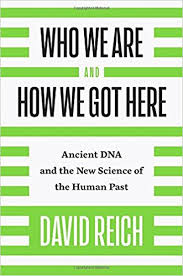
In Who We Are and How We Got Here one of the things that David Reich states is that while China consists to a great extent of one large ethnic-genetic group, India (South Asia) is a collection of many ethnic-genetic groups. To some extent, this is not entirely surprising. People from the far south of the subcontinent look very different from people from Kashmir or Punjab.

But that’s really not what Reich is talking about. People in Hebei look quite different from people in Guandong. Perhaps less different than a Tamil from a Kashmiri, but still quite different. But these regional differences grade into each other along a cline.

South Asia is different because strong genetic structure persists within regions. Both Tamil and Bengali Brahmins share some distinctive genes with local populations, but genetically they’re still a bit closer on the whole to Brahmins from Uttar Pradesh (I say this because I’ve looked at a fair number of genotypes of these groups). Similarly, Chamars from Uttar Pradesh and Dalits from Tamil Nadu share more with each other than either do with Brahmins from their own regions (though again, Chamars share more with Brahmins from Uttar Pradesh than Dalits from Tamil Nadu, in part because of gene flow from Indo-Aryan steppe pastoralists into almost all non-Munda people in the Indo-Gangetic plain).
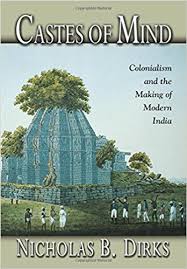
When I read Castes of Mind: Colonialism and the Making of Modern India in the middle 2000s it seemed a persuasive enough argument to me. I had read other things about caste during that period, by both Indians and non-Indians. The authors were historians and anthropologists and emphasized the cultural and social preconditions variables shaping the emergence of caste..

The genetic material at that time did not have the power to detect fine-grained differences (classical autosomal markers) or were only at a single locus (Y, or, more often mtDNA). By the middle to late 2000s there was already suggestion from Y/mtDNA that there was some serious population structure in South Asia, but there wasn’t anything definitive.
A full reading of works such as Castes of Mind leaves the impression that though some aspect of caste (broad varnas) are ancient, much of the elaboration and detail is recent, and probably due to British rationalization. The full title speaks to that reality.

This is one reason I was surprised by the results from genome-wide analyses of Indian populations when they first came out. On the whole, populations at the top of the caste hierarchy were genetically distant from those at the bottom, and the broad pattern of the differences was mostly consistent across all of South Asia.

To give a concrete example, there are “lower caste” groups in Punjab which may have more steppe pastoralist ancestry than South Indian Brahmins. But within Punjab “highest caste” groups still have more ancestry than “lower caste” groups.

But this wasn’t the most shocking aspect. That was the fact that many castes are genetically quite distant, and anciently so. In a recent paper, The promise of disease gene discovery in South Asia:

We identify 81 unique groups, of which 14 have estimated census sizes of more than a million, that descend from founder events more extreme than those in Ashkenazi Jews and Finns, both of which have high rates of recessive disease due to founder events.
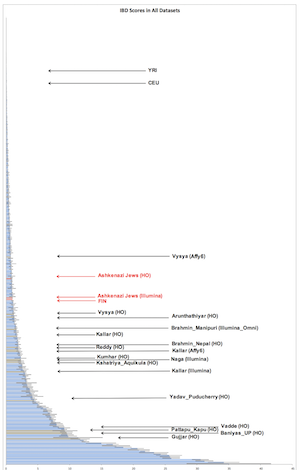
Some of this is due to consanguinity among Muslims and some South Indian groups, but much of it is not. Rather, it’s because genetically it looks like many Indian communities stopped intermarrying ~1,500 years ago. This reduces the effective number of ancestors even in a large population due to increased drift. At a recent conference, an Indian geneticist suggested that this might have something to do with the crystallization of caste Hinduism during the Gupta period. I can’t speak to that, but anyone who has looked at the data sees this pattern.

To illustrate what I’m talking about, assume ~1% introgression of genes from the surrounding population in a small group. Within 1,500 years 50% of the genes of the target population will have been “replaced.” The genetic patterns you see in many South Asian groups indicates far less than 1% genetic exchange per generation for over 1,000 years in these small groups.

But this post isn’t really about genetics. Rather, I began with the genetics because as an outsider in some sense I’ve never really grokked South Asian communalism on a deep level. Yet the genetics tells us that South Asians are extremely endogamous. It is unlikely that this would hold unless the groups were able to suppress individuality to a great extent. Though people tend to marry/mate with those “like them”, usually the frequency is not 99.99% per generation.
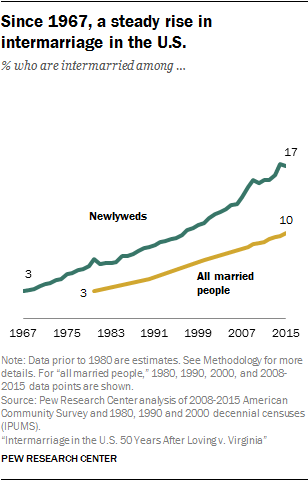
In the United States, things are different. Interracial marriage rates were ~1% in 1960.* This was still during the tail end of Jim Crow in much of the south. Since then the fraction of couples who are in ethno-racial mixed marriages keeps increasing and is almost 20% today. There is still a lot of assortative mating, and ingroup preference. But fractions in the 10-20% range are worrisome for anyone who is concerned about genetic cohesion over a few generations.

Though some level of group solidarity exists, explicitly among minorities, and implicitly for non-minorities, individual choice is in the catbird seat today. This was not always so. By the time I was growing up in the 1980s social norms had relaxed, but a black-white couple still warranted some attention and notice. In earlier periods interracial couples had to suffer through much more ostracism from their families and broader society.

In some South Asian contexts, this seems to be true to this day. But unlike the United States the situation is much more complex, with numerous ethno-religious-linguistic subgroups operating in a fractured landscape of power and identity.

I have wondered in part whether the South Asian fixation on sensitivity and feeling when it came to offense and insult is a function of the strong communal/collective aspect to honor, identity, and decision-making. Muslims outside of South Asia are similar to this, and in the Islamic context the rationale is quite explicit: non-Muslims and heretics are tolerated so long as they don’t challenge the public ethno-cultural supremacy of Islam. For example, atheism is punished less because of deviation from religious orthodoxy and more because it destabilizes public order and is seen as a crime against the state.

The conflicts between Hindus and Muslims in relation to religious parades have their clear analogs to strife between the dominant Catholics and the new Protestant communities in Latin America. But among Hindus the same tendencies crop up in inter-caste conflicts. The sexual brutalization that is sometimes reported of lower caste women by upper castes in parts of the Gangetic plain is a trivial consequence of the power that land-holding upper castes have over all the levers of power over low castes in certain localities. Lower caste men are powerless to defend their women against violation, just as in the American South enslaved black men couldn’t shield their womenfolk from the sexual advances of white men.

Will any of this change? I suspect that economic development and urbanization is the acid that will start to break down these old tendencies and relations in South Asia. It also seems clear that all South Asian communities which are transplanted to the more individualistic West have issues with the fact that collective and communal power is not given any public role, and in a de facto sense has to face the reality that individual choices in mates and cultural orientation are much more viable in the West.

This is particularly important to keep in mind on a blog like this, where many people are reading from South Asia (mostly India) and many are reading in the USA and UK. The conflict of values and signifiers occasionally plays out in these comments! For example, a Hindu nationalist commenter once referred to me as “Secular.” As an atheist, materialist, and someone who is irreligious in terms of identity and affiliation, secular describes me perfectly…in the West. But I was aware of the connotations of the term in India in particular, I told him that in fact, I wasn’t “Secular” in the way he was suggested. The reality is that unlike Indian Americans I don’t take a strong interest in what India does so long as it’s a reasonably stable regime, and so don’t signal my affiliation with Hindu nationalism or anti-Hindu nationalism.

* Latinos were not counted as part of this in 1960, so the rate looking at those numbers is 0.4%. I assume this is an underestimate because of Latinos.

Paki Pundits

I’m responding to Kabir’s concerns that this blog is becoming far too Islam-focussed and not in a nice way.

I have been very busy so I’ve been following the threads quite lightly. Furthermore my perspectives are beginning to align online and offline (the advantage of blogging under your own name – difficult to troll).

So while I can appreciate why ethnic Pakistanis such as Kabir & myself may constantly refer back to Pakistan as a reference point, it’s becoming a bit obsessive on this blog.

If the whole point of Brown Pundits is for some commentators to bash Pakistan & Islam then that calls for introspection.

While there can be a healthy debate on whether the Islamic conquests, Partition and Islam are positive or negative influences on South Asia; the contention that Islam is the source of all misery is simply bunk.

Kerala, Tamil Nadu & Sri Lanka are probably the least Muslim regions in the Subcontinent since Islam was brought there by traders rather than conquerors. One could argue that it has much higher HDI than the rest of South Asia (Kerala & SL) but it hasn’t been all that more peaceful (Tamil politics in both countries has been turbulent).

One could of course counterclaim that the modern day polity of India was sullied by long periods of medieval Muslim rule. However Indonesia, Malaysia and even Turkey provide examples of very vigorous & even forward-thinking Muslim polities.

I’m not giving Islam or Muslims a clean chit but to dwell on them excessively, especially when one is not of the culture, smacks of Islamophobia. We have had some interesting discussions on Sri Lanka, caste politics, voting in Gorakhpur and other myriad topics however if the commentariat wants to obsessively continue to discuss Pakistan & Islam then let’s rename this blog to Paki Pundits so that we have a very clear focus..

Is there a Muslim concept of nationhood?

I should have titled this post as “Islamic concept” since there is a difference between Islam & Muslim.

When I review Two Nation Theory (I am not assessing the merits & demerits of it) it sounds remarkably like the Bahá’í conception of the world.

In the sense that Bahá’ís have a very weak notion of nation or race or even language but prioritise the Faith over all else. Now while there are substantial differences with the parent religion (we must always be loyal to the governments we reside, we can be patriotic, we can take up arms etc, integrate wherever possible) this is ultimately an Islamic concept that wormed its way into the Faith.

Both Christianity & Islam are universalistic religions and Christianity only became reconciled to the Nation-State (after the Treaty of Westphalia – now I could be wrong but that’s not the point of the post – we are talking about Islam here).

The Dharmic religions are about an individual’s relationship to their own path (again I could be wrong) and it is arguable that their institutionalisation May have been speeded up interactions with the aggressive Abrahamic faiths (who as an example have divvied up Africa between them).

The question is what is the equivalent of the Treaty of Westphalia for the Islamic world. Until the abolishment of the Ottoman Empire; there was nominal allegiance (if you can call it that) to the Caliph and some Sunnis have a weakfish relationship with the House of Saud.

Two Nation Theory is a reflection that the universalising tendencies of Islam co-exists with the Western formulation of the Nation state (most complex societies developed into Empires & Kingdoms with few exceptions, which is why projecting nationalism into the deep past is unsatisfactory at best).

The “strange political behaviour” of UP Muslims, who primarily and paradoxically drove the cause of Partition, to then abrogate all power to the indigenous people Cis-Indus (since the 50’s Pakistan has primarily been under Punjabi & Sindhi rule with the exception of Musharraf) is a worthwhile discussion.

A few questions and statements;

(1) for the Muslim-majority provinces Partition was an absurd concept. Until a few years before 1947 political sympathy for Pakistan in the Punjab, Sindh, NWFP & Bengal was tepid at best.

(2) how were these Muslims cuckolded; was it primarily the promise of dislodging their non-Muslim economic elites but then again no one could have foreseen the vast ethnic cleansing to come; the Quaid thought it would be a legal, technical matter (of course Direct Action Day also mena that QeA was no strange to the power of a good communal riot)?

(3) as an aside Quaid-e-Azam was a brilliant tactician but a pathetic strategist. He achieved his immediate goals at the sacrifice of larger ones. He could have withdrawn Muslim support for Independence (which was not strong particularly after the crushing Delhi genocide of our Mughal antecedents post-Mutiny by the Brits) in exchange for a Lebanon arrangement and security guarantees (PM Hindu, President Muslim etc etc / Muslim regiments so on so forth).

(4) why has Pakistan endured? It is arguable just how successful 1971 would have been without Indian support. Indira masterfully tapped into the East Pakistani zeitgeist and galvanised a old Bengali-speaking nation into a new Bangladeshi beginning. Kudos to Indira & Sheikh Mujibur; but Bangladesh (like Pakistan before it) was not a foregone conclusion. The language question was not as important as the political and economic one. Why didn’t Zulfikar cede to Sheikh Mujibur?

(5) what is the Treaty of Westphalia moment for Islam? For South Asian Muslim nationalism it was certainly 1971 as well as Urdu nationalism (why did we import millions of fair skinned Alien Afghans but not couple of hundred thousand darker skinned Biharis – Musharraf stabbed the Urdu-speaking cause in the back when he lectured Bangladesh to integrate them in rather than repatriate to their homes in Karachi). The vast majority of “foreign ancestry” in South Asian Muslim (both Urdu-speaking and Indus Muslims) is in fact Pathan (also Afghan/Pashtun) not Arab, Persian or Turkish. Rohillakand is a good example; the Bollywood fraternity is stocked with Khans, who are only a few generations removed from Peshawar.

(6) the idealisation in Pakistan are ethnic Punjabis who speak (& ape/aspire according to one’s political vernacular) Anglo/Urdu Mughalai-infused culture (is it little wonder that Kabir & I cant be objective when it comes to the Mughals?) but who also magically look very Pathan (the exact same thing is happening to Persians & Azeris; Persians from the south, east and centre of Iran are traditionally a swarthy olive skinned people who are dramatically lightening up as Azeri assimilate into the Persian ethnicity).

(7) is Two-Nation theory a threat to India vis a vis Urdu speaking Muslims and Kashmir?

(a) The Urdu speakers are resigned to their political marginalisation and seek to make their way in cricket & Bollywood (a bit like African Americans – a very visible rhetorically active population that is also economically weak/ does that make the Jains, Marwaris as Jews; I would suggest the Parsis are like a miniature reflection as they are conscious of their foreign origins). In fact it is the ethnic Muslims (who speak local languages) that seem more susceptible to fanaticism.

(b) Kashmiris fight predominantly for Kashmiri nationalism, Pakistani Pan-Indus (pan-Urdu / pan-Islamic; it’s so nebulous) is a distinct second (more like pan-Indianism is a distant third).

(8) In a case of supra-nationalism; SAARC, CENTO or OIC. Aam admi would go for OIC; Muhajir intellectuals (who are still a very important class, this was BBs social circle) are fond of the Persianate goals of CENTO (which is dead for all intent & purposes; I resurrected it for this post) while SAARC is the pragmatic choice.

(9) however 70years of Pakistani nationalism has very successfully planted the seed of Islamic glories. The hearts of Pakistanis skip a beat when they see Alhambra but they simply mouth off unconvincingly about Taxila or Gandhara. The irony of Partition is that Mohenjadaro & Taj Mahal are really in the wrong countries.

(10) When I made the heated quip about the alien Brahminical scripts it touches up a very really reality that the Highest culture in Pakistan looks West & further West rather than East. We may dance to Bollywood tunes and Pakistan actors look to Bombay but there has been a very real cultural and emotional rupture in the Aftermath of Partition. The mind follows where the heart is..

(11) my final point is that among Pakistanis; Kabir & I form the most “Indian” contingents. We both ascribe to some sort of Indianism, which the vast majority of our cohort do not. The fact that Kabir looks toward Hindu musical traditions and my wife is of course a Hindu-born atheist.. it’s interesting to see we can’t find common ground with the Indian contributors in this blog; maybe because we perceives what it means to be Indian very very differently.

(b) I am willing to give up on Pakistan but without the giant totems symbols of Urdu & the Mughals I cannot relate to India except as my wife’s country of national origin. Desiness would be a meaningless absurd concept in favour of my Persian Bahá’í identity.. what I’ve learnt in the history of Indian Muslim nationalism (like with Sir Syed & Allama Iqbal) emotional catch quixotic soundbites have a surprising way of informing the discourse 50, 60 years onwards..

That’s all for now folks..

Ps: just read the comments let’s refrain from absurd comments; the safest country for Muslims is India (why not Israel come to think of it). It’s absurd; I can agree that for liberal Muslims; India & Israel have some advantages (they have nightclubs & alcohol; are generally less conservative etc). But to be a Muslim in these societies is to be distinctly second-class..

Brown Pundits