I was recently asked by AnAn to write a detailed post about Mr. Hussain Haqqani (henceforth HH) and his three books that I’ve read. I find it difficult to write about someone who is still active in his field of work and someone who arouses so much anger and partisanship among the commentariat in Pakistan. I decided to write about things that I know definitively, publicly available information about him and testimonies from two reliable witnesses about HH and then briefly discuss the three books (Pakistan: Between Mosque and Military, Magnificient Delusions and India vs Pakistan: Why Can’t we just be friends) that I’ve read (I just started reading his fourth one, ‘Reimagining Pakistan’). It is hard to label HH as a turncoat or opportunist because most major politicians in Pakistan changed course in their political life starting with Zulfiqar Bhutto, followed by Mian Nawaz Sharif, Benazir Bhutto(BB) and Imran Khan. People and their ideas evolve or else, they are ossified and become part of history while they are alive (Exhibit A: Most of the left-wing politicians of Pakistan).
HH comes from a Muhajir family based in Karachi and went to Karachi University where he was an active member of Islami-Jamiat-Tulaba (IJT), the student-wing of right-wing, religio-political party, Jamaat-e-Islami (JI). He claimed in Magnificient Delusions that he stopped students from burning down the American Consulate in Karachi in 1979 when Grand Mosque in Mecca was seized by ultra-Wahabi rebels and the conspiracy theorists put the blame on the US initially (the Embassy in Islamabad was burnt down by a mob of students). His claim has been debunked by several members of IJT at the time. He worked as a journalist for a few years after graduation. In the late 1980s, he was a media-consultant for Nawaz Sharif, the center-right politician from Punjab who rose to prominence as Punjab’s finance minister under General Jilani’s governorship (1980-85) and later served as the Chief Minister of Punjab (1985-90). Nawaz Sharif was part of an Islamist alliance, Islami Jamhoori Ittihad (IJI) which opposed Benazir Bhutto’s Pakistan Peoples Party (PPP) in the 1988 elections. It is beyond doubt that the character of Benazir Bhutto and Nusrat Bhutto was mercilessly attacked during the election campaign. Helicopters were used to throw fliers over major cities in Punjab with explicit photos of the Bhutto ladies to malign their reputations. According to witness number 1, he saw HH in New York during that campaign where HH was offering nudes of Benazir Bhutto to anyone who was interested to see them. IJI still couldn’t win the federal election and ended up winning in Punjab, where Nawaz Sharif assumed the Chief Minister-ship.
Due to Palace intrigues and constant bickering between Punjab and the Federal Government and unrest in Sindh, BB’s government was dismissed by Ghulam Ishaq Khan, the President, after twenty months. In the ensuing elections, IJI succeeded in winning the election (there was massive rigging taken place on orders of the Presidency and funds were distributed to various IJI politicians, details of which can be found by googling ‘Mehran Bank Scandal’). HH served as Sharif’s spokesman till 1992 until he was sent to Sri Lanka as Pakistan’s ambassador. In 1993, the Sharif Government was dismissed by President Khan (with prodding and backroom deals by BB and Co). HH flew back from Sri Lanka and became a spokesman for the BB government that followed (1993-1996).
In 1996, the second BB government was dismissed by President Laghari and Nawaz Sharif’s party started ruling again. It was toppled during October 1999 and General Musharraf became the ‘Chief Executive’ of Pakistan. According to witness number 2, he saw HH begging Musharraf (or one of his generals) for the Information Ministry. The request was denied and HH spent a few years running a consultancy. In 2002, he arrived in Washington DC, as a guest of Carnegie Endowment for International Peace. In 2004, he joined Boston University as an Associate Professor of International Relations. He also headed a project by Hudson Institute on Islam and Democracy. Post-9/11 was a time in which the issue of Islam and Democracy was selling quite well in the ‘West’.
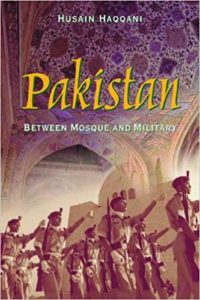
In January 2005, ‘Pakistan: Between Mosque and Military’ was published. It is a very good book detailing the history of Pakistan and the Mullah-Military Nexus that rules Pakistan today. The book was written with the help of Carnegie Endowment and the audience in mind was definitely American (with emphasis on post 9/11 understanding of Pakistan). It touches on all the relevant bases (quoting Ayesha Jalal, Khalid bin Sayeed, Margret Bourke-White, Stephen Cohen, Lawrence Ziring), the way Islam was used by Muslim League (and in certain instances, Jinnah himself) during the ‘Pakistan Movement’, the paranoia induced by newspapers and politicians about threats to Pakistan’s existence, the trifecta of Pakistan Ideology (Islam, Urdu, hostility towards India), suppression of dissent by ethnic groups using the tools of the Ideology (branding anti-state elements as anti-Islam is favored strategy even today), the way history was shaped from an anti-British perspective to an anti-Hindu perspective (since we got Independence from the British, not the Hindus), the first Kashmir War, the first Martial Law, attempts at a revisionist historiography, the disaster that was the 1965 war with India and so on. The book reveals very little new information (if you have read the liberal-secular version of Pakistan’s history) but is a very good collection of various liberal-secular and diplomatic sources and serves as a good primer on Pakistan’s political history. I’ve always maintained that HH’s writing is often much better than his politics or his past.
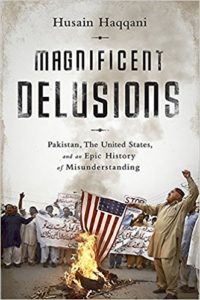
It is often said that Pakistan’s political landscape is dominated by 3 A’s (Allah, Army, and America). The discussion on US-Pakistan relations in the first book forms the basis of his second book, Magnificent Delusions. Four years ago, I wrote a couple of articles, titled ‘Good Ally, Bad Enemy?’ reviewing US-Pakistan relations with excerpts from HH’s second book alongside the works of Carlotta Gall, Gary Bass and Daniel Markey (1. here 2. here). I’ll mention some quotes from HH’s book that I used in those articles.
“Anti-western propaganda was often unleashed precisely so Pakistani officials could argue that the United States had to support Pakistan against India, so as to preserve its alliance with them. Few Pakistanis knew how much their country and its armed forces had become dependent on US assistance.”
‘James L. Langley, American Ambassador to Pakistan (1957-59) wrote, “Pakistan’s forces are unnecessarily large for dealing with any Afghan threat over Pashtunistan. Pakistan would be of little use to us should perchance worse come to worst and India go communist… One of the most disturbing attitudes I have encountered in the highest political places here is that the United States must keep up and increase its aid to Pakistan, and conversely, that Pakistan is doing the United States a favor in accepting aid, in addition to the Pakistani pro-Western posture in the Baghdad Pact and SEATO and the United Nations, when actually these postures are in part dictated by Pakistani hatred for India.”
“India’s Prime Minister at the time, Indira Gandhi, ‘tried to persuade [Henry] Kissinger to recognize the need for more robust US involvement. She said that Pakistan has felt all these years that it will get support from the United States no matter what it does, and this has encouraged an “adventurous policy.” India is not remotely desirous of territory, and to have the Pakistanis base the whole survival of their country on hostility to India was irritating.”
“When Zia was approached by an American diplomat who conveyed the anxiety on America’s part regarding Pakistan’s nuclear weapons development, Zia said: ‘I am an honorable man. We are an honorable people. I ask you to tell your President that I give him my word of honor as President of Pakistan and as a soldier, that I am not and will not develop a nuclear device or weapon.'”
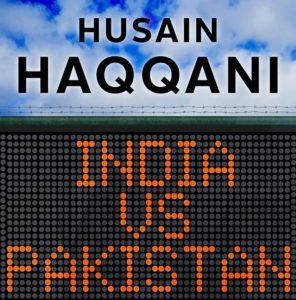
In his third book, HH focussed on certain aspects of the thorny India-Pakistan relationship: History, Kashmir, Nuclear Bombs, and Terrorism. The book is peppered with anecdotes and is a useful read as a primer on the relationship and the difficulties therin. One gets the impression after reading the book that if it were left to the civilians, the two countries would have patched out most conflicts, however, Pakistan’s military and India’s diplomatic bureacracy took maximalist positions to thwart that ambition time and time again.
Why is HH so controversial in Pakistan now?
He was appointed Pakistan’s Ambassador to the US by the PPP-led government (2008-13). It was a turbulent time for Pakistan because barbarians were literally at the gates (Taliban in Swat and Al-Qaeda+TTP in Waziristan). HH has certain views about Pakistan that are not palatable for the military establishment/Deep State. Those views include his insistence on civilian supremacy in the country, deceptive attitudes towards the United States and over-reliance on religion in political discourse. In addition, HH was trying to be a conduit between Pakistan’s civilian government and the United States during his time as the Ambassador (as opposed to a majority of Pakistani Ambassadors to the US who are appointed only after a firm nod from the GHQ) and that irked the establishment even further. It was during his tenure that Osama bin Laden was found and killed in Abbotabad (May, 2011). HH, in an op-ed published last year in Washington Post (read here), took credit for helping the Obama administration in that endeavor (which, in light of Trump’s recent ascension to power, seemed an opportunistic move). Soon after the raid, a conspiracy theory was hatched by the Military Establishment in Pakistan implicating HH. It was alleged that HH had sent Admiral Mike Mullen a memo (on President Asif Zardari’s advice) through a shady in-between named Mansoor Ijaz asking for help from the US in case our generals tried to topple the government in the wake of the OBL raid. The case dragged on in the court and later, a judicial commission but the charge was not proven. HH had to resign as the Ambassador. He has since been at Hudson Institute. In recent years, he has started, with the help of another Pakistani-American, Dr. Mohammad Taqi, SAATH forum (South Asians Against Terrorism and Hatred) that gathers progressive voices in London every October to talk about the future of Pakistan. (Full disclosure: I have been invited to the last two versions of this forum but the first one i couldn’t attend because of visa refusal and the second because I was doing an internship in Houston at the time). I personally agree with most of his views regarding Pakistan but I think his name has been tarnished so much by the Deep State that it is hard to advocate for his name/ideas/books in Pakistan. I believe that he is worth-reading and worth-engaging. If only the military establishment could fight ideas with ideas instead of slander and mis-information.
P.S I have highlighted two events mentioned in the article that were based on stories shared with me by two people I have known for a while. HH presented his own version of events in two tweets last night (05/22/19). Here’s what he tweeted:
The piece contains some ‘I saw X do Y’ without cross-chekcing and is not accurate because of that. (https://twitter.com/husainhaqqani/status/1131390153400958977)
For example, witness no 1 claims he met in NY during 1988 election campaign. Browsing through my passports (all preserved since 1974) would reveal that I was never in US during that period. people lie for all sorts of reasons. That’s why corss-checking is so important. (https://twitter.com/husainhaqqani/status/1131391145546801159)
Witness 2’s claims suggest that he was present in meetings between Musharraf and I or between one of Musharraf’s minitsers and I. Again, should have been easy to verify veracity or lack thereof with a little effort. (https://twitter.com/husainhaqqani/status/1131395539835207680)