
Please keep the other posts on topic. Use this for talking about whatever you want to talk about.
Category: Uncategorized
Do they even pretend to care about BAME anymore?
https://twitter.com/barstoolsports/status/1128828665322590208?s=20
I thought the US was a lot more “racially aware” than the UK. I’ve seen countless ads that always put BAME actors in blue-collars roles.
Why didn’t they put a white UBER driver and a black couple in the back? And for those who huff and puff that Art must mirror Life; art never imitates life, have you ever seen an ugly actor? Actors and actresses are order of magnitudes better looking than the rest of the population; it’s a stylised representation of what we want life to be. Continue reading Do they even pretend to care about BAME anymore?
Why Pakistan is Middle Eastern
The arguments around the broader regional framework Pakistan lies in have often centered on cultural/aesthetic similarities or pure geography. Here, I will argue that Pakistan lies in the Middle East using scientific metrics that describe human behavior.
Regional comparisons of this kind have to account for other explanatory variables. For example, comparing Pakistan, where the urban population is less than 40%, to countries like Turkey or Iran, where it is nearly 80% can be confounding. Also, these countries are much richer than Pakistan, in part due to their more urbanized and industrialized economies. Finally, these countries are not based on the plains around large rivers.
Luckily, there is a comparator which is similar to Pakistan in these control variables: Egypt. It is a predominantly rural country, with a per capita income not much higher than that of Pakistan.
We consider Hofstede’s six cultural dimensions. Hofstede gives countries scores along the following metrics: power distance, individualism, masculinity, individualism, uncertainty avoidance, long term orientation and indulgence. Higher numbers indicate a society and culture more oriented towards these values, and lower ones vice versa.
The figure below shows the scores of Egypt (blue), India (violet) and Pakistan (green) on various metrics. We see that along the metrics of individualism, uncertainty avoidance and indulgence, Egypt and Pakistan align very well with each other, but are very different from India. On power distance, Pakistan differs from India and Egypt, on long term orientation, Egypt differs from India and Pakistan, while they score similarly on the masculinity metric.
We see that Indian society is more individualistic and has higher tolerance for uncertainty and risk taking than Egypt and Pakistan. It is also much more indulgent.

Hofstede attributes India’s scores on individualism and uncertainty to Hindu philosophy. The caste system is certainly an important factor on India’s power distance score. On the other hand, the shared religion of Pakistan and Egypt decisively shapes values regarding individual autonomy, risk aversion and indulgence.
There are other similarities as well. The preeminent minority group in both Pakistan and Egypt are Christians. However, Egyptian Copts are a stronger group with links to the West, but the Pakistani Christians are former Hindu Dalits, who converted during the British rule to unshackle caste chains. In terms of marriage customs, both Pakistan and Egypt see predominantly cousin marriages.
They key difference between Pakistan and Egypt is that Pakistan’s elite speaks English and has a vocal diaspora in Anglo countries. The longer and deeper historical imprint left by Britain has decisively shaped Pakistan, indeed much of the country was settled as canal colonies during British rule. Such a deep British imprint is not seen in Egypt, where the elite was originally Francophone, but an increasing switch to English is underway.
Live blogging – Rethinking Soviet invasion of Afghanistan
This is why Pakistan is a shit country-
I'm in Lahore and was not fasting. At lunch I ran through complete MM Alam road to grab something to eat, none of the restaurants including KFC McDonald's was serving. So what are minorities, sick people, women on menstruation & any other person who is not fasting supposed to do?
— Ahsan (@ahsanzawar) May 15, 2019
Hollywood’s rising South Asian Starlet
https://www.instagram.com/p/Bw7CgMhACZ-/?igshid=1ne6xgijmjd9a
Browncast Ep 36: Karl Smith, Communist to neoliberal
Another BP Podcast is up. You can listen on Libsyn, iTunes, Spotify, and Stitcher. Probably the easiest way to keep up the podcast since we don’t have a regular schedule is to subscribe at one of the links above.
You can also support the podcast as a patron (the primary benefit now is that you get the podcasts considerably earlier than everyone else…).
 On this episode, I talk to Karl Smith. A former economist, Smith is now a columnist at Bloomberg. Smith’s style is that of a nonpartisan neoliberal driven by empirical considerations, but he actually has a very interesting background as someone who came out of an orthodox Marxist family. He was raised, quite literally, as a Bolshevik.
We also talk about his experiences being a relatively heterodox black American public intellectual, and how both of us see how racism has played out in our lives and in the country at large.
Finally, we discuss what we see in store for the United States in the future on the global stage.
We would definitely appreciate more positive reviews. Many of you listen to us, but don’t leave any reviews!
Live Blogging – Brahmin Identity in Modern India
Im officially an idiot I thought the reception started at 5 and the lecture at 5.30 (I ended up there at 5.40) but I still managed to hit a few points.
Continue reading Live Blogging – Brahmin Identity in Modern India
When Brahmins get treated like Dalits; the world listens
https://www.instagram.com/p/BxYNcrTAw0Y/?utm_source=ig_share_sheet&igshid=xogsyngrd9zr
Swipe right and you’ll see why I wrote that.
I agree white people have to learn *more* about race but how many upper caste Indians would be comfortable with their children playing with Dalits?
And yes for white people *we* (coloured volk) are all Dalits since we were their subordinates and slaves less than half a century ago (history would have turned out very different had they not destroyed each other in White War 1 & White War 2).
As an aside I find it a bit absurd when Brits go on and on about how they “died for our freedom.” Our ancestors were subjects (or rather more like glorified servants; Hindustani text books in the 19th century is how an English lady should tell her staff to do a better job) both before and after the Wars so it’s a bit rich to presume they shed their blood in our name. Even the epithet “World War” masks that though the world was at war, it was simply because it was controlled by White Powers (with the exception of Japan). Language is a masking told and all powerful in how to reshape the narrative.
I’m not going to be an icon for Hinditva (I wanted to write Hindutva but my phone defaulted to Hinditva LOL) simply because I make a daily habit of shitting on Islam.
There are some deeply disturbing aspects of Hindu culture especially with regards to treating a huge section of their population on a lower rank than animals.
Caste is the South Asian curse and makes us the laughing stock of the world. Our colour obsession stems from the simple fact that colour is profoundly correlated to the caste hierarchy (as a Chennaite once told me in Kampala- never trust a black Brahmin).
I find it a bit amusing when Indians hyperventilate that Islam is the biggest threat to world peace and Indian security. I would have imagined a significant subsection of their truly dark population (Ms. Subramanian is *not* dark in Chennai) in abject and soul-wrenching poverty should rank a bit higher on their list of concerns..
A Quick Question- when did Hindus revenge themselves?
We just wrapped up another podcast but I listened this time and didn’t say anything. It was really dense and informative!
As I was clearing away everything (well past my bedtime) a random thought popped into my head.
At what point pre-1947 did Hindus (or Sikhs) revenge themselves on Muslims? What I’m trying to establish is that was there a justifiable fear on the part of the Muslim League to assert that a Hindu-majority India would be a no-go zone.
I’m specifically excluding the Partition events but I’m looking for a Hindu equivalent of Direct Action Day, where legions of Hindus set themselves on Muslim localities.
My distinct impression is that these mob riots emerged in the bad blood post Partition. In comparison to the Greeks, Israelis or even now the Chinese; Hindus and Indians have been particularly partial towards their Muslim population.
At any rate this is my short note and remember I’ll be (iA) live blogging tomorrow’s lecture.
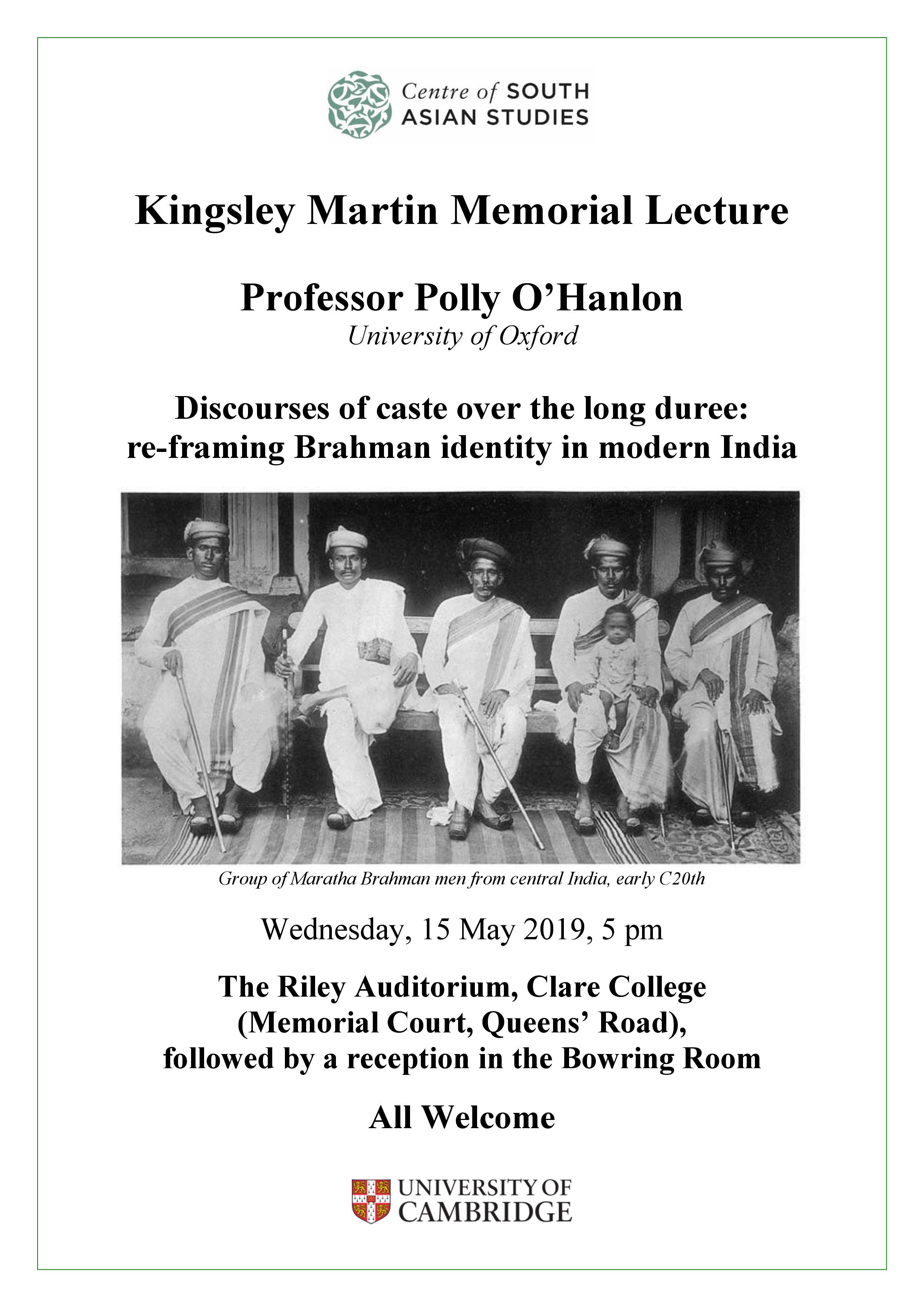
I’ve discovered the South Asian Centre at Cambridge and I’m rather kicking myself for not availing it sooner. I missed an interesting talk on Lahori resistance in the 19th century on Monday.
I’ll try to live blog the lectures where I can; there’s also the Shahnama Institute and the Ancient India & Iran Trust.

I’ll try to live blog lectures where I can and of course ask speakers onto Podcasts (I’m still pending some questions to Professor Foltz but since there weren’t too many, I’ll putting that on ice for now).
If commentators are interested in particular lectures please do let me know so I can make sure to attend.