Recently came across this essay on Pocket, that was published in 2018 in the NY Review of Books:
https://getpocket.com/explore/item/who-killed-more-hitler-stalin-or-mao
Suhaib.
Recently came across this essay on Pocket, that was published in 2018 in the NY Review of Books:
https://getpocket.com/explore/item/who-killed-more-hitler-stalin-or-mao
Suhaib.
 This week two quick episodes with two sagacious repeat guests.
– With Jasper Gregory I revisit the situation in Vietnam. From coronavius, to BLM, to K-Pop.
– With Abhinav Prakash I discuss the Hathras rape, how it relates to caste politics in UP, and the various Dalit groups in that state.
You may notice a difference in sound quality. I decided to get a legitimate microphone. I think that will reduce the complaints about sound quality. Since it cost some money, I wouldn’t mind more Patreon subscriptions.
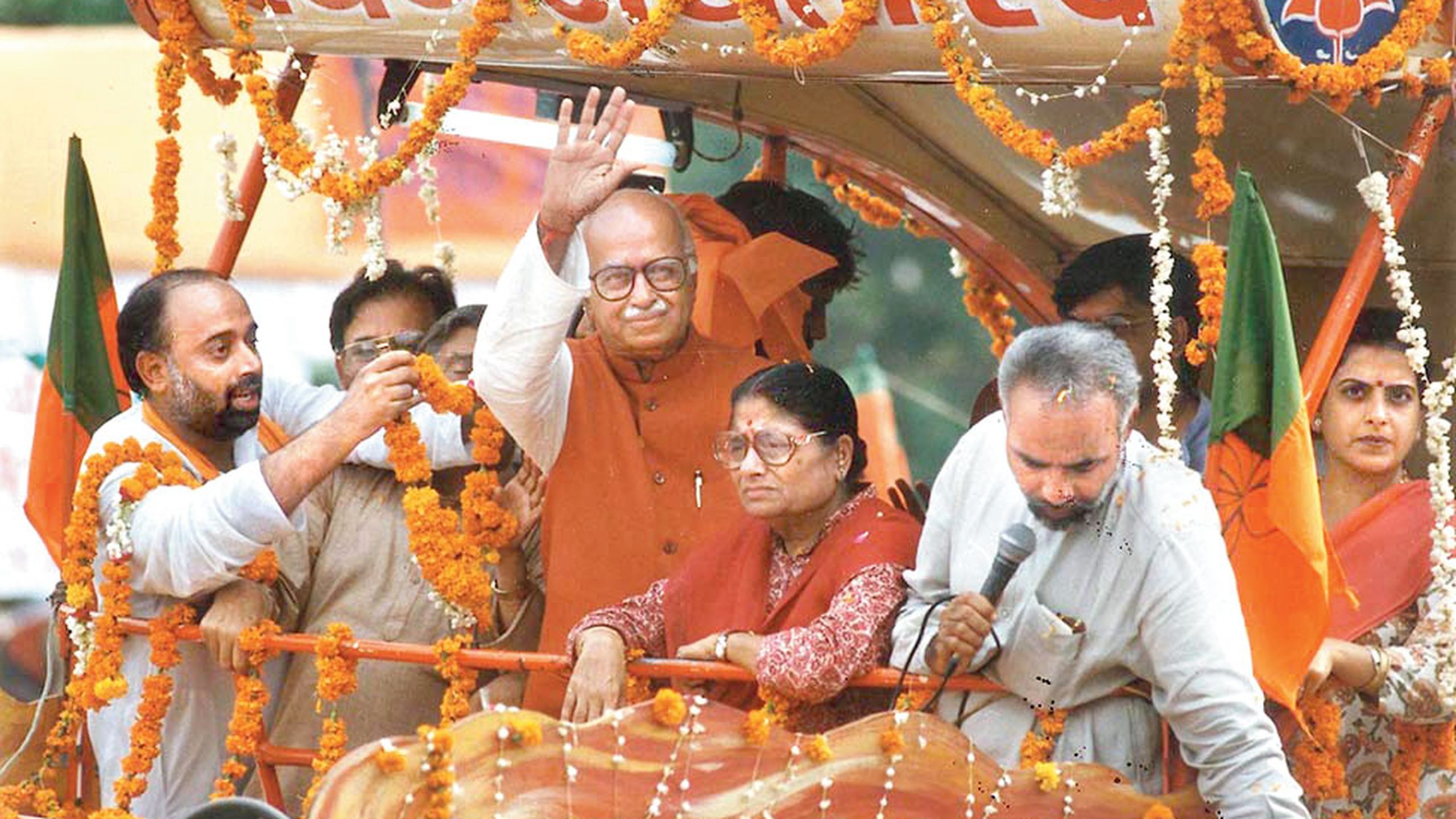
Unless you are living under a rock, you will have noticed the Babri demolition conspiracy verdict. All 32 accused including the firebrand Ashok Singhal and Uma Bharti were acquitted of the conspiracy charge. A conspiracy charge is notoriously difficult to prove in Indian court even with Political will, in this case from an objective perspective, the charge was unlikely to stick owing the excessive burden of proof required to prove conspiracy.
I came across this interview of Advani with Prannoy Roy from 2000.
After six years of Modi Shah, Advani appears like a fresh of breath air (to my liberal ears). Notwithstanding his role as the prime mover of the Ram Janmabhooni movement which left trails of blood across the country, Advani appears significantly liberal to my eyes in 2020. The willingness to talk to the enemy (as seen in a range of interviews given to aggressive media), comparatively more respect to democratic ethos and institutions, and an overall soft spoken-ness.
However, the interview leaves us with the question – Is Advani telling the truth?
There seem to be three potential chain of events which led to the culmination of the demolition of Babri Masjid.
If either of 2 and 3 is true, it is fair to say the BJP and Sangha Parivar leaders were playing with fire and when the fire got out of control it burned every one to a certain extent. Though today even if the fire was unintended, the fruits of the fire continue to be reaped.
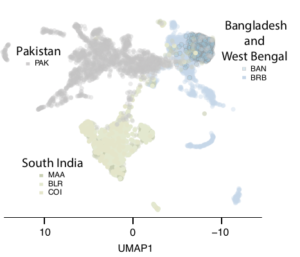 The Genomes Asia 100K has put their Indian paper out. It’s OK, and mostly focuses on the fact that Indians are enriched for inbreeding vis-a-vis other world populations. There are several layers to this. In some cases, as among South Indian Hindus and Muslims, there is cousin-marriage. But, in other cases, for example, Scheduled Castes and Scheduled Tribes, there seem to be extreme bottleneck effects due to delimited marriage networks. Finally, even among large population groups, such as Iyers, there seems to be some elevation of runs of homozygosity due to endogamy.
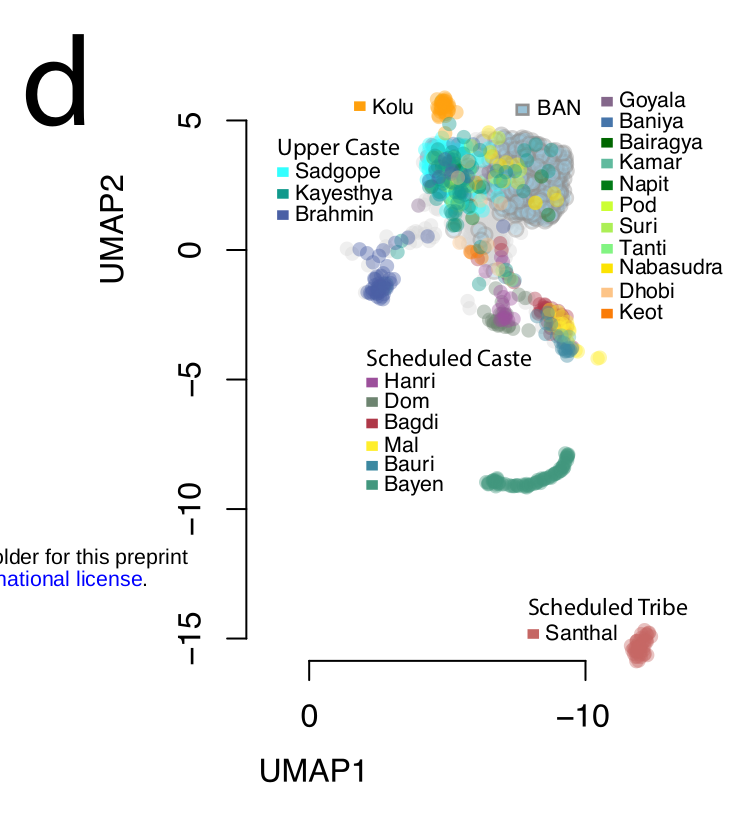
But that’s really not what I’m interested in. This preprint has a lot of Bengalis from Birbhum district in West Bengal of various castes. The UMAP (an advance over PCA in some ways) figures aren’t super informative, but you can see that their pooled sample recapitulates the Indian subcontinent. In fact, West Bengals on the whole are to the “west” of Bangladesh samples. Totally unsurprisingly.
The main reason I’m putting this post up is the UMAP plot below. It’s hard to read (they will clean it up for final publication), and I don’t know all the castes (I’m assuming “Nabasudra” is a typo). But some things that jump out
1) Bengali Brahmins are distinct.
2) Kayastha are generic West Bengalis.
3) Some of the West Bengal samples are in the Bangladesh (collected from Dhaka) distribution. These are probably descendants of Bangal migrants from the east.
4) Some groups are very distinct. That’s partly due to strong endogamy, and in the case of Santhals high East Asian ancestry (they’re Munda). Other groups are less distinct. The “Namasudra” seem to be two groups. One overlaps with the main Bengali cluster (slight bias toward Bangladeshis), while a second group is shifted toward Scheduled Castes.
I assume readers can make more heads or tails of this, as I don’t know much about caste in West Bengal (and yes, the figure is very badly labeled/colored; this is a preprint)
Addendum: Not comments about Jatts please. I will delete them.
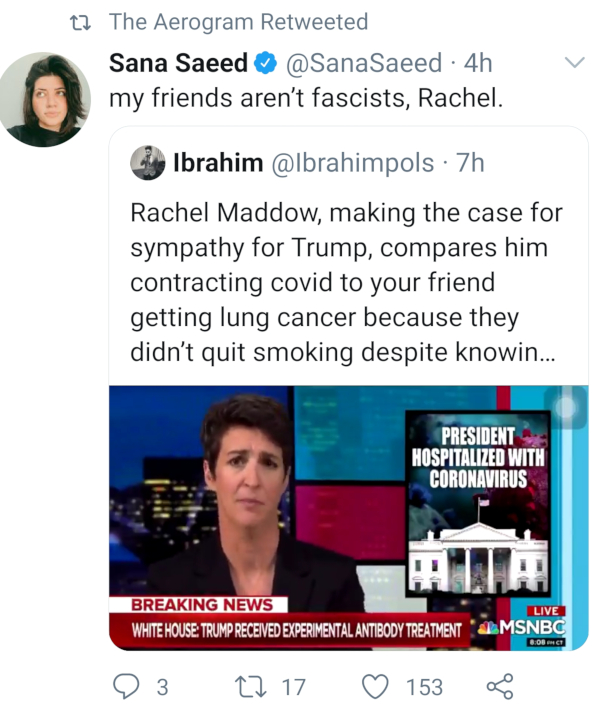
I am not a media person, so I do not understand the deal with AJPlus and its “woke” journalists.
AJPlus is owned by the Al Jazeera Media Group, which is a catspaw of the government of Qatar. Qatar is a Salafi petrostate run for the benefit of the Thani family and is run like a capitalist caste state. I’ve been to Qatar. It’s a fine place if you have money, but perhaps less fine if you one of the laboring classes.
I don’t begrudge Sana Saeed for making a living, but I doubt she would begrudge herself that opportunity if she was on the outside looking in.
The world is complicated. I dislike engaging in guilt-by-association but woke journalists at AJPlus do it constantly. It’s like they don’t see the glasshouses that they live in.
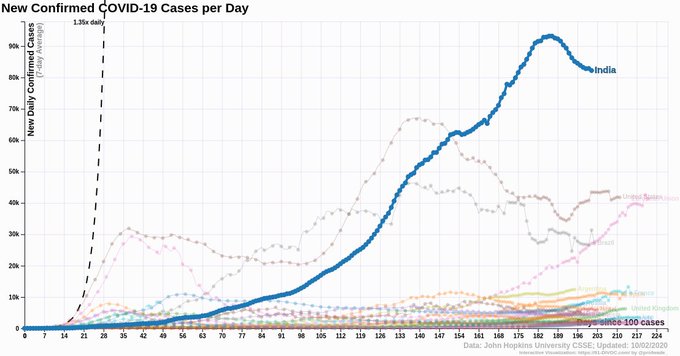
What’s going on in India with COVID-19? Both deaths and cases are now plateauing. Since India is really many nations, this might just be major population centers recovering, even if there are lots of local outbreaks?
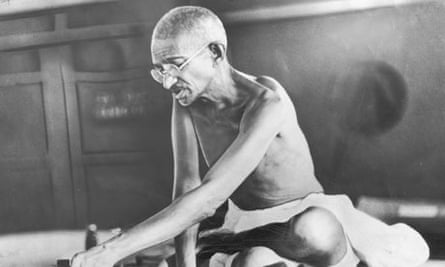
A brief summary of my views about Gandhi
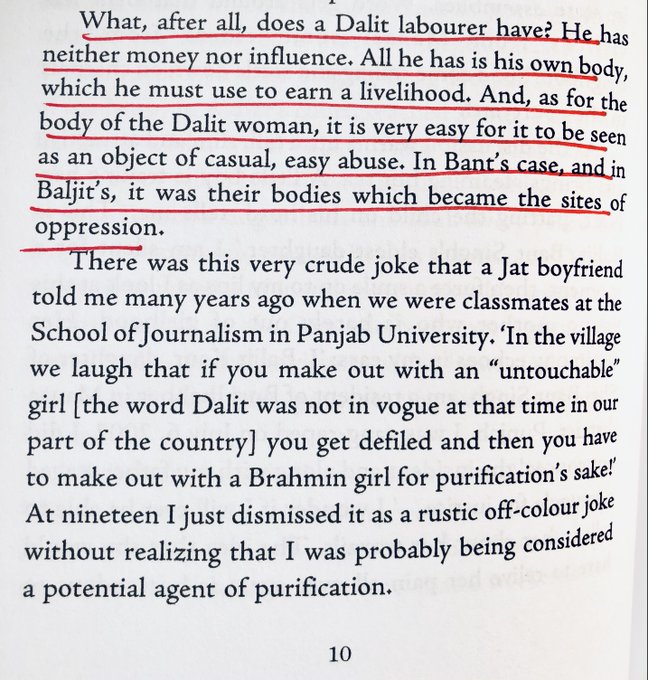
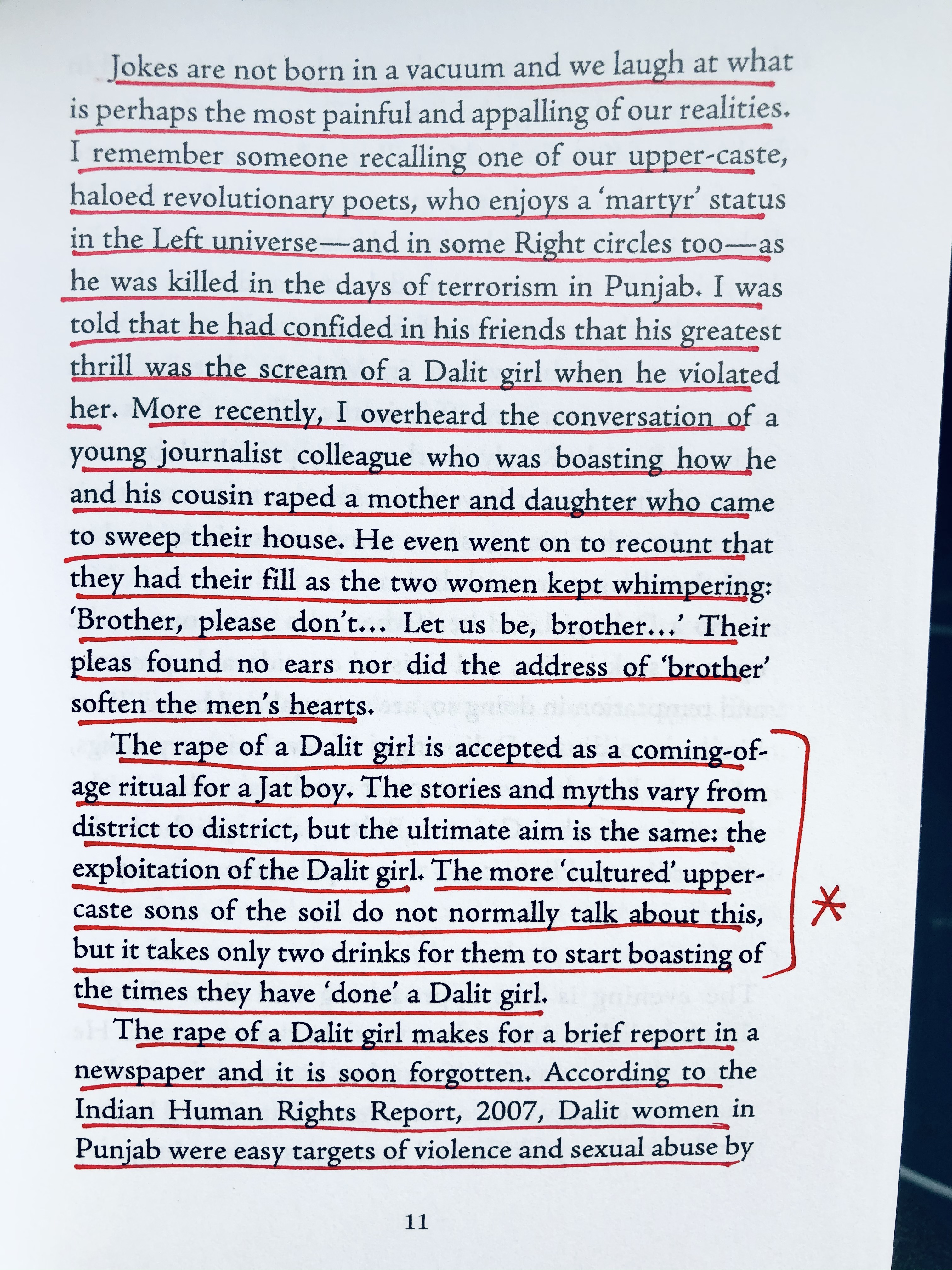
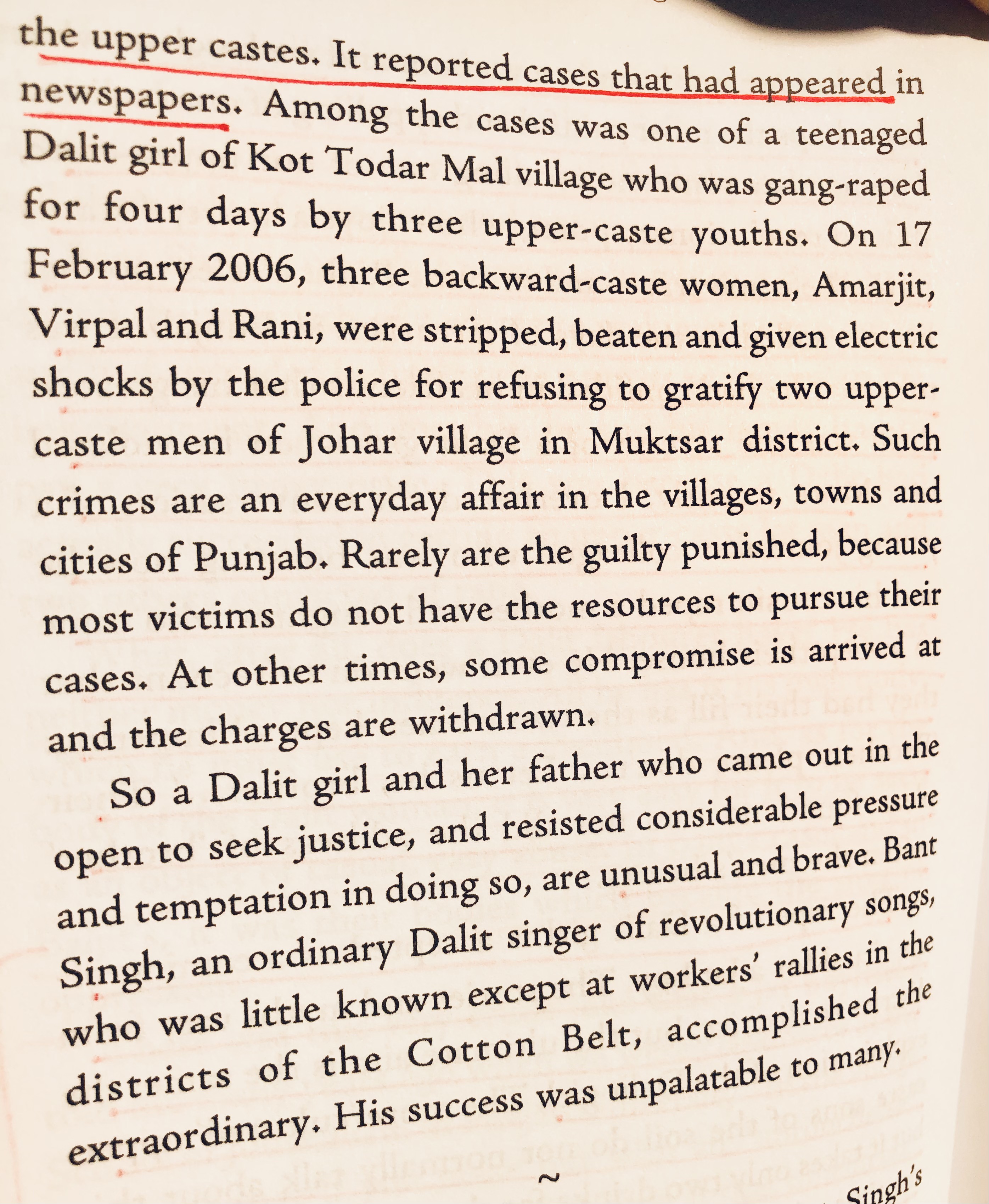
There is news about another rape case (alleged rape case?) making wavers in India and Twitter regular @conradkbarwa posted some excerpts from a book by poet and journalist Nirupama Dutta that you can see below:
TW: Discussion of Rape and Sexual Violence
The pervasiveness of sexual violence for Dalit Women across all settings, pp.10-12, “The Ballad of Bant Singh: A Qissa of Courage” Nirupuma Dutt pic.twitter.com/BOEbtRTXCX
— Conrad Barwa (@ConradkBarwa) October 1, 2020
The anecdotes listed in these pages are obviously very disturbing and shocking, and I have no doubt that even if Nirupama moves in unusually nasty company, many such cases do occur across the Indian subcontinent and in most of them the police are yet another source of oppression (and sometimes even a second rape in the police station). The excerpts above are from East Punjab, so from a land that we are not entirely unfamiliar with (apart from whatever similarities exist across east and west Punjab, my in-laws are from villages near Ludhiana). It made me think about our own Punjab and the various anecdotes I have heard about rape of lower class women in villages as well as the use of sweepers and servants for sexual favors in urban areas. And of course, about the well publicized recent rape cases in Pakistani Punjab and about Razib Khan’s comment somewhere that “THIS is what a real rape culture looks like”. Which led to a tangential question in my mind: what are the similarities and differences between rape culture in Pakistani Punjab and Indian Punjab?
Fire away…
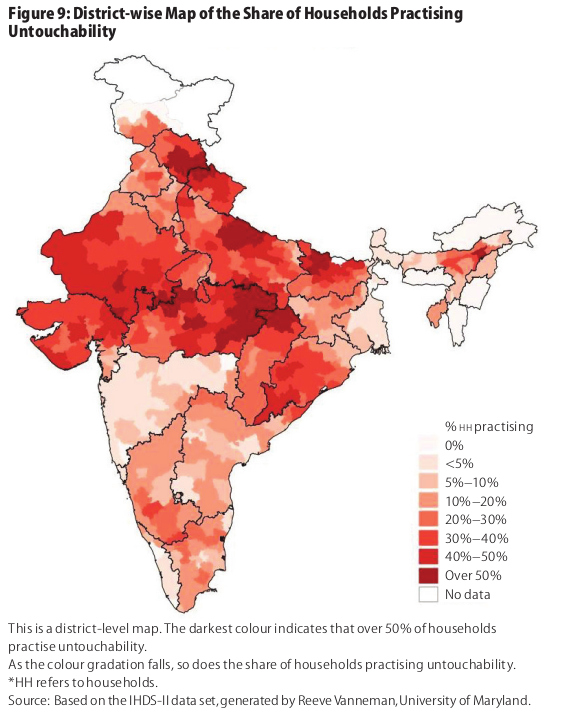
I found the above map from Alice Evans. It’s from a paper, The Continuing Practice of Untouchability in India.
The regional patterns turn out to be the most striking. More than education, income, or caste status. You can even see the outline of states, which is indicative of the impact of regional governments on policy and culture.
From Dr Hamid Hussain.
“A real friend is one who takes the hand of his friend in times of distress and helplessness’. Afghan proverb
In September 2020, Afghan government and Taliban representatives met for the first time publicly in Qatar to start intra-Afghan dialogue. There were lot of hurdles between the first step of signing of agreement between United States and Taliban in February 2020 and start of intra-Afghan dialogue in September 2020.
All parties are asking Taliban for a ceasefire during intra-Afghan dialogue. Taliban are not agreeing to this condition and violence has escalated in the last few months. Taliban leadership is concerned that if it agrees to a ceasefire then foot soldiers and local commanders will head back to their homes. This will weaken Taliban negotiation position and it will require some effort to re-mobilize foot soldiers. In addition, there is also fear that hardline Taliban may break away. The price that Taliban are paying is negative public opinion inside Afghanistan. Large number of Afghans are angry that Taliban have signed a truce with foreign troops; the very rai-son d’etre of Taliban fight while shedding the blood of fellow Afghans with impunity. Continue reading Afghan Conundrum