Browncast Ep 42: American Arranged Marriage

Another BP Podcast is up. You can listen onĀ Libsyn, Apple,Ā Spotify, and Stitcher. Probably the easiest way to keep up the podcast since we don’t have a regular schedule is toĀ subscribeĀ at one of the links above.

You can also support the podcast as aĀ patronĀ (the primary benefit now is that you get the podcasts considerably earlier than everyone else…this podcast was posted a week ago).

Probably the number #1 reason that the “Browncast” is of interest to me is that I can talk to people who are different from me in some deep and important manner. This podcast is a conversation with Amit, an Indian American who is doing a medical residency. Raised on the “best coast” of the USA, after some conventional dating travails, he has decided he will go the route of an “arranged” matched.

If you listen, you will see that the process has been a positive one for Amit, and it includes much more flexibility and volition than most Americans might imagine.

I went into the discussion mildly skeptical and came out of it with an appreciation for how people can make different choices, but those choices are probably the best for them.

I would really appreciate if regular readers/commenters would leave more positive feedback/ratings, especially on Apple and Stitcher.

The decline of the bee


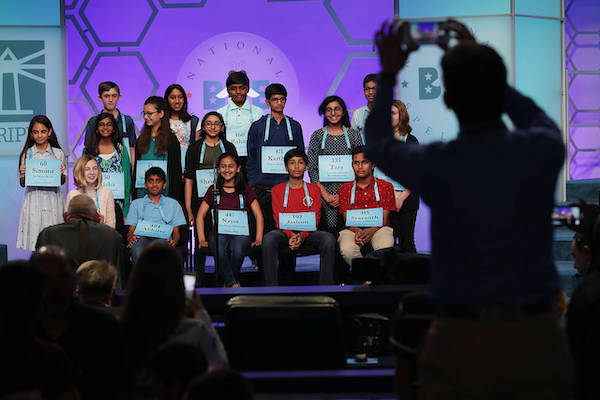
At the Spelling Bee, a New Word Is M-O-N-E-Y – Elite spellers now can pay to get a spot in the national event. For this generation of zealous competitors, it just means another chance to shine:

An extra factor driving the stakes for this generation of spellers is a concerted effort by non-U.S.-born parents, particularly Indian-Americans, to make a mark on the competition. In 1985, Balu Natarajan was the first child of immigrants to win the Scripps bee. Of the 33 contests since then, fellow Indian-Americans have won 17 more, including the last 11 straight.

Indian-Americans, just 1% of the U.S. population, have established their own minor-league spelling bee circuit that adds opportunities to hone on-stage performance. They have led the way in paying for coaching, buying or developing proprietary study software and traveling to participate in more bees. Many spellers’ parents came to the U.S. via the Immigration Act of 1990 that admitted exceptionally skilled immigrants who specialize in STEM topics. It is no mystery that they would value education—and recognition of it—above all else; it is the very thing that gave them access to this country.

Reminds me of the stuff in Jerry Muller’s The Tyranny of Metrics. Now that the national bee is going in this direction it will be impossible to reverse the trend and make it a test of childhood exuberance and passion, as it was until recently. Rather, it will be just another part of the meritocratic conveyer belt, another notch in one’s resume or c.v.

And, unfortunately, it illustrates one of the effects of the rise of Asian American immigrant parents, who come from extremely competitive societies, and so bring the same ethos to the United States. Childhood in the old sense is disappearing, as people begin to prepare their children for adult roles in the economy before they enter elementary school.

A quick reaction to Indian Election

I wrote the following article for one of the English daily newspapers in Bangladesh. The main idea is directly borrowed from a very good post in Brown Pundits (2016) by always superb contributor Omar Ali bhai.Ā  “Is Islam the rock on which the liberal order broke?” Ā https://www.brownpundits.com/2016/12/05/islam-is-rock-on-which-liberal-order/

Link to my article here.Ā  Text follows. Just as a reminder, newspapers op-eds are not suitable place for good elaboration and defense of ideas. This is not an analysis or theorizing, just a reaction.

The rock that broke liberalism

https://www.dhakatribune.com/opinion/op-ed/2019/05/25/the-rock-that-broke-liberalism?fbclid=IwAR3cQVWjO1PYe6muE33Dijy44kR90fJRH1Iv6UBqS9KYqHr9e7AlTHKjvdo

I was watching live streaming of the India Election 2019 results on the NDTV website. Panelist after panelist was commenting on how significant were Balakot strikes in boosting BJP’s re-election prospects, and how ignorant are the liberal elites of India about the appeal of national identity among the masses.

This was NDTV, as a reminder, one of the citadels of India’s liberal elites. BJP’s triumphant re-election under Narandra Modi underscores the wave of right-wing populist nationalism sweeping across democracies of the world — Europe, Australia, Latin America, the US, Asia, maybe soon in Canada also.

With every election, every referendum taking place in established democracies, it is becoming apparent that this wave may not be just yet another right turn in the cycle of politics soon to be corrected by pivot to the left, but a fundamental shift in the people themselves.

A couple of years ago, in a South Asia focused blog I frequent, a much-admired Pakistani-American writer wrote a post posing a great question: ā€œIf and when modern humanism and liberalism crashes and burns, will future historians look back and say that Islam was the rock on which it first and decisively broke?ā€

His point was not that Islam single-handedly threw a powerful challenge to the liberal order, or ā€œend of historyā€ would have been achieved if Islam didn’t throw a wrench into the gears of civilization.

He argued that by obdurate refusal to accept the fundamental assumptions of post-enlightenment worldview, by obstinate resistance to assimilate with the mainstream when in the minority and by dogged persistence in recreating antediluvian theocracies when in majority, Muslims not only undermined the universal validity of the whole liberal project, but also sowed deep doubts about the liberal project among its previously most faithful adherents.

Muslim recalcitrance has hastened delivery of the contradictions that the liberal project was pregnant with from the beginning.

And the contradictions are huge indeed. The liberal order is prone to breakdown because it doesn’t sufficiently account for the fact that human nature itself is broken. People are not just utility or satisfaction maximizing beings. Enjoyment and suffering are intimately co-mingled.

People do not just want to reach heaven together; they want some, preferably who are somewhat different, to be confined to hell as well. Apart from the contradictions, surely undercurrents of technological and economic change, the shift in global power balance, the inevitable decay of political order, played a far more important role in undermining the liberal dominance than obstinate resistance of the followers of Islam?

However, it’s hard to deny any causative role of Islam. The emergence of right-wing, national identity politics was perhaps inevitable in India, but BJP’s astonishing dominance must be partially attributable to Pakistan’s persistent spoiling and nightmare-neighbour role? Right-wing majoritarians everywhere are scapegoating Muslims as the principal other; morality of their methods can be questioned, but the success cannot.

Moreover, I would argue that Islam has not undermined the liberal order by sowing doubts within liberal ranks or exposing its contradiction, it has weakened liberalism by emboldening and consolidating the enemies of liberalism in established democracies which were scattered and disheartened after the bloodbath of WWII and subsequent emergence of liberal world order.

Stubborn defense of group identity by Muslims of the world has made upholding group identity respectable for all groups, majority or minority, powerful or weak. In the age of mass politics, group identities like religion or nation have more elements in common than in difference. If Muslims can be unabashedly assertive about the sanctity of their religious identity and traditions, other groups can be unapologetic about their respective identities too.

Muslims may be a small minority in most of established democracies, but they comprise nearly one-fourth of humanity, and they have a very emphatic presence in Asia, Africa, and parts of Europe. To people of different faiths, Muslims, regardless of their actual numbers as minority, represent the much talked-about demographic threat from the south.

Muslims, whether in majority or minority, are on the other hand deathly afraid of the political, cultural, and economic threats emanating from the leading political and ethnic groups of the world. It’s a mutual cycle of fear spiraling downwards. Muslims cheering the probable demise of a liberal world order is the height of folly.

As the world’s most powerless and disunited major group, they will continue to pay the major price of breakdown in blood and misery. Uighurs of China portend that bleak future.

In established democracies, Muslims are generally politically allied with liberal progressives, and this alliance has opened liberals up to accusation of double standards in protecting a very illiberal minority identity. Abandoning universalism and embracing identitarianism is hollowing out liberalism from within. Either the principles of liberalism apply for all groups or none at all.


The Hindu Liberal test

Zach, please back this up with facts – “This tirade has gotten old – India has rejected her Muslim heritage and culture (not socially but politically).” <br /><br />Indian history books discuss Muslim rule at length – the Delhi Sultanate, the Mughal dynasty, and myriad Muslim dynasties from the Deccan. Monuments built by Muslim kings are well preserved and regarded as a heritage of all Indians. Mosques are preserved and new ones are being built all the time. Hindi/Urdu – a heritage of Islamic rule – is becoming more widely spoken every year since independence. <br /><br />How is this similar to what has happened in Pakistan?

As you all know I call out Pakistan and Islam on a fairly regular basis especially liberalstanis who baulk at the no-go zone of Pakistani culture.

The test I would devise to test whether a Hinditva values liberalism or Hinduism is the Babri test.

Do you believe Babri Masjid should be rebuilt brick for brick as it stood pre-92?

If you don’t then that means you are a Hindu before you are a liberal. It isn’t a bad thing but don’t pretend that your liberality is so magnanimous so as to extend to your cowering minorities.

By way of comparison it’s pretty obvious that Al-Aqsa Mosque stands on top of the Old Temple (a bit like Babri Masjid). If a mob were to destroy Al-Aqsa tomorrow would the Israeli government be right in apportioning the site?

Browncast Ep 41: An Indian Muslim on Maharajah Modi

Another BP Podcast is up. You can listen on LibsyniTunesSpotify,  and Stitcher. Probably the easiest way to keep up the podcast since we don’t have a regular schedule is to subscribe at one of the links above.

You can also support the podcast as a patron (the primary benefit now is that you get the podcasts considerably earlier than everyone else…).

We speak to Jahanara, a Cambridge student who has extensive experience with the Delhi education system and who happens to be an Indian Muslim.

Image result for maharaja modi

I’m joined by MJ & LV (this is part 2 of Episode 38; I plan to do part 3 with Kushal of Carvaka) as we discuss the ramifications for India; it was a balanced podcast in the sense I felt that we respected all viewpoints and respectfully disagreed but enjoyed listening to one another.

As I alluded to in yesterday’s post; Jahanara is the “ideal Indian Muslim” by Indian standards. I don’t want to delve into her life details, to protect her privacy, but I can’t think of a prouder or more assimilated Indian. But it seems to me that her “Muslimness” is now almost being foisted on her; making her an incidental Muslim.

I get from the podcast that Indian Muslims, who are a multiplicity, are increasingly becoming a minority who have to prove their “Indianess.”

But listen to the podcast and make your own views. I did take LV & MJ to task for their “Hindu privilege”; a bit like white privilege, it’s so invisible in India that once can take it for granted.

I also called LV a Left-Liberal Hindu, her Hinduism isn’t necessarily important to her, but becomes an issue when she feels it’s being hijacked by Rightist forces.

So it was an interesting back and forth and as always I try to keep my views fluid so that the podcast can reflect the right balance of views. I did point out that Modi, in terms of his personal austerity and immense work ethic, is an enviable leader. He has no progeny to leave office to and no dynastic politics at work; he is all about the country. Incidentally Imran may be the same as I can’t see any of his three children succeeding him in terms of PTI.

I also feel that if India is heading towards the same type of governance as Pakistan (God forbid) then the idea that Hinduism is somehow manifestly superior to Islam is a bit weak. I do sense Indians want to keep the tagline of secular, liberal democracy but with overtly Hindu characteristics, which is fine albeit majoritarian.

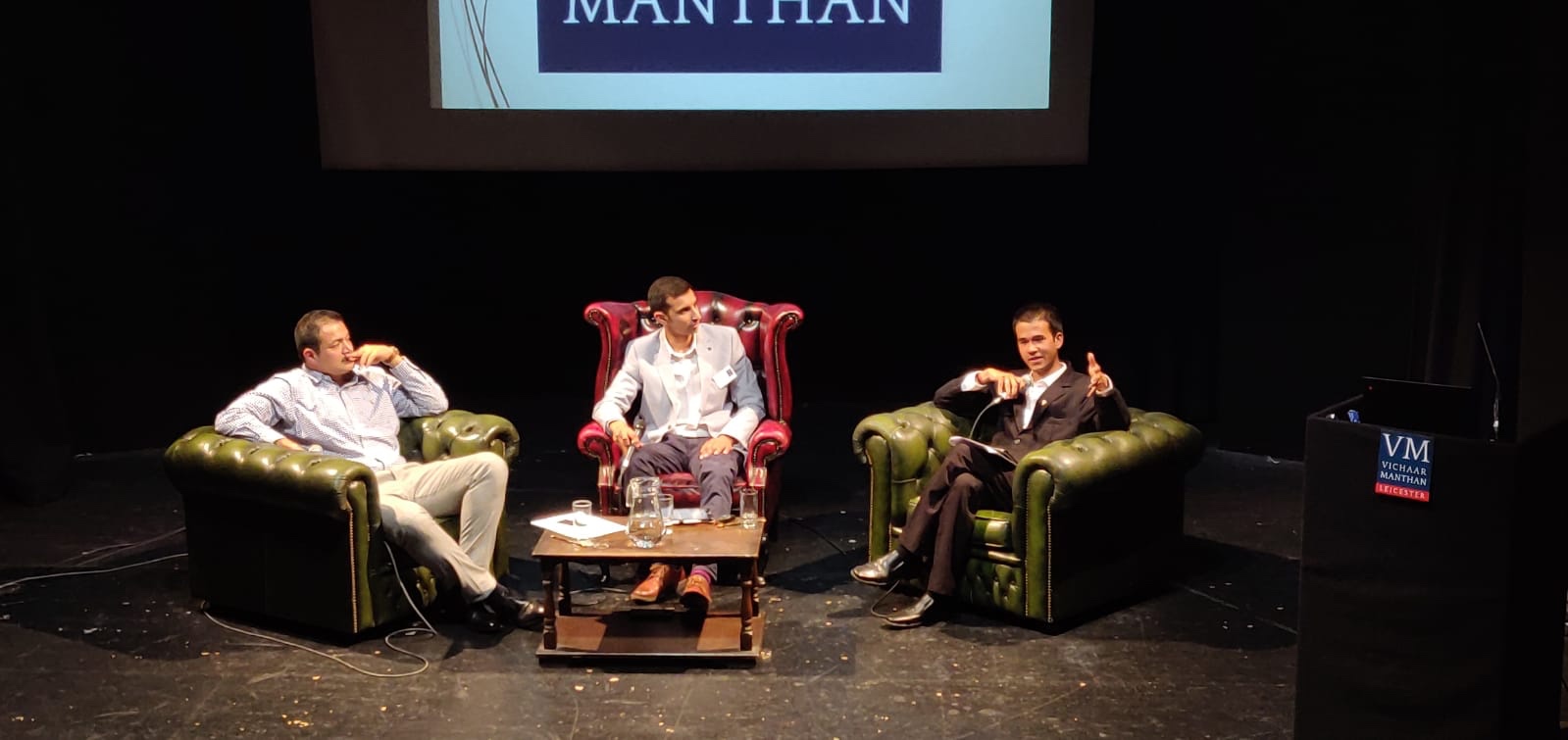
MJ, as per usual, is off to good and great things; giving a speech today on Brexit and Dharma with Hindo Sengupta.

We would definitely appreciate more positive reviews. Many of you listen to us, but don’t leave any reviews!

Indian Muslim podcast

I’m doing the Indian Muslim podcast right now.

I’m shocked the Indian Muslim participant (hugely invested in India, family anti-Pakistan) describes feeling fear for the first time in India.

Shocking- Pakistan has a moral obligation to open her doors if/when the time comes.

Triumph of the Gujarati

Election 2019 reflects a victory of the Gujarat model. But not the model you are thinking of. Not even that other, more sinister model. It is something very fundamental, rooted deeply in economic ecologies.

Human beings are shaped fundamentally by the networks they find themselves embedded in. In India, these networks overwhelmingly take the shape of caste groups marked by an occupational role, social status and marital rules.

For the North Indian peasant, with an economy driven by land and service to an imperial power, caste identity emphasizes kinship and honor. Biradari literally means brotherhood, and membership is conditioned on izzat.

For the Gujarati merchant, in a dry region of relatively unproductive land, caste identity emphasizes pooled resources, adherence to fiscal norms and shared interests. Even for the peasant Patels, caste is today fundamentally an economic union, channelized into farming and dairy cooperatives.

2019 might well be the year that the North Indian peasant realizes the futility of imbibing a kinship and honor based caste identity. On the one hand, these networks simply do not provide the resources to grow and thrive in a post-agrarian world. And even if optimally politicized, the sheer number of caste groups makes the gains from achieving political power limited and concentrated.

The North Indian does realize the need for new kinds of networks. And Modi’s opening up of North India to the world, via a liberal visa policy, river transport from the Bay of Bengal all the way upto Noida and big ticket global engagement platforms like the Mumbai-Ahmedabad Shinkansen would not have escaped the eye of the sharp Yadav and Jat, who realize that they will have to reach out to the world to grow.

After all, previous engagements with foreigners in the recent past have given Indians globally important automobile and IT industries.

India today is more open to the world than ever before. Everybody from Peru to Russia to Ghana to Indonesia can come in after submitting a simple electronic form. Less than 7 million people visited India in 2013, by 2016 that number more than doubled to 15 million. Modi’s Gujarati mind grasps the decisive role of networks in the growth of individual, and he might have well coaxed the North Indian to look beyond his caste tunnel.

Was India ever really “secular”?

Anton Wessels, a Reformed Christian professor of “missiology”, wrote a book many years ago, Europe: Was It Ever Really Christian? The title reflects on the fact that a secular ‘post-Christian’ Europe may never have been very Christian at all, at least in Wessels’ telling.

Wessels writes from a Reformed Protestant perspective. This tradition has taken a very dim view historically of ‘popular folk religion’ during the medieval period in much of Northern Europe. Wessels’ catalog of non-Christian beliefs and practices before and during the Reformation emphasize that from the perspective of a confessing Reformed Protestant it may actually be a fact that most of the population never truly internalized in the gospel, even if they made outward show of affiliation with the Christian religion. Christendom was nominal, not substantive.

There are many arguments one can bring to bear to critique Wessels’ views. In particular, some historians of religion assert that in fact, late medieval piety resulted in the spread of genuine deeply held Christianity to the peasantry of much of Europe. The argument then is that this sincere Christianity is actually one reason that the Reformation occurred when it did. Additionally, even granting Wessels’ contention about the medieval period, the competition between Protestants and Catholics after 1500 guaranteed attention to popular beliefs and practices for several centuries before secularization. The suppression of pagan practices among Lithuanian peasants occurred during the period when Catholic clerics were fighting off the expansion of Protestants.

And yet I think we need to give the nod to some element of Wessels’ thesis: that popular Christianity was quite distinct and different from the faith promulgated from on high, and officially claimed as the ideological basis of Western societies. Perhaps the rise of modern secularism is in some ways the proletarianization of European culture?

What does this have to do with India? In the comments below, and in the media, some Indians are bemoaning the death of secular India. But was India ever secular truly?Ā Nehru was an agnostic. His great-grandchildren now make a show of attending Hindu temples and asserting their Brahmin lineage.

I grew up in the United States of Ameria with the children of elite Indian Americans, who left in the 1960s and 1970s. These people were all urbane, and most of them were not particularly religious. But, like my own parents, they were all very self-conscious of their “communal” identity. These were people who grew up in a “secular India”, and moved through good universities. Because of the times, and when they left, many still retained socialist sympathies (as my own parents do). But, these were not liberal cosmopolitans. Most of their children were absorbed into American culture, but they were products of something very alien to liberal individualism.

The India that people are mourning was a weird chimera. Traditional, collectivist, and communal on the broad level. But ruled by a small English-speaking elite with cosmopolitan pretentions, Macaulay’s children. Generations of secularism and socialist rule did not erode the ancient foundations of Indian society, with caste and community reigning paramount.

What we are seeing is the death of the chimera and the revolt of the middle class. True change and secularization are going to occur only with broad-based prosperity and urbanization. Secular socialist India couldn’t bring that, and so nothing changed on the fundamental structural level. Its failure laid down the seed-bed for the emergence of the Hindu Right, which draws deeply at the well of communal sentiment which is stitched throughout the fabric of Indian society.

Brown Pundits