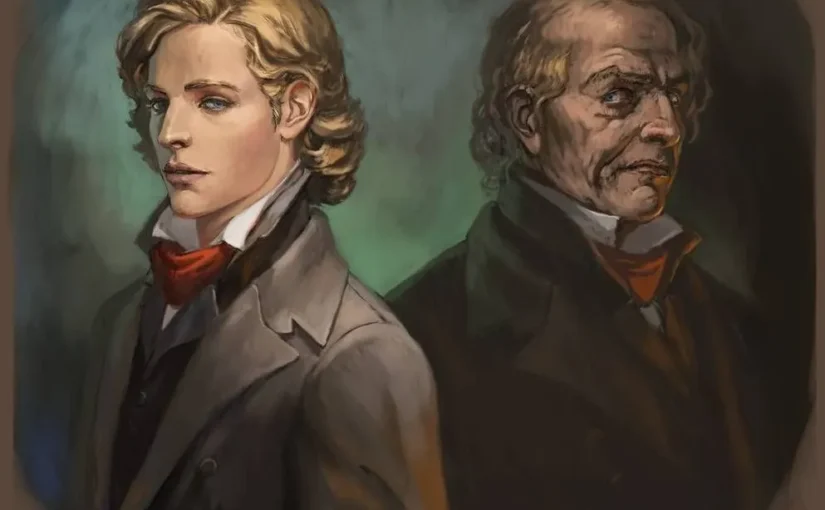
Oscar Wilde’s The Picture of Dorian Gray: The Controversy around the novel’s depiction of homoeroticism
This essay has nothing to do with South Asia but I am sharing it in the interest of mixing up topics and discussing things that don’t have to do with Ind-Pak.  For FlyDie specifically. 

Oscar Wilde’s The Picture of Dorian Gray is a classic work of 19th century gothic horror. Initially published in the July 1890 issue of Lippincott’s Monthly Magazine, the novel became immediately controversial, primarily because of its “immorality”. In his “Introduction” to the annotated, uncensored edition (Belknap 2011)–based on Wilde’s original typescript– editor Nicholas Frankel quotes a contemporary review in the Daily Chronicle:

It is a tale spawned from the leprous literature of the French decadents–a poisonous book, the atmosphere of which is heavy with the mephitic odours of moral and spiritual putrefaction–a gloating study of the mental and physical corruption of a fresh, fair and golden, youth, which might be fascinating but for its effeminate frivolity, its studied insincerity, its theatrical cynicism, its tawdry mysticism, its flippant philosophizing…

Frankel argues that a large part of the reviewers’ outrage arose out of what they perceived to be the novel’s references to homosexuality. He writes:

That outraged British reviews of The Picture of Dorian Gray share the same coded language (unhealthiness, insanity, uncleanliness, and so on), while making allusion to criminal prosecution, shows very clearly that many early British readers were cognizant of the the ways in which the novel challenged conventional Victorian notions of masculine sexuality, particularly through its preoccupation with the homoerotic and emotional relations between the three main male characters (Dorian, Basil, and Lord Henry) and through its complex interest in the potentially corruptive nature of interpersonal influence.

As a response to this criticism, Wilde made substantial changes to the 1891 book-length version, substantially toning down the homoerotic content. However, during his 1895 trials for “gross indecency”, passages from the novel were often introduced into evidence, usually in the more scandalous magazine version. Thus, the controversy around Dorian Gray became inseparable from the scandal around Wilde’s sexual behavior more generally. Continue reading Oscar Wilde’s The Picture of Dorian Gray: The Controversy around the novel’s depiction of homoeroticism
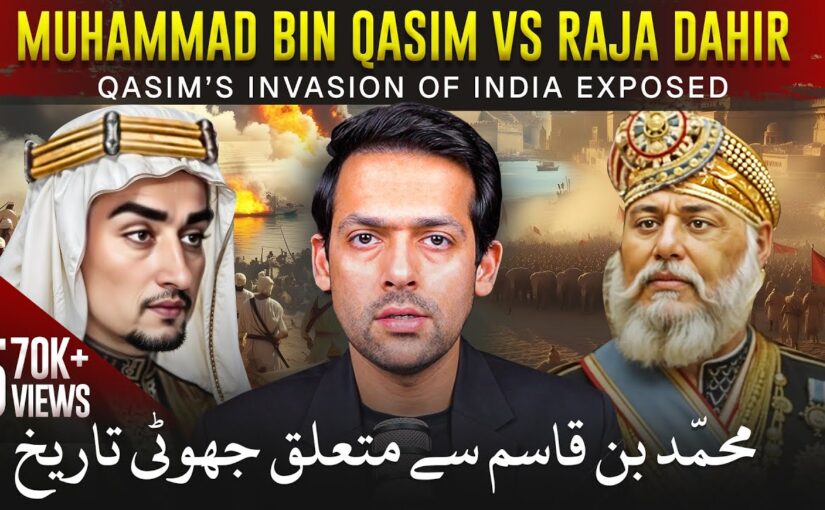
The invisibility of caste in Pakistan

I’ll do a larger post sometime later (maybe tomorrow) but a quick rebuttal of some points raised by Kabir in his latest post regarding caste.

Kabir mentioned this about privilege.

All the Pakistanis on BP are privileged given that we are all English-speaking and all of us have foreign citizenship (I assume).


All the Indians on BP are also privileged in that they are able to converse in English.

Notice the difference. The Pakistanis had to go abroad to live/study. The Indians didn’t. I don’t know about most Indians here (maybe they would like to enlighten) but I have spent my entire life in India. I have only gone abroad on vacation. There is no Pakistani equivalent here.

And that is telling.

India is better than Pakistan on all socioeconomic metrics. And I can link charts, data etc here but real world examples like this are more telling.

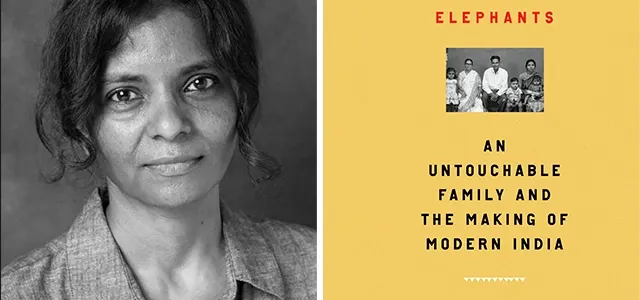
Sujatha Gidla, a Dalit was able to get education in some of India’s best educational institutions and make it to the United States where she could write a book in English. Unlike in Pakistan, one need not be a descendant of “doctors and lawyers” to be able to go down that path.

Again, I am not denying the existence of discrimination against Dalits (or for that matter Muslims) in India.

But the fact that Dalits (and Muslims) have dissenting voices as well as a visible presence in India speaks for India’s relative egalitarianism vis a vis Pakistan.

In fact, I would say caste is even more pervasive in Pakistan than India due to the complete denial by the privileged castes (as we can see here) and the complete invisibility of it. Kabir has multiple times spoken of his Iranian ancestry as well as EK of his Kashmiri Brahmin ancestry so they are very much “Ashrafs” speaking about “Ajlafs” and “Arzals”.

Poetry by Iqbal is fine and dandy but that doesn’t change the reality on the ground.

All those Muslims exist on the Indian side too where they receive affirmative action (as they should). What is called as “biradiri” is basically “caste”.

Kabir did make this comment about “proper Muslims”.

Proper Muslims (Arabs) don’t have caste.

First of all, it is good to see the acceptance by Pakistanis that they are not “proper Muslims”.

Secondly, since they are not “proper Muslims” but “Hindu Muslims” maybe time for them to examine their faults?


Ants Among Elephants: A Portrait of Untouchability in India

Since we have been talking about caste, I am sharing this review of Sujatha Gidla’s Ants Among Elephants: An Untouchable Family and the Making of Modern India.  

Caste has religious sanction in Hinduism while in Islam all believers are (theoretically) considered equal in the eyes of Allah.  This is an important distinction between the two religions. 

One of the frequent topics of debate among those interested in South Asia is the caste system and whether it is unique to Hinduism or features in other South Asian religions as well. Hindu society has traditionally been divided into four castes (or varnas): Brahmins (priests), Kshatriyas (rulers, administrators and warriors), Vaishyas (merchants and tradesmen), and Shudras (artisans, farmers and laboring classes). A fifth group consists of those who do not fit into this hierarchy at all and are considered “untouchable”. What separates caste from other systems of social stratification are the aspects of purity and ascribed status. Upper-castes consider lower castes to be “impure” and have rigid rules about the kind of social interaction they can have with them. For example, upper castes will not accept food from those of a lower caste, while lower castes will accept food from those above them. Caste status is also ascribed at birth and has nothing to do with an individual’s achievements. A Brahmin peasant remains a Brahmin while an “untouchable” engineer is still an “untouchable”. This system persists in India today, though the government does provide affirmative action in order to uplift members of “backward” castes.

Coming from a Pakistani background, I was not familiar with the operation of the caste system in daily life. Though Pakistan is a highly socially stratified society, this system has no religious sanction. In Islam, all believers are considered equal in the eyes of Allah. Unlike in India, where until recently, “untouchables” could not go into several temples, all social classes pray together in the same mosques. This fact is highlighted in one of the famous couplets from Allama Iqbal’s poem “Shikwa” (the complaint) which states: “Ek hi saf mein khare ho gaye Mahmood-o-Ayaz/ Na koi banda raha aur na koi banda nawaz” (Mahmood the king and slave Ayaz, in line as equals stood arrayed/ The lord was no more lord to slave: while both to the One Master prayed). At least in religious terms, one Muslim is not better than any other, no matter what his social status. Of course, this does not mean that social stratification ceases to exist. To this day, rich Pakistani families have separate utensils in their homes which are to be used by the servants. Punjabi Christians who engage in janitorial work are still known as “chuhras”, a derogatory reference to their pre-conversion caste status as “untouchables”. However, unlike the Hindu caste system, social class in Pakistan is not based on ascribed status. If someone from a low socio-economic background attains an education and a well-paying job, he or she will no longer be treated as belonging to their previous socioeconomic group. This is a major difference from India, where one’s caste remains salient, no matter one’s economic status. Continue reading Ants Among Elephants: A Portrait of Untouchability in India

Bin Qasim’s Thousand-Year Wound

There is one fault line under everything that happens here, and it is old. Pakistan stands, whether it wishes to or not, as the proxy for the Muslims of the subcontinent, and India as the proxy for its non-Muslims. This is not a quarrel of the last election or the last war. It is a wound more than a thousand years old, set running when Muhammad bin Qasim landed in Sindh in 711, and it has been arguing with itself in the subcontinental subconscious ever since. Every thread on this site is a small, late episode of that argument.

There is a scene in The Devil Wears Prada, the cerulean one, where a colour chosen by Miranda Priestly (Meryl Streep) at the summit of fashion is followed down the seasons, runway to department store to clearance bin, until Andy (Anne Hathaway), who fishes it out is sure her choice owed nothing to any of it.

Anne Hathaway referencing the ICONIC cerulean sweater scene for her first  day filming The Devil Wears Prada 2 💙 Andy is back! , #AnneHathaway  #TheDevilWearsPrada #TheDevilWearsPrada2 #AndySachs ...

The subcontinent’s argument works the same way. Bin Qasim’s landing in 711 was a decision taken at the top of history, and it has filtered down through thirteen centuries of conquest, doctrine and memory into a comment thread, where two strangers swapping insults are certain the quarrel is about this week. It is not. It was chosen for them a thousand years ago, and they are wearing it without knowing the name of the colour.

What is new is that the argument is going quiet, and quiet is worse than loud. The subcontinent is partitioning itself a second time, in the mind. Indians increasingly talk only to Indians, Pakistanis only to Pakistanis, each inside a feed built to agree with them. The 1947 line cut the map; the algorithm is cutting the conversation. Against that, the value of Brown Pundits is simple and almost embarrassing to state. It is one of the few open places left where the two sides still argue with each other in public and mean it. That is worth defending even when the argument is ugly, because the alternative is not a calmer argument. It is no argument, and two rooms that never open the door.

Is BP sui generis on the Internet?

Continue reading Bin Qasim’s Thousand-Year Wound

On BP: A Diagnosis

First of all, I want to thank X.T.M for enforcing a “ceasefire” between myself, BB and RNJ.  I really do think it is better for the mental health of everyone concerned to not indulge in these “low-signal” exchanges which are mostly just personal acrimony.  Insulting someone’s career as “grift” for example or posting a picture of the Netanyahus at the Taj are not adding anything to the discussion and only serve to trigger the other party.

I would be open to revisiting this “ceasefire” after a certain period (a few weeks or months) provided the people concerned learn how to debate without being disagreeable.  However, for now, it is best to limit interaction.

With that preamble out of the way, I want to turn to the main topic of this post: A diagnosis of what BP is or isn’t.    I am including the (somewhat tongue-in-cheek) song “A Diagnosis” from the TV Show Crazy Ex-Girlfriend to illustrate the importance of obtaining a correct diagnosis.  Before one can prescribe a cure, one has to first understand what the problem is.  This post is my attempt to do so.  It is inherently subjective and of course there is room for respectful disagreement.

Continue reading On BP: A Diagnosis

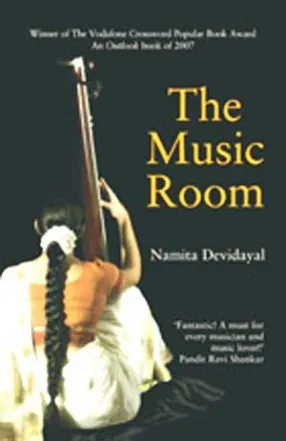
Review: The Music Room by Namita Devidayal

In an attempt to cool the temperature, I am sharing this review of Namita Devidayal’s book The Music Room.  I appreciate that BP is not afraid to tackle controversial and fraught topics relating to India-Pakistan but we need to mix it up with less controversial (but no less important) topics. 

Namita Devidayal’s memoir The Music Room is a chronicle of her relationship with her guru Dhondutai Kulkarni (1927-2014). The book describes Devidayal’s initiation into Hindustani classical music as a reluctant ten-year-old from Bombay’s upper-middle class. Along with describing her growing appreciation for Dhondutai and the music that she imparts to her, the narrative also tells the story of two other important figures in Hindustani music: Ustad Alladiya Khan (1855-1946)–the founder of the Jaipur-Atrauli gharana–and Keserbai Kerkar (1892-1977)–one of the most famous khayal singers of the 20th century. Through telling the stories of these individuals, Devidayal elucidates several important themes such as communalism and “Hinduization” of music as well as the place of women in classical music.

Devidayal describes the process through which Hindustani music became communalized and “Hinduized”. Though Dhondutai is extremely proud of the musical legacy passed on to her by Alladiya Khan Sahib’s family, she still expresses some bigoted views about Muslims. When pressed on this by Devidayal, Dhondutai attempts to square the circle by telling her that Ustad Alladiya Khan was not a real Muslim since he was (allegedly) descended from a Brahmin singer who had been forced to convert to Islam by a Muslim king. She also notes that he always wore the caste thread usually worn by Brahmins. This story allows Dhondutai to hold the belief that Hindustani classical music is essentially Hindu despite the fact that many of the most prominent gharanas had Muslim founders. Dhondutai’s prejudices connect back to the broader process through which–during the colonial period– Hindustani music was “Hinduized” by reformers such as Pandit Bhatkhande and Pandit Paluskar. Bhatkhande wanted to create a “national music” and believed that Hindustani music had been degraded by Muslims and dancing girls and needed to be rescued from both. This process has been extensively discussed by Janaki Bakhle in her book Two Men and Music: Nationalism in the Making of an Indian Classical Tradition. Unfortunately, while most ethnomusicologists agree that Hindustani music is a syncretic tradition, many (on both sides of the India-Pakistan border) persist in claiming it for one or the other religion. Continue reading Review: The Music Room by Namita Devidayal

On Bigotry

“Unfortunately, my experiences dealing with Indians (not all Indians obviously) have shown me…”

“I find a large subset of Hindus extremely toxic and hateful. I’m glad I don’t have to share a country with them. …”

“The “Saffroniate” cannot now claim innocence. The fact is that they get off on loss of life in Pakistan. They have real psychological problems.”

“There seems to be a genuine bloodlust for war and the decimation of Pakistan among Indian nationalists.”

Replace the target ‘Hindu’ with black, or even muslim, and what would happen if such statements are repeatedly published?

Pakistani claims of “false flag” has been a consistent pattern going back to the Mumbai attacks of 26/11/2008, where the Pakistani government for years refused to accept that Ajmal Kasab and his co-murderers were Pakistani.

It is deeply offensive for Brown Pundits to platform such preposterous assertions regarding the brutal massacre of Hindu tourists in Pahalgam. It has barely been a year since the tragedy occurred.

Platforming such propaganda is an overt choice. This is not free speech. This is spitting in the face of trauma.

Open thread

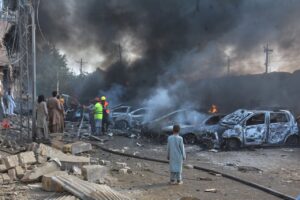
On early Sunday morning, May 24, 2026 — Just a few days before the festival of Eid al-Adha — on a quiet morning in Quetta’s Chaman Pathak neighborhood.  An explosive-laden vehicle ripped through a shuttle service carrying passengers, from the Quetta Cantt station –  killing at least 24 and 70+ wounded, mostly military personnel, laborers and families, that were headed to the Peshawar-bound Jaffar Express. These were ordinary Pakistanis looking forward to getting back to their hometowns for the Eid holidays. The Balochistan Liberation Army has claimed responsibility for the attacks. This tragedy comes just around the first anniversary of the Khuzdar school bus bombing  — killing 8 civilians, injuring dozens, most of the fatalities being school girls. This attack was also connected to separatist militants in the province. Celebrated by journalists, talking heads and govt officials across the eastern border along with their social media commentariat – blinded by nationalism.

Jaffar express sounds familiar as that train was also attacked a little over a year ago, March of 2025, early in the holy month of Ramadan. That attack orchestrated by the BLA, killed over 60. It seems like attacking Pakistan around the holidays is the M.O of these militant groups and their handlers.

There is grief across Pakistan as terrorism has gone up, patience is wearing thin among the general public with the states inaction against these adversaries of the nation. The Dhurandars are running up their kill streak, maiming innocent Pakistanis across the country, trying to instill fear, chaos and division. There is palpable frustration among the citizenry due to government incompetence and lenience towards ethno-fascism and a failure to protect its citizens from this regional proxy war. Will the Dhurandars be brought to justice for the mass murder of innocent civilians or will the Dhurandar-ing continue with more violence, terrorism and bloodshed across Arz-e-Pak to no avail.

Here’s to another somber Eid and world peace.

The Crescent has a sharp edge

Context in BP is cumulative, mes amis.

As we know, certain members of the Crescentiate remain emotionally invested in Pakistan, and certain members of the Saffroniate respond by undermining Pakistan. Neither tendency is a criticism in itself, we try to keep as few Shibboleths as possible in BP.

As an aside the Crescentiate are “Zionesque” (or perhaps more appropriate Jinnahesque) in the sense of preferring Pakistan to Islam.

What is a criticism is repeatedly reaching across that line, eliciting the predictable reaction, and then presenting oneself as the neutral party once it arrives. This is a small community with a very long memory. The personality maps build over time, and we remember who did what first.

The Crescentiate, with whom Sbarrkum is aligned, correctly called Iran the victor in this year’s confrontation with the United States and Israel, a reading the Saffroniate has refused to grant. We deeply dislike the regime but acknowledge that its valiant defence of the homeland may augur new glimmerings for the Ummah (we are who we imagine ourselves to be hence why psych warfare is so dangerous).

Getting Indian Classical Music Wrong

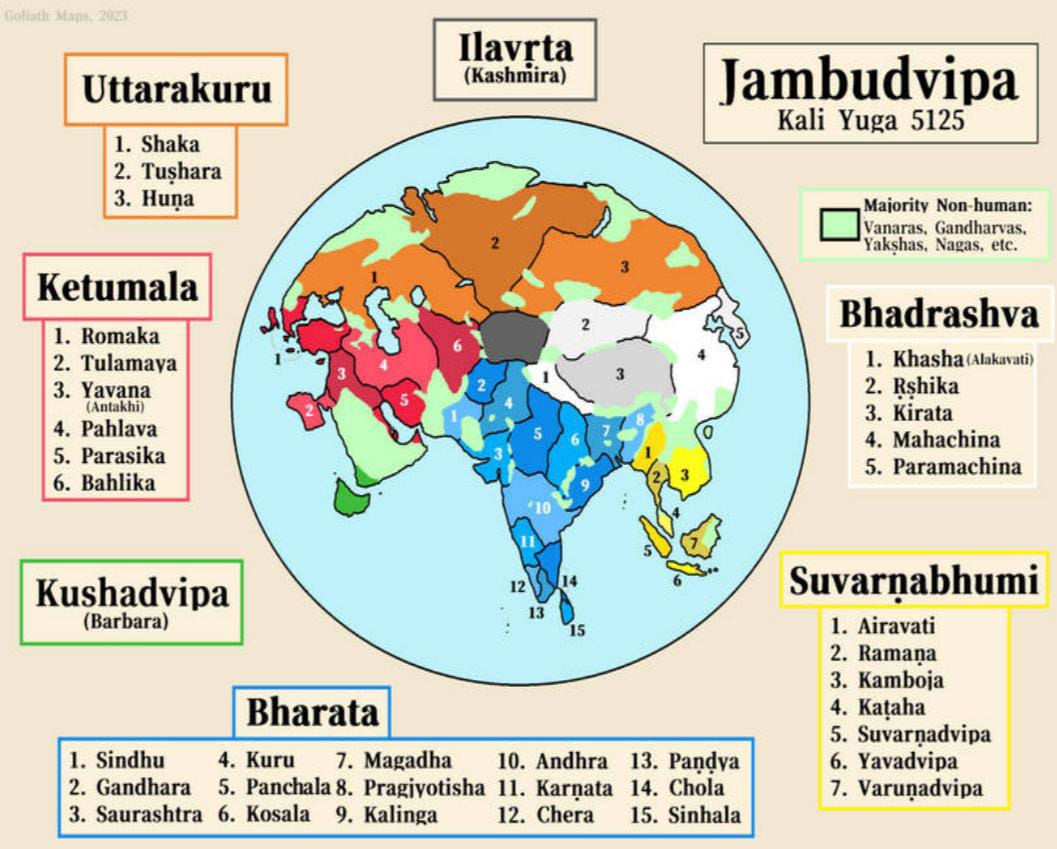
For instance, to tell our resident ethnomusicologist, an academic at Pakistan’s top university (Ivy+ crawls with LUMS researchers), that his field is entirely Hindu is ahistorical. Lest we be accused of green-washing, we prefer the Indian Continent be called Jambudvīpa.

Let's dive into the forgotten map of the ancients - Jambudvipa as described in our Puranas & Itihasas. This isn't just geography, it's cosmic cartography: mapping realms of humans, Devas, Nagas, Gandharvas

But we are also appreciative of historical truth: all major khayal gharanas have Muslim founders, converts or otherwise. Islam has long since moved past the mawali stage.

Imam Bukhari, compiler of Sahih al-Bukhari and the most authoritative hadith scholar in Sunni Islam, had a great-grandfather who was a Zoroastrian convert and mawla of the Banu Ju’fa.

So when someone is triggered, we will look to understand whether the trigger is justified, and what “triggered” the trigger, before acting.

Parliament at her Best:

Remember this is Parliament. And in Parliament, the curious thing is that members of opposing benches are often more cordial with one another than they are with members of their own party. The hostility you see across the aisle is theatre. The knife-work happens at home.

We moderate by nunchi, not by formula, encouraging congeniality both within and across the benches.

Brown Pundits