
The Last Hurdle to Afghan Peace

Brigadier Simon Saraf wrote a piece on the Afghanistan “peace” process that reflects the Paknationalist viewpoint. Major Amin has added his comments to it. (Major Amin’s comments are bolded). Major Amin is a military history aficionado who has decades of on the ground experience in Afghanistan.  

The last hurdle to Afghan peace

https://nation.com.pk/02-Feb-2019/the-last-hurdle-to-afghan-peace

Taliban and USA are in constant negotiations over withdrawal of US forces from Afghanistan. A draft pact addressing mutual sensitivities is concluded. The two parties facilitated by Pakistan will again meet towards end February to build a roadmap on the skeletal agreement.  

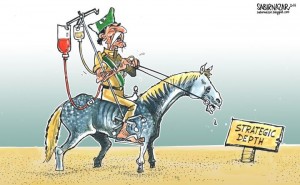
APPEARANCES ARE DECEIVING— US HAS NO STRATEGY AND ITS ACTIONS ARE ACTIONS OF A LAME DESPERATE PRESIDENT BESIEGED BY SCANDALS AND A MINORITY IN CONGRESS–THIS MAKES HIM MORE DESPERATE THAN THE MOST UNDERFED TALIBAN–MR TRUMP WANTS TO NEGOTIATE A US WITHDRAWAL WHICH WOULD BE COMPLETED BY THE TIME ELECTIONS ARE ON THE TOP AND HE MAY WIN THE ELECTIONS—AFGHANISTAN AND PAKISTAN CAN GO TO HELL—A.H AMIN

The best solutions must consider lessons learnt from the Soviet withdrawal in 1989, leaving power in hands of proxies and ignoring a broad based representative government. A representative government for Afghanistan does not mean democracy. Besides the people, it also means co-opting various warring groups, warlords and educated elites. Links with drug mafia and gun running are intrinsic. So unless these groups are satisfied, they have many supporters to make them disruptive. 

BROAD BASED REPRESENTATIVE GOVERNMENT WAS NEVER THE LESSON IN SOVIET AFGHAN WAR— PAKISTAN HAD ITS STOOGES–LOWEST RUNG MULLAHS LIKE HAQQANI WHO AS PER HIS ISI HANDLER COL QASIM ABBAS STANK SO MUCH THAT THEN MAJOR QASIM MADE HIM SIT IN THE OPEN BACK BODY OF HIS VEHICLE–THERE WAS NO BROAD BASE IN SOVIET AFGHAN WAR AND NO BROAD BASE NOW–ONLY STOOGES-PAKISTANI STOOGES OR IRANIAN STOOGES OR AMERICAN STOOGES OR RUSSIAN STOOGES OR INDIAN STOOGES—A.H AMIN

USA, the Afghan resistance, Taliban and Pakistan have been here before as a resistance to Soviet occupation and then a broad based alliance approved by Pakistan and USA. 

Return of warlords gave meteoric rise to Taliban. They over ran most Mujahedeen groups led by warlords and fought fierce battles with Al Qaeda. 

AL QAEDA NEVER EXISTED — FOUGHT AFGHAN WAR AS LOGISTICS ADVISOR OF A SIDE –NEVER SAW AL QAEDA–BASED IN AFGHANISTAN SINCE 2001–NEVER SAW AL QAEDA—DAESH IS ALSO A FICTIONAL ENTITY THAT THE PAKISTANI STATE INVENTS WHEN IT GUNS DOWN INNOCENTS LIKE AT SAHIWAL Continue reading The Last Hurdle to Afghan Peace
The religious and genetic structure of Bengal & Partition

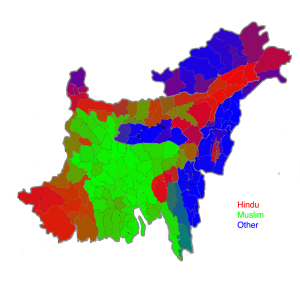
I was emailing with a friend of mine about population genetic history and Southeast Asia. I mentioned offhand that there is an east to west cline of Tibeto-Burman ancestry in Bengal. He expressed surprise, assuming Partition had scrambled everything.

As most readers of this weblog know, Partition was less traumatic for Bengal than it was for Punjab. The violence was less extreme, and the population movement also not as massive. And yet looking at the religious map it is clear that some sorting has occurred. The proportion of Hindus in the region that is now Bangladesh has gone from ~25% to about 10% over the past 70 years, or three generations. Though some of this is due to differences in fertility, the main driver has been migration of Hindus out of East Pakistan, and later Bangladesh. In contrast, there has not been much of a reciprocal migration of Muslims into Bangladesh.

This results in a peculiarity when I receive genotypes from people of Bengali origin: a large minority of people of Hindu background mention that one or both of their parents have origins in eastern Bengal, what is not Bangladesh. In contrast, I have never received a gentoype from someone who tells me that their family migrated from western Bengal into Bangladesh.

The genetic consequence is simple: there is a larger variance of East Asian ancestry in West Bengal than East Bengal because of more mixing in the west than the east. In contrast, one could probably infer the extent of the migration simply by doing genetic analysis and not looking at Census data!

Afghanistan. Exit to Chaos?

Prompted by some discussion on Twitter, a few random thoughts:

  1. The US has spent 100s of billions of dollars in its longest war and Trump has had it and wants out. He is not wrong in regarding this as a colossal waste of money. But Trump being Trump, he will probably end up wasting whatever gains the US DID make in the region in the process. Zalmay Khalilzad may be sincerely interested in a viable Afghanistan, but his boss has neither the interest nor the ability. Without knowing ANYTHING about the various layers of secret planning and execution going on right now, just on general principles (losers don’t get to dictate terms, winners are not bound by promises they made, Trump is an ignorant conman, etc) this is not going to end well. There WILL be blood.
  2. The waste is going to get blamed on “corrupt Afghans”, but really, the Afghan elite (while undoubtedly corrupt in many cases) is not the main actor here. The United States is simply not a very effective imperial power. Much of the corruption is on the US side (contractors for the most part) and all of it is ultimately the responsibility of the imperial power cutting the checks. The US has a frighteningly capable military and a huge war chest. For the US to spend 100-1000 billion dollars and be unable to manage Afghanistan is a tribute to American incompetence, not Afghan resistance or corruption. If they were fooled by Pakistan is it Pakistan’s fault? if they were fooled by Afghans, is it all the Afghan’s fault? Beyond the obvious corruption on the US side there is the issue of ideological incompetence; the US is neither a capable imperial power, nor an innocent spectator with no interest in meddling in far away countries. And somehow its processes are so designed that it is easier to waste a 100 billion per year than it is to sit back and figure out what the aims are, where the carrots and sticks are most likely to work and now to apply them.
  3. The threat of withdrawal is not necessarily a bad idea. There is an obvious moral hazard in this situation, where Afghan (and other anti-Taliban parties, including India, Iran, Russia, China etc) have limited incentive to shape up or step up as long as the US is walking around with a generous checkbook and a tremendous fighting force willing to act on their behalf. In better hands, this might have been exactly the way to make everyone shoulder their own share of the burden.. but these are not “better hands”. Trump has no plan and less interest in any good (or bad) outcome. I find it hard to imagine that this could end up as a US “win”. As a US citizen, I will be happy if it does, but I am not holding my breath.
  4. Pakistan, supposedly the “winner” in this war, will not find victory too satisfying. The Taliban will not take orders (I mean they probably WILL entertain requests to kill X or Y as a favor to us, but they won’t do things they don’t want to do anyway), anti-Taliban Afghans will not roll over and play dead. India will continue to support them and Indian support is not insignificant. Russia, Iran and even China probably do not want a Taliban govt either. Instead of peace, we will have renewed civil war and more violence, not less violence. (Including blowback IN Pakistan). While the US may pay us (directly or more likely, indirectly via Gulf allies) for help in getting out, they will not keep paying once they are out. And they may not leave either. They may stick around to support the rump Afghan regime, and may pay troublemakers in Pakistan. And China will never be as generous as Uncle Sam used to be. Our troubles will not end with “victory” in Afghanistan.
  5. It would have been better to work WITH the US to stabilize a pro-US Afghan regime back in 2002 instead of playing double games. The cost of these games may extend beyond “victory”.
  6. 316743_10150340654784292_529734291_7856373_1074019852_n1-300x185

BrownCast Episode 12: The global China, with Carl Zha

Another BP Podcast is up. You can listen on Libsyn, iTunes and Stitcher. Probably the easiest way to keep up the podcast since we don’t have a regular schedule is to subscribe at one of the links above. You can also support the podcast as a patron (the primary benefit now is that you get the podcasts considerably earlier than everyone else).

If you aren’t in a position to be a patron, please give us 5-star ratings and a positive review!

After this podcast was recorded and edited Carl Zha Informed informed me that he is no longer doing CLASH! and rather is starting a new podcast: Silk and Steel. This is actually the first post on Silk and Steel as well. A “cross-over.”

Continue reading BrownCast Episode 12: The global China, with Carl Zha

BrownCast Episode 11: Indian Numismatics with Mohit Kapoor

The latest BP Podcast is up. You can listen on Libsyn, iTunes and Stitcher. Probably the easiest way to keep up the podcast since we don’t have a regular schedule is to subscribe at one of the links above. You can also support the podcast as a patron (the primary benefit now is that you get the podcasts considerably earlier than everyone else). Show-notes after the jump!

Image result for gandhara coin
Gandharan Coin

Continue reading BrownCast Episode 11: Indian Numismatics with Mohit Kapoor

Open Thread – Brown Pundits

Please keep the other posts on topic. Use this for talking about whatever you want to talk about.

ZackNote: As per suggestions; I’m listing all the Posts Written since last week’s Open Thread (in Reverse Chronological Order):

  1. The Balto-Slavic & Indo-Iranian Connection
  2. Pakistani Psychosis
  3. Is it time for Asian Americans and Latino Americans to ask to be considered “white”? (b)
  4. Brexit and Democracy
  5. Indian Numismatics Browncast Podcast Coming Up –
  6. Notes on Brown Pundits “BrownCast”
  7. 1857: The Central Indian Campaign
  8. Watching Shtisel.. (and Turkish TV)
  9. Brown Pundits BrownCast episode 10, with Josiah Neeley
  10. the British “created” India according to this Coloniser
  11. Why doesn’t Arundhati Roy move to Pakistan?
  12. ‘In the milk of OBCs and Dalits, Muslims have added sugar’
  13. (Machine) Learning Biases
  14. American Muslims and Kamala Harris
  15. Various Asiatic raps
We average 2 posts a day making it a fairly prolific blog.

American Muslims and Kamala Harris

The number of Democrats who have thrown their hats in to run as President has already approached double digits or crossed it; its difficult to keep tab. So far the most impressive launch was Kamala Harris, who declared from a huge rally in her homeground, Oakland, California. It’s not hard to see more than a similarity with another hugely famous biracial candidate, Barak Obama, who declared in his homeground Illinois with much fanfare.

Everybody understands that Kamala Harris will be a formidable candidate. Apart from all her personal and professional qualifications, liberal America may just want to recitify the Trump presidency with another emphatic progressive statement.

However, for now I am curious about how Muslims in America will regard Kamala Harris. I find it interesting that several Muslims media personalities have been twitting about Harris with barely disguised antipathy and are quickly delving into oppo research of Harris’s background.

Ofcourse, any sober political observer understands that people like Mehdi Hassan are fanatics who cares for only one issue, how good is the candidate for global Muslims and the way to judge that is probably position on Israeli-Palestine issue. But I believe people like Mehdi Hassan and his cohort do not move in own ways. These guys either coordinate intesely or their ideological lodestar acts as an Schelling point for coordination.

I am curious to see if general American Muslims show hesitancy about Kamala Harris. If they do, what could be reason for such luckwarmth?


(Machine) Learning Biases

Cross posting from Ali Minai’s excellent “Barbarikon” blog (this is, of course, Ali Minai’s writing, not mine)

 In a recent tweet, Congresswoman Alexandria Ocasio-Cortez – widely known as AOC – responded to a report from Amazon that facial recognition technology sometimes identified women as men when they have darker skin. She said:

When you don’t address human bias, that bias gets automated. Machines are reflections of their creators, which means they are flawed, & we should be mindful of that. It’s one good reason why diversity isn’t just “nice,” it’s a safeguard against trends like this

While I agree with the sentiment underlying her tweet, she is profoundly wrong about what is at play here, which can happen when you apply your worldview (i.e. biases) to things you’re not really familiar with. To be fair, we all do it, but here it is AOC, who is an opinion-maker and should be more careful. The error she makes here, though, is an interesting one, and get to some deep issues in AI.

The fact that machine learning algorithms misclassify people with respect to gender, or even confuse them with animals, is not because they are picking up human biases as AOC claims here. In fact, it because they are not picking up human biases – those pesky intuitions gained from instinct and experience that allow us to perceive subtle cues and make correct decisions. The machine, lacking both instinct and experience, focuses only on visual correlations in the data used to train it, making stupid errors such as relating darker skin with male gender. This is also why machine learning algorithms end up identifying humans as apes, dogs, or pigs – with all of whom humans do share many visual similarities. As humans, we have a bias to look past those superficial similarities in deciding whether someone is a human. Indeed, it is when we decide to override our natural biases and sink (deliberately) to the same superficial level as the machine that we start calling people apes and pigs. The errors being made by machines do not reflect human biases; they expose the superficial and flimsy nature of human bigotry.

There is also a deeper lesson in this for humans as well. Our “good” biases are not all just coded in our genes. They are mostly picked up through experience. When human experience becoming limited, we can end up having the same problem as the machine. If a human has never seen a person of a race other than their own, it is completely natural for them to initially identify such a person as radically different or even non-human. That is the result of a bias in the data (experience, in this case), not a fundamental bias in the mind. This is why travelers in ancient times brought back stories of alien beings in distant lands, which were then exaggerated into monstrous figures on maps etc. This situation no longer exists in the modern world, except when humans try to create it artificially through racist policies.

The machine too is at the mercy of data bias, but its situation is far worse than that of a human. Even if it is given an “unbiased” data set that includes faces of all races, genders, etc., fairly, it is being asked to learn to recognize gender (in this instance) purely from pictures. We recognize gender not only from a person’s looks, but also from how they sound, how they behave, what they say, their name, their expressions, and a thousand other things. We deprive the machine of all this information and then ask it to make the right choice. That is a huge data bias, comparable to learning about the humanity of people from distant lands through travelers’ tales. On top of that, the machine also has much simpler learning mechanisms. It is simply trying to minimize its error based on the data it was given. Human learning involves much more complicated things that we cannot even fully describe yet except in the most simplistic or metaphorical terms.

The immediate danger in handing over important decision-making to intelligent machines is not so much that they will replicate human bigotries, but that,within their limited capacities and limited data, they will fail to replicate the biases that make us fair, considerate, compassionate, and, well, human.

‘In the milk of OBCs and Dalits, Muslims have added sugar’

Catch our latest Episode 10 of BrownCast on Libsyn, iTunes and Stitcher. 

Back to the Post. I was thinking that usually Jinnah (I prefer to use QeA but this time I’ll dispense with honorifics) is contrasted with Nehru or Mahatma Gandhi. Nevertheless a better basis of comparison would be Ambedkar.

When All India Majlis-e-Ittehadul Muslimeen President Asaduddin Owaisi, MP, and Bharip Bahujan Mahasangh leader Prakash Ambedkar addressed a rally in Aurangabad on Gandhi Jayanti, it marked a milestone in contemporary Indian politics.

It was the first time a Dalit party has tied up with a Muslim outfit.

In pre-Partition India, Muslim League leader Mohammed Ali Jinnah understood the power of this vote bank and quickly latched on to the idea of separate electorates when the British proposed it.

But the plan came a cropper when the more astute Mohandas Karamchand Gandhi convinced Dr B R Ambedkar that separate electorates were not the way forward and sealed the Poona Pact.

Then in the 1980s, Kanshi Ram realised the potential of Dalit votes and went on to form the Bahujan Samaj Party. It reached its zenith under his chosen successor Mayawati, a four time chief minister of India’s most populous state, Uttar Pradesh.

See Also: Pakistan’s Forgotten Dalit Minority

Continue reading ‘In the milk of OBCs and Dalits, Muslims have added sugar’

Brown Pundits