Love is love

https://www.facebook.com/354522044588660/posts/2759518440755663/

I’m adding a few more thoughts here on the Priyanka Chopra – Nick Jonas nuptials.

https://twitter.com/soumyadipta/status/1068007070618677248?s=21

I am proud of Priyanka Chopra and what’s she managed to accomplish (Quantico, Royal Wedding Invite, Met Gala, Nick Jonas).

I believe she’s an emancipated Desi woman who has broken the back of the Patriarchy by marrying a white celebrity 10years younger to her.

She is also one of the few Bollywood celebrities who arguable could have gotten married in Italy but chose India because she’s a proud Indian!

Pakistan Wins in the Sikh Punjab under Imran’s Captaincy

https://www.facebook.com/etribunevideo/videos/493287031079400/

Anyone who knows my writing knows that I am a voicerferous critic of Pakistan and Islam; especially since Hazrat Asia’s unfair imprisonment.

But I must say this Kartarpur Corridor is a huge win by Pakistan and Imran.

As an aside and not to quibble but it’s obvious that Imran “thinks English and speaks Urdu.” While he is fluent in Urdu he’s not immersed in the language and his English borrowing is unseemly. However that is neither here or there and shouldn’t detract from his powerful message.

I will relay a curious incident over the weekend. I was speaking to my friend’s father who was visiting from Delhi. He had asked me if I ate pork to which I replied in the affirmative and in return I asked him if he ate beef.

His response startled me telling me that he had everything and that there was no prohibition in beef-eating in Sikhism and that furthermore while he was Indian he wasn’t Hindu. This is not a Jat Sikh Khalistani but a Khatri background (at Partition they came from the Pindi region) and I was struck by the quiet and emphatic manner of speaking.

Furthermore from the deepest tendrils I am able to sense slightest discomfort with Indians & Hindus (understandably so given their thoughts on Pakistan) when they are interacting with Pakistanis, which is why I tend to downplay it to an almost invisible degree (I tend to ramp up the Parsi connotations) but with this chap he was almost positive aboethnicity married to the latter casteut the fact that I was a Pakistani.

By playing high, & not low for once, Pakistan has generated incredible goodwill by showing love & tolerance across the border. There will be very few Sikhs who will have the heart to abuse Pakistan after this magnanimous gesture.

A friend of mine bemoaned on Facebook as to why all Indo-Pak reconciliations centred on the Punjab and why didn’t it involve other “split ethnicities” like the Muhajirs or Hindu Sindhis. Initially I was struck by the status since I’m from the former married to the latter. However Punjabi blood was the painful sacrifice of Partition so it is only fair that they determine the tempo of peace and reconciliation..

A few random notes on gallantry awards (British Indian Army)

From an email from Dr Hamid Hussain. Also sheds some light on the cultural knowledge expected of British-Indian army officers..

Gallantry Awards:  Gallantry awards are always controversial depending on the perch from where you are looking at.  Many gallant deeds go unnoticed as there was no witness or Commanding Officer (CO) didn’t initiate his report in time.  Elite battalions and regiments have many godfathers in senior positions, hence these battalions have an edge when it comes to awards.  Those regiments known as ‘no body’s own’ usually fall behind in this race.  On the other hand, an enthusiastic CO can be too liberal in his recommendations for gallantry awards and military bureaucracy kicks in to downgrade or altogether reject his recommendations.  Bias against Indian officers may have been a factor in early stages of war but in later stages especially when Auk became C-in-C, he was instrumental in getting Indian officers battalion commands and liberal award of gallantry awards.

6/13 FFR (now 1 FF of Pakistan army):  6/13 FFR nick named ‘gaRbaR unnath’ for its naughtiness and old number of 59th Scind Rifles had one company each of Sikh, Dogra, Pathan & Punjabi Muslims.  VD Jayal was first Indian officer posted to this elite battalion.  It is to the credit of British Indian army that Indians came to know fellow Indians of different race and religion.  Officer assigned to a company had to pass language test and know about his men.  Jayal learned Pushtu and probably knew about Pathan culture and customs better than a Muslim from Hyderabad or Lucknow.  In the same paltan, a Muslim officer ‘ganga’ Hayauddin (later MG) was posted to Sikh company. He was a Pathan but a fluent speaker and writer of Gurmukhi and knew about Sikh religion more than many Sikhs.  6/13 FFR was commanded by Dudley Russell ‘Pasha’; a fine officer and gentleman.  Paltan won many gallantry awards in this theatre.  Jayal won DSO.  Battalion adjutant Sher Khan (later approved MG but died in air crash in 1949) was recommended for DSO but awarded MC.  Battalion intelligence officer Anant Singh Pathania (later 1/5 Gorkha Rifles and MG) also won MC.  The uncle of Pathania’s wife was the legendry Subedar Major of 6/13 FFR Prabhat Chand who won MC in First World War (the first Indian to win MC).  Lieutenant Sadiqullah Khan (later Brigadier, one of the first Indian officers posted to scouts, commanded South Waziristan Scouts and Tochi Scouts and retired as Inspector General of Frontier Corps) also won MC.  Later, in Italy, Sher Khan’s younger brother Bahadur Sher (later LG) who had joined battalion after emergency commission also won MC.  At the battle of Mont Cassino, Kashmir Singh Katoch (later LG) won his MC. In the battle of Gothic Line, Sepoy Ali Haider won his VC.

Distinguished Service Order (DSO):  Several Indian officers won DSO in Second world war. Rajendrasinhji ‘Reggie’ of 2nd Lancers (later General) was the first Indian officer to win DSO.  In addition to Jayal, another 6/13 FFR officer Akbar Khan (later Major General) won DSO in Burma while serving with 14/13 FFR.  The only Indian officer who won DSO and Bar was Lt. Colonel S. S. Kalha of 2/1 Punjab Regt.  He was killed in action during occupation duty in Dutch East Indies.  Family of Captain Taj Muhammad Khanzada (5/11 Sikh Regt) claims that he had won DSO in Burma but I could not confirm it.  He later joined INA and after the war, removed from the army.  The most famous case is of 51 Indian Infantry Brigade with unique distinction of Brigade commander Brigadier R. A. Hutton and three commanding officers of the battalions winning DSOs. Normally, infantry brigades had two Indian battalions and one either British or Gorkha battalion.  51 Brigade had all three Indian battalions and all three were commanded by Indian officers. Lt. Colonel S. P.P. Thorat (later LG) commanding 2/2 Punjab Regt, K. S. ‘Timmy’ Thimayya (later General) commanding 8/19 Hyderabad and Lt. Colonel L. P. ‘Bogey’ Sen (later LG) commanding 16/10 Baloch Regt. All these three Indian officers won DSO.

Additional award to a winner of DSO is addition of Bar.  There are many officers who won bar to DSO.  There are few officers who have the rare distinction of winning four DSOs (DSO with three bars).  The most decorated officer that comes to my mind is Brigadier Frederick Lumsden of the famous Lumsden clan that raised legendry Guides.  Frederick won VC and four DSOs before dying at the age of 45.  VC and three DSOs were won within six month time period during First World War.

Post Modernism (c)

https://www.youtube.com/watch?v=eDrRkDmoET0

Camille Paglia says (as Jordan Peterson nods along) that Post Modernism is a rejection of:

  • 1960s radicalism (few radicals have gone to graduate school)
  • India, Hinduism, consciousness, psychedelics
  • genuine multiculturalism
  • the body and sensory experience

What are everyone’s thoughts on the psychological basis of Post Modernism?

Post Modernism (b)

Post Modernism (a)

Intellectual Dark Web (a)

Intellectual Dark Web

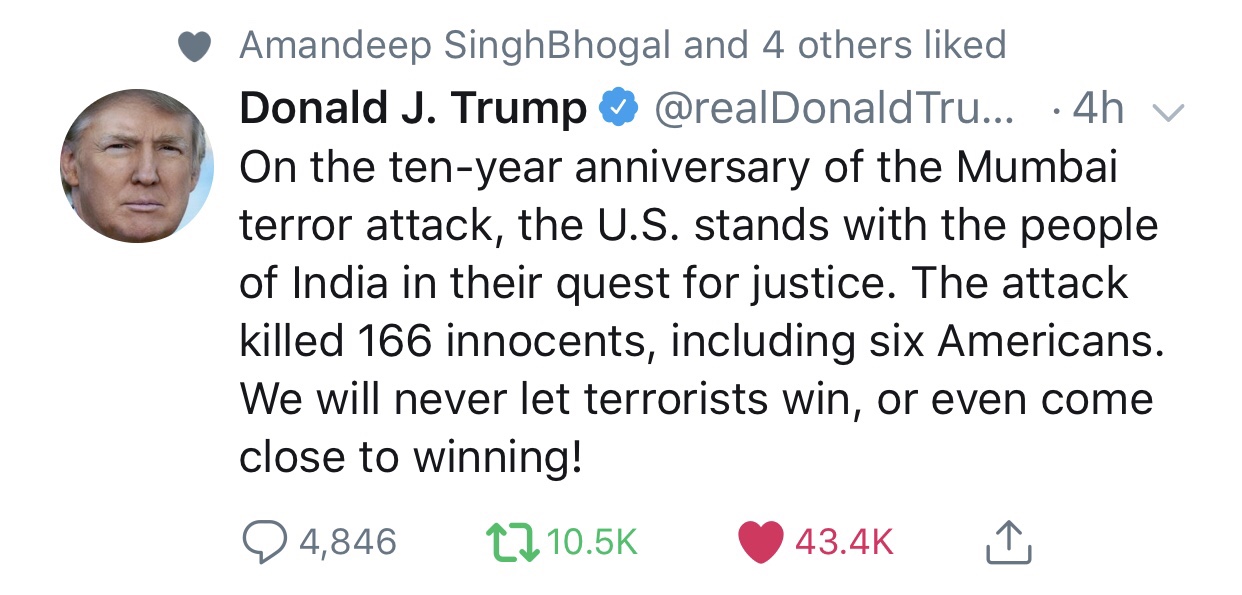
Shame on Pakistan- 10years on from 26.11; In Memoriam.

Vidhi observed a minute’s silence, as she mentioned at Friday’s dinner, the Pakistani attack on India on 26.11 was when India & Indians forever distrusted Pakistan.

When police asked Kasab what he understood about jihad, Kasab told the interrogators “it Jihad is about killing and getting killed and becoming famous.” “Come, kill and die after a killing spree. By this one will become famous and will also make God proud.”[79]

“We were told that our big brother India is so rich and we are dying of poverty and hunger. My father sells dahi wada in a stall in Lahore and we did not even get enough food to eat from his earnings. I was promised that once they knew that I was successful in my operation, they would give 150,000 rupees (around US$3,352), to my family,” said Kasab.[79]

Police said they were shocked by his readiness to switch loyalties after he was apprehended.[79] “If you give me regular meals and money I will do the same for you that I did for them,” he said.[79]

Young Moshe is a living symbol of an eternal Indo-Israeli friendship:

“Time Heals, They Say, But…”: Baby Moshe’s Grandfather On 26/11

When myth becomes reality


Netflix now has Arjun: The Warrior Prince on its stream. I watched most of it to get a feel for some of the details of the story. I know the general outline of the Mahabharata, but I know the Bible or the Iliad far better (in case you can’t be bothered to follow the link, it’s only a small part of Arjun’s early life).

Depending on the sources you trust, the events of the Mahabharata date to around ~1000 BC. They were probably refined at a later date, perhaps around 500 years later.

I watched a fair amount of Arjun: The Warrior Prince. In some ways, it reminded me a lot of the Iliad and the Odyssey. These two works are a melange of influences and time periods, synthesizing true recollections of the large polities with highly stratified social systems and literacy of the Bronze Age, with the simple chiefdoms of the Dark Age Greece. The issue is disentangling the different periods.

One assumes the same is true of the Mahabharata and Ramayana.

The “wild card” here is that the most recent work has now likely confirmed the arrival of agro-pastoralists from the steppe in the period between 1500 and 1000 BC. By the time the historical analogs of the Pandavas were settled in the Gangetic plain, they’d likely been there for many centuries.

Questions for the genetics of India podcast….

Zach, Omar, and myself will do a podcast on Indian genetics next week. I already did one on this topic for my main podcast, so I’m curious what readers of this weblog want to hear about. We can’t guarantee we’ll use the questions, but it’s possible. I think the format will mostly involve Zach and Omar leading the conversation and I’ll try to talk as fast and concisely as possible.

Also, we got our first review on iTunes. Would still like to get some on Stitcher. And in case people want to hear more from me, I was a guest on the Two for Tea podcast. My episode should drop in the next day or so.

Pakistani potluck with a dash of politics

Last night V & I hosted Pakistani potluck. It turned out to be a rather intimate affair with a few Pakistani friends of ours. After the last few weeks of intense Indian & Kashmiri events I thought it would be nice to have a light-hearted evening of biryani, nihari and haleem especially before we go meat-free at home.

As an aside I’ve begun to believe that the meat consumption we are having is simply far in excess of our hunter-gatherer ancestors. Industrial farming is a blight and my hack is simply to eat meat outside of the home.

Toward the end of the evening the talk drifted towards politics and V mentioned some of her opinions about Pakistan. It rapidly became a bit more intense since at the root of it V has deep misgivings about the Pakistani state. Her contention is that all Indians, of whatever hue, couldn’t forgive Pakistan for what happened on 26-11 and that in a way it was India’s 9-11. Continue reading Pakistani potluck with a dash of politics

White people will still define the non-white age..

After the jump is a thread on the brief history of the North Sentinelese by “Respectable Lawyer.” This thread appeared in my Moments Page. His bio reads as “Anti-corporate pirate who gains access to courthouses with foolproof cosplay of a Respectable White Lawyer.”

There are three actors in this recent Missionary saga:

(1.) The (part) Chinese American missionary, John Allen Chau, who is technically a PoC.

(2.) The Sentinelese themselves who are the pristine natives.

(3.) The Indian government, which is not Western.

Essentially in a rather amusing way it involves the three great non-white colours of mankind (black, brown and yellow). Also to make the matter even more tantalising when we think “remote Indian tribes” we don’t usually think of India but rather Native American or Amerindian peoples. So the story involves Christianity, missionaries, colonialism and native people trying to fight back; a real life Desi version of Avatar.

https://twitter.com/kaeshour/status/1065545714485403648?s=20

Also when the NY Times did profile an Indian anthropologist (with the helpful name T.N Pandit), they had to throw in these lovely lines (cue eye-roll for helpful mention of caste and colour):

Mr. Pandit, the pale-skinned son of a Kashmiri professor, reaches to pass a coconut to a group of naked, dark-skinned young men who have waded waist-deep in water to greet him. He sits companionably beside a dark-skinned young woman, whose hand rests casually on his thigh. Film shot in 1974 shows him — a reserved Brahmin — dancing exuberantly with a bare-breasted Jarawa woman.

Continue reading White people will still define the non-white age..

Brown Pundits