
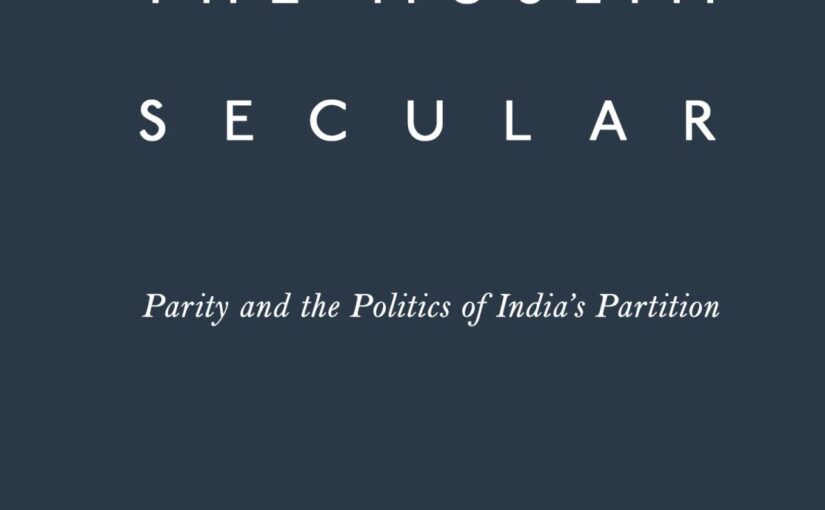
Review: The Muslim Secular: Parity and the Politics of India’s Partition by Amar Sohal
Since Partition is a popular topic here on BP, I am posting this review from my Substack. Amar Sohal’s book is important because it focuses on three Muslim politicians who did not support the Muslim League’s vision: Maulana Azad, Sheikh Abdullah and Abdul Ghaffar Khan. Thus, the book foregrounds a vision that is an alternative from those of Indian and Pakistani nationalisms.
Historians of the politics leading up to the Partition of British India usually focus on the Indian National Congress and the Muslim League. To an extent, this is understandable–along with the colonial power, the Congress and League were largely responsible for the decision to partition British India into the sovereign nation-states of India and Pakistan. This historiography is largely focused on judging which of these two parties was most responsible for the lack of compromise that led to the ethnic cleansing of August 1947 and to decades of antagonism between (the now nuclear armed) states of India and Pakistan. Ayesha Jalal’s The Sole Spokesman: Jinnah, the Muslim League and the Demand for Pakistan can be considered a representative work of this school of historiography.
Amar Sohal’s book The Muslim Secular: Parity and the Politics of India’s Partition attempts a very different task. Based on his DPhil thesis at Oxford, the book examines three comparatively lesser-known thinker-politicians of late colonial British India: Maulana Azad, Sheikh Abdullah, and Abdul Ghaffar Khan. While unequivocally Muslim, all three of these figures aligned their politics with the Indian National Congress’s vision of a united India. As Sohal writes in his “Introduction”:
My endeavour, then, is to escape, as far as possible, from the long shadow cast on modern Indian history writing by Britain’s dramatic withdrawal and the minutiae of the Partition negotiations. Rather than rehash that familiar tale, I want to contribute instead to the burgeoning field of Indian and global political thought by unearthing a forgotten argument for integrationist nationalism and shared sovereignty. And this is significant because ideas (and not only transitory interests) mould the narrative of history, and ultimately survive it to speak to the epochs that follow. The subjects of my investigation were some of India’s foremost politicians…. So like other intellectual historians of India and the Global South that have engaged with this anti-colonial moment, here my task is ‘to reconstruct these “politicians” as thinkers and their words as concepts that were central to the making of political thought’. (Sohal 2-3)
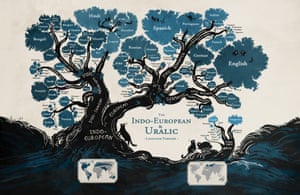
War of the Aryans
since Sbarrkum writes on Dravidians, Dalits & Aryans; I wanted to leave a short comment (for now)
What is
Vedam
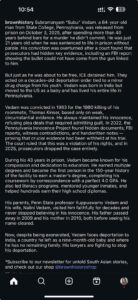
A fellow TamBram writes about it; https://nereview.com/article/the-trials-of-subu-vedam.
The word Brahmin is mentioned 4 times in the non-paywall foreword.
Subu’s father was an academic, a physics professor and materials scientist at Penn State, who would have blended seamlessly with my parents’ friends in North Carolina, who were all vegetarian and spoke Brahminical Tamil with its idiosyncratic conjugations and vocabulary.
Dr. V
Wag the dog?
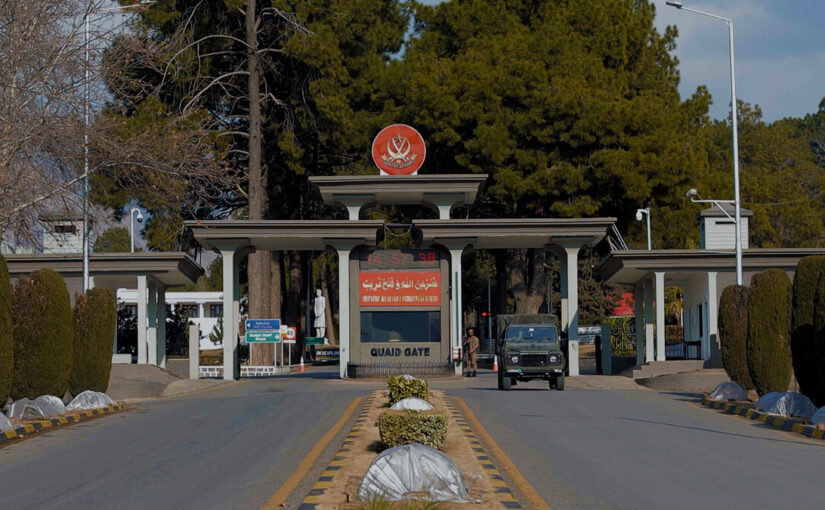
This idea came to me randomly when two people, separately, asked why they should pay taxes if half the budget supposedly goes to the army—a claim that is factually untrue. I am here trying to play devil’s advocate. While writing this, I consulted people to understand why the proposition, “The establishment is the root cause of every Pakistani problem,” is so widely taken for granted, especially after Imran Khan’s exit.
By “establishment,” I am specifically referring to the military, the way it is colloquially understood nowadays, not the “elite” in the class or socioeconomic sense. I presented sector-wise facts to them, and most had no answer. That prompted me to pen this piece. Since mainstream discourse now often takes an anti-establishment position, I decided to challenge that perspective.
https://www.thenews.com.pk/latest/1354698-wag-the-dog
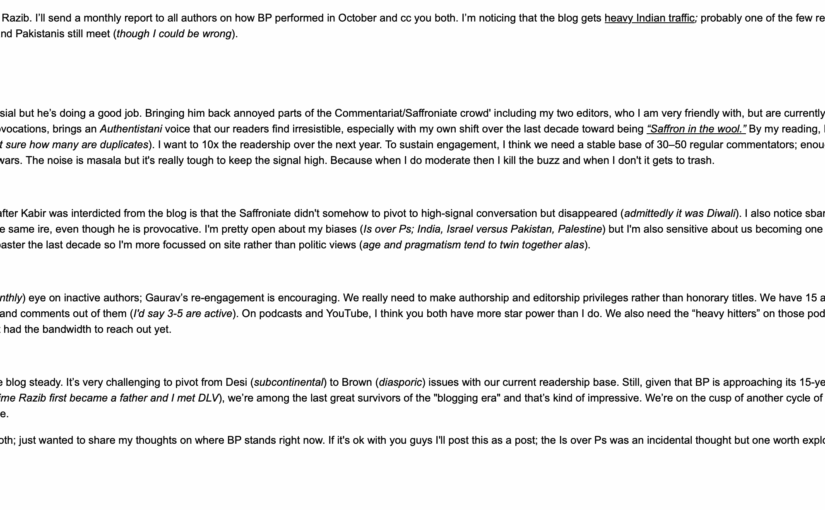
Co-Founders Confer
I sent this email to the CoFounders of the Blog (Omar | Razib) and tomorrow I will send through the Monthly Author Report.
Genetics open thread
On popular request — or curiosity. Two recent studies are making the rounds:
-
Kashmiris and Central Asians: Nature – February 2025
-
Sri Lankans and South Indians: Nature India – February 2025
I’m generally skeptical of population genetics papers, what is their point exactly? But presumably this will awaken the Commentariat, who have been quieter lately.
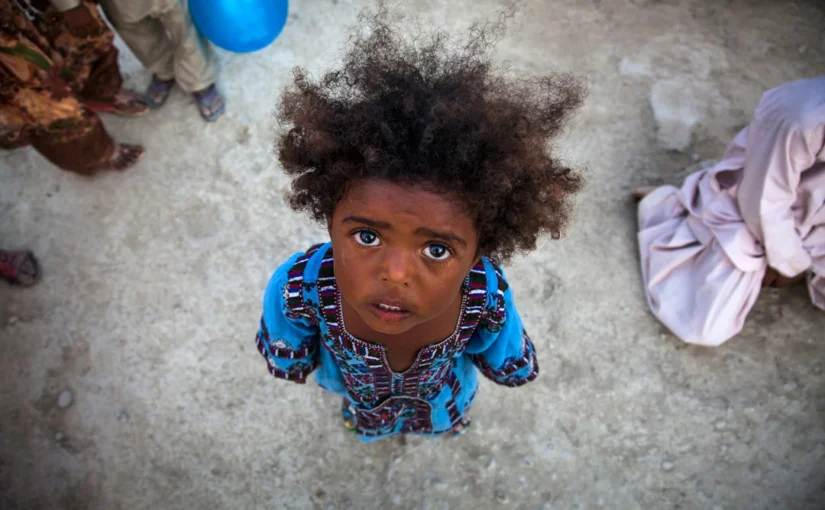
If nothing else, consider it intellectual cake; open to everyone, rich in speculation. As an aside the young girl featured is a Baloch.
The Earth’s Lost Industrial Heart
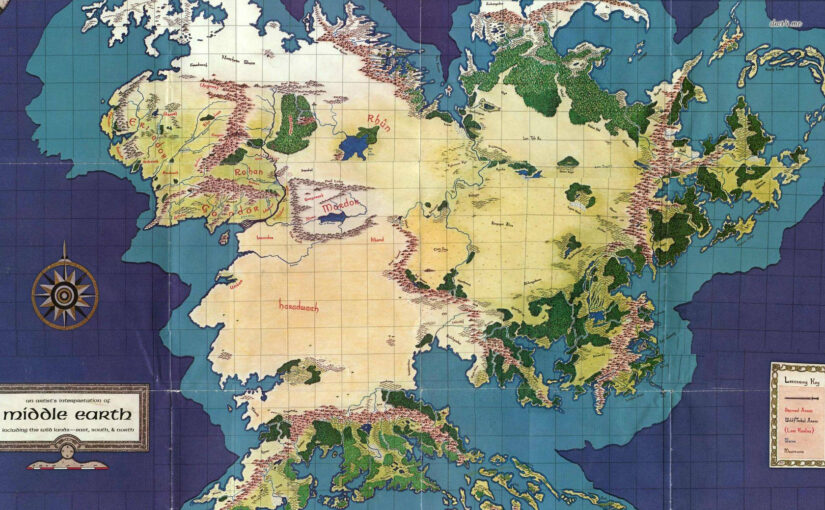
After our discussion on industrialisation in India, I began to wonder: if the Earth were one country, one government, one infrastructure grid, one economy, where would its industrial heart lie?
Geographically, the answer is obvious. The natural centre of the world, for energy, labour, and trade routes, isn’t London, New York, or Beijing. It’s the triangle between the Persian Gulf, the Indo-Gangetic plain, and the Red Sea.
Deserts rich in hydrocarbons. River basins dense with labour, water, and grain. Seas that touch every continent. If the world were united, this belt, Arabia to India to the Nile, would be the Ruhr, the Great Lakes, and the Pearl River Delta combined.
The Natural Order of Geography
Before empire, this region was the planet’s connective tissue. Spices, silk, horses, and steel moved from India to Arabia to Africa. Energy, grain, and knowledge flowed through the Red Sea and the Persian Gulf like the arteries of the Earth. It was not the “Middle East”; it was Middle Earth. Continue reading The Earth’s Lost Industrial Heart
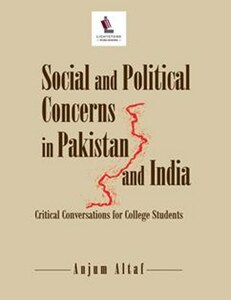
Review–Social and Political Concerns in Pakistan and India:Critical Conversations for College Students
Sharing this review of Dr. Anjum Altaf’s book Social and Political Concerns in Pakistan and India: Critical Conversations for College Students. The book is a collection of essays originally published as blog posts on The South Asian Idea. The mission of the blog was:
The South Asian Idea is a resource for learning, not a source of expert opinion. The posts on the blog are intended as starting points for classroom discussions and the position at the end of the discussion could be completely at odds with the starting point. Thus the blog simulates a learning process and does not offer a final product. The reader is invited to join the process to help improve our understanding of important contemporary issues.
The heyday of the blog was from around 2008- 2018. It hosts hundreds of essays about issues relevant to South Asians–many of them about Partition, Hindutva, Pakistan etc. At a time when Indians and Pakistanis are barely able to interact in a civilized manner (as we have seen on this blog), it is a record of an earlier time when the hope for better relations still seemed possible. It is also an example of the work that goes into running and moderating a blog aimed at teaching people how to argue well about humanities subjects.
Here are an excerpt from the review in DAWN:
All in all, Altaf’s tome deserves praise for courageously, convincingly and argumentatively questioning the dictatorship of mainstream discourses. Fanaticism has reduced the Indian Subcontinent to an Absurdistan. Altaf’s book shows that a patient argumentation in the tradition of Enlightenment is the only way to reverse the course.
Here’s a link to the post mentioned in the review (entitled “The Road to Partition”)
Currently, the book is only available in Pakistan. However, it is available on Kindle for those in India.
Islam the religion of Peace
He also brokered the fragile ceasefire between Thailand and Cambodia after deadly border clashes earlier this year – he stepped in after Trump threatened to impose tariffs on both sides if the fighting didn’t stop.
Some called it a diplomatic victory for Malaysia, while others said Anwar was simply in the right place at the right time – this year, it was the Malaysian PM’s turn to lead Asean.
Two Theravada Buddhist neighbours go to war over a Hindu Temple Complex and come to peace because of a Muslim & Christian President.
I know the Commentariat – Saffroniate are a bit miffed by my sudden change of tone; but as you can see I would be intellectually dishonest if I didn’t cover all sides of the story. This is where Dharmic civilisation, which is ordinarily peaceful, had to be *helped* by Abrahamic one.
On closer interrogation; I think when the Blog becomes dominantly “one-tone”, I then flip to ensure we maintain a parity of sorts.