Hooray to the ceasefire

The politics of Partition was not driven by the masses but by elite insecurities and ideological maximalism. The Muslim League and the RSS were mirror movements—each imagining purity, each refusing pluralism.

Against this tide stood Gandhi and Nehru: flawed, but fundamentally committed to a united, secular, socialist India. That republic—messy, crowded, imperfect—might have spanned 2 billion people today.

Instead, the war of elites birthed nations. And the cost was paid by peasants, mothers, porters, and children—those who never cast a vote in the halls where maps were redrawn.

Pakistan Is Showing Restraint. That Should Worry India.

Not out of weakness, but calculation. It’s waiting for the international community to bribe it into silence. One advantage of being quasi-democratic (like Russia or China) is the ability to sideline public opinion. Pakistan can afford to wait. India, by contrast, appears to be following an Israel-style doctrine. But Pakistan is more Prussia than Palestine and Modi feels much weaker from this episode (he promised a safe Kashmir).

Competing regional giants and nuclear powers, India and China are widely seen as long-term strategic rivals, sharing a 3,800 km (2,400 mile) Himalayan border that has been disputed since the 1950s and sparked a brief war in 1962. The most recent standoff began in 2020 and thawed only in October 2023, when both sides agreed to a formal patrolling agreement, placing limits on forward deployment and coordinated disengagement. Even between nuclear-armed antagonists, restraint is possible when war threatens mutual prosperity.

Likewise, Putin’s behavior post-Maidan in 2014 was not immediate escalation. Instead, Crimea was seized swiftly, but Russia spent eight years supporting separatists and waging hybrid war in Donbas before launching a full-scale invasion in 2022. It was restraint with intent, waiting for the West to appear divided or distracted.

It’s strange that every time the region stabilizes, something reignites tension. Why would China, India, or Pakistan want instability when wealth and growth depend on peace? Yet here we are.

The BJP base craves nothing short of Pakistan’s annihilation. That’s a fantasy; militarily, diplomatically, and strategically. Why shouldn’t India fully cooperate in an international investigation to determine who was behind the Pahalgam attack? The refusal suggests this moment is being used as a casus belli; leveraging the incident to project force in a world increasingly shaped by Trumpian-Putinesque instincts.

Even the postponement of the IPL was an indirect consequence of what Pakistan could do. This is not a toothless state. Pakistan is David with a nuke or more accurately, an incidental Prussia, hyper-militarized but calculating. The public isn’t rising up against its military; if anything, this round has shown that Pakistan can restrain itself without looking weak.

In fact, Pakistan has consistently been the more restrained nuclear power. Israel has spent two years trying to flatten Gaza with limited success. The U.S. stayed in Afghanistan and Iraq far too long, trapped by asymmetric warfare. These are textbook examples of tactical response leading to strategic drift.

Modi should study those cases. Retaliation may thrill headlines. But strategy lies in staying still until the storm passes and only then, deciding if and how to move.

Quaid, Modi, and the Operation Sindoor

On Pakistan’s second birth, India’s rising nationalism, and the politics of martyrdom

There’s a strange irony in history: the founder of Pakistan and the “strongest” Prime Minister of India may ultimately be remembered for the same thing—giving Pakistan life.

Muhammad Ali Jinnah birthed the state. Narendra Modi may have revived its soul. Because nothing steels a national identity like resistance. And nothing immortalizes a cause like martyrdom.

Blood in Pahalgam, Resolve in Islamabad

When civilians—children—are killed, as in the recent attacks in Pahalgam & Bahawalpur, the horror doesn’t demoralize. It clarifies. It creates martyrs. And martyrdom sanctifies. Pakistan, often in search of a purpose, just received one. What makes this even more striking is the dynamic behind it. Modi may need Pakistan—not as a partner, but as a perpetual foil. A pressure point. A mirror. A justification.Every strong nationalism needs its adversary:

  • Israel has Hamas.
  • The U.S. had the USSR.
  • India, increasingly, needs Pakistan.

Nationhood hardens in opposition. This is what the “failed” projects of Czechoslovakia and Yugoslavia lacked: no existential other. No enemy, no glue. Even the most successful WillensnationSwitzerland, a country built by choice, not ethnicity—engaged in intense nation-building during the 1960s. Its wealth today isn’t just neutrality—it’s the compound interest of skipping two world wars. But in today’s world, Dubai may inherit Switzerland’s darker mantle—as the future capital of hot money and global shadow finance. Meanwhile, across the Atlantic, Canada’s national identity has paradoxically strengthened in Trump’s wake—a quiet rebellion through civility, as if to say: we are what he is not.

The Strategic Misstep?

Operation Sindoor. Suspension of the Indus Waters Treaty. Visa blocks. High Commission closures. Are these pressure points—or accelerants? The danger is that such moves only validate Pakistan’s siege narrative. And that narrative fuels its resilience. You can’t bomb a martyr complex. You can only confirm it. Continue reading Quaid, Modi, and the Operation Sindoor

Let Pakistan Throw Stones. India Should Build the Skyline.

These thoughts emerged as I was replying to the 100+ comments on Omar’s post, India and Pakistan, Back to the Future..

Flight, Fragility, and the First Bollywood Snake

My first memories of Pakistan are tangled with flight and childhood fiction. In 1990, as we escaped Kuwait after the Iraqi invasion, our car crossed into Pakistani Baluchistan carrying five adults and three children. After over a month in Iran (the family gardens of Shiraz are a blurry childhood memory), where we were understandably low-key about being Bahá’ís, I remember yelling out the car window the moment we crossed the border, “I’m Bahá’í! I’m Bahá’í!” My family laughed (I was the youngest and always the most impetuous). The story has been retold so often I don’t know where memory ends and performance begins.

But the innocence of that moment gave way quickly. I remember the poverty at the border: raw, overwhelming on both sides of Baluchistan. And then, in Karachi, came my first exposure to India—through a Bollywood film featuring a dancing girl in a Sari transforming into a snake. That, more than any textbook, was my introduction to Hinduism. Try as it might, Pakistan is the ineffable portal to Hindustan, a mirror that reflects what it cannot contain. These memories—flight, fragility, and fantasy—etched into me the idea that culture moves where politics cannot.

Restraint Is the Strategy: Rethinking Peace in South Asia

South Asia is home to nearly 2 billion people. It’s a region of nuclear states, frozen conflicts, and postcolonial trauma. Yet every time a cross-border terrorist attack kills 20 or 30 civilians, it makes global headlines. That’s not just because of the violence—but because the violence is rare. This isn’t an excuse. It’s a signal: South Asia has already learned restraint. The question is whether it can remember why.

The Bug in the Democratic Mind

After 9/11, the U.S. was angry. George W. Bush gave the people what they wanted: a war. Two, actually. Instead of a tactical mission to dismantle a terrorist network, America destabilized entire regions, wasted trillions, and incubated future threats.

This is the paradox of democracy:

  • Populations demand retribution.

  • Leaders comply.

  • Strategy is hijacked by spectacle.

India must adopt a radically different approach. Treat Pakistan the way South Korea treats North Korea: sidestep, outperform, outgrow. Engagement legitimizes provocation. Retaliation restores parity. Indifference signals dominance. Continue reading Let Pakistan Throw Stones. India Should Build the Skyline.

Born in Blood: a relook at the final act of Parv

Please find the earlier review of the same novel i wrote a few years back: Parva (Marathi): An epic masterpiece | by Gaurav Lele | Medium

Spoilers ahead

The futility of war really comes through in the retelling of by SL Byrappa in the final act. A very brief summary of the final act with climax I had missed the first time around.

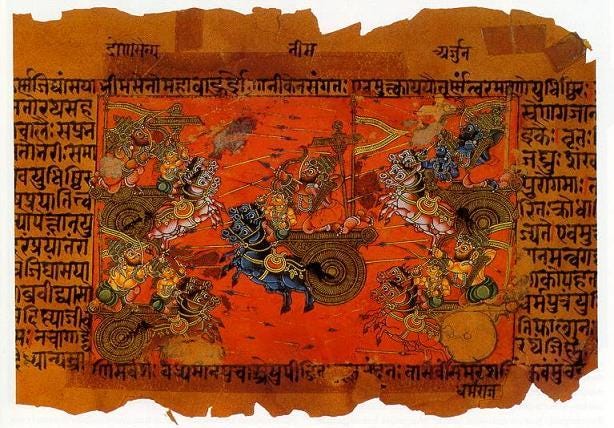
Bhima goes over to Hidimba forest, only to find out that some of his fellow Arya have burned up the forest like the Pandavas had done all those years ago in the Khandav-Van. Life comes a full cycle for him, like Takshak killing Parikshit in the original epic. We descendants of Vaidik Aryas must swallow a bitter pill as we look back with Bhimasen at the ways in which our forefathers brought forest land under cultivation.

अ॒ग्निमी॑ळे पु॒रोहि॑तं य॒ज्ञस्य॑ दे॒वमृ॒त्विज॑म् । होता॑रं रत्न॒धात॑मम् ॥ (RV 1.1)

Kṛṣṇa looks at the tsumani swallowing his Dwarka, as the alcohol fueled Yadava fratricide looms.

Continue reading Born in Blood: a relook at the final act of Parv

Are You Sri Lankan?

Notes on Identity, Gharbzadegi, and the Azizam Effect

Yesterday, a Persian friend casually asked me if I was Sri Lankan. I wasn’t offended. Startled, yes — but not offended. I take pride in being Desi. And truthfully, there isn’t a stark difference between many South Asian and Persian phenotypes at the human level. But the interaction stayed with me.

Because while I can understand a Scandinavian confusing Indians and Iranians — my Danish friend, for example, couldn’t reliably tell them apart — it hits differently when Persians, especially non-Muslim, Westernised Persians, make the same mistake.

Immediately, another half-Indian, half-Iranian friend interjected:

“Zach doesn’t look Sri Lankan at all.”

For what it’s worth, when I was in Colombo over New Year’s, I fell in love with Sri Lanka — the island, the people, the everything. Also the phenotype range in Sri Lanka is extensive since there is so Dutch, Portuguese & Moorish ancestry in addition to the native ones. Some Sri Lankans even thought I was Sri Lankan myself. Truly, it is Serendib.

Continue reading Are You Sri Lankan?

The Myth of the British-Made India

Six years ago, I wrote an outraged post on BP when a British historian casually claimed that “the British created India” (we had a very thriving commentariat then); a breathtaking erasure of one of the world’s oldest civilizations.

Today, reading Francis Pike’s piece in The Spectator, I feel the same cold disdain. Pike repeats the same old colonial fantasy: that India was a “patchwork of principalities,” and that Nehru and Gandhi “invented” the myth of Indian unity. Let’s be clear: this is not history. It’s imperial nostalgia dressed up as analysis.

“India’s first prime minister, Jawaharlal Nehru, and Mahatma Gandhi both propagated the myth that India had always been a unified country.”

“More reflective commentators knew that this was hogwash.”

“It was the British who… for the first time introduced the rule of law and a democratic form of government.”

This is colonial gaslighting at its most refined. Continue reading The Myth of the British-Made India

Caesar’s Pakistani wife must be above suspicion

May those who lost their lives in the Pahalgam tragedy rest in peace. May the injured find swift healing. And may the perpetrators be brought to justice.

False Flags, Fragile Ideologies, and the Weight of History

I don’t want to take away from Omar’s excellent piece, India and Pakistan: Back to the Future—he nailed it on the trajectory of Pakistan’s self-conception and the road ahead for India.

But what began as a comment evolved into something more. I wanted to briefly address the misinformed murmurings online about the attack on Pahalgam being a false flag.

Caesar’s Wife

There’s an old line: Caesar’s wife must be above suspicion. If you want to be taken seriously on the world stage, perception is half the battle. India has a clear civilizational and national narrative. Despite its contradictions, it’s attempting—seriously—to join the ranks of the U.S. and China. And it’s making real progress.

Pakistan, by contrast, seems increasingly defined by what it opposes rather than what it builds. Its civilizational narrative has, over time, narrowed into a single impulse: block India at any cost. There are dozens of Muslim-majority nations. But there is only one India. That asymmetry matters—culturally, strategically, metaphysically.

Zia’s Logic: Annihilation as Strategy

One quote making the rounds—attributed to General Zia-ul-Haq—offers a glimpse into a mindset that’s still disturbingly prevalent: Continue reading Caesar’s Pakistani wife must be above suspicion

India and Pakistan, Back to the Future..

A group of terrorists attacked tourists in a remote meadow in Kashmir, identified those who were non-Muslim, and shot them dead (they also shot dead a Muslim tour guide who tried to oppose them). The horrendous and barbaric attack has led to a predictable outburst of harsh anti-Pakistan (and in many cases, anti-Muslim) outrage in India and the govt has already announced some steps against Pakistan and is presumably planning to undertake some more in the coming days.

Meanwhile, Pakistan (and individual patriotic Pakistanis) have taken to social media and traditional media to paint this as a “false flag attack” (i.e. carried out or planned by the Indian authorities themselves, presumably to allow them to retaliate against Pakistan; why?) or at least as India being “too quick to accuse Pakistan” (ie “we did not do it, and they are accusing us without proof”). This is all as expected in the usual India vs Pakistan show, but it is important to keep in mind that the situation has supposedly changed a little since 2019. Before that date there were many terrorist attacks in Kashmir and every major event would be followed by tit for tat exchanges along the line of control, but with both sides respecting “red lines”. Then in 2019 there was a large attack in Pulwama that was followed by an Indian retaliatory attack on a militant camp in Balakot in Pakistan proper (which crossed the previous red line of what retaliation was permissible). Since then there had been relative peace in kashmir and many commentators felt that the balakot bombing had established a new “red line”, that India will respond to any major attack in this or similar manner, so Pakistan has dialed down the terrorism it previously promoted in Kashmir. But if that is the case, then this attack obviously crosses that threshold and will lead to response. Irrespective of who is at fault and who did what, this was the supposed line and it has been crossed, so what next? 

As usual, i dont know. But lets list the questions and possible answers.

  1. IF this was indeed planned by Pakistan, then the question is “why”? Why now?

Possible answers and objections: Continue reading India and Pakistan, Back to the Future..

Cheap Catharsis, Expensive History

Sathnam Sanghera recently alluded to a moment from his 2019 Channel 4 documentary The Massacre That Shook the Empire. In it, the great-granddaughter of General Dyer, the man responsible for the 1919 Jallianwala Bagh massacre, is brought face-to-face with descendants of the victims.

In the clip, Dyer’s descendant calls the massacre victims “looters” and praises her great-grandfather as an “honourable man.” Twitter was predictably outraged. KJo chimed in. Think-pieces bloomed.

But why does her opinion matter?

This wasn’t justice, it was television. And like most televised reckonings with Empire, it was a performance. One more entry in the growing archive of aspirational brown catharsis, where the goal is not transformation but temporary relief; therapy instead of revolution.

Yes, the Jallianwala Bagh massacre was horrifying. No one disputes that. But to repeatedly stage these moments of inherited guilt and symbolic outrage is to substitute emotional spectacle for actual change.

Britain is not closer to redress. The Commonwealth isn’t inching toward reparations. British Asians are not about to own a fairer share of land, institutions, or equity. But we are expected to feel healed by the awkward mutterings of a descendant who’s not even sorry; just embarrassed that another cousin openly defended their ancestor.

This is not about historical accountability. It is about managing the mood of postcolonial subjects. Keep us emotional. Keep us visible. Keep us grateful.

But don’t give us power.

That is the unspoken logic of these curated moments: mourn the wound, not the cause.

And it works — because so many of us still seem to want respect more than justice. To be seen, included, affirmed.

But history will not be rewritten through awkward Channel 4 moments. It will only be reckoned with through real structural change.

Until then, let the Twitter mobs rage. But some of us will remain quietly asking the harder question:

What are we really performing here?

Brown Pundits