Showing an early entry of steppe ancestry into India

Introduction

A common claim that can be increasingly found in the Indic internet is that the steppe ancestry found in modern day Indians with significant frequency entered India in the late Iron Age and/or the Early Historic Period. Dr Niraj Rai has implied as much in interviews, and Ashish has championed this theory, recently identifying a sample in Iron Age Turkmenistan as an example source of ancestry for modern day Indians.

I previously responded to these claims on Twitter and am here restating my arguments together with some additional analyses. To begin with, we must understand the geography of gene flow from the steppe, whether via migrations or via inter-marriages.

Geography of migrations
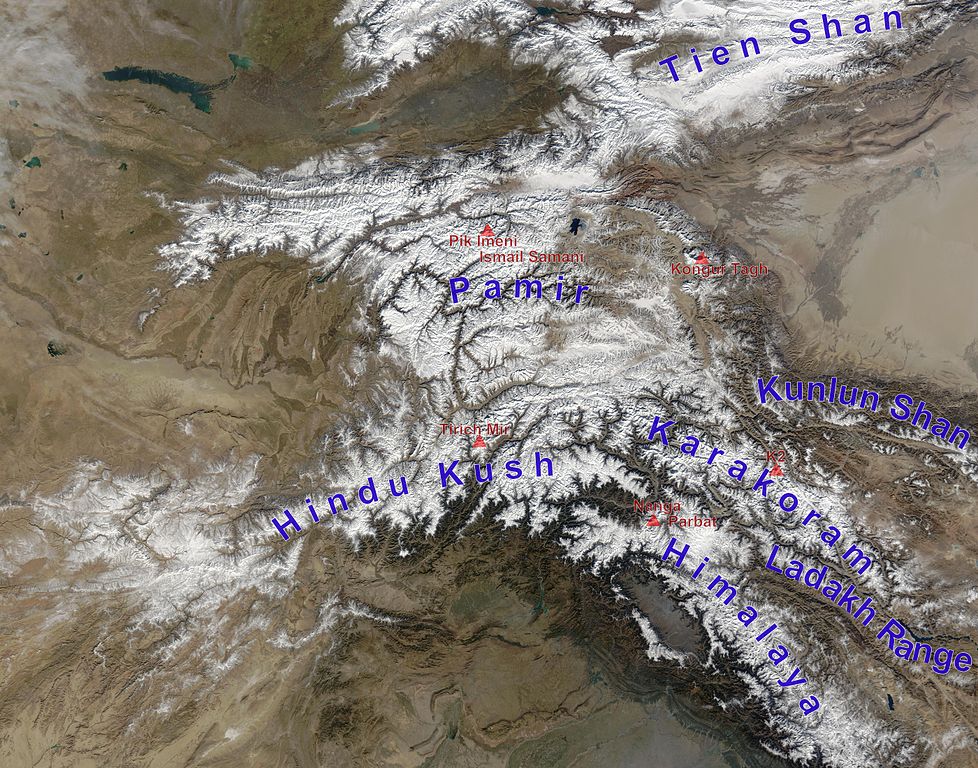
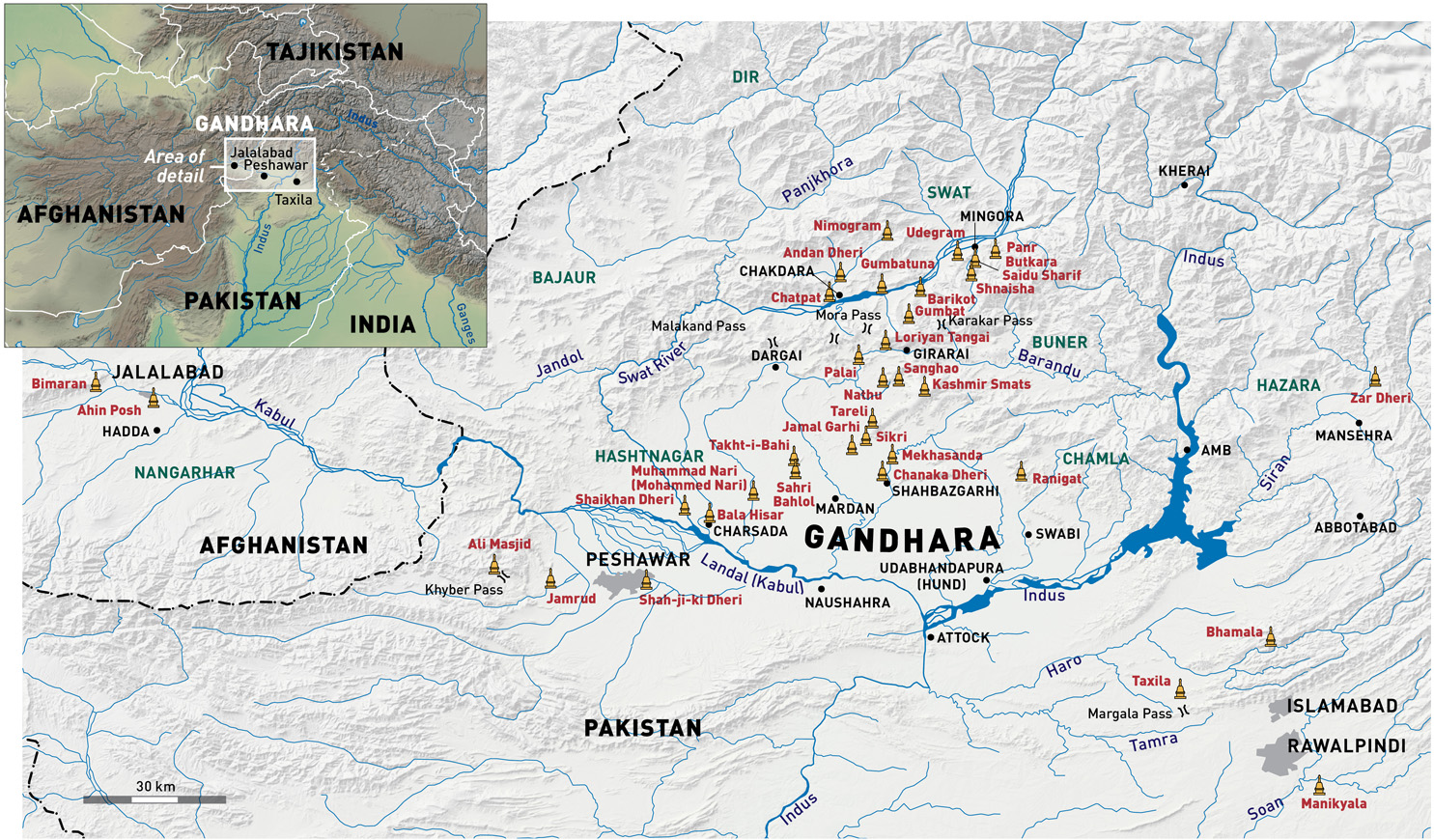
Map showing Gandhara and Swat, with archeological mountain sites in Swat valley North of Gandhara

Here are some maps of the northern end of the Indian subcontinent. Notably, the Hindu Kush mountains formed a barrier between Gandhara and the areas north of it – travel through this area in large numbers was quite difficult. Instead, travelers from the steppe would travel around the western tip of the Hindu Kush mountains, heading southeast from Balkh to Kabul/Begram through semi-mountainous lands, and from there heading east down the Kabul river valley into the Vale of Peshawar via the Khyber Pass, to the city of Pushkalavati at the Bala Hisar / Charsada sites. From there, they could head down the Indus Valley or more commonly further east to Taxila, before continuing on towards the Ganga Valley. An alternate route would travel around the semi-mountain regions of Afghanistan, heading south from Herat to Kandahar, and then southeast from there via the Bolan Pass into the middle of the Indus Valley (i.e. roughly the Punjab-Sindh border).

Either way, the Swat Valley in the mountains north of Gandhara was not a stopping point along the route into India. Furthermore, the Swat Valley was not directly part of the general Indian geographic sphere, which extended up to about Shahbazgarhi. In many ways Swat’s relationship to the Indus Valley was akin to Nepal’s relationship to the Ganga Valley – significant trade and cultural contact but also some degree of genetic differentiation.

As such, we would expect steppe ancestry to have entered in greater proportions into Indo-Gangetic Plains than in Swat – especially into Punjab. In fact, that’s exactly what we observe in modern populations. The highest steppe ancestry modern populations are Punjabi / Haryanvi Rors and Jats.

To ascertain the timing of steppe admixture, ideally we’d have ancient DNA samples from the relevant time periods in these regions to check directly for steppe admixture. However, due to a mixture of climate issues, underfunded archeology, and a culture of cremation, there is a total dearth of relevant ancient DNA samples. Instead, we must rely on what samples we’re able to find and utilize the DATES tool to estimate admixture times.

DATES Estimates

Interpreting / theory

Now, to interpret DATES results, we must keep in mind particularly with an incompletely admixed population such as India’s, that admixture times can be much later than migration times. When Indian-residing groups with elevated steppe ancestry interbreed with those with low steppe ancestry, their intermediate steppe ancestry offspring will show more recent admixture. This does not mean the steppe migration occurred at the time of admixture, but rather that admixture continued after migration occurred. As such, admixture times are lower bounds, not mean estimates, for the timing of migration. In the Indian context, we must look to older samples as well as groups with early caste endogamy to discern the true time of migration, without the confounding effects of later intermingling.

Additionally, when modeling with DATES, preference should be given to the model that provides the narrowest estimates. Per Chintalapati et. al., a model is considered to be valid if the Z-score is > 2, the normalized root mean square deviation is below 0.7, and estimated number of generations is below 200.

To model the sources of admixture in DATES, I’ve used Sintashta-Petrovka samples for the steppe source (both sets of Sintashta samples as well as the Petrovka sample available in the Reich database) against the AASI-proxy used by Narasimhan et. al. (STU.SG, ITU.SG, BIR.SG) plus Irula.DG and Pallan-like Roopkund outliers. Using the relatively pure Sintashta-Petrovka samples instead of Central_Steppe_MLBA particularly reduces the noisiness of DATES modeling in the single target sample modeled later here.

We can sanity check this model by testing admixture times for steppe-enriched Iron Age Swat samples and ensure the results are calibrated in line with the Narasimhan paper:
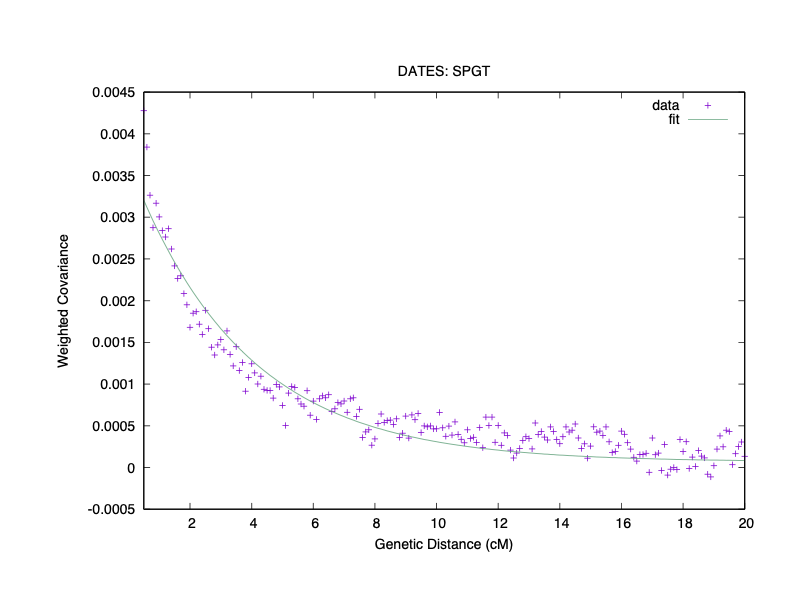
Graph showing DATES curve for SPGT

mean: 27.970 std error: 2.691 Z: 10.394
nrmsd: 0.055
Sample date estimate: 920 BCE
95% interval admixture estimate: 1853-1552 BCE

This yields a good fit that’s pretty much identical to the Narasimhan paper and indicates that steppe ancestry entered the Swat Valley in the first half of the 2nd millennium BCE.

In Roopkund

To find a bound on the timing of admixture in mainland India, we can examine one of the few sets of premodern DNA samples – namely, a collection of pilgrims 聽who had succumbed to hailstorms in the 8th-10th centuries CE in Roopkund Lake. The skeletons sequenced here had a variety of steppe ancestry and included several individuals with relatively high steppe ancestry who clustered with modern day Brahmin Tiwaris.
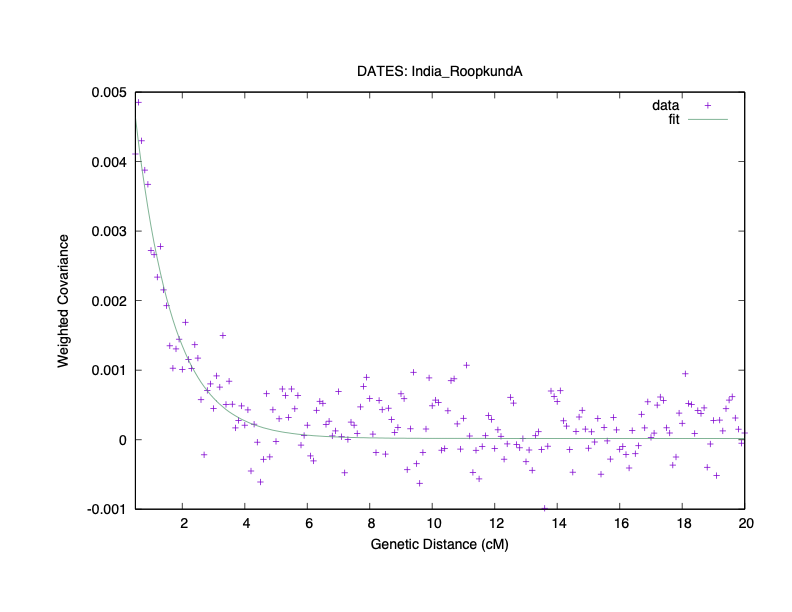
Graph showing DATES curve for Roopkund A

mean: 84.592 std error: 10.206 Z: 8.288
nrmsd: 0.100
Sample date estimate: 850 CE
95% interval admixture estimate: 2091-948 BCE

The fit is excellent and the results are highly statistically significant. We see clear evidence that the Roopkund samples obtained their steppe admixture in the 2nd millennium BCE and became relatively genetically isolated by the start of the 1st millennium BCE.

In Loebanr outlier

Now, we can look at one outlier Iron Age woman from the Swat culture who had particularly high steppe ancestry, and appeared to be an individual at the far end of the ANI cline. This woman proved to be a better proximal source of steppe ancestry for modeling modern day Indians than her Turkmenistan contemporary (another single sample that has been proposed as a source of late steppe ancestry). Where did this woman come from? Punjab would be a good bet. After all, her significant amount of AASI in combination with聽a relatively low Anatolian neolithic ancestry argues against a location in Central Asia. And modern day Punjabi / Haryana Jats and Rors are not far removed from her – e.g. I modeled a Haryanvi Ror sample as 16% Irula and 83% ancestry from a population akin to this woman. Therefore, it’s likely she was a migrant up from Gandhara or further south and can be used as a representative of higher caste Punjabis of her time.

Let’s look at the DATES modeling for this woman:
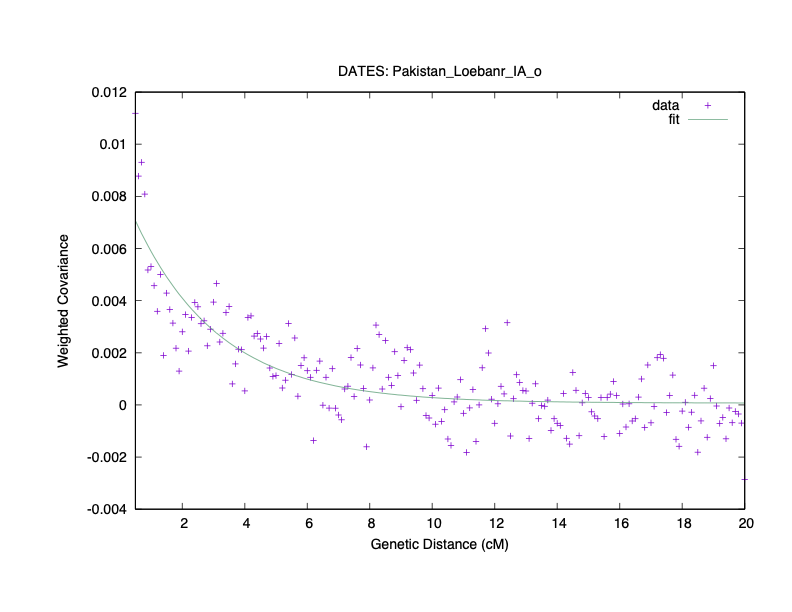
Graph showing DATES curve for Loebanr outlier

mean: 37.593 std error: 13.239 Z: 2.840
nrmsd: 0.191
Sample date estimate: 920 BCE
95% interval admixture estimate: 2714-1231 BCE

As is normal for a single sample, the data is somewhat noisy. Nevertheless, DATES is designed to be able to handle single target samples, and we have a good nrmsd score and a statistically significant result, albeit with a wide range. This would confirm that the woman came from a large population that had been well formed by the late 2nd millennium BCE. More crucially, the weighted covariance at large genetic distance is close to 0, indicating she was not for example a product of recent marriage between a high steppe migrant from Turkmenistan and a lower steppe inhabitant of Loebanr. However, let’s obtain a narrower estimate of admixture time.

IVC-related as source

To improve the fit, in light of the low AASI proportion in the Loebanr outlier, we can use IVC and similar individuals high in neolithic ancestry but lacking in steppe ancestry as the source. For this group, I’ve used the IVC periphery samples in the Reich dataset, along with Aligrama (Iron Age Swat samples without steppe ancestry), and SiS-BA-1 (non-Indus-periphery samples from the Helmand culture, which have India-related ancestry).

Once again, let’s check calibration against the results from the Narasimhan paper:
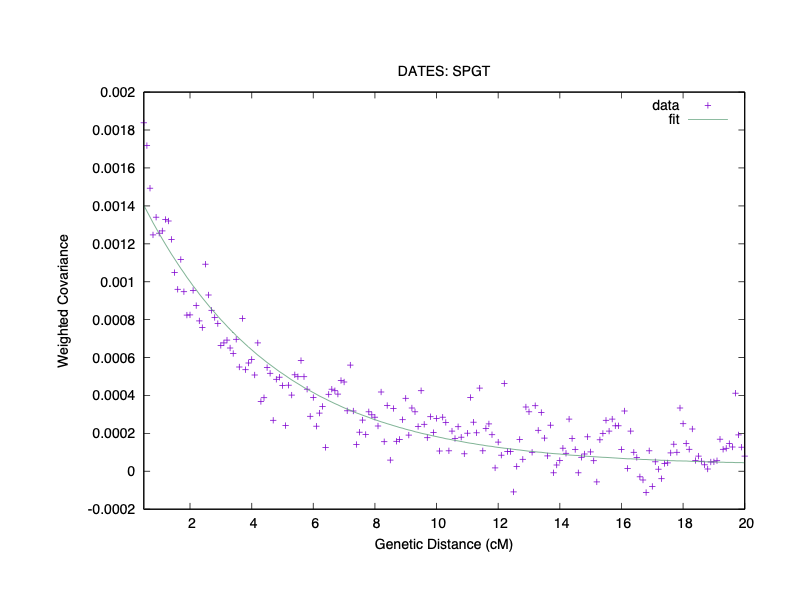
mean: 24.077 std error: 2.658 Z: 9.059
nrmsd: 0.101
Sample date estimate: 920 BCE
95% interval admixture estimate: 1743-1445 BCE

The nrmsd is somewhat worse but the results are essentially in line with the modeling using AASI-rich sources.

Now, let’s give it a go on the Loebanr outlier woman:
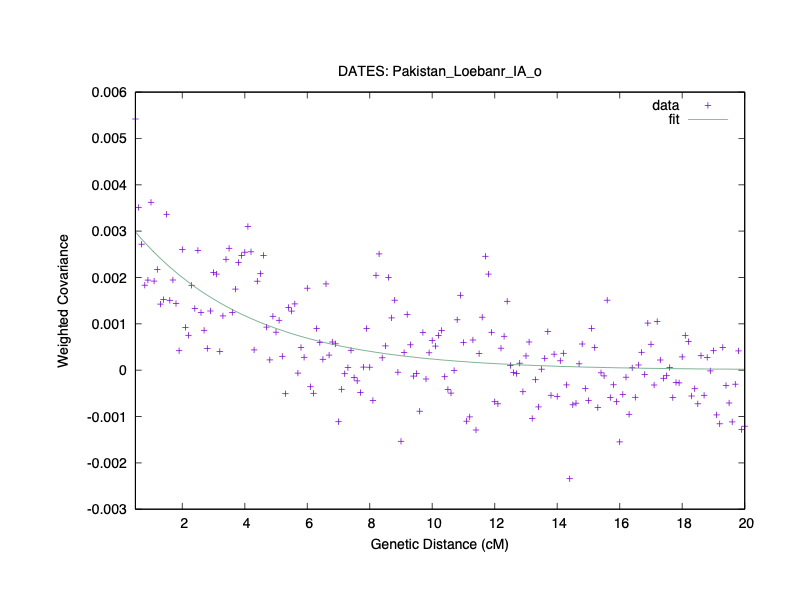
mean: 27.621 std error: 5.222 Z: 5.290
nrmsd: 0.356
Sample date estimate: 920 BCE
95% interval admixture estimate: 1986-1401 BCE

Due to noise, nrsmd worsened but is still well below 0.7. Notwithstanding this though, the shape of the curve fits like a glove and appears spot on with the average weighted covariance. And that good curve fit is reflected in the improved Z score and lower standard error. The result lets us conclude that the Loebanr outlier woman received her steppe ancestry admixture at roughly the same time as her Swat Valley contemporaries did.

Conclusion / Implications

To conclude, we’ve found evidence that high steppe ancestry may have reached聽the Ganga Valley by the end of the 2nd millennium BCE, and likely had reached 聽Gandhara / Punjab by the middle of the 2nd millennium BCE. Some of the steppe ancestry that entered Gandhara also traveled up into the Swat Valley in the same timeframe.

All of this evidence is consistent with steppe ancestry settling in the Punjab centuries prior to the composition of the Rigveda there, in conjunction with the observed spread of R1a-L657 in India which originated from the R1a-Z93 Y-haplogroup of the steppe. It’s also consistent with the beginning of formation of caste groups in the Kuru-Panchala Kingdoms around the time the varna system began to be implemented in the Iron Age Late Vedic Period.

We may also hypothesize that perhaps the people of the Swat Valley spoke old Burushaski. After all, the modern day Burusho people are located in the mountains further uphill from the Swat Valley, and genetically have some traits in common with the non-outlier samples of the Swat – viz. lower Sintashta ancestry and elevated IAMC (Aigyrzhal-like Inner Asian Mountain Corridor) ancestry. They have additional East Asian ancestry but this is consistent with a population that would have had trade links to the Tarim Basin, and the observed presence of Turkic and Tibetan loanwords in the Burusho language.

Note that while the evidence here indicates that there had already been substantial steppe admixture into India in the Bronze Age, it does not preclude additional later admixture of steppe ancestry in the Iron Age or Early Historic Period. Substantial admixture in this period is unlikely for a few reasons: lack of admixture from East Asian or Anatolian heavy groups (why would the groups resembling earlier steppe populations be the only ones to admix into India?), lack of migration of newer steppe-originated Y chromosome lineages, and the sheer size of the growing Indian population which would lessen the relative genetic contribution of migrants. But regardless though, the presence or absence of additional late steppe admixture does not have much of a bearing on the debate regarding the origins of the Indo-Aryan languages.
Episode 17: Mughals-the socio-cultural milieu and their Decline


Another Browncast is up. You can listen on聽Libsyn,聽Apple,聽Spotify, and聽Stitcher聽(and a variety of other platforms). Probably the easiest way to keep up the podcast since we don鈥檛 have a regular schedule is to聽subscribe聽to one of the links above!

Episode 17 of the series of Podcasts on the history of Indian sub-continent.

Maneesh speaks to Jay and Omar on the socio-cultural milieu of the Mughals and their decline.

Across the two episodes on Mughals we haven’t talked about the Sikhs and the Rajpoots. We plan to do dedicated episodes on them.

A notable miss across both the episodes is Kabir Das. Perhaps an episode on the great spiritual figures of the millennium some day !


Sources and References:

1. Advanced Study in the History of Medieval India : Volume II by J.L Mehta
2. The History and Culture of the Indian People: Volume 7. The Mughul Empire
3. Akbar and His India by Irfan Habib
4. Culture of Encounters: Sanskrit at the Mughal Court by Audrey Truschke
5. The life of a text: performing the R膩mcaritm膩nas of Tulsidas by Philip Lutgendorf
6. Three Bhakti Voices Mirabai, Surdas, and Kabir in their Time and Ours by John Stratton Hawley
7. The Mughals and the Sufis by Muzaffar Alam
8. Did Aurangzeb Ban Music? Questions for the Historiography of His Reign
by Katherine Butler Brown [ARTICLE]
9. The Early S奴r S膩gar and the Growth of the S奴r Tradition
by John Stratton Hawley [ARTICLE]
10. Hidden in Plain View: Brajbhasha Poets at the Mughal Court
by Allison Busch [ARTICLE]
11. The Meeting of Musical Cultures in the 16th-century Court of the Mughal Akbar by Bonnie C. Wade [ARTICLE]


Journey Till Now – Who and What is The Indic Explorer?

On the 21st Episode of The Indic Explorer Show, my weekly podcast I do a monologue talking about my journey before YouTube, the manner in which I went about starting this channel and how has the story been so far since inception in the last 6 months.

I also take some of the audience questions and talk about future plans and show formats that I intend to experiment with over the coming year.

The Indic Explorer YouTube channel focusses on the interplay of Indic culture with modernity explored through different facets in the socio-cultural sphere.

Do subscribe to the channel at https://www.youtube.com/theindicexplorer

and follow me here

Twitter- https://twitter.com/theindicexplor1

Instagram- https://www.instagram.com/theindicexplorer/

Substack-https://digitaldharma.substack.com/

Best of The Indic Explorer Show – 2022 Rewind

On this End of the Year Special Episode of my weekly Podcast- The Indic Explorer Show on YouTube, you can get to see the best highlight reel moments of the show. It has been just 6 months since I started this channel and we have grown from strength to strength, clocking 1k subscribers this month.

Looking forward for your continued support.

The Indic Explorer YouTube channel focusses on the interplay of Indic culture with modernity explored through different facets in the socio-cultural sphere.

Do subscribe to the channel at https://www.youtube.com/theindicexplorer

and follow me here

Twitter- https://twitter.com/theindicexplor1

Instagram- https://www.instagram.com/theindicexplorer/

Substack-https://digitaldharma.substack.com/


South Asian nations

I dislike the “GDP wars” that sometimes crop up on this message board. Comparing India to Bangladesh or Pakistan is apples to oranges. India is economically a collection of nations, and the average can be misleading. That being said, a lot of the Indian commentators also seem to engage in a lot of cope when it comes to GDP comparisons between Bangladesh and India; on the whole I often agree with them…but the fact that there can be a comparison despite India having relatively dynamic economies in Gujarat, Maharashtra, and around Delhi, Bangalore and Hyderabad, should lead to some soul-searching about inter-regional inequalities, rather than arguing about statistics.

But, as a biologist I like looking at health indicators. Harder to fake (thought not impossible), and clearer in interpretation.

First, let’s be honest: Pakistan is now the “slow kid” in the subcontinent. Mind you, many South Asians will admit that they are more handsome people because they are taller and lighter skinned (let’s be frank here), the advantages Pakistan accrued through its Cold War alliance with the US and less strident adherence to socialism than India have been frittered away. Anytime India sees itself clustering with Pakistan, it has to wonder “what are we doing wrong???” (again, the story in India is inter-regional variation). Despite over a generation of war and strife, Sri Lanka still had a lead in these indices, but the other nations are catching up. Finally, Bangladesh’s status is a basket case still shadows some of the numbers, like the number of physicians per thousand and age at teen births and motherhood. All that being said, what’s the good of having physicians if your life expectancy isn’t that great?

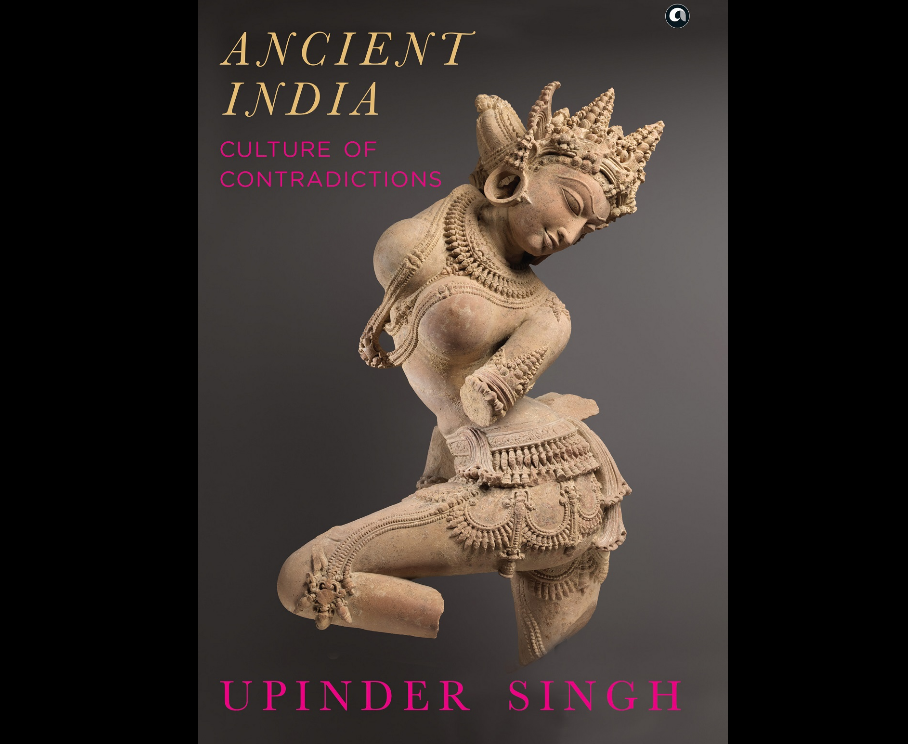
Book Review: Ancient India, a Culture of Contradictions

Of the 4 books of Dr Upinder Singh i have read, this is arguably the weakest. Firstly it doesn’t add much to the discourse – its largely summary of her earlier works thematically – with slight re-interpretation. The book is divided along four themes – Social inequality (Caste), Love, Gender relations, Violence and Religious freedom/plurality.

If you have been reading and following Dr Singh’s work and have good recollections, the ever present politics of this book can be jarring. The author starts with the anecdote of suicide of Dalit activist Rohit Vemula before embarking on the historic analysis of “Caste”. jAti-varna Matrix of Ancient India needed more in depth analysis as done for Political violence (in author’s previous book on Political Violence in Ancient India). The essay covers all the bases, but fails to enrich an informed reader – while making some unsubstantiated arguments.
eg: Caste in Sangam Era (or lack thereof). While the argument made holds for Vaidika concept of “Varna” it doesnt hold for Caste – a hybrid of jAti-Varna.

I felt the author played it very safe ending with “remains imperfectly understood”. Isn’t jAti-Varna system also an “old kin based” system ? Doesn’t it seem more natural to speculate that existing old kin based system merged with Vaidika abstraction of Varna ? Maybe – maybe not but the author doesn’t try to speculate.

The “desire and detachment” essay was refreshing, something i would definitely go back to. The next section “Goddesses and misogyny” covers the religious developments well enough but leaves the Economic(“Marxist?”) reasons for patriarchy out of the analysis. The role of economics in the patriarchal setup of agrarian and pre-industrialised societies doesn’t get more than a brief mention.

The next section, “Violence and Non-Violence” was a summary of her earlier book – good enough, but i would suggest interested parties to read that book – as it goes into the texts while making grand narratives and arguments. As a result the arguments in the previous book stick, this doesn’t (though its the same argument). Also some inconsistencies I had not noticed in earlier book came to my notice this time around. While comparing Ashok’s ideological espousal of Non-violence to Kautilya’s pragmatic approach (one may differ in the labels), the author doesnt fully challenge the above assumption even though it comes up in the text. Following is Kautilya’s recommendations for looking after animals.

How is looking after incapacitated horses pragmatic?

If one re-reads the subtext, ideology (empathy?) comes up again and again in Kautilya, whereas pragmatism and realpolitik in Ashok – the point the author notices in Ashok but not in Kautiya.

The last section was also enjoyable, if one manages to ignore the often jarring political undertone. The author lets slip a line

“These days, one dare not crack jokes about religion.”

Firstly, we cannot compare what we can glean of an ancient society from reconstruction to the documented 21st century realities. While trying to avoid the romantic reconstruction (or for contemporary politics), the author seems to have gone into the same. Yet I enjoyed the information I got from the last section, especially the Kshemendra’s satires from ancient Kashmir.

I would recommend the books for those who are really interested in Ancient India, but I would also recommend dozens of other books before this – especially the ones I havent read. Jarring and without original insights (unlike her previous works) I would still rate this book 3/5 for its readability and denseness.

What I had admired about Dr Singh’s work till now was her unwillingness to let politics and ideology rear its ugly head in her work – unlike other authors on ancient India (Including new emerging scholarship from the Hindu side). Though what saves the book is the author’s unwillingness to make “leaps of faith” – which become foundation for next scholarship – common in Ancient Indian History.


Merry Christmas!

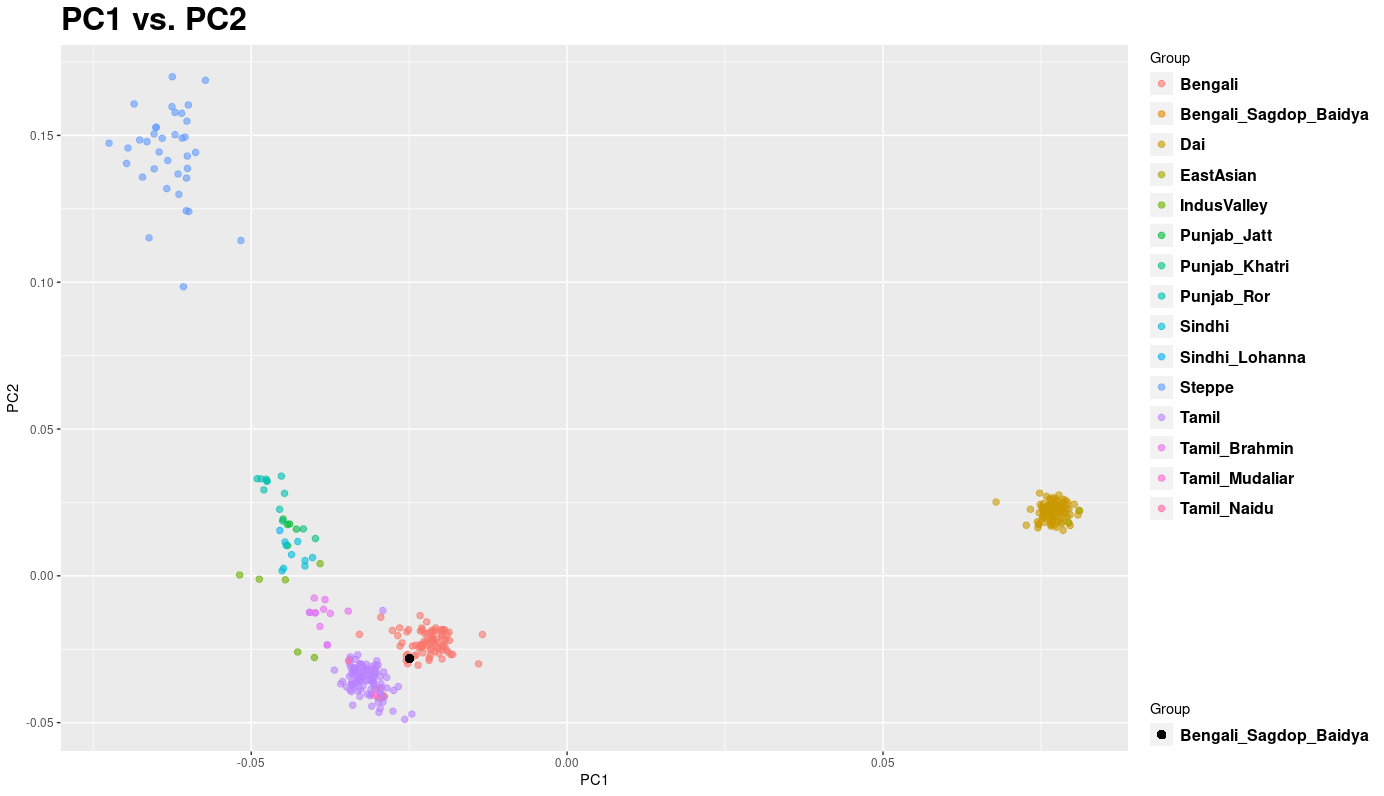
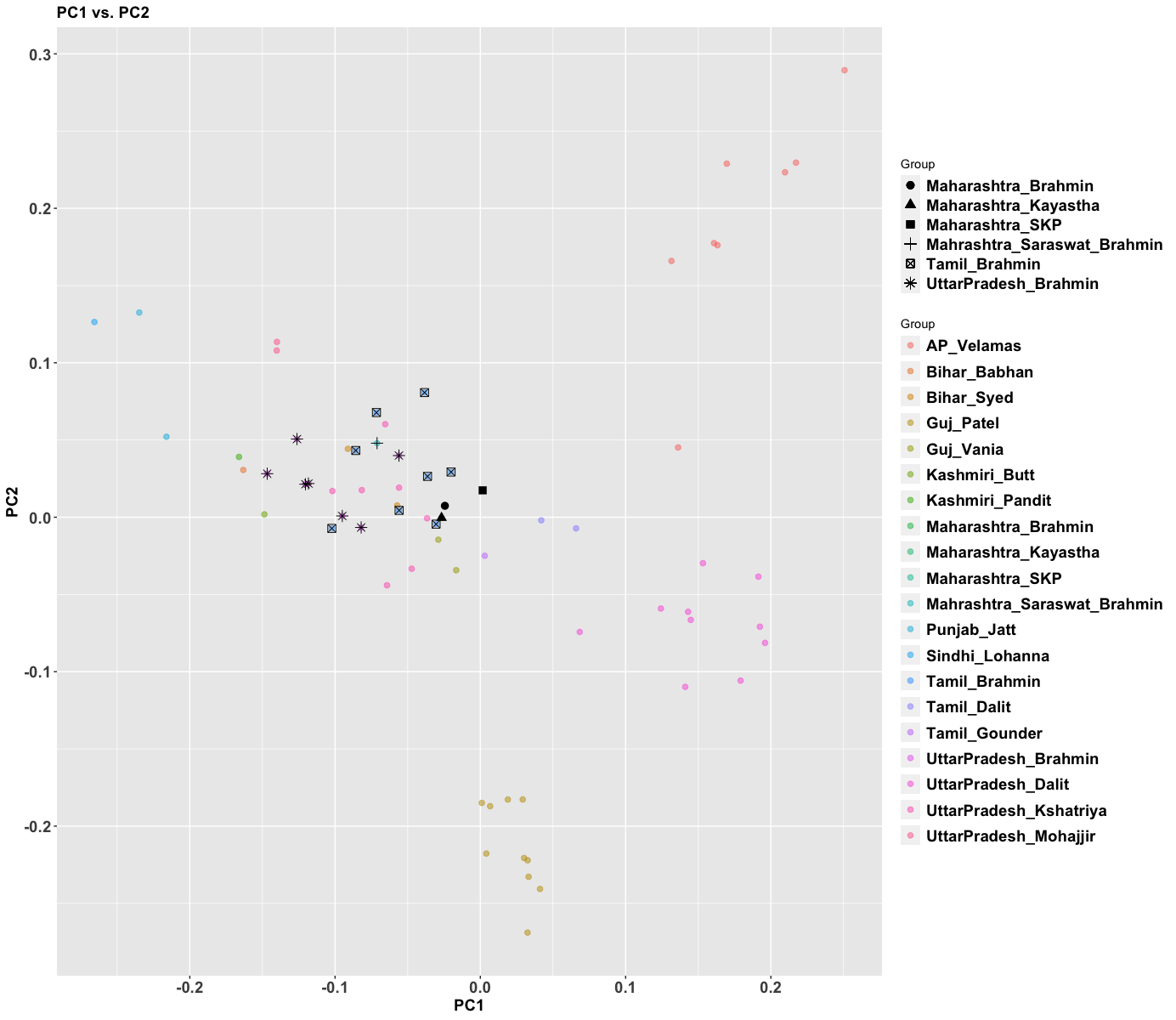
I got a sample from someone where one parent was a West Bengal Sadgop, and another parent a Baidya with family origins in East Bengal. One hypothesis that I’ve see is that Baidya are basically Brahmins who lost their caste. Genetically this does not seem to be the case. Bengali Brahmins shift considerably toward the steppe samples compared to average Bangladeshis, and this individual does not. Rather, their uniqueness is that they have very little East Asian ancestry compared to the median. This is typical of non-Bramin West Bengalis. It is plausible to me that this individual’s Baidya parent, from East Bengal (Bangal), had more East Asian ancestry than their West Bengali (Ghoti) parent, so you see an average.

Though there are some exceptions, it seems that the non-Brahmnin bhadralok castes did undergo ritual uplift from that of conventional peasant cultivators at some point in Bengal. This seems similar with regard to Kayasthas in UP, but not in Maharashtra, where CKPs seem to have an affinity with Brahmins distinct from the Maratha cultivators.

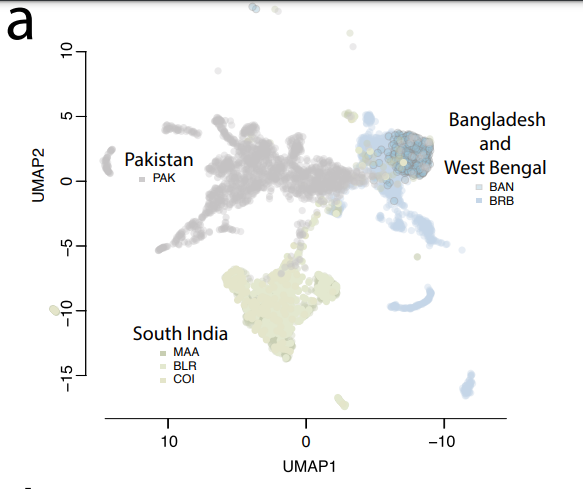
Update: I found a preprint that pretty much answers all the questions re: Bengalis.

Here is a panel with a UMAP representation of genetic distance, and you see West Bengal is adjacent to Bangladesh. But there is a “tail” of individuals that are parallel to South Indians.

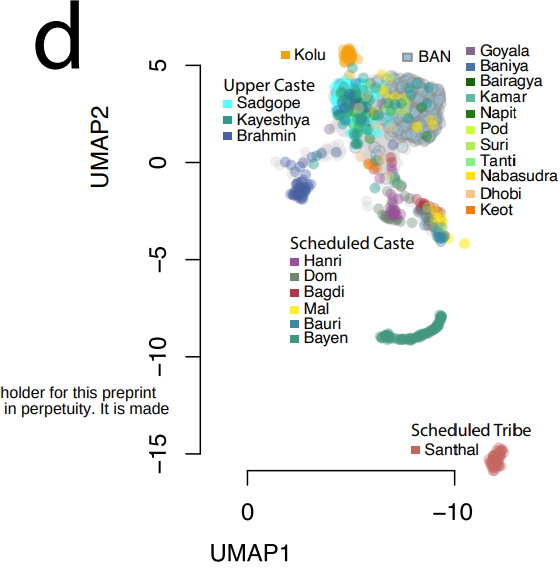
This UMAP makes clear Bengali Brahmins are distinct from Kayasthas and Sadgop. These populations seem roughly similar to most Bangladeshis except they are shift over, and I assume this means less East Asian ancestry, as PCA seems to how:

Sree Iyer on the Cultural Outlook of the Indian Diaspora

Sree Iyer of the Pgurus YouTube Channel came on the 20th Episode of The Indic Explorer Show, my weekly podcast to talk about The Cultural Outlook of the Indian Diaspora.

The Indic Explorer YouTube channel focusses on the interplay of Indic culture with modernity explored through different facets in the socio-cultural sphere.

Do subscribe to the channel at https://www.youtube.com/theindicexplorer

and follow me here

Twitter- https://twitter.com/theindicexplor1

Instagram- https://www.instagram.com/theindicexplorer/

Substack-https://digitaldharma.substack.com/

Brown Pundits