Another Browncast is up. You can listen on Libsyn, Apple, Spotify (and a variety of other platforms). Probably the easiest way to keep up the podcast since we don’t have a regular schedule is to subscribe to one of the links above!
WordPress dashboard data noted roughly 20,000 monthly readers circa mid-2020 .
Updated trends confirm continued modest growth, with India-based IPs making up a rising share .Monthly Unique Users
Comment Engagement
Recent posts regularly attract 100+ comments, indicating strong reader engagement and active discourse.
An average reading time on site is 4+ minutes, suggesting high dwell and thoughtful consumption .
Reader Geography (2018 Data)
Estimated by mid-2018:
United States: ~35%
India: ~29%
Followed by UK, Canada, Pakistan, and others .
Likely similar or more skewed toward India today, given recent commentary.
|
Metric |
Estimate / Insight |
|---|---|
|
Monthly Readers |
~20,000 (unique visitors) |
|
Engagement per Post |
~100+ comments; high dwell time (~4 min+) |
|
Geographic Spread |
USA ~35%, India ~29%, UK ~6%, Pakistan ~5% |
|
Engagement Quality |
Active discussions, reflections, back-and-forth |
|
Growth Trend |
Steady rise; India traffic accelerating |
Readership is modest in scale (~20K/month), but engagement is high, with active comments and deep platform dwell.
Most traction likely comes from Indian-origin and South Asia-adjacent readers, especially online communities aligned with diaspora and intellectual South Asian discourse.
This audience profile aligns with Brown Pundits’ ethos — curated intellectual conversation, not mass media reach.
I’ve been busy and I’ve posts on the go but Open Thread:
(1.) Charlie Kirk
(2.) Nepal
thanks Indosaurus and sbakkarum for excellent posts in the meantime..
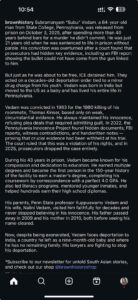
A fellow TamBram writes about it; https://nereview.com/article/the-trials-of-subu-vedam.
The word Brahmin is mentioned 4 times in the non-paywall foreword.
Subu’s father was an academic, a physics professor and materials scientist at Penn State, who would have blended seamlessly with my parents’ friends in North Carolina, who were all vegetarian and spoke Brahminical Tamil with its idiosyncratic conjugations and vocabulary.
Dr. V
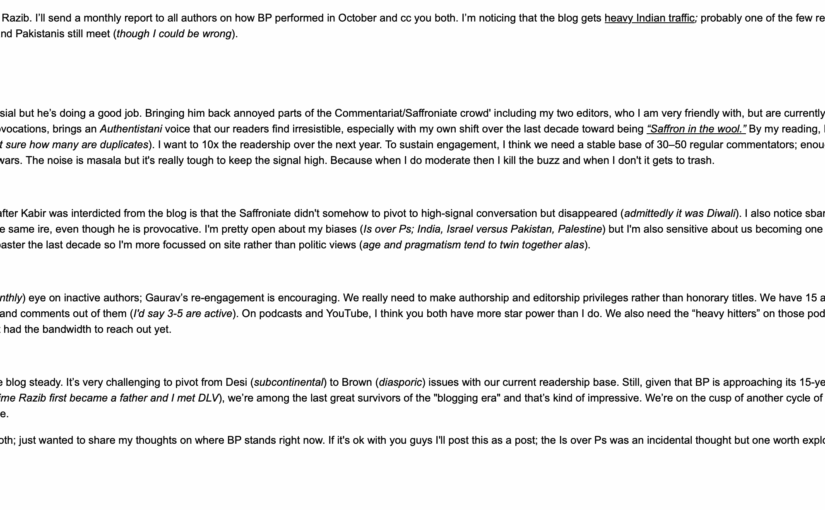
I sent this email to the CoFounders of the Blog (Omar | Razib) and tomorrow I will send through the Monthly Author Report.
I actually agree with Kabir on one key point — I don’t think people should be brought back to Brown Pundits merely as bait or for spectacle. The value of this space has never been provocation for provocation’s sake.
What makes Brown Pundits “gold” is that it forces us to face uncomfortable truths: about ourselves, our societies, our religions, our histories. The goal isn’t comfort; it’s clarity.
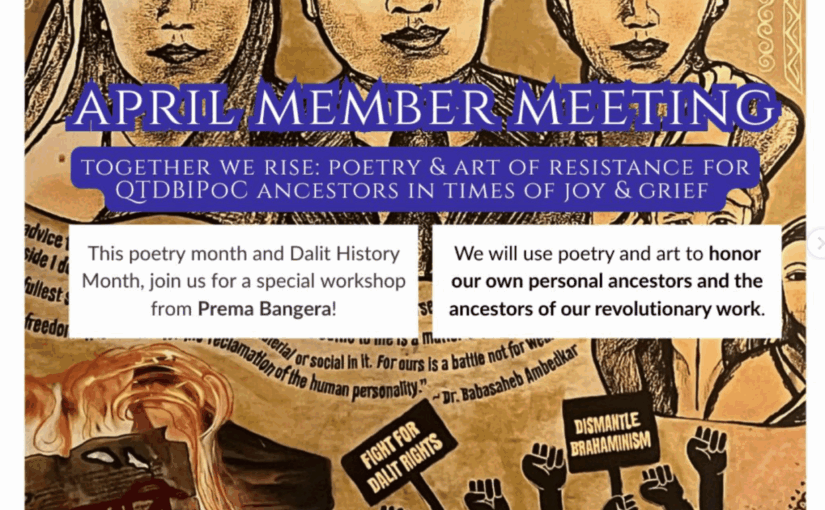
That’s why I push back when people say “don’t talk about caste” or “that’s offensive.” Caste, class, and every other structural reality are not optional topics — they’re fundamental to understanding how our societies actually work. Discussing them honestly is the only way to make sense of why things function, and malfunction, as they do.
If we avoid those hard conversations, the whole project collapses into noise. The point is not to inflame, but to illuminate— even when illumination burns a little.
We had a quiet Diwali dinner with some South Asian literati here in Cambridge, Mass. No fireworks, but some useful clarity especially about the need for a unified South Asian voice, and where Brown Pundits fits in.
Threads, Fire, and a New Warrior Class
Kabir remains catnip for the Commentariat or as I’ll now call them, the Saffroniate (Brahmins or Brahminised). They pretend otherwise, but the numbers don’t lie. The threads light up when he’s around and yes, I’m aware of the layered joke: threads mean something else too, especially to our youngest Pundits-in-training. Continue reading Fire and the Saffroniate
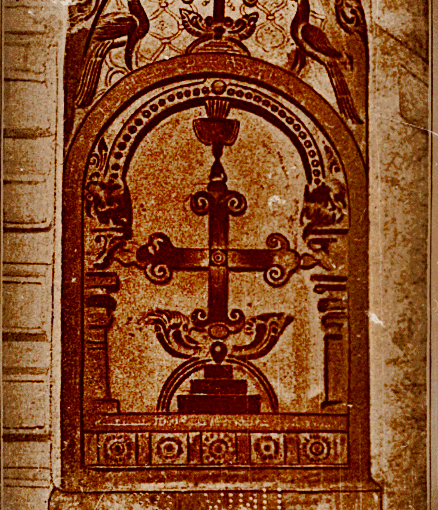
It is somewhat understood that the Christians of Lebanon and Kerala, though separated by 4,000 miles of land & sea, belong to the same ancient linguistic and theological world. Both descend from the Syriac-speaking Christianity that once stretched from Antioch to the Malabar Coast, and both have wrestled with what it means to be indigenous after centuries of empire, conversion, and cultural layering.
1. The Syriac World
Before Latin or Arabic ruled their respective shores, both Lebanon and south western India were part of an Aramaic Christian zone. The language of Christ, Syriac, a dialect of Aramaic, became the scriptural and liturgical medium for Christians from Edessa to Mylapore. From this matrix emerged:
The Maronites of Lebanon; Chalcedonian Syriac Christians who accepted the Christology of Constantinople but maintained their own monastic independence in the mountains.
The Nasrānīs (Saint Thomas Christians) of Kerala; East Syriac Christians under the Church of the East in Persia, who never knew Byzantium but shared the same liturgical ancestry.
In both regions, Syriac liturgy defined the faith long before Latin, Greek, or Malayalam translations appeared. To this day, Maronite and Keralite priests still whisper “Qadishāt Alohō”, Holy God, in the same ancestral tongue.
2. Lebanon; A Christian Mountain Built on Shiʿite Soil Continue reading Syriac Echoes: From the Mountains of Lebanon to the Coasts of Kerala
I’ve found myself drifting further left than I expected this year. Much of that is circumstantial, being involved in local activism in the United States naturally places one within progressive coalitions. Yet even in this frame, my ideological compass is firmly rooted in some admiration for Brahminical continuity and Bharat Mata as civilizational anchor.
At times I speculate on where Bharat truly ends. Is it the Hindu Kush? The Iranian plateau? The Persian world has always seemed to me about 20–30% Indianise; its mythology, musicality, and memory bear the imprint of the Indo-Aryan stream more than the Indo-European one, no matter how insistently modern Iranians lean toward a Westward identification.
This brings me to a provocative thesis I’ve often floated: that Brahmins are the civilisational custodians of the Indian subcontinent, and that their displacement often signals a broader cultural erasure. The tragedy of the Kashmiri Panditsis not merely a community’s trauma, but a warning. Without Brahminical continuity, Vedic frameworks falter. Hinduism in Pakistan and Bangladesh remains vulnerable precisely because it lacks the embedded authority and supervisory function of Brahmin elites to anchor Vedic traditions and calibrate resistance to incessant Islamisation. Continue reading Caste in America
The Echo Chamber of the Commentariat
It has been on my mind that Brown Pundits, for all its liveliness, risks drifting into an echo chamber. The commentariat is our lifeblood: their activity sustains the blog far more than page views alone. And yet, the very strength of that community can also be its blind spot.
I do not want Kabir to end up being the Cassandra of BP, always warning of decline, and being proved right in the end. If we are not careful, we could slide into a right-wing echo chamber where challenging voices fade, and the capacity for deep interrogation, the core of what makes BP unique, is diminished.
Pahalgam and the Question of Narrative Continue reading Brown Pundits and the Echo Chamber Problem