
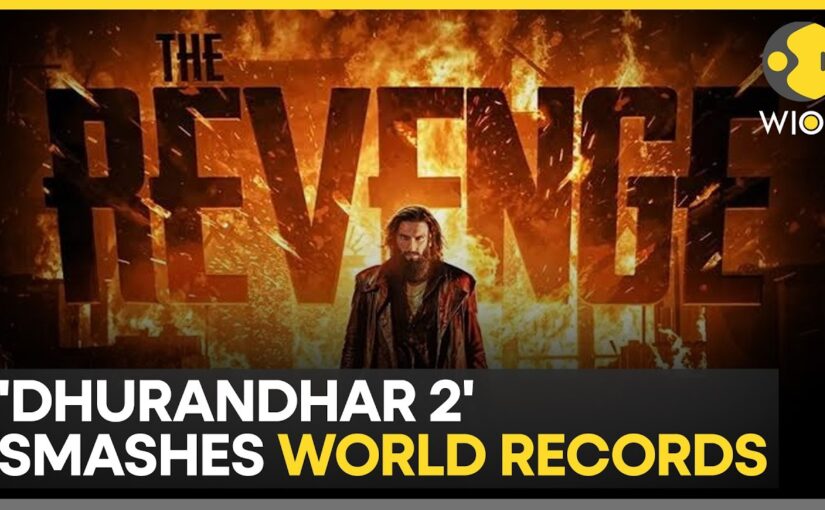
We wrote in December that Dhurandhar perfected Bollywood’s new formula: the fetishisation of Pakistan as the subcontinent’s most glamorous disaster. Dangerous, broken, desirable, and always in reach. Three months later, the world has changed more than the franchise has. Iran has seized the Strait of Hormuz. Pakistan is psychologically vacating South Asia. And Dhurandhar 2 arrives as a cinematic relic of a paradigm already dissolving.
It is not good.
The first film worked because the villain was the gravitational centre. Akshaye Khanna’s Rehman Dakait, Baloch, charismatic, smouldering, made Ranveer Singh’s Hamza credible by giving him something worth the deception. A spy story lives or dies by its antagonist. Remove the antagonist, and you don’t get a hero. You get a man punching air for four hours. That is Dhurandhar 2. Angrier, louder, emptier; and at 3 hours 55 minutes, a film that confuses scale with depth.
The structural collapse is ideological as much as narrative. Dhurandhar 1 had grey. Hamza was a man genuinely lost between two worlds; the film understood that proximity to Pakistan produces desire, not only contempt. That complexity, that slippage between intimacy and danger, was what made it aesthetically serious. Dhurandhar 2 closes that gap entirely. The Pakistani Muslim is now simply a target, and the film is at pains to multiply them faster than they can be eliminated. This is the Hydra error; the same mistake Mossad has made in Gaza. Cut off the head and ten more appear, until the only logical conclusion the audience is being nudged toward is collective punishment. You cannot make a film that glorifies this logic and then claim it is merely entertainment.
The Hindutva-Zionism convergence is now visible at the level of cinematic grammar. Both traditions have arrived at the same endpoint: the innocents cannot be separated from the combatants, therefore the innocents must go too. It is a short distance from that premise to a football scene with a severed head, which Dhurandhar 2 includes without irony. This is not complexity. This is an audience being educated to hate, and that is far more dangerous than any amount of bad plotting.
Bollywood has always used Pakistan as its erotic shadow; familiar enough to feel intimate, foreign enough to feel forbidden. That formula depended on the Pakistani figure retaining some glamour, some interiority, some capacity to make the Indian hero sweat. Dhurandhar 2 strips all of that away. What remains is a shooting gallery. The irony is that by dehumanising its villains, the film also destroys its hero. Hamza becomes less interesting the more Pakistan becomes merely a backdrop for his competence.
The music, which in the first film gave us a Persian Gulf aesthetic that became genuinely anthemic, is a significant step down. The background score intrudes rather than elevates. And Ranveer Singh, who is a serious actor, is given a character arc built almost entirely around rage; which is a waste of an instrument that can do much more.
There is a deeper geopolitical irony the filmmakers did not intend. Dhurandhar 2 is a film about Indian dominance of the AfPak axis at precisely the moment that axis is reorienting toward Iran. Pakistan is stepping into its role as a Muslim power, mediating with Tehran, psychologically decoupling from the subcontinent. The Baloch and Pashtuns are the eastern Iranians; Punjab’s future is as a lowland frontier of a broader Persianate world, not as the last redoubt of a subcontinent fixation. Dhurandhar 2 is the cinematic expression of an India that has not yet noticed.
What Dhurandhar 1 understood, and Dhurandhar 2 has forgotten, is that the most dangerous person in any room is the one you cannot stop watching. Rehman Dakait was that person. His absence is not a plot problem. It is the film’s entire problem.
The sequels that matter are the ones that deepen what came before. Dhurandhar 2 only amplifies it, and amplification without depth is just noise.
⚠️ SPOILERS BELOW – Read only if you have seen the film Continue reading Dhurandhar 2: When the Villain Disappears, So Does the Film