Forbidden Fruit. Military in Politics in Pakistan

From Dr Hamid Hussain. An old article (from 2003).

Forbidden Fruit – Military & Politics

Hamid Hussain

2003

Introduction

Politics and profession of soldiering has nothing in common. They are totally different but essential elements of any society. Politicians and soldiers have an interesting relationship in all societies. In societies where civilians are in control, military officers act in accepted boundaries though ready to defend their turf against civilian encroachment. In societies where political institutions are weak and there is lack of consensus on legitimate course of succession, soldiers gradually expand their area of influence. They gradually restrict the role of civilians in various areas and sometimes directly take over the state replacing the civilians. This generally accepted model does not mean that military as an institution has no relevance to the important policy decisions. Even in countries where the tradition of civilian supremacy is well established, military has a political role relating to national security, albeit a different one. One commentator has correctly pointed that “the military’s political role is a question not of whether but of how much and what kind”. [1]

This article will evaluate soldier’s attitude towards political activity and how it develops. This will be followed by the details of Pakistani experience of politicization of officer’s corps and how repeated and prolonged military rules have militarized the politics. In the end, the complex relationship between soldiers and politicians will be summarized.

Soldiers & Politics

Soldier’s disdain for politics and politicians is universal. Soldiers by nature of their training and job requirement place high value on discipline, recognized chain of command and espirit de corps. These values are essential for any professional army. Soldiers generalize these values and attitudes to the whole society without appreciating the difficulties and various conflicting demands by interest groups in a modern nation state. In under-developed countries, the problems are compounded by host of other negative social and economic factors. Discussion, debate and arguments about different points of view are essential ingredients of politics in every society. The nature of political activity is more chaotic on surface. Soldier’s concept of political order is based on the model of discipline, which he has learned in his barracks and daily life. “Institutions that permit disorder are condemned. The men who purposefully encourage disorder, as well as those whose inactions inadvertently allow for disorder, are dangerous”.[2] This is how soldier sees the political activity of his society. Political activity is seen as undermining of the discipline of society and politicians as opportunists and self-seeking demagogues. This thought process is at the root of how a military first withdraws respect and later support of any civilian government which is followed by kicking the quarrelling politicians out of the corridors of power. The chaos and instability caused by the weak civilian institutions is blamed for paving the way for military to take over the state. This is the universal justification used by all military rulers. Once the politicians are condemned as useless bunch, the question arises then who is competent to run the state? Now the self-righteous attitude of officer corps comes into play. In under-developed countries, military sees itself as the most modern institution of the society. In addition, being a member of a well organized and disciplined force and overdose of patriotic and nationalistic symbols reinforces the notion that soldiers are more competent than civilians. In countries where military is the dominant institution, the military leadership considers itself as ‘final arbiters of political process, final judges as to whether a particular turn of events is acceptable from their standpoint as the guardians of national integrity’. [3] Continue reading Forbidden Fruit. Military in Politics in Pakistan
Brown Pundits – Episode 4, three Hindus talk about the Golden Age of Islam

The latest BP Podcast is up. You can listen on Libsyn, iTunes and Stitcher. Probably the easiest way to keep up the podcast since we don’t have a regular schedule is to subscribe at one of the links above.

Thanks to everyone who reviewed the podcast! Please leave more 5-star reviews. If this podcasts interests enough people I’ll be getting us on other platforms.

Note: Using the older context of Hindu.

Major General Akbar Khan

From Dr Hamid Hussain. A short note on Major General Akbar Khan (of Kashmir Jihad and Rawalpindi conspiracy fame)

Akbar Khan (1912-1994) was a Pathan from Charsadda area of Khyber-Pukhtunkhwa.  He was from the pareech khel clan of Muhammadzai tribe that inhabits the village of Utmanzai.  Akbar was from the last batch of Indian officers commissioned from Royal Military College Sandhurst in February 1934.  Lieutenant General B.M. Kaul ‘Bijji’ was his course mate at Sandhurst and they became friends during their service.  Officers commissioned from Sandhurst were called King Commissioned Indian Officers (KCIOs).  Akbar joined 6/13 Frontier Force Rifles (FFRif.).  This battalion is now One Frontier Force (FF) Regiment of Pakistan army.  He fought Second World War with 14/13 FFRif. (now15 FF).  This was a new war time battalion raised in April 1941, at Jhansi.  In new war time raised battalions, officers and men were posted from different battalions, usually from the same regimental group.  Lieutenant Colonel Arthur Felix-Williams, DSO, MC of 1/13 FFRis. was the first Commanding Officer (CO).  There were fourteen officers in the battalion and Akbar at the rank of Major was the senior most of the four Indian officers of the battalion.   Lieutenants H. H. Khan, Fazl-e-Wahid Khan and A.K. Akram were other Indian officers (Wahid won MC).  Battalion was part of 100th Brigade (other battalions of the brigade included 2 Borderers and 4/10 Gurkha Rifles) of 20th Division commanded by Major General Douglas Gracey.  Continue reading Major General Akbar Khan

Let Shiva’s Holy Lingam come back to Mecca before we talk of syncretism

Interesting thread on Ayodhya with Ms. Gogoi, who is a Nehruvian.

Since Hazrat Asia is still in hiding my natural empathy for Pak, Islam & the Mughals is on the ebb. I won’t forgive Pakistan for this until they disproportionately compensate her and her family publicly for this illegal sentencing

I use to be like Ms. Gogoi arguing for the Mughal and Muslim legacy in South Asia. But these matters aren’t really very difficult to solve; let Hindu gods, rituals and ceremonies creep back into Muslim Holy Sites.

While I was waiting for last night’s podcast (which is proving to be very popular mA) to start I was listening to some nice Urdu music (to curate for the Sherbert Socialites) and listened again to Afreen Afreen. To be honest it’s not my cup of tea (I was especially moved by Kapil Sharma’s rendition of a sad Punjabi folk melody; the Persian in me yearns art to be always melancholic, tragic & nostalgic) but the first line in it is about the spectacular caves of Ajanta. I was a bit taken aback but the only way forward for a true Decolonisation of the Subcontinent is bringing back syncretism on both sides (Shiva Lingams have a place in Allah’s Abode before Mohammed smashed the idols).

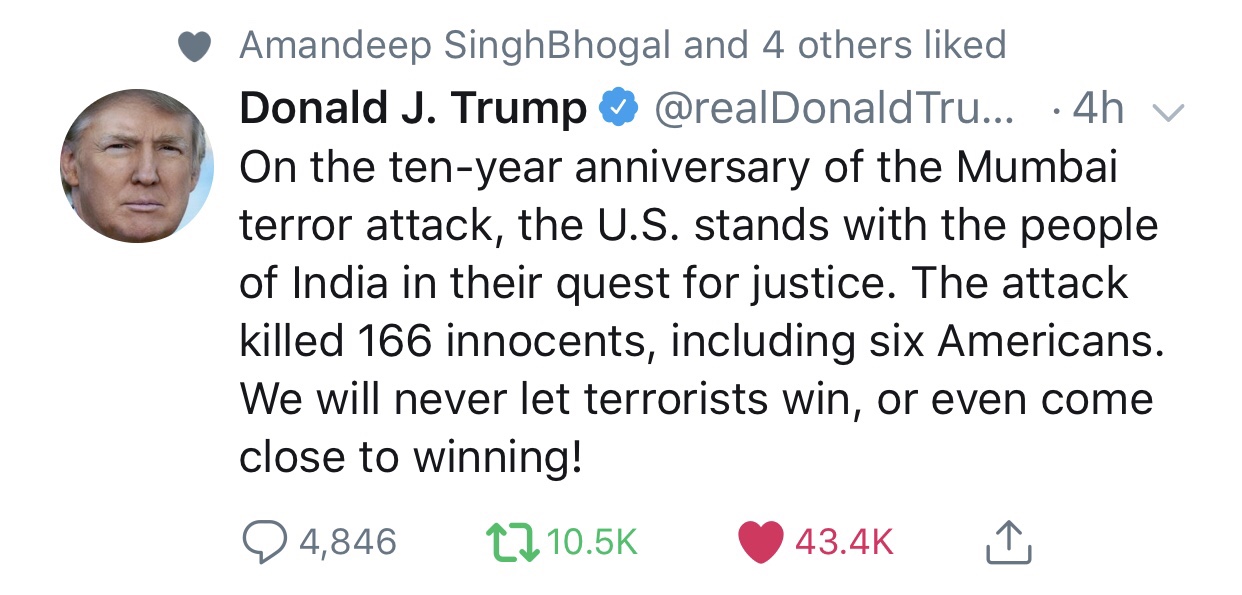
Shame on Pakistan- 10years on from 26.11; In Memoriam.

Vidhi observed a minute’s silence, as she mentioned at Friday’s dinner, the Pakistani attack on India on 26.11 was when India & Indians forever distrusted Pakistan.

When police asked Kasab what he understood about jihad, Kasab told the interrogators “it Jihad is about killing and getting killed and becoming famous.” “Come, kill and die after a killing spree. By this one will become famous and will also make God proud.”[79]

“We were told that our big brother India is so rich and we are dying of poverty and hunger. My father sells dahi wada in a stall in Lahore and we did not even get enough food to eat from his earnings. I was promised that once they knew that I was successful in my operation, they would give 150,000 rupees (around US$3,352), to my family,” said Kasab.[79]

Police said they were shocked by his readiness to switch loyalties after he was apprehended.[79] “If you give me regular meals and money I will do the same for you that I did for them,” he said.[79]

Young Moshe is a living symbol of an eternal Indo-Israeli friendship:

“Time Heals, They Say, But…”: Baby Moshe’s Grandfather On 26/11

Pakistani potluck with a dash of politics

Last night V & I hosted Pakistani potluck. It turned out to be a rather intimate affair with a few Pakistani friends of ours. After the last few weeks of intense Indian & Kashmiri events I thought it would be nice to have a light-hearted evening of biryani, nihari and haleem especially before we go meat-free at home.

As an aside I’ve begun to believe that the meat consumption we are having is simply far in excess of our hunter-gatherer ancestors. Industrial farming is a blight and my hack is simply to eat meat outside of the home.

Toward the end of the evening the talk drifted towards politics and V mentioned some of her opinions about Pakistan. It rapidly became a bit more intense since at the root of it V has deep misgivings about the Pakistani state. Her contention is that all Indians, of whatever hue, couldn’t forgive Pakistan for what happened on 26-11 and that in a way it was India’s 9-11. Continue reading Pakistani potluck with a dash of politics

Aasia Bibi case comes full circle (part 2)

I showed up at the Institute of Peace and Secular Studies (IPSS) a few days after the rally. The person who had called the meeting was running late so I just loitered around. It was a two-room apartment that had been modified into a makeshift office space with some spare area for sitting, with floor cushions etc. There was a book rack full of books in one corner. The lady who managed the place was present there and said Hello. A few minutes after I had arrived, two boys a few years younger than me showed up as well. We started chit-chatting and it turned out that one of them was a student at LUMS and the other went to another private school. We were talking about democracy when they revealed that they were not in favor of democracy at all and then spent the next hour arguing why they thought so. They were under the influence of Hizb-ut-Tehrir, an Islamist organization that wanted to establish a caliphate. I tried to argue with them using rationality and logic but they were not willing to listen to a counter-argument and eventually stormed off. I discovered that IPSS was offering a short course in Political Economy and History and all I had to pay for was a copy of their syllabus.

Salmaan Taseer (ST) was a larger than life person. He grew up in a literary family, with his father passing away at an early age but the familial ties and his family’s social standing in the Lahori society gave him a footing in the tightly-knit hierarchy of Lahore’s elite circles. He was an active member of the Pakistan Peoples Party (PPP) during its heyday, starting in 1968 and through Zulfikar Ali Bhutto’s rule (1972-77). After Mr. Bhutto was hanged (1979) and PPP was under threat by Dictator Zia’s government, ST wrote a biography of Mr. Bhutto. I attended a talk by one of the fact checkers on ST’s book (at the cafe, Books n Beans, a small liberal enclave for such events) and she remembered how hard she had to work to meet ST’s standards. ST was instrumental in arranging for Benazir Bhutto’s arrival in Lahore in 1986 and the grand reception that ensued. He was elected in the PPP wave that swept most of Pakistan during the 1988 elections. He didn’t win another election in during the rest of his political life. However, he was considered PPP’s man in Lahore, someone who could take on the Sharif’s of PML(N). ST started an English daily in the early 2000s, called Daily Times (DT) which started with much fanfare and even had an Urdu counterpart. Continue reading Aasia Bibi case comes full circle (part 2)

RIP Fahmida Riaz

The poet and scholar Fahmida Riaz passed away today. She was known for her fearlessness and her willingness to call a spade a spade and she suffered for it (including an Indian exile during the Zia regime).

Here is Hasan Mujtaba’s poetic tribute to her:

سربکف سارے ستارے مشعلیں
اس کی آنکھوں میں جلوسوں کی طرح چل رہے تھے
جل رہے تھے جام سورج کی طرح سارے اسکے نام پر
اجرکوں کے رنگ سارے اسکی آنکھوں سے چراکر
تتلیاں لیکر اڑیں
دیس دیس دور دور
بچے اپنے ہاتھ مائوں سے چھپاتے پھر رہے تھے
رتجگوں میں بھکشوئوں کی ریت تھی
جیت تھی اسکے ماتھے پر لکھی
تاریخ کی خونی گلی میں
رات وہ مجھ کو ملی۔

Translation:

Severed head in hand

All the stars were like lamps marching in procession in her eyes

In her name, the wine-cups were circulating like the sun

Taking all the colors of the (Sindhi) Ajrak from her eyes

The butterflies took wing

From land to land and country to country

Children are hiding their hands from their mothers

All-nighters and the rites of bhikshus

Victory was written on her forehead

as in the blood soaked alleys of history

She met me..

Her poem Aqlima was translated by Ruchira Paul

Aklima
jo Habil aur Kabil ki maa jaani hai
maa jaani,
magar muqtalif
muqtalif beech raano ke
aur pistanon ki ubhaar mein
aur apne pait ke andar
aur kokh mein
is sab ki kismet kyun hai
ek farba bher ke bachche ki qurbani
woh apne badan ki qaidi
taptee hui dhoop mein jalte
teele par khadi hui hai
patthar par naksh banee hai
us naksh ko ghaur se dekho
lambee raano se upar
ubharte pistanon se upar
paicheeda kokh se upar
Aklima ka sar bhi hai
Allah kabhi Aklima se qalam karain
aur kuchh puchhain.

(Translation)
Aqlima..
Born of the same mother as Abel and Cain
Born of the same mother but different
Different between her thighs
Different in the swell of her breasts
Different inside her stomach
And her womb too
Why is the fate of her body
Like that of a well fed sacrificial lamb
She, a prisoner of that body
See her standing in the scorching sun on a smoldering hill
Casting a shadow that burns itself into the stones
Look at that shadow closely
Above the long thighs
Above the swelling breasts
Above the coils in her womb
Aklima also has a head
Let Allah have a conversation with Aklima
And ask her a few questions.
(Aklima was the lesser known offspring of Adam and Eve, the sister or Cain and Abel)

RIP.


Aasia Bibi case comes full circle(part 1)

I have a special interest in Aasia Bibi’s case because it was the assassination of Salmaan Taseer that shook most of my worldview and lead me to a completely different path in life. It coincided with my political awakening. I was a 4th-year medical student at the time (January 2011) when the incident took place and I started my new journey. I grew up in a conservative, Salafi family in small town Punjab. I had always been a bookworm, interested in reading the news and reading all kinds of books (more in Urdu than English, mostly because books in Urdu were much more accessible to me). When my classmates in high school were busy memorizing textbooks for history, I was reading books in the school library that had not been read for ages (including both English and Urdu books). I was more interested in biographies and didn’t read (or had access to) books on politics and social sciences written in English. I was curious but didn’t have enough material to understand my own curiosity.

I was aware of the Aasia Bibi case and considered it a bigoted attempt by the village folk as a way to settle scores (not an uncommon occurrence in Punjab, my homeland). I was heartened to see Governor Taseer’s photos in the news when he visited Aasia. I had actually written a letter to Governor Taseer about some issue with our university exam (Governor of Punjab is the de facto Chancellor of all public universities in the province) a week before he was assassinated. From a political standpoint, I did not like him because he had been used by Zardari (President of Pakistan at the time and belonging to Pakistan Peoples Party-PPP) as a pawn to keep the PML(N) government in the bay. It was during this period that photos from some private events attended by the Taseer family were ‘leaked’ on social media. They showed the Taseer family in swimming pools and the ladies in swimsuits (which was considered too much skin). Those photos were circulated on Facebook and then on news channels by both PML(N) folks and later by the religious right which had started calling for Salmaan Taseer’s head after he visited Aasia in jail.

At the beginning of January 2011, I had taken part in an inter-collegiate competition taking place in Lahore University of Management Sciences (LUMS) and was still living in the slightly less-bigoted mindset that was present in LUMS. The assassination on January 4th, 2011 took place a day after I came back from LUMS. A few short years before that, Lawyers movement (2007-08) had swept urban parts of Pakistan in a frenzy and it felt like a new era for raising your voice, to demand greater freedoms. Some of my friends from high school had played an active role in the movement and LUMS had been a citadel of resistance during those days. The band, Laal (meaning Red) had sung some of Faiz Ahmad Faiz’s poems and made a wonderful video talking about protest. After 8 years of Musharraf’s ‘hung democracy’, the politico were back in action. (Side Note: for admission to 11th grade in a military-run boarding school, I had to write an essay on demoracy in pakistan (in 2004) and I used the words ‘hung democracy’ in my essay. I got admitted. Omar Ali of BP went to the same school.) There used to be a ‘study circle’ oraganised by some LUMS students (current and former), who had taken active part in the Lawyers movement, at a place on Jail Road, Lahore near my hostel which I had attended twice. During one of the sessions, Ashar Rehman (Taimoor Rehman-of Laal’s uncle and brother of Rashid Rehman, editor of Daily Times) talked about his days fighting alongside the Baloch against the Pakistan army and how he learned tactics of guerrila war from Che Guevara’s books. At the other session, a lady who used to be active in leftist circles in the 1940s (I believe it was Tahira Mazhar Ali, Tariq Ali’s mother) talked about the freedom she enjoyed in those times, roaming Lahore in her tonga. Continue reading Aasia Bibi case comes full circle(part 1)

Why I Repeated Aasia Bibi’s Alleged Words

Kabir was right to question why I repeated the remarks Aasia Bibi was accused of making. The point did not require repeating them. But the principle did.

I try to be respectful towards all religions. I’ve even been accused of being too sympathetic to Islam and to Pakistani narratives. But many people still do not grasp that the rage some believers feel when they think their Prophet has been insulted is the rage I feel when a powerless Christian woman spends years on death row for something she did not do—or had every moral right to say.

Aasia Bibi is the clearest example in our era of what happens when a blasphemy taboo becomes a blasphemy law.

And what happens when a blasphemy law becomes a political weapon.

If we cannot speak the very words that put her in prison, then the injustice done to her cannot be fully confronted. Sanitising the allegation only sanitises the cruelty.

This is the core of the matter:

Freedom of expression is meaningless unless it protects speech that some consider offensive or sacred.

It cannot protect only polite dissent. It must also protect speech that religious authority hates.

I don’t indulge in theatrics or gratuitous insults. But the principle has to be clear: in a free society, no religion, none, can demand immunity from criticism, satire, or even irreverence. If believers wish to revere, they are free to do so; if others do not, they are free not to.

What troubles me is the growing chorus of Western liberal Muslims and “hijabi feminist” activists who demand respect under the banner of “Islamophobia,” while simultaneously insisting that Muhammad must never be depicted, mocked, or even discussed without ritualised reverence. This is simply a diplomatic version of the same rule that keeps women like Aasia in prison: the Prophet’s honour is more important than human freedom.

And the moral inconsistency is glaring.

There is deafening anger over Gaza. There is a whisper, at best, over Aasia Bibi. For some, outrage is selective, calibrated to global cause-identity. Aasia is inconvenient because she reveals an uncomfortable truth about the political uses of piety.

This is why I repeated the alleged words. Because the principle they engage is non-negotiable:

In a free society, all ideas, including religious ones, must be open to criticism.

No faith gets to write exceptions into the law.

Aasia Bibi paid for that principle with a decade of her life.

The least I can do is speak the words that she was punished for—even if only to show how absurd it was to punish her at all.

Brown Pundits