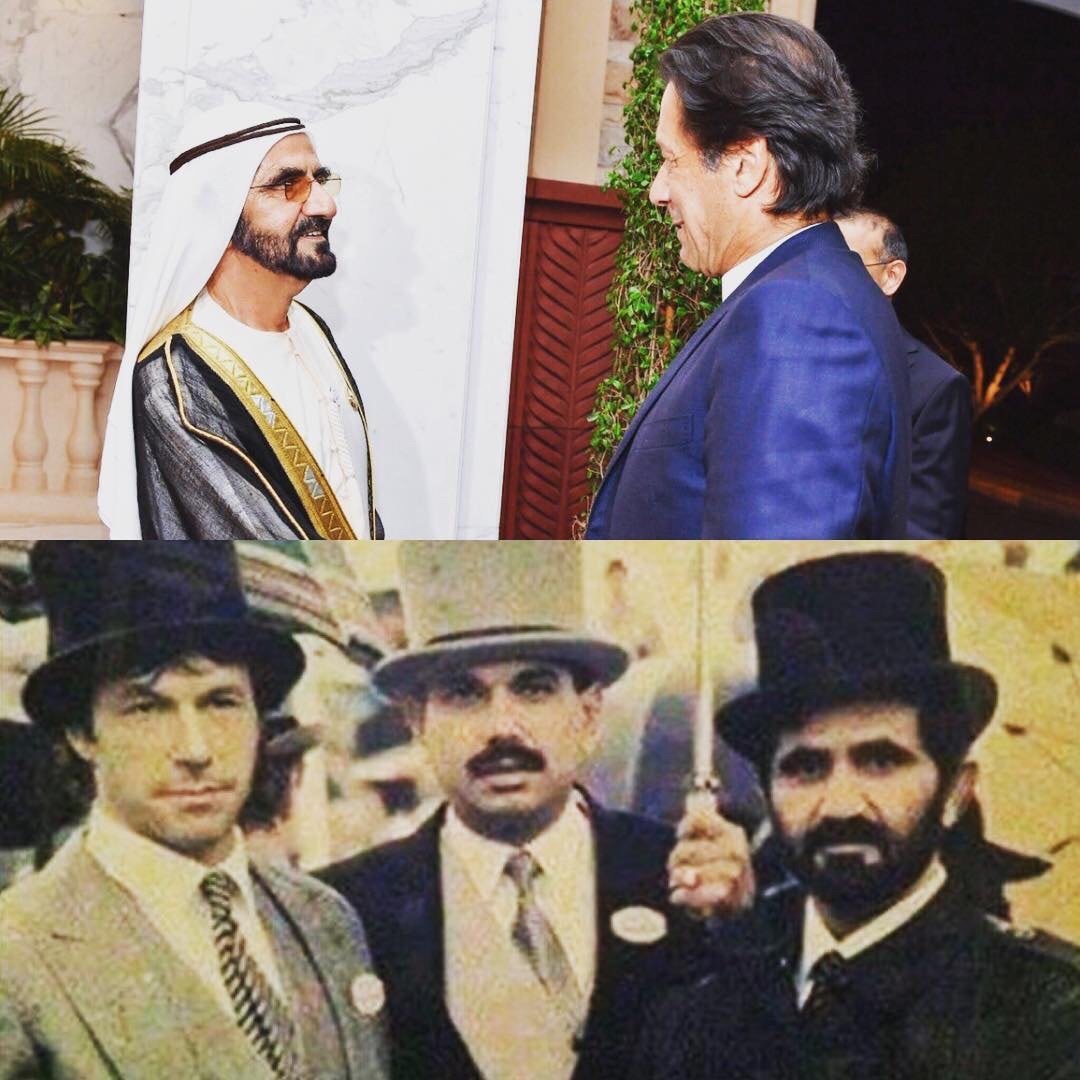
Why has Imran Khan aged so badly-

In the top photo he’s with Sheikh Zayed of the UAE. This is them in the 70’s. Imran these days looks so haggard and old especially in comparison with his dashing younger self.

The Emir on the end pretty much looks the same; in fact looks even better since he’s more au fait.

Unfortunately for Imran; I think he became a born-again Muslim a little too late for his own good. There’s obviously been a lot of sharab in his wilder days and god knows what else.

It’s part of the reason as to why I have such a visceral dislike of substances; they can age you really quickly. Black don’t crack but brown also has pretty amazing staying power.

That’s why when I see Indians boast about how much they drink I tend to roll my eyes. Alcohol is no great panacea and instead for Brown people we must guard against weight gain. I wonder if there is salient Vedic wisdom on staying young as long as possible.

I do notice that as one ages sleep is increasingly an issue. Our 9-5 industrialised tempo with some leisure time thrown in after doesn’t make for long and conducive rest periods, which is necessary to our psyche and well-being.

It may sound controversial but I imagine the outbreak of depression and mental illness probably has some simple solutions. There was big news over the weekend that 17 children (most of them autistic or on the spectrum) have transitioned at a single school.

I may sound a bit old-school here but I suspect there’s a deep spiritual malaise in the West that’s almost consuming it. It’s why poorer nations aren’t necessarily unhappier ones; there’s much to be said for spiritual and social solidarity once basic fundamental needs & wants are met.

Brown Pundits Podcast #2 – Asia Bibi and Colorism

The latest BP Podcast is up. You can listen on Libsyn, iTunes and Stitcher. Probably the easiest way to keep up the podcast since we don’t have a regular schedule is to subscribe at one of the links above.

The title makes it clear what we talked about this week. It as a long podcast at more than one and a half hours. Would appreciate it if some people reviewed the podcast positively on iTunes and Stitcher.

Maududi and Iqbal: A Brief History

A few days ago, on the occasion of Allama Iqbal’s proposed birthday (November 9th was chosen by a committee created in the 1970s), Mr. Rafi, a Pakistani commentator on twiter tweeted that

“Iqbal chose Maududi to head Dar-ul-Islam in Pathankot to reconstruct Islam in a new light and eventually Maududi founded Jamaat-e-Islami (JI) so Iqbal is indirectly a founder of JI as well” (my translation, the original tweet was in Urdu).

Having written extensively on Jamaat-e-Islami and Maududi in the past and with a moderate knowledge of Iqbal’s poetry and prose, I was not thrilled by this simplistic association. In my opinion, it was a tenuous argument and required a bit more nuance and detail. To set the record straight, I went back to some of my source materials and re-read about the relation between Iqbal and Maududi. I wrote a brief blogpost about this issue in April 2012 for Pak Tea House blogzine (May it rest in Peace), which you can access here.  Following is a detailed look at interactions between the two gents. (For more, see Vali Nasr’s Mawdudi and the making of Islamic revivalism)

The first time Maududi and Iqbal crossed paths was in the 1927 when Maududi wrote a series of articles on the issue of the concept of Jihad in Islam titled”Islam ka qanun-i Jang” (Islam’s law of war), in twenty-two issues of his magazine Al-Jam’iat beginning in February and ending in May 1927. The articles were well received in Muslim intellectual and political
circles. Mawdudi was lauded for his service to Islam by Muhammad Iqbal;Muhammad Ali; Mawlana Ahmad Sa’id of the Jamiat-i Ulama-i Hind, who wrote a complimentary note about the first installment; and the eminent alim, Sayyid
Sulaiman Nadwi, who saw to the publication in 1930 of the articles in book form under the title Al-Jihad fil-lslam (published by Darul-Musannifin in Azamgarh). The first time Iqbal met Maududi was in 1929 in Hyderabad where he had gone to deliver a lecture.

In 1937, Iqbal wanted to establish a model ‘darul-ulum’ (house of knowledge) in Punjab to lay the foundation for a new Islamic worldview, which would in turn facilitate the creation of a Muslim national homeland. His friend Niyaz Ali, a retired civil servant, wanted to establish a waqf (endowment) using a piece of land he owned in Pathankot, a small town in Punjab.

Iqbal’s aim was evident in his letter to the rector of al-Azhar in Cairo, Shaikh Mustafa al-Maraghi, requesting a director for the intended darul-ulum; Iqbal asked the Egyptian alim for a man who was not only well versed in the religious sciences, but also in English, the natural sciences, economics, and politics. Al-Maraghi answered that he had no suitable candidate. Iqbal was disappointed and handed the task of selecting a suitable overseer to Niyaz Ali, but he remained firm about establishing the darul-ulum.

Niyaz Ali, meanwhile, searched for a suitable administrator for his waqf. He turned first to the famous Deobandi alim, Ashraf Ali Thanwi, but Thanwi rejected the offer. Niyaz Ali then tried to encourage Mawdudi to move to Punjab (Maududi at the time was in the state of Hyderabad working ), though he made him no firm offer and the two disagreed about the aim of the project. Niyaz Ali insisted Mawdudi consult with Thanwi, with whom Mawdudi was at loggerheads, along with the rest of the the Deobandi Jamiat-i-Ulama-i Hind. Disagreements, however, were soon overshadowed by mutual need.
The situation in Hyderabad was fragile, and Mawdudi had come to the conclusion that it was not the best possible place for launching an Islamic revival. This made him more interested in Niyaz Ali’s project, and he solicited
the job of administering the waqf. Unable to find any other suitable candidates, Niyaz Ali was inclined to agree, but the final decision had to await a response from al-Maraghi. Niyaz Ali asked Iqbal to write to Mawdudi and invite

Unable to find any other suitable candidates, Niyaz Ali was inclined to agree, but the final decision had to await a response from al-Maraghi. Niyaz Ali asked Iqbal to write to Mawdudi and invite him to settle in the Punjab. Iqbal arranged for him to come to Lahore and serve as the imam of the Badshahi mosque at a salary of 100 rupees per month and to partake in Iqbal’s plans for the revival of Islam, “umraniat-i Islami ki
tashkil-ijadid” (reconstruction of the social aspects of Islam). Mawdudi turned down Iqbal’s offer on the grounds that he did not want a payingjob that would restrict his freedom. Niyaz Ali then suggested Maududi as overseer of the waqf and secured Iqbal’s agreement to this appointment.

At the meeting , Mawdudi’s appointment was confirmed, but Iqbal did insist that he establish at Pathankot some form of educational institution with a clearly defined curriculum. Mawdudi accepted Iqbal’s scheme and agreed to use the
waqf to train a number of capable Muslim students and young leaders in Islamic law as well as modern subjects. Although the project was essentially educational, the imprint of Maududi’s politics was evident in its name, Darul-Islam (Land of Islam).

All this cooperation was uncharacteristic of the independently minded and self-righteous Maududi, especially since it was clear that by no means had he abandoned his political objectives. Accepting the position was, therefore, partly
out of respect for the celebrated poet and the appeal of being a close associate. Following their meeting with Iqbal, Mawdudi and Niyaz Ali agreed on the terms of Mawdudi’s position as waqf overseer, and Niyaz Ali included Maududi
in the waqf’s governing committee, the Darul-Islam Trust.
Niyaz Ali guaranteed Maududi the autonomy he had asked for, but not the permission to involve himself in political activity, because their agreement with Iqbal regarding the nature of the waqf’s projects precluded it. Mawdudi agreed
to these terms. In the November 1937 edition of the Tarjuman, it was announced that the journal would be moving from Hyderabad to Pathankot; Maududi arrived there on March 16, 1938.

After Iqbal’s death, JI cadres tried to cash in on Iqbal’s brand and called Dar-ul-Islam his brainchild but Maududi himself had a different view. Maududi argued that “the commonality
of views between ‘Allamah Iqbal and me are limited to our belief that Islamic law should underlie the revival of our religion; my thoughts and intellectual probing are my own.” Iqbal did not conceive of the Darul-Islam project as it eventually unfolded, and Maududi was not Iqbal’s choice to lead it. Even after the two met again in 1937, Iqbal’s opinion of Mawdudi was guarded. Mian Muhammad Shafi, Iqbal’s secretary, recollected that he referred to Maududi as
“just a mullah [low-ranking cleric] ,” someone more suited to lead the prayers at the Badshahi mosque than to oversee a pioneering educational project.

Now, in hindsight, did Iqbal’s poetry influenced Maududi and JI’s conception of Islam and the world? It depends on if you want to focus on Iqbal’s more Ummah-focussed poetry and his ideas about mixing of religion and Islam. You would find some overlap in ideas but it is hard to separate the threads in some instances. Whether Iqbal wanted it or not, JI cadres used his poetry for their propagands. But then, such is life.



Book Review: The Stan

Dead Reckoning is a (fairly new) imprint of the Naval Institute Press that publishes military-themed graphic novels and books (e.g. they have published “All Quiet on the Western Front” as a graphic novel).   The Stan is a comic book based on stories collected by two American journalists (autors Kevin Knodell and David Axe) who have spent a long time covering the war in Afghanistan. The only story not based on their work is the opening chapter, which is a comic based on the life and words of former Taliban ambassador to Pakistan, Abdus Salam Zaeef. They use this first comic as a capsule history of the background to this war as well as a prediction of its futility and eventual failure.  This is the only comic that gives a nod, albeit a minimalistic and relatively simple one, to the “big picture” of the Afghan war and it is a strictly anti-war and anti-interventionist one. The other comics are all about the “little people”, ordinary soldiers, an Afghan interpreter, an Afghan soldier and an Afghan policeman. The last comic is about one of the authors (Kevin Knodell), who may have some PTSD, and his parting words are that “America’s longest war was going to stretch on longer”. Continue reading Book Review: The Stan

Dynamics of the Saudi Royal Family

From Dr Hamid Hussain

This piece written in summer of 2017 is a backgrounder for Kingdom at a crossroad.  This will help in understanding the background to my upcoming piece about challenges faced by the Kingdom in the aftermath of Jamal Khashoggi murder. Stay tuned.

Hamid

Royal Rumble – Dynamics of Saudi Royal Family

Hamid Hussain

 ‘In a western democracy, you lose touch with your people, you lose elections; in a monarchy, you lose your head’.  Prince Bandar Bin Sultan, Former Saudi ambassador to Washington.


 In the last two years, Saudi Arabia has gone through many changes.  Absolute monarchies are not easy to decipher.  There are many opacities and it is very difficult for any outside observer to have a real sense of events.  Two main factors are very limited expression by Saudis in their own country and opaque decision making process in the form of decrees with flavor of palace intrigue.  A Saudi will not express his honest view in the presence of another Saudi due to fear factor.  In view of these limitations, the perspective of an outsider has severe limitations.

Current system of governance of the country is based on accession to throne of one of the sons of the founder of the country Abdul Aziz bin Abdur Rahman al-Saud (d. 1953).  He works with other family members especially senior princes, Council of Ministers (most of whom are also royal family members) and Council of Senior Clerics in running day to day affairs of the country.  There is a fair amount of competition among all these groups about various issues and King carefully balances his act to avoid open conflict.

In January 2015, Salman bin Abdul Aziz ascended to Saudi throne after the death of his brother Abdullah bin Abdul Aziz.  He came quite late into the complex inner power circle of the al Saudi royal family.  He was appointed Governor of Riyadh province in 1962; a post he held until 2011 when he was appointed Defence Minister.  For five decades, his main influence was in business and media through his sons and a half-brother (Sattam bin Abdul Aziz).  His sons controlled different business and media interests.  Abdul Aziz was Assistant & Deputy Minister of Oil and now Minister of State for Energy Affairs, Faisal owned Sharq-al-Awst newspaper and appointed Governor of Medina in 2013.  Sultan is a pilot and worked at Saudi Ministry of Information.  He now heads tourism commission with the rank of a minister.  Khalid is also a fighter pilot and in April 2017 appointed ambassador to Washington.  Turki, Saud, Rakan and Nayef are little known and involved in various business ventures.  Fahad; a business tycoon and Ahmad with media interests died in their 40s from heart disease.  Continue reading Dynamics of the Saudi Royal Family

Only in the Land of the Pure

The reality in Pakistan and India may (or may not) be the same however the political and philosophical aspirations of the two societies are in entirely different directions.

There may be many families in India who would disown their child for marrying outside of caste & religion however none of them would have the temerity to post it publicly in a newspaper. In Pakistani culture the shame isn’t on the parents for doing so but the young man for marrying out.

I was going to remove my previous post as it was quite incendiary and with Aasia extradited but Paki liberals need to be shamed into action.

Why Pakistani liberals will always fail

I wrote a longish post on Aasia Bibi which I summarily deleted.

Pakistani liberals are a toothless lot because they dare not challenge the best itself, Islam. There is no peaceful Islam, like any other man-made ideology it becomes cancerous when not checked.

One could accuse me of hypocrisy because I’m a Bahai. However it so happens that my religious body isn’t sanction death sentences on innocent women. If it did I would be equally scathing.

Unless Muslims stand up, attack Islam and have the freedom to call Mohammad a pedophile (whether he was one or both) in central square Mecca without any fears of retribution from either State or individuals, there can be no respite in the taming of Islam.

The Tory Party and Republicans instinctively understand this which is why all Hindus, Sikhs & non-Muslims familiar with Islam must vote with the Right.

I am very upset about the Aasia Bibi case and I find the response of Pakistanis of it to be simply bullshit. Shame on them and shame on Pakistan and shame on me.

Pakistan’s Hybrid Government and the Aasia Bibi Fiasco..

Aasia bibi is a poor Christian woman from a village in Punjab who was arrested for blasphemy in 2009. She got into an argument with some other women from the village while working in the fields (purportedly over her drinking from a cup of water and hence “polluting” it) and in the course of the argument she allegedly said something  “blasphemous” about the holy prophet of Islam. The details of the case are murky and no one seems to know for sure what blasphemous statement she actually made that day (the most commonly reported one is that she said something along the lines of “Jesus died for the sins of the world, what has your prophet done for humanity”; other versions exist; the investigating police officer claims that she said much more, but even quoting it wud be blasphemy, so look it up on wikipedia) but whatever the details, a case was registered under Pakistan’s uniquely harsh blasphemy law (a death sentence is mandatory in case guilt is proven) and she has been in prison ever since.

Related image

As usually happens in blasphemy cases, she was sentenced to death by the local court (local judges usually feel it safest to convict any and all accused blasphemers, expecting that the most egregiously wrong verdicts will be reversed by higher courts that have better security). Meanwhile her case had come to national attention and the governor of Punjab, Salman Taseer, visited her in prison and spoke of her getting a presidential pardon. He was attacked in the media as a supporter of blasphemers and one of his own body guards shot him dead. The body guard was arrested and eventually hanged, but his grave has become a religious shrine and several ministers (including some in the current Imran Khan government as well as the opposition PMLN) have visited the grave to pay respects to this “hero”. Continue reading Pakistan’s Hybrid Government and the Aasia Bibi Fiasco..

Why do nonmuslims treat muslims so badly (e)?

This is a follow up to:

The video of ISNA’s recently held meeting in Houston interviews many muslims supportive of, respectful of or interested in dialogue with atheist muslims and ex muslims. An accelerating trend among muslims who live in North America, India, South East Asia and Australasia.

Sadly many nonmuslims [anecdotally almost all caucasian] are interviewed who are deeply hostile to atheist muslims and ex muslims. The ex muslims are kicked out of Starbucks. The extent of hostility on the part of nonmuslims is hard to understand. Sadly this attitude of backing extremist Islamist or Jihadi muslims against reasonable muslims and reasonable people of muslim heritage is a serious “THING” among the world’s 6 billion nonmuslims. In this next clip Armin–protector of the Arya peoples–tries to engage in dialogue with many different hostile nonmuslims. Mostly unsuccessfully. Even atheist nonmuslims engage in xenophobic personal attacks against ex muslims and atheist muslims:

https://www.youtube.com/watch?v=RYhCm2sz-e0

Nonmuslims are also demonizing a moderate muslim, the fabulous Wajahat Ali:

Mr. Subramanian Swamy is one of the few prominent global nonmuslims who publicly acknowledges that moderate muslims are afraid of getting killed if they publicly critique extremists. Nonmuslims need to stand by moderate muslims and protect them from extremist muslims. So far Hindus (including Buddhists, Jains and Sikhs), Taoists, Christians, Jews, atheists and post modernists have been during a terrible job at it.

Continue reading Why do nonmuslims treat muslims so badly (e)?

Muslims have always known how weird Saudi Arabia is

I’m not a big fan of Hasan Minhaj’s “Millennial smug” style of comedy. What it really reminds me is Brad Stine’s “Christian comedy.” It’s aimed toward ingroups and comes off as tone-deaf and stupid to outgroups. So you know what you’re getting into.

That being said, as someone who is Muslim Minhaj has always “gotten” the issue with Saudi Arabia. Most Muslims I have known, from very conservative Salafi types to irreligious cultural varieties, have strange and strong attitudes toward Saudi Arabia. Even the most conservative often have mixed attitudes, because Saudi Arabia may sponsor Salafism worldwide, but no one can deny that the ruling family are hypocrites in their private practice.

Believing Muslims though have to admit that the Saudis are currently the guardians of Islam’s holy sites, and, the kingdom provides a great deal of money for various Muslim causes as well as Muslims more generally. And of course, Saudi Arabia has been a source of employment for many Muslims from outside the kingdom for many decades.

The fact that we are “having a discussion” about Saudi Arabia as if there is a discussion to have is a testament to the power of money in public discourse, and how one can buy elite complicity.

Brown Pundits