
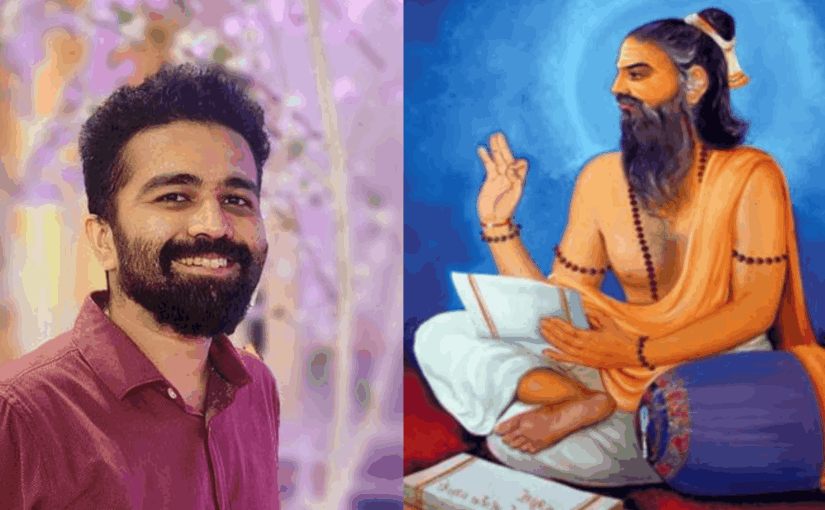
Pāṇini, the “Glitch,” and a Note From an Old Cambridge Friend

I received a message from a publicist this week. The name caught my eye because I knew the scholar from Cambridge years ago. The subject of the email was simple: a new book on Pāṇini and the old claim that something in his system “doesn’t work.”

For two and a half millennia, scholars have argued that Pāṇini’s grammar, the first true computational system for language, contains a flaw. His treatise gives a compact system for generating correct Sanskrit forms. But in cases where two rules seem to apply at the same time, most readers assumed the system breaks. Textbooks describe this as a “conflict problem.” Generations of commentators tried to patch it with exceptions, hierarchies, or interpretive workarounds.

The new book, Pāṇini’s Perfect Rule (December 2025), argues that the flaw was never there. The author, Rishi Rajpopat, claims the system already contains a rule for solving the conflict. According to him, Pāṇini didn’t leave a hole; modern readers simply looked in the wrong place. If his reading is right, the entire architecture of the grammar becomes visible as a single machine; elegant, compact, and self-consistent.

There are two parts to this story. Continue reading Pāṇini, the “Glitch,” and a Note From an Old Cambridge Friend

One or other, both or neither?

Reposted from Zenpundit — Modi or Trump, special or chosen? — with thanks to The Emissary — and closing in on the shining suchness of the Tathagata
.

Modi of India, Trump of USA?

**

Trump of USA proclaims himself the Chosen One, while Modi of India’s supporters claim Modi is the Special One.

Who knew?

**

Sources:

  • The Emissary, The Special One
  • Giphy, I am the Chosen One
  • .
    **

    Buddhist logic from the beginning differs from its Aristotelian cousin, featuring the chatushkoti or tetralemma:

    India in the fifth century BCE, the age of the historical Buddha, and a rather peculiar principle of reasoning appears to be in general use. This principle is called the catuskoti, meaning ‘four corners’. It insists that there are four possibilities regarding any statement: it might be true (and true only), false (and false only), both true and false, or neither true nor false.

    Hence my title, One or other, both or neither?

    Oh ah:

    speaking of the Buddha, Nagarjuna states that the Buddha’s teaching is “emptiness is suchness, not suchness, both suchness and not suchness, and neither suchness nor not suchness.”

    Furthermore:

    The suchness of the Tathagata is the suchness of all phenomena.

    Rumor therefore has it that there’s a fifth possibility, a refuge from all dualities: the shining suchness of the Tathagata.

    **

    No, really — please comment!

    Brown Pundits