Open Thread – 08/01/2020 – Brown Pundits

I think when we started the Brown Pundits Browncast we planned a ~1 time a week affair. As it happens it’s not that regular. The Browncast will be gone for 3 weeks, and then come back every other day for a week. Really you should subscribe at one of the options (just click the link in the strip above the latest podcast).

If you want to hear the podcasts early, please become a Patron. I do post them early. Sometimes hours. Sometimes days. Now and then weeks. And on an occasion here and there months. There is also a podcast you can’t hear unless you are a patron since the person interviewed was up for a government position, and they thought it would be best to remove all public opinions for the moment.

The open threads are getting super long, and I will try some non-WP option at some point. Also something with a killfile. I’m pretty relaxed on censorship with the open threads…but at some point, the nastiness is going to turn people off.

I am frustrated by the historical ignorance of many readers of this weblog and “India” Twitter. So a question, if there are three history books someone should read on the West, India, and China, what would they be? I have plenty of suggestions but I’m wondering what the reader would say.

I’m not going to post a separate show notes episode for Kushal Mehra and myself talking about caste, but it’s up.

Browncast Episode 113: Richard Hanania

Another BP Podcast is up. You can listen on LibsynAppleSpotify,  and Stitcher (and a variety of other platforms). Probably the easiest way to keep up the podcast since we don’t have a regular schedule is to subscribe to one of the links above!

You can also support the podcast as a patron. The primary benefit now is that you get the podcasts considerably earlier than everyone else. This website isn’t about shaking the cup, but I have noticed that the number of patrons plateaued a long time ago.

I would though appreciate more positive reviews! Alton Brown’s “Browncast” has 30 reviews on Stitcher alone! Help make us the biggest browncast! At least at some point.

“I’m not insane at all”

In this episode, I talk to Richard Hanania. By heritage a dhimmi from the Levant, Hanania’s primary focus is on foreign policy. We discuss the “blob”, the importance of path dependency in American foreign policy commitments, and the impact of sanctions on Iran.

We also discuss his upbringing as an Arab American, and what it’s like to be right-of-center and an academic in 2020.

He has a very interesting and contrarian Twitter account.

Note, if you are a patron, I’ve already posted the interviews of Indian Bronson and Sean P. McCarthy.

Browncast Episode 111: Rob Henderson, from redneck to turtleneck

Another BP Podcast is up. You can listen on LibsynAppleSpotify,  and Stitcher (and a variety of other platforms). Probably the easiest way to keep up the podcast since we don’t have a regular schedule is to subscribe to one of the links above!

You can also support the podcast as a patron. The primary benefit now is that you get the podcasts considerably earlier than everyone else. This website isn’t about shaking the cup, but I have noticed that the number of patrons plateaued a long time ago.

I would though appreciate more positive reviews! Alton Brown’s “Browncast” has 30 reviews on Stitcher alone! Help make us the biggest browncast! At least at some point.

In this episode, I talk to Rob Henderson, a Ph.D. student in psychology at Cambridge, a graduate of Yale, and a former member of the United States military. Rob was born to a drug-addicted Korean mother. He does not know who his biological father is, and spent his early years in the working-class town of Red Bluff, bouncing around foster homes before he was finally adopted, albeit into a very unstable family situation.

After a stint in the military, Rob decided to pursue his intellectual interests and received admission into Yale. I got to know Rob first through his op-ed in The New York Times, Why Being a Foster Child Made Me a Conservative. Rob’s current plan is to continue being a writer and return to the United States.

I’m pretty pessimistic on the United States in many ways, but Rob’s life is a testament to what makes this country great, even today.

Browncast Episode 110: Kala!

Another BP Podcast is up. You can listen on LibsynAppleSpotify,  and Stitcher (and a variety of other platforms). Probably the easiest way to keep up the podcast since we don’t have a regular schedule is to subscribe to one of the links above!

You can also support the podcast as a patron. The primary benefit now is that you get the podcasts considerably earlier than everyone else. This website isn’t about shaking the cup, but I have noticed that the number of patrons plateaued a long time ago.

I would though appreciate more positive reviews! Alton Brown’s “Browncast” has 30 reviews on Stitcher alone! Help make us the biggest browncast! At least at some point.

This episode is a bit of a “brocast”, as Razib, Mukunda, and Suraj, a Bengali, and two Tam-Brahms, talk about being dark-skinned and South Asian. But there are lots of other topics that were touched upon.

– Incomprehension and prejudice from Punjabis toward Tamils
– Is “black Madrasi” really insulting?
– Indian American hypocrisy in terms of “social justice” discourse
– Being the children of immigrants and having to negotiate different value sets
– Is Indian color fixation going to persist?
– What characteristics should people look for in a mate?

Dalit in Silicon Valley

Indian American food

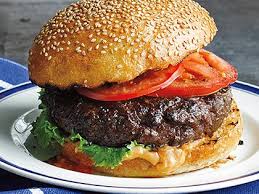
Growing up in the 1980s and 1990s in the United States as brown was different than now. The Indian Americans I knew were a heterodox bunch who, like me, grew up around white people, and habituated themselves to American culture. Though most were Hindu, a fair number enjoyed beef hamburgers, just like other kids.

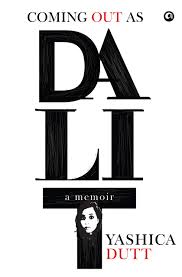
This is why the story of caste discrimination in Silicon Valley is so striking to me. Most of you know already about what is happening with Cisco, but The New York Times covers it well in The Specter of Caste in Silicon Valley. The author of Coming out Dalit, she is herself a Dalit Indian American, and so has a unique perspective.

There is one number which is reported in the piece and aligns with everything I’ve ever seen in the United States of America: 90% of Indian Americans are not lower caste. Of those who are lower caste, whatever that means, I doubt much more than 1% are Dalit. I know this partly because I have a sampling of 300 Indian American genotypes from one of the DTC firms (four parents born in India), and the genetic variation aligns pretty much with the above distribution.

Therefore, I am skeptical of the idea of pervasive caste discrimination because there are just not that many Dalits, period. The last data I have seen shows that 25% of Indian Americans are Brahmin.

That being said since the late 1990s a massive wave of immigrants from India have arrived to work in tech and recreated their home country in the US. When I was in graduate school I met a young woman who was a master’s student with a very mild Indian accent. I asked her when she had arrived from India, and she said that she was born in Cupertino! So it would not surprise me if some people did bring the habits and views of the old country, and without assimilation into diverse workplaces, things such as caste discrimination may occur (I have heard from people that networks of people from the same region and caste are a thing, though not pervasive).

But, I don’t think this will ever be huge in the United States for a simple reason: the number of Indian Americans of 1.5 and 2nd generation who marry within caste/jati is not that high. The last data from the 2010s indicate 35-40% of those born or raised here marry non-Indians. Of the remainder, many of them marry people from other backgrounds than that of their parents. In fact, the majority.

Caste is about pedigree. That is just not maintained in the USA.

Life is a great test

Being Asian American is often about tests. Doing well on tests. That’s what Asian Americans are supposed to do. Two conventionally liberal (“woke”) publications have stories about test-prep, testing, and Asian American academic life.

First, in The Juggernaut, Why Test Scores Can Be a “Proxy for Privilege”. To be franky, I did not like this story, because the conclusions were already there to begin with, and the author was just figuring out how to buttressed the preexistent argument. For example:

Mettu, for example, is well aware of her advantages as the daughter of educated, middle-class Indian immigrants who could invest in her college preparation. She recognizes that few students enjoy such privilege. That is why Mettu sympathizes with efforts at higher education institutions across the country to downplay — or altogether eliminate — test scores as a criterion in admissions. “In terms of equal opportunity,” she said, “it is a good shift.”

That’s the general gist. “Actually, testing is bad for the underprivileged.” Even though standardized testing actually emerged as a way to get around the unfairness of recommendations.

Meanwhile, Refinery29 has a much better story, An Interview with an Asian student at Stuyvestant. Since it’s an interview, most of the talking is given over to the student. That results in more candor and less canned conclusions:

How do students talk about the lack of Black and Latinx students?

When the news came out, it just wasn’t a big thing in Stuy. No one cared about it. We saw it in a random newspaper and everyone was just like, okay. We’re used to places writing about us. I remember one time, one of the chairs broke during one of our theater productions, and that made headlines. Everyone was like why?

Honestly, we were more vocal about school shootings. There was a whole walkout, a lot of us missed class for it, and we went to city hall. We were way more vocal about guns. The reason that Stuy is Stuy is that we’re the smart kids who do well on tests. NYC has LaGuardia, which is for people who are good at dance or music or singing. We have other schools with different talents that anyone else with those talents can get into. I think that’s one of the reasons that everyone in Stuy thinks the SHSAT test should be there, because if the test wasn’t here, what’s the point of Stuy then? What’s the point of even being here?

One thing to note: well-off white New Yorkers send their kids to exclusive private schools like Dalton. Stuyvesant is populated by children of working-class immigrants by and large.

ABCD Politics, Episode 2: Why I Am A Conservative

A new episode of ABCD Politics is out. For those of you who can, can you please subscribe on Apple Podcasts or Google Podcasts. And give us a rating too! Surya has submitted to Stitcher and Spotify, so it will be on those platforms soon too (my experience is that Stitcher approves fast, while Spotify approves slow).

The topic of the second podcast was nominally our own political evolution. It turned out to be mostly about me, and my own “conservatism.” Though Surya has followed my work, after a fashion, for 15 years, my politics are somewhat cryptic to him, so it was a useful exercise in exposition. Surya is a center-Left Democrat and ran as one in 2010. Myself, my own views are a bit more heterodox and difficult to pin down.

A simple way one can summarize my evolution is that I have gone from being a moderate libertarian in the early 2000s to more of a populist conservative in 2020, albeit of a moderate and cosmopolitan personal bent.

But when someone on Twitter asked to summarize my politics recently in five words or less, I said “family first family last.” What did I mean by this?

The issue came up on the podcast because I expressed by “pro-nuclear family” stance as one reason I aligned with the Right and was skeptical of BLM. One of Surya’s correspondents asserted that I didn’t characterize BLM correctly. As it happens, BLM has an “official” website. It has a section on the nuclear family, which I read a while back:

We disrupt the Western-prescribed nuclear family structure requirement by supporting each other as extended families and “villages” that collectively care for one another, especially our children, to the degree that mothers, parents, and children are comfortable.

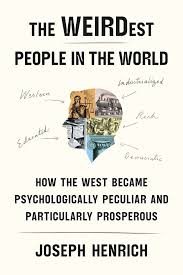
In early September the evolutionary anthropologist Joe Henrich will come out with a book, The WEIRDest People in the World: How the West Became Psychologically Peculiar and Particularly Prosperous. I obtained a review copy, so I will probably post my thoughts closer to the publication date. But, the book outlines a simple and widely discussed thesis: that unique aspects of Western Europe’s kinship and family structure that dates to the period after the fall of the Roman Empire were amenable to the emergence of economically dynamic liberal democratic societies.

The nuclear family is key to that argument. Obviously people can be happy in joint-families, clan compounds, or as part of dense tribal networks. But the nuclear family has some social and cultural consequences which I strongly favor. In the American context, the nuclear family is associated with positive outcomes for children, and a level of material and emotional well-being that many of us aspire to.

This does not mean that those who are not in nuclear families should be ostracized or thought of as second-class citizens. Rather, the idea is that society and politics should have the dominant family structure, the nuclear family, at the heart of its understanding, and that that should shape policy (e.g., tax-credits for having children). My impression and understanding are that the modern Left does not believe this privileging should occur (explicit in the platforms of groups like BLM above). Therefore, I am against the modern Left.


Open Thread – Brown Pundits

The usual. Talk about whatever (that means Pakistan, Islam, and haplogroup H, I guess).

Second, please remember to subscribe to the podcast (see the links for the services). There has been a delay in some episodes for posting show notes.  Also, please post more positive reviews.

Third, this month is a Brown Pundits record for traffic. Indian readers who are new might check out my other blog, Gene Expression. Or, my other podcast, The Insight.

Finally, the comments have been OK despite becoming lively. You don’t have to be inoffensive or polite, but please remember at some point I do intervene.

{{{Brown Pundits}}} 2020 survey results

260 responses so far.

– 95% male

– 55% S. Asian and 35% white

– 50% USA, 25% Asia (mostly India?). A lot of the rest is Europe

– 50% completed postgraduate work

– 35% no religion, 35% Hindu, 20% Christian

– 35% atheist, 25% skeptical of gods, 25% conventional theist

– More Right of Center than Left, but ideologically diverse, with the exception of very few “Far Left” respondents

– Diverse views on Hindu nationalism.

– 40% English speakers (mother tongue). 10% Hindi, 10% Tamil.

– 25% {{{Brahmin}}}. Means nearly half the brown respondents are {{{Brahmin}}}.

– More people come to the side via links from other sites than social media or search engine

Brown Pundits