
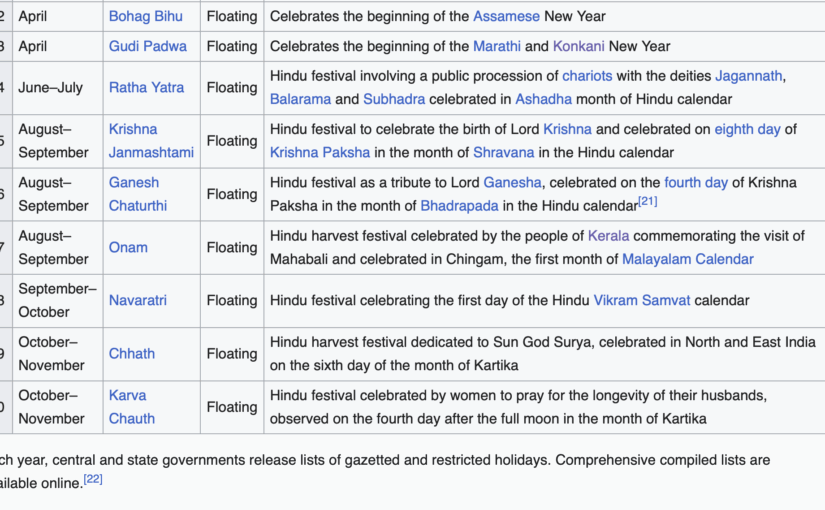
India’s national holidays should reflect its civilisation. They do not. Five Abrahamic festivals sit at the centre of the calendar, while most indigenous ones sit on an “optional” list. This is a distortion, not pluralism.
National holidays are public signals. They show what a country holds to be central. When non-indigenous festivals are guaranteed space and indigenous ones are not, the state sends a clear message: it is unsure of its own foundations.
This was a mistake made at independence. India had full freedom to shape its symbols. Instead of anchoring the calendar in its own tradition, the new state tried to avoid offence. That caution hardened into policy, even though no society builds confidence by sidelining itself.
Other civilisational states do not make this error. China marks its native festivals. Japan marks its own cultural days. Israel marks Jewish time. None of them are theocracies. They simply know who they are.
The present imbalance in India has no honest defence. Abrahamic groups form about 16% of the population yet have five central holidays. Dharmic communities form more than 80%, yet most of their festivals are treated as regional. This is not parity. It is misplaced deference.
The usual objections do not hold. Secularism does not forbid a cultural centre. France and Germany are secular and still observe Christian festivals. Minorities do not become unsafe because the majority marks its own time; every minority in the world lives within a larger cultural frame. Communal tension is not eased by self-erasure. It grows when a society refuses to stand on its own feet.
A simple correction is possible: replace the five Abrahamic national holidays with five major indigenous ones drawn from the optional list—Sankranti, Shivaratri, Holi, Ram Navami, Janmashtami. These are observed across India and carry deep history.
Minority citizens would still observe their festivals as they do in every other secular democracy. What changes is only the state’s signal: India’s identity begins with its own civilisation. Symbols matter. A calendar is not a small thing. It tells a people who they are. India is the last continuous ancient civilisation. Its national calendar should reflect that fact.