
Tarighat, Chattisgarh lies amidst the lush Central Indian forests (Gandhians with Guns territory).
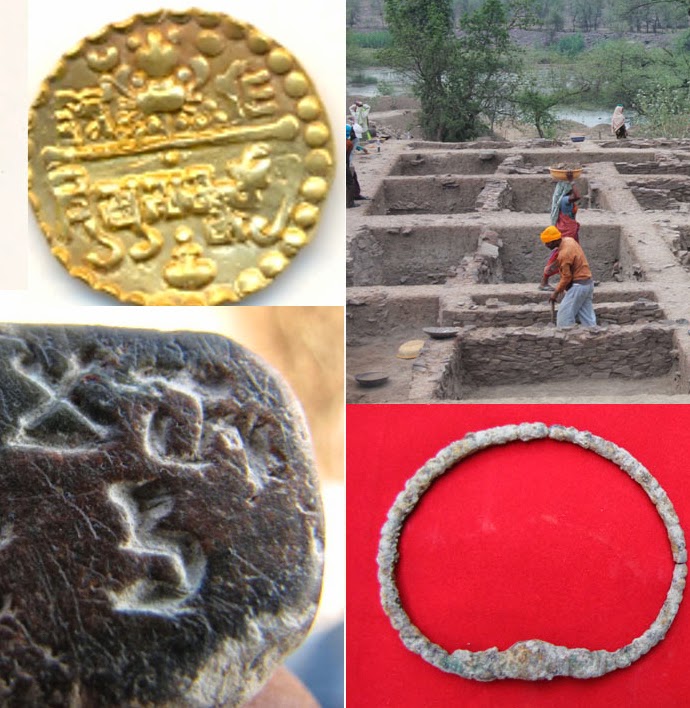
The discoveries were made from Tarighat in Durg district
and spanned five acres of a sparsely inhabited region beside a river,
according to archaeologists from the state’s department of culture and
archaeology.
“As of now, we have four 15ft high mounds around which we
have evidence of pottery, coins and some terracotta figures,” said J.R.
Bhagat, deputy director in the department. “Once we begin, the entire
digging could take at least 5-10 years.”
The 5th and 3rd century BC—to which the Tarighat finds
date—points to a period when the region was ruled by the Kushan and
Satavahana dynasties in central India. While there have been extensive,
previous evidence of urban growth after the first century, such finds
are extremely rare for preceding periods.
“These were among the most interesting times in early
India,” said Abhijit Dandekar, an archaeologist at the Deccan College,
Pune. “It was the end of the period of the 16 mahajanapadas
(loosely translated to great kingdoms) when the Mahabharata was
supposedly set, and the beginning of the Maurya empire. There’s very
little known about urban structures in this period, in regions spanning
modern-day Madhya Pradesh and Chhattisgarh.”
Dandekar, who is not involved in these finds, added that
evidence of towns and urbanization spanning five acres was quite
significant in an Indian context, though only excavations and peer
review would throw true light on the import of these findings.
He added that the excavations at Ahichhatra, near
Bareilly in Uttar Pradesh, that began in 1960s were the most recent
evidence of large-scale town planning in India for a comparable period
and, if the Chattisgarh findings were as extensive, then it would be a
significant find.
“In an Indian context, an excavation has rarely been
disappointing,” said Dandekar. “If you believed there’s a city, it
usually turns out to be one and bigger than what you first expected.”
To be sure, Bhagat clarified that the finds still haven’t
been dated using methods such as radiocarbon or thermoluminescence
dating—modern, established techniques that measure the amount of carbon
or the relative proportions of other elements from which exact ages of
materials are deduced—but he added that the texture of the pots, the
typical pattern of raised mounds etc all pointed to evidence of an urban
agglomeration.
“The kind of pottery called the Red and Black Northern
Pottery, the coins, etc., at the surface of the site itself show very
visible signs of complex urbanization.”
Arun Raj, a Chhattisgarh-based archaeologist with the
Archaeological Survey of India, characterized Chhattisgarh as being an
untapped “gold mine” for archaeology. “We’ve just given them permission for this dig, and I
think it will be some time before we understand how important this is,”
Raj said.
The truly interesting question: is there any demonstrable link with the Indus valley civilization?
……
Explorers claim they have evidence of a 2,500-year-old
planned city—complete with water reservoirs, roads, seals and
coins—buried in Chhattisgarh, a discovery that is being billed as the
nation’s biggest archaeological find in at least half a century.
The discoveries were made from Tarighat in Durg district
and spanned five acres of a sparsely inhabited region beside a river,
according to archaeologists from the state’s department of culture and
archaeology.
“As of now, we have four 15ft high mounds around which we
have evidence of pottery, coins and some terracotta figures,” said J.R.
Bhagat, deputy director in the department. “Once we begin, the entire
digging could take at least 5-10 years.”
The 5th and 3rd century BC—to which the Tarighat finds
date—points to a period when the region was ruled by the Kushan and
Satavahana dynasties in central India. While there have been extensive,
previous evidence of urban growth after the first century, such finds
are extremely rare for preceding periods.
“These were among the most interesting times in early
India,” said Abhijit Dandekar, an archaeologist at the Deccan College,
Pune. “It was the end of the period of the 16 mahajanapadas
(loosely translated to great kingdoms) when the Mahabharata was
supposedly set, and the beginning of the Maurya empire. There’s very
little known about urban structures in this period, in regions spanning
modern-day Madhya Pradesh and Chhattisgarh.”
Dandekar, who is not involved in these finds, added that
evidence of towns and urbanization spanning five acres was quite
significant in an Indian context, though only excavations and peer
review would throw true light on the import of these findings.
He added that the excavations at Ahichhatra, near
Bareilly in Uttar Pradesh, that began in 1960s were the most recent
evidence of large-scale town planning in India for a comparable period
and, if the Chattisgarh findings were as extensive, then it would be a
significant find.
“In an Indian context, an excavation has rarely been
disappointing,” said Dandekar. “If you believed there’s a city, it
usually turns out to be one and bigger than what you first expected.”
To be sure, Bhagat clarified that the finds still haven’t
been dated using methods such as radiocarbon or thermoluminescence
dating—modern, established techniques that measure the amount of carbon
or the relative proportions of other elements from which exact ages of
materials are deduced—but he added that the texture of the pots, the
typical pattern of raised mounds etc all pointed to evidence of an urban
agglomeration.
“The kind of pottery called the Red and Black Northern
Pottery, the coins, etc., at the surface of the site itself show very
visible signs of complex urbanization.”
Arun Raj, a Chhattisgarh-based archaeologist with the
Archaeological Survey of India, characterized Chhattisgarh as being an
untapped “gold mine” for archaeology. “We’ve just given them permission for this dig, and I
think it will be some time before we understand how important this is,”
Raj said.
“But this region, which has been relatively unexplored due to
Naxalite conflict, could throw up several such finds.”
He added that one strand of Indian archaeological
research sought to find common threads urban lifestyle patterns of the
Indus Valley civilization that declined around 1300 BC, to urban
formations in central India. “This may possibly falsify or add more
credibility to such theories,” he said.
research sought to find common threads urban lifestyle patterns of the
Indus Valley civilization that declined around 1300 BC, to urban
formations in central India. “This may possibly falsify or add more
credibility to such theories,” he said.
regards