
Chennai, without any doubt, is one of the better cities in the country. I agree with many of the issues raised by XTM here. Along with Hyderabad, Ahmedabad, and Bangalore, Chennai continues to fare better in many aspects of life compared to Mumbai, Delhi, Kolkata, and even Pune.
My Experience
While I appreciated the cleanliness and infrastructure of Chennai, I cannot say I came away with the same impression as XTM. Of all the Indian cities I have visited, I found Chennai less hospitable than Ahmedabad, Hyderabad, or Delhi. Even as a fluent English speaker, I struggled to hail autos or get directions. Surprisingly, I did not face this issue in the rest of Tamil Nadu. For older Hindi speakers with limited English, the experience is even worse. The issue is not simply language, but linguistic chauvinism (also present in Karnataka and Maharashtra, though to a lesser extent). A non-Tamil speaker often looks for Muslim individuals to ask for help in Chennai.
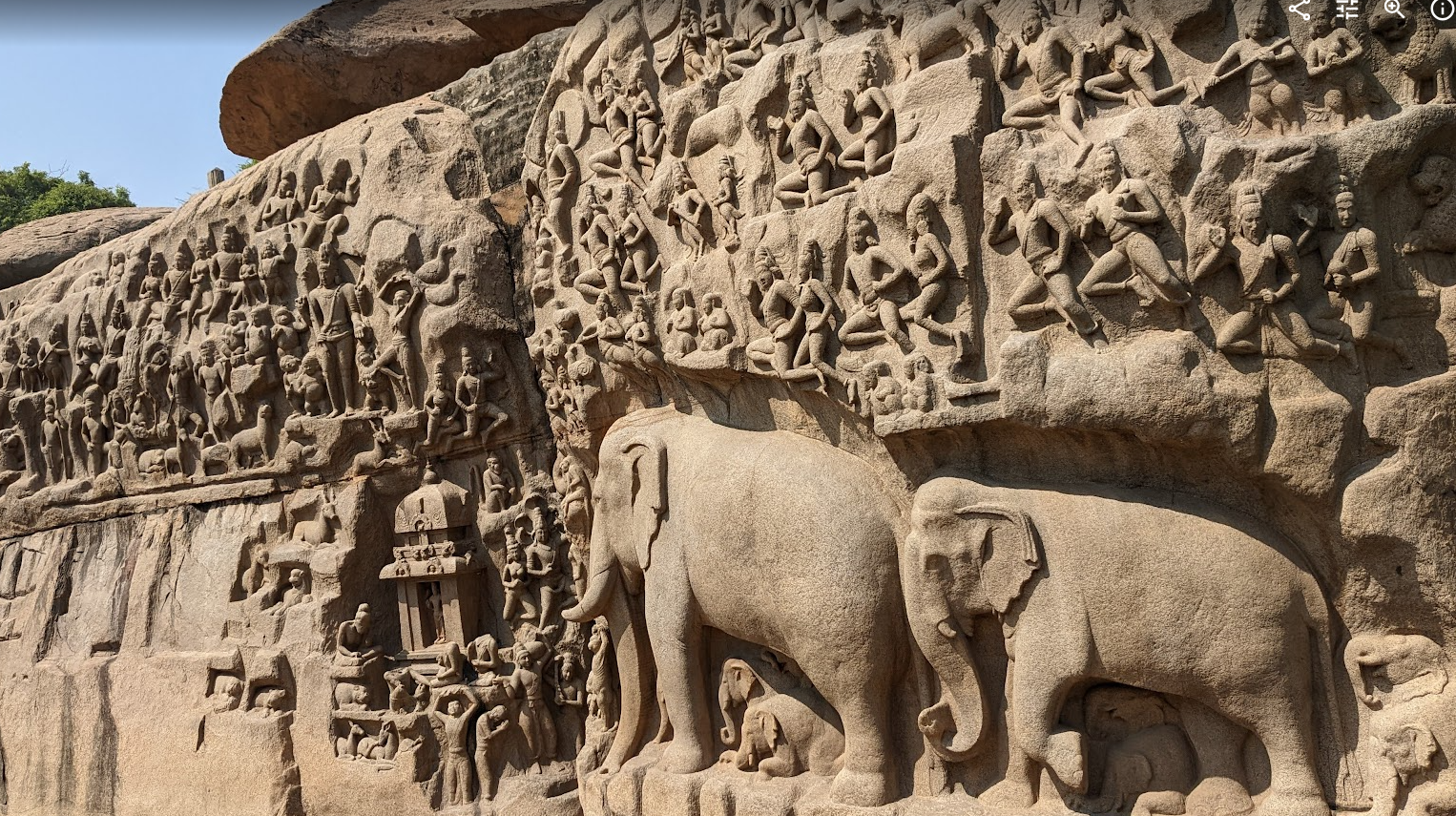
I had a wonderful time in Mamallapuram, enjoying the Pallava ruins and the beach, thanks to a very helpful Muslim auto driver. But enough of auto-wala stories.
Culture and Politics
Without comparing cities directly, it is important to recognize that culture may play a role in Chennai’s successes. However, correlation should not be confused with causation, and credit should not be misplaced. Any link between Chennai’s well-being and Dravidianism is tenuous or purely incidental at best. While successive Tamil Nadu governments aligned with Dravidianism have been relatively successful (especially compared to the North) in providing welfare nets, what direct connection do these well-run policies have with Dravidianism?
Let us compare Tamil Nadu with the rest of India on the metric that Dravidian progressivism claims to address: CASTE
Link:
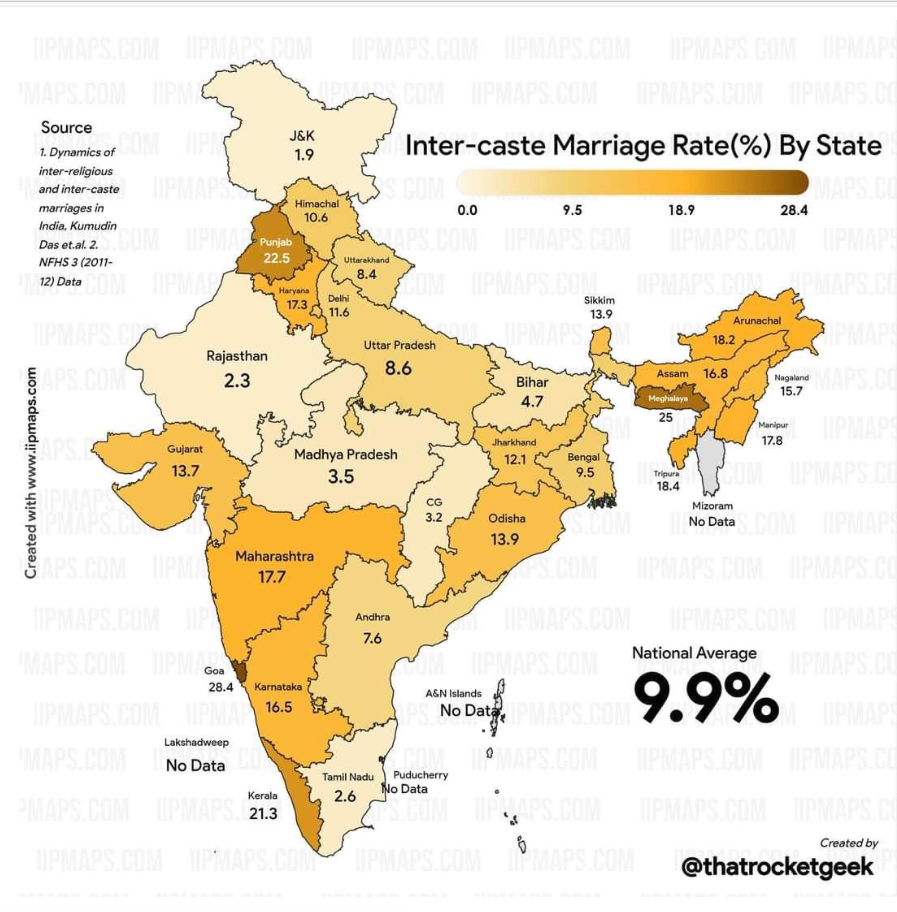
Scroll piece : Caste endogamy is also unaffected by how developed or industrialised a particular state is, even though Indian states differ widely in this aspect. Tamil Nadu, while relatively industrialised, has a caste endogamy rate of 97% while underdeveloped Odisha’s is 88%, as per a study by researchers Kumudini Das, Kailash Chandra Das, Tarun Kumar Roy and Pradeep Kumar Tripathy.
Put differently: caste endogamy seems unaffected by how anti-Brahminical or “progressive” a state claims to be. Tamil Nadu, the heart of the Dravidian movement, remains at below 3%, while Gujarat—often seen as Brahmanical and vegetarian—stands around 10% (15% in a 2010 study, though possibly overstated). However one frames it, Gujarat has more inter-caste marriages than Tamil Nadu.
Surprisingly, even Haryana and Punjab—traditionally associated with Khap Panchayats and honor culture—show significant inter-caste marriages, along with Gujarat, Maharashtra, Karnataka, and Kerala.
While data on Haryana, Punjab, and Goa is contested, Tamil Nadu consistently lags, whereas its neighbor Kerala consistently leads, along with Maharashtra.
Crossing from Kerala into Tamil Nadu, the difference is stark: one in five marriages in Kerala are inter-caste, compared to fewer than one in thirty in Tamil Nadu. Would it be fair to blame Dravidian politics for this? That claim has more merit than attributing Tamil Nadu’s successes to Dravidianism. Tamil Nadu ranks alongside Madhya Pradesh, Rajasthan, and Kashmir, while Karnataka, Kerala, and even Andhra/Telangana are far ahead.
Even Kashmir, with a 65% Muslim population, has an inter-caste marriage rate just below 2%, lower than Dravidian-ruled Tamil Nadu. So, after 500 years under a “casteless” religion and 100 years of “progressive” Dravidianism, both Kashmir and Tamil Nadu lag behind Gujarat, Bihar, and Uttar Pradesh.
Additional Observations
This data does not fit neat narratives. I was surprised to see higher percentages of rural inter-caste marriages. Rates are negatively correlated with wealth and income (more strongly with assets such as land). Landed communities show stronger caste endogamy, for historically and pragmatically clear reasons. That Brahmins, as a group, have the highest inter-caste marriage rates is unsurprising, given how progressive (some might say deracinated) Brahmins have become in India.
One social metric where Tamil Nadu performs well is female foeticide. Tamil Nadu and Kerala are among the leading states less affected by sex-selective abortions compared to the rest of India.
Tamil Brahmins have generally been more socially aloof compared to Brahmins elsewhere in India (both anecdotally and objectively) and disproportionately occupied government posts in the late 19th and early 20th centuries. The Justice Party movement, which arose in response, was initially a elite-feudal project, though Periyar’s early movement (also virulently anti-Brahmin) was more inclusive of Dalits and non-dominant castes. Over time, while retaining its anti-Brahmin rhetoric, the movement became a proxy for domination by landed and wealthy communities. Dravidianism today (or perhaps always) resembles what it claimed to oppose—Brahmanism. The dominant elites have simply shifted from Brahmins and the British to others who hold power today. Hatred alone does not create positive change.
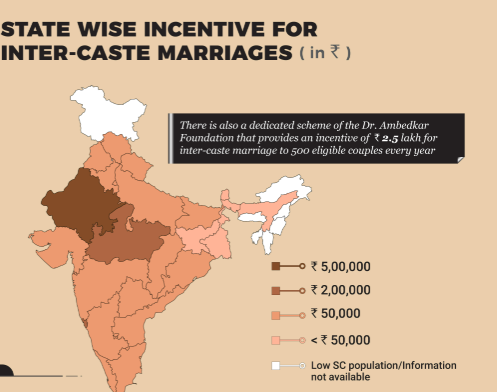
It seems Rajasthan and Madhya Pradesh understood the incentives for reform, while Tamil Nadu did not.
Anecdotes or caste violence are often dismissed when praising the Dravidian model of social progressivism. Comparative caste violence data is brushed aside under claims of underreporting or lack of Dalit assertion in other regions. But caste endogamy cannot be ignored. If anything that truly encapsulates Caste is endogamy.
Post Script:
Tamil politicians, both DMK and AIADMK, have run better governments in terms of welfare, industrialization, and infrastructure, and they deserve credit for that. However, linking these achievements to culture may not be wise. Geography is a more convincing explanation.

A lot of people will point at the persistence of caste identitarianism in TN as a failure. More pragmatically, the dravidianist political intent was that elite non-brahmins are better custodians of wider social prosperity than brahmins or savarnas. The astounding reversal in poverty rate from 1960 to present in erstwhile Madras presidency gives much to consider, but isolating social variables and not overfitting models is difficult in this case.
One of the interesting things about TN is how distributed its development and prosperity is. Unlike many other states, i wouldnt say the “nicest” part of TN is the capital region / Chennai. Kongunad/Coimbatore and South TN/ Tirunelveli are prosperous in ways that greater chennai area is not. These are places that are not part of a port economy necessarily.
More pragmatically, the dravidianist political intent was that elite non-brahmins are better custodians of wider social prosperity than brahmins or savarnas. The astounding reversal in poverty rate from 1960 to present in erstwhile Madras presidency gives much to consider,
So maybe bot so much of a scam
Except the elite non-brahmins aren’t Dalits but Savarnas themselves? What am I missing?
Economic outcomes whether ‘overfitted’ or not, aren’t the focus of the write-up though, no?
This is an excellent piece by Gaurav – I do prefer when a thousand flowers bloom on BP
I can’t comment directly on the post (some glitch on my laptop, which it’s too late to resolve).
Great post but I wonder where the caste intermarriage data is from (does it also measure interrelation)..
I do not think Brahmins are necessarily deracinated but they are the WASPs of India; they are natural vectors for aspirants to intermarry with (they command a premium in the dating-marriage marketplace)..
Yes also my experience in Chennai is coloured by the fact that my FiL’s family are generational Sindhi-Chennaites, so it’s a very very different experience. I don’t experience Chennai as a tourist per se.
So this was great framing and I’m glad to be corrected 🙂
my ex-wife’s mother was a daughter of multi-generational gujarati jain Chennaiites. Unfortunately I did not get an opportunity to visit Chennai yet.
He concludes that TN has made progress due to being “well run” but wants to parse it out from having anything to do with culture, but only geography. I’m not sure geography and culture can be untangled in any meaningful way. It seemed reductive
Also, using intercaste marriage as the benchmark metric for social outcomes is problematic when southern India’s baseline is extreme endogamy, and northern india is the other extreme.
Is that the case versus the extremes on intermarriage?
Geography is more salient than culture. I am not claiming culture is irrelevant but links are often tenuous and played with lot of what ifs.
My pt being if Dravidianism gets credit for success they should get credit for ICM rate too.
I think link either way is overblown
Geography is more salient than culture.
Culture does matter the most, When
a) When people dont want clean up after others it is often culture
Sri Lanka has similar problem. No civic sense. It is turning a corner. The well off (Rotary, Lions) regularly go to depressed areas and clean up. Civic sense by Example
You see this kind of ads regularly
https://www.rotarybatticaloaheritage.com/our-projects/cleanup-sri-lanka-2025-batticaloa-heritage-joins-the-movement-for-a-greener-future
Culture is more salient in stuff like cleanliness and some softer aspects.
But Geography rules when coming to bigger aspects.
North Indian states which are landlocked as considerably disadvantaged (except ones which are connected to NCR.
Even on lower level geography like mountain desert riverine transitions. Topography.
Nature of rivers, deposits – all these matter.
Tamil Nadu is blessed in that aspect compared to even KN and MH.
Both KN and MH have economic powerhouses but disparity in their east west regions is very sharp.
TN doesn’t see that to an extent.
Western 1/3 MH is truly on different league than rest.
Same for Bangalore Mysuru region.
TN has good areas of economic drive naturally spread in diff region which Kerala lacks.
All this is relative though and incremental not final.
TN has good areas of economic drive naturally spread in diff region which Kerala lacks.
I dont know why Indians criticize Kerala. It is clean lot of natural beauty. Like Bali it does not need huge manufacturing or economic drive to have a nice clean life.
It doesn’t if someone does that dirty job.
Its not “Indians” in general to take issue with lack of opportunities in Kerala but Keralites in particular. I changed my opinion after interactions with them.
I dont think Kerala needs to replace current model – just supplement a bit that ought to work
This feels like a problem with the Global South and in particular South Asia; lack of civic identity?
Classmate worked for many years in Botswana and Mali.
They were impressed by Africans sense of cleanliness, specialty in Public Toilets
I found regions of Kenya cleaner than India 10 years back. Infra was also decent
Thats been my observation in the African countries i’ve been to, its cleaner and people are better groomed.
Filthy public spaces are signs of moral failure and have little to do with planning and governance, imo. The foremost symptom of an emasculated culture is the decline of accountability. Indic civilization is a bit “overripe”. The most “civilised” parts of india are the most decadent, the extremities of india are the most well-ordered.
One would probably have similar observations a 100 years ago comparing long civilized Naples to Copenhagen.
public places such as bus terminus and railway stations are becoming bit more clean. b’lore metro is really clean. roads and side walks need more municipal supervision and waste disposal methods improved. ( money is not an issue)
now domestic segregated waste is being collected literally on door steps.
bit more push will be needed. privatisation has helped. more needed.
public toilets needs to be built more and maintained.
Presumably the two interplay with one another..
Also when a state is run by its middle castes, who are broadly representative of the population; it will do better than when it is run by either extreme.
Another thing is that India needs to reconfigure its states; for instance the Madras Presidency should have become Greater Chennai ..
A few key cities, especially the Western derived ones, (Bombay, Madras, Bangalore, Calcutta) should be “liberated” from their states. NCR should be triple its size ..
Also UP/MP/Bihar should be subdivided into smaller linguistic states.
This is all politically impossible of course.
This can’t even happen in Pakistan (Karachi should not be a part of Sindh, the Seraiki belt should be separated from Punjab).
the problem is that, these cities contribute more than 70% of revenue to the state exchequer. hence no one wants to separate them!!
Also Chennai – Madras historically wasn’t so much TN; a bit like Mumbai – Bombay or Karachi even.
These are Anglo cities that then got absorbed by a linguistic state. Even Calcutta-Kolkata eclipsed Dhaka..
The Brits were very focussed on their port cities
great comment – thank you
[…] Dravidian Progressivism is a Scam January 5, 2026 […]