
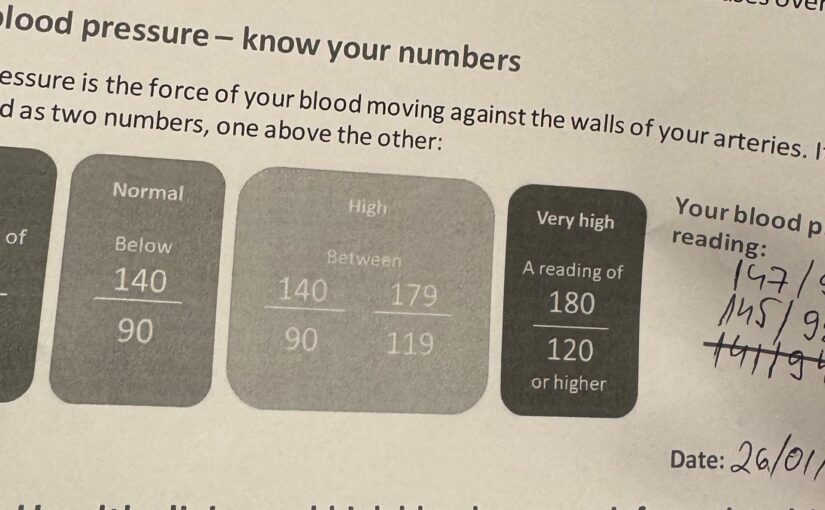
I am forty-one. Five foot ten. Around ninety kilos. My blood pressure is borderline high. My resting heart rate is higher than it should be. A nosebleed and a sustained pulse over 100 were enough to tell me something was off.
Ordinarily, I do my health checks in India each January. Apart from high cholesterol, things usually come back fine. During the pandemic I was very fit. Even as recently as October, I was training regularly and moving well. This is not a story of collapse. It is a story of drift.
My baseline habits are solid. I do not drink. I do not smoke. I eat cleanly and avoid excess sugar and carbohydrates. I carry weight well, but weight is still weight. At forty-one, the body compensates more slowly. Margins narrow.
Borderline Is a Signal
There was a moment of unintended comedy. I mentioned the blood pressure to my friend in Chennai. He listened carefully, nodded, and then said, “Don’t stress about it.” This was, of course, excellent advice delivered at exactly the wrong level of abstraction.
The problem is not ignorance. It is sequencing. When work intensifies, movement slips. Steps fall without notice. Exercise becomes irregular. Food becomes functional rather than intentional. The body absorbs this quietly, until it does not. Borderline blood pressure and an elevated resting heart rate are how it speaks up.
High blood pressure rarely announces itself. It accumulates. A higher resting heart rate reflects sustained stress, poor recovery, or insufficient aerobic conditioning. A nosebleed alone means little. Combined with a pacing heart, it earns attention.
At this stage of life, health cannot sit behind work or projects indefinitely. It has to become a standing priority, not something deferred until there is time. Maintenance now matters more than bursts of optimisation.
This is not about obsession or restriction. It is about realism. The body is no longer infinitely elastic. Sensitivity increases with age. Consistency matters more than intensity.
For 2026, the adjustment is simple. Movement becomes non-negotiable. Baseline cardio returns. Daily steps matter again. Weight needs to trend down, even modestly. Stress requires deliberate outlets rather than assumed dissipation. Borderline is not failure. It is feedback. And it is the moment to act.
I’m approximately the same age and height as you. I’m about 71 kgs. This is probably the lowest my weight has been since I was a teen. I go the gym five days a week.
Just about two years ago, my weight was over 80 kgs. This was when I was living in New York and largely getting food delivered.
More than exercise, the deciding factor is diet. My mother has recently completed a fellowship in Integrative Medicine from the Andrew Weil Center at the University of Arizona. Since the pandemic, our household has been doing intermittent fasting. We eat our first meal around noon and our second meal at around 5 PM. After that, there is no eating until the next day.
My mother has changed her entire medical practice to focus on patients with metabolic problems. She argues that the entire medical system operates on the wrong model. Doctors only see patients after the patient is already ill and then they only provide symptomatic treatment (for example: insulin). Instead, doctors should be aiming to change people’s behavior such that diabetes etc don’t develop. Her patients regularly get their blood tests done and she calculates their insulin resistance. It’s a topic of regular discussion in our family.
Very well said.
This is the biggest health crisis coming in subcontinent I think – people who appear thin also tend to carry a lot of insulin resistance.
Some scientists says it’s the British Era famines but dunno if that has got any merit.
The whole medical model operates on patients becoming sicker and doctors increasing their medicine.
Diabetes is very common in Pakistan. So much so that people don’t even really treat it as a disease.
If people take care of themselves in their twenties and thirties, they can generally avoid a lot of lifestyle illnesses.
Update on the BP; went to the doc this am everything checked out normal textbook.
As I have heart disease in the desi side of the family I’m going to have bloods done for cholesterol.
You should look into getting a CCTA scan done. Also advanced lipid testing – not just LDL but LDL-P and oxidized LDL.
Till age 30 I was about 110 lbs (5′ 4″” short). Then when in US ballooned to 195lbs. Must have been the almost daily beer. Now that I have been back in SL down to about 150 lbs.
I have been a smoker and boozer since the age 14.
Above average athletic ability, but no discipline to make it to a school team. Rugger or Swimming, never liked Cricket.
No discipline to exercise. Not a big eater either..
Past teens and when I entered Uni had become a Binge drinker. Minimum 350ml of hard liquor or more. Three 20 packs of cigarettes funded by my giving tuition.
My heavy boozer friends dead by age 40.
The last couple of years my clean living classmates are dying.
Given my Lifestyle I too should be dead.
Still standing at 67 dont know why. Genetics?. Diabetic the last 7 years or so (under control). I don’t do health checkups or visit doctors if I can help it
stay healthy
So may be I have long life genes. Irish Genes? Irish men who are heavy drinkers have life expectancy of 81 years. 2 years higher than OECd average
A new study, published Thursday in the journal Science, has challenged that idea. A team from Israel’s Weizmann Institute of Science, turning to mathematical modeling and data pulled from twin and sibling studies, came up with a surprising new estimate that heritability contributes more than 50% of our lifespan.
Maybe mixed genetics are good.
Another lottery from genetics.
I have 2% SE Asian genes. And my sweat does not smell even though overweight and sweat a lot. (rs17822931 TT)
On the other hand my sister is more hairy than me and smells horribly even after a shower.
I was very fit during the pandemic and I do train when I can but just not enough.
Ur mother’s views are really interesting!!
I think more than exercise, the main thing is diet.
I remember when we first started doing intermittent fasting (maybe five years ago), I was very unhappy about not having breakfast soon after waking up. I thought there was no way I could exercise before breakfast. Now, I have no issues doing an entire workout after drinking green tea and then coming back home and having breakfast.
Somehow we have all been enculturated into thinking that we need to eat three times a day (breakfast, lunch, dinner). There is nothing inherently natural about this.
Do look up integrative medicine if you’re interested.
Yes I don’t eat three times a day but tend to do two .. brunch and dinner
Take care of your health.I heard they have changed the reference normal range for BP. But either way not a bad thing of take care of health even otherwise and try to avoid getting on to the lifelong pill train.