
Running a platform is not the same as winning an argument. It is about tone, trajectory, and whether the conversation rises or sinks. I edit out BB’s comments not because I fear disagreement, and not because I am fragile about India or Pakistan. I edit them because they are crude. Crudeness is not courage.
Between Critique and Provocation
There is a difference between sharp critique and coarse provocation. Kabir and I disagree deeply about India. He defends the fake term “South Asia” as necessary. It’s a neocolonialist invention designed to dissolve the world’s oldest and most prominent civilisation (the Indian Subcontinent) into a compass direction. We argue. We contest premises. We clash over legitimacy, sovereignty, and naming. But the disagreement is structured. It is intelligible. It is civil. It forces clarity.
BB’s interventions, by contrast, tend to flatten everything into sneer and insinuation. That degrades the space. A forum that tolerates permanent coarseness slowly becomes defined by it. Readers do not return for noise. They return for thought. There are, to be fair, strong exceptions; for instance when he analysed the cricketing economy to illustrate how much weaker the Pakistani consumer-tax base is compared to its Indian counterpart.
Japan & Germany wake up
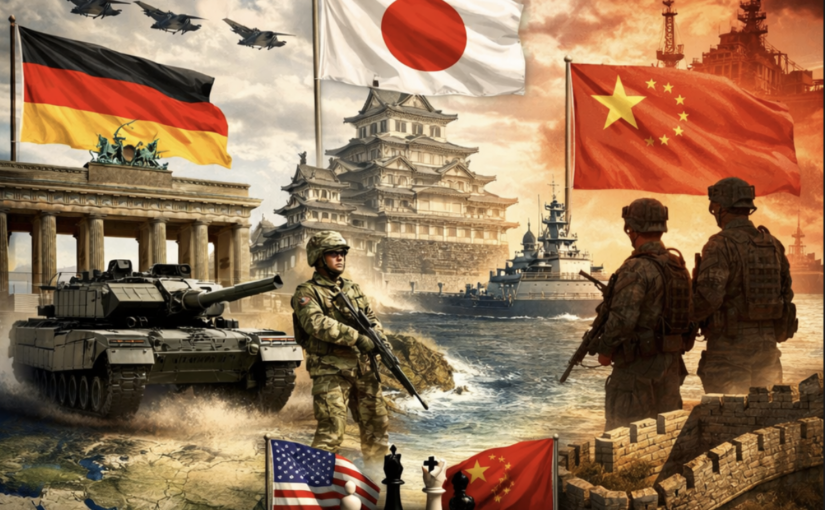
The world is changing fast. Germany is rearming. Japan is debating immigration and identity in ways unthinkable a decade ago. Former defeated powers are recalibrating. The global order is shifting from American unipolarity to something colder and more transactional. In such a moment, analysis must be disciplined.
Sinopac is real
Pakistan is not optimising itself. That is obvious. Its institutions are uneven. Its economy is fragile. But it is functional. It survives shocks that would break smaller states. Sinopac alignment is not a fantasy; it is structural. China will not permit state collapse on its western corridor. The catastrophe of 1971 was exceptional: civil war, Indian intervention, and a superpower moment that does not replicate easily. History rhymes, but it does not photocopy.
Since the fall of the Soviet Union, only one UN-recognized state has actually broken apart: Sudan in 2011. State dissolution is the exception, not the rule.
The World can change in a blink of an eye
To analyse such matters requires sobriety. It requires recognising that post-war Germany and Japan were once broken states and are now pivot points in a new balance. It requires admitting that India’s civilisational coherence predates 1947 while also acknowledging that Pakistan’s sovereignty is not negated by that fact.
Brown Pundits must remain a place where difficult claims are made carefully and precisely. Where India can be defended without derision. Where Pakistan can be criticised without mockery. It requires resisting the temptation to reduce everything to insult.
apart from sudan, indonesia was broken, now ukraine, in future russian speaking enclaves of maldova, georgia etc. armenia was broken.,,,,,
Sudan broke because it was an artificial colonial weld with no cohesive centre and decades of internal war. Indonesia nearly broke, but the core Javanese state held and re-consolidated. Ukraine is under external invasion, not spontaneously dissolving. Moldova and Georgia face frozen conflicts precisely because Russia intervenes. Armenia was broken by war, not internal incoherence alone..
the pattern is not “multiethnic states collapse.” the pattern is weak institutions plus violent external pressure. states survive when they retain a functioning centre, fiscal capacity, and a security guarantor. they break when those fail simultaneously.
Indonesia did break. East Timor is now an independent country.
Didn’t Yugoslavia break up post the fall of the USSR?
But your larger point is well taken. State dissolution is the exception not the norm. The entire international system is based on the territorial integrity of nation-states.
South Sudan is the only state break up this century. These are very rare events since it requires State validation.
Most states are anyway multi-ethnic entities so recognising a breakaway states invariably invites scrutiny.
East Timor was not a Dutch colony. It was a Portuguese one. So, one can say the union was an artificial one.
Thank you.
I am not really bothered by people disagreeing with me. This forum is dominated by Indian nationalists. Obviously, their premises are different from those of a Pakistani nationalist. That’s fine.
But fantasies about the breakup of Pakistan are extremely triggering. As I’m sure fantasies of the breakup of India are for Indian nationalists. I will clarify that Kashmir is a Disputed Territory. I’ve never fantasized about the breakup of any part of “India Proper”.
It’s also important to note that Pakistan actually did break in 1971–in large part due to India’s intervention. The Republic of India has not suffered a loss of territorial integrity since its creation in 1947.
The territorial integrity of Pakistan is a red line for me as is equating the Pakistan Army with Nazis.
Anything else is fine.
I don’t think BP is dominated by anyone; it’s also that you are intent to pushing back on every opinion.
There are far more Indian nationalists on this forum than Pakistani nationalists.
I wrote a few months back about BP being a “soft Hindutva” platform. I’m not going to rehash that here.
I have to push back when Pakistan is attacked. Also when I’m attacked personally. And I have experienced vile homophobia, transphobia, and Islamophobia here. I don’t think there is another single person who is bullied quite as much as I have been. And I have learned in my life not to concede any ground to bullies.
I don’t really care that much about people’s opinions on non Pakistan related topics.
Where did he say that?
did he make the comment or not
I have no need to make any comments under anonymous accounts.
I have a long history on this forum. You know that I have never made any comments about skin color. It’s not an issue that I have any interest in.
If I were dark skinned, I would accept it as a fact of life.
Constantly making this accusation is slander.
Did you or did you not use the word “taqqiya”? It is incredibly offensive to use this word against a Muslim.
I have no need to use anonymous accounts. And frankly, I have no interested in skin color whatsoever. This is slander.
Kabir this is XTM – don’t threaten unnecessarily please
Why is RNJ allowed to threaten taking Pakistani territory along the LOC?
Threats to the territorial integrity of the Islamic Republic of Pakistan are a red line. We will respond in the strongest terms.
Kabir I just read the comment; he did no such thing. It was actually a thoughtful and intelligent comment by RNJ. Are the Commentariat just expected to agree to everything and not dissent or have independent opinions??!?!!
Kabir there is no point policing everything. This is RNJ’s comment in full. Maybe the “this time” is a little much; but Sharda Peeth is a Hindu Holy monument, Lord Shiva’s sacred remains, I can imagine why people may want it to be in Bharat? Something’s are more sacred than states.
If the Hazratbal Mosque was on the IndoPak border it would make sense that it should be in Pakistan just as Golden Temple went to India.
>Sinopac alignment is not a fantasy; it is structural. China will not permit state collapse on its western corridor. This is very true. Even during the short sharp skirmish of Op Sindoor, The CCP took a vocal public stance indicating it would wade in if the conflict started involving any threat to “Pakistan’s territorial integrity”. Now I doubt whether they would have put their money behind this in the case of minor alterations along the LoC – many an Indian RW-er had started fantasizing about grabbing a couple of kilometers along the line to ‘bring ShardaPeeth home”. But the Indian investment in the ….borderization of the LoC meant that this sort of thing was never going to be on the objectives list. This time.
What do the words “This time” mean?
That is a threat to the territorial integrity of Pakistan.
No one is expected to agree to everything. But threats to the territorial integrity of the Islamic Republic of Pakistan are not on.
I can also make threats to the territorial integrity of India. But you would immediately delete those.
“Maybe the “this time is a little much”–
I am sorry. That was a threat to the territorial integrity of the Islamic Republic of Pakistan. I do not tolerate that.
“Some things are more sacred than states”– Nothing is above the territorial integrity of the Islamic Republic of Pakistan.
Don’t worship the Nation, Kabir
Territorial integrity of nation-states is a red line.
Kartarpur sahab is in Pakistan. We gave Sikhs a visa free corridor.
Tone it down Kabir..
Why is it OK to contemplate taking land away from Pakistan?
I don’t think you would take kindly to people contemplating taking land away from India?
Kabir stop weaponising and policing constantly. It gets tiring otherwise I’ll stop moderating the threads ..
It’s a serious question. Would you tolerate discussion of adjusting India’s borders? Not that the LOC is a border. It is a ceasefire line.
In the end it’s your blog. You can even get rid of me entirely. I won’t complain.
But the territorial integrity of Pakistan is a red line.
The world is changing fast. Germany is rearming.
Can Germany fight a war, specially an invasion. The minority population/immigrant population is 20%
The question is whether US. UK and Western Europe are socially cohesive because of large (over 15%) Immigrant groups.
Meanwhile F-35 is being delivered without Radar
F-35 faces a significant REE supply chain vulnerability, largely stemming from its reliance on Chinese-produced, high-strength permanent magnets for its radar, electric motors, and electronic warfare systems. With over 900 lbs of REE used in each jet—particularly in the AN/APG-81
Kathleen Tyson says on X
And so was I in saying in April 2025 that China’ ban on Rare Earth Element export for military use will export global peace by denying the war addicted West the materiel for war.
https://x.com/DragonWong2024/status/2021504508275429647?
I think there is nothing wrong in the term “South Asia”. India is a member of SAARC which meant Indian policy makers recognised this term
Thank you.
“South Asia” is a geopolitical term while “Indian subcontinent” is a geographical one. They both have uses in certain contexts. One term is not meant to erase the other.
You may be interested in an essay I wrote on this topic:
https://kabiraltaf.substack.com/p/in-defense-of-south-asia