Moves in the Glass Bead Game

I came across two images recently which seemed closely parallel, and yet distinctly different.

When I saw this image:
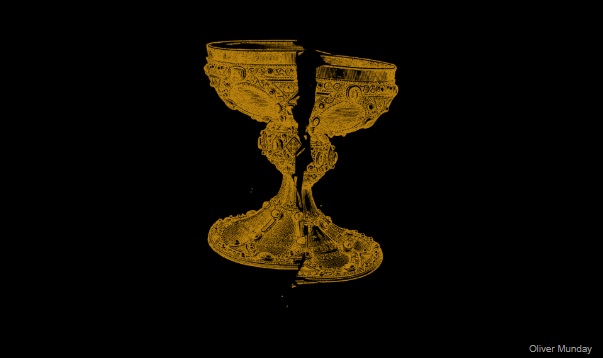
it immediately reminded me of this one, which I’d seen a few hours earlier:
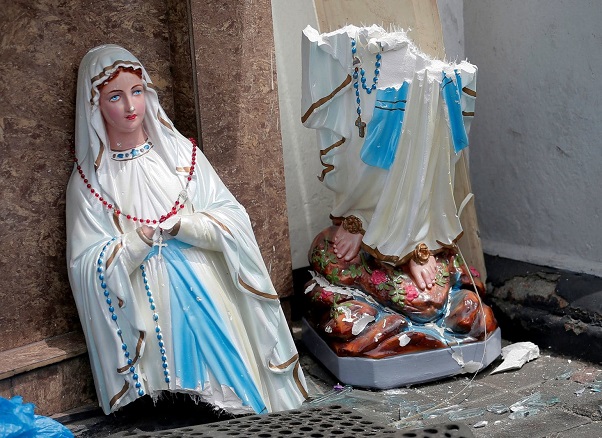
That’s the first clue as to how to play the Glass Bead Game: it’s as simple as this reminded me of that.

**

The two images are very different, yet very similar.

Each is an image with a strong Catholic resonance — one image is of a statue of the Virgin Mary, mother of Jesus, the other is an image of a chalice, the cup which Jesus passed to his followers on the night before his crucifixion, and which Christians to this day drink in their various communion services, remembering him.

And both images are very visibly shattered — the shattered statue representing the devastating impact of jihadist suicide-bomber attacks on churches across Sri Lanka, the shattered chalice representing the Catholic Church, “broken” by priestly sexual abuses, and in urgent need of reformation.

In playing Hesse’s Glass Bead Game, at least in the variants that I have devised and which I call the HipBone family of games, the move from one of those images to the other is a move. And the nature of the move is their resemblance across a cognitive distance.

**

Hesse’s book was written in 1943, a time when elite thinkers — and Hesse was certainly elite — were more comfortable than we are today with sheer erudition — and he gives as an example of a move in the game, a player who had been studying —

…the rhythmic structure of Julius Caesar’s Latin and discovered the most striking congruences with the results of well-known studies of the intervals in Byzantine hymns…

— and here’s another move for you, one of my own. Little did Hesse know it, but I myself was studying up on Church music one day, and dis=covered a book by a nun, Jane-Marie Luecke OSB, entitled:

Measuring Old English Rhythm: an Application of the Principles of Gregorian Chant Rhythm to the Meter of Beowulf

Not only is Sister Jane-Marie’s book itself a monograph length move, buy my association of Hesse’s move in his book and the good Sister’s monograph — one reminded me of the other — is also a move, and a most fortuitous one, starting in the pages of the book I devoted ten or more years of my life to, and ending in a discovery in an area of my own scholarly interest — and now, in my proud ownership of Sister Jane-Marie’s slim blue volume.

**

Remember, mnthe scope of the game allows moves to be made from the whole range of human intellectual production:

The Glass Bead Game is thus a mode of playing with the total contents and values of our culture; it plays with them as, say, in the great age of the arts a painter might have played with the colors on his palette. All the insights, noble thoughts, and works of art that the human race has produced in its creative eras, all that subsequent periods of scholarly study have reduced to concepts and converted into intellectual values the Glass Bead Game player plays like the organist on an organ. And this organ has attained an almost unimaginable perfection; its manuals and pedals range over the entire intellectual cosmos; its stops are almost beyond number. Theoretically this instrument is capable of reproducing in the Game the entire intellectual content of the universe.

If you can think it, imagine it, jot it down, sketch it, hum it, or represent it as an equation, you can make a move of it, linking it to some other move already in play, or proposing it for others to link to.

**

Music is notated in a score, and in the music of ideas which Hesse’s game proposes and my HipBone Games attempt to make playable, my suggestion is to notate such moves as simple graphs — in the form of two named nodes with an edge connecting them.

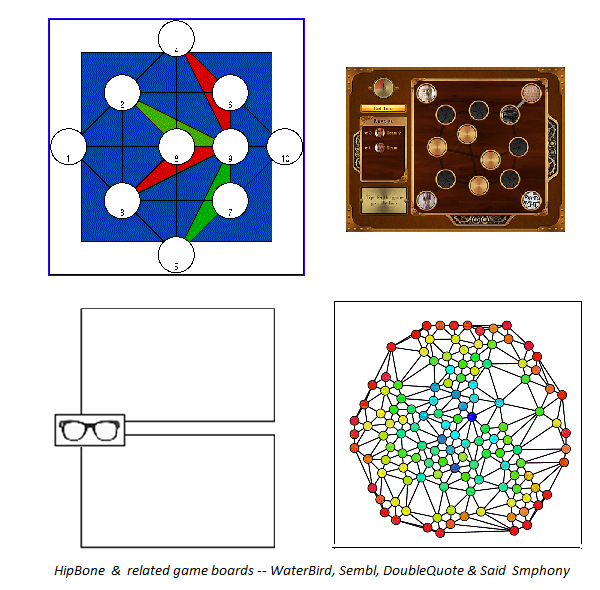
Here’s a board I’ve devised to allow you to notate a move with two concepts and a linkage between them. I call it my DoubleQuotes Board, and it represents the smallest board on which a HipBone Game can be played — either solo or with a friend:
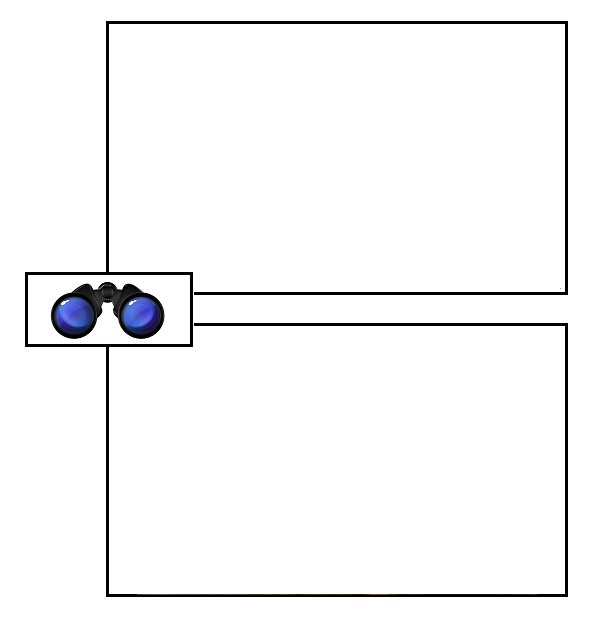
You can then assign your move to to a node in your game, and link it to another in a way that is rich in content at both ends, and which features rich connections between them, across some conceptual distance — perhaps across distinctly separate disciplines.

Here’s a DoubleQuote between Theodor von Kármán’s Vortex Street, and Van Gogh’s painting of the night sky:
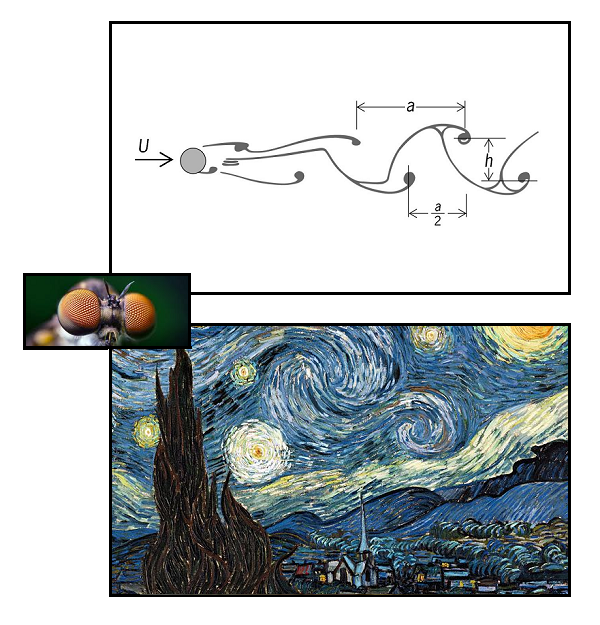
From the dynamics of flow nto post-impressionist modern art — that’s quite a leap! And yet the two are so close, they might as well be twins!

**

So — the challenge:

What memory-leap — what associative leap, what creative leap can you come up with that most neatly and beautifully links two conceptually distant but richly associated concepts? If you feel like it, you can identify them in the Comments section, or email me at my gmail address — my handle there is hipbonegamer.
You’ll be playing one of my playable variants of Hermann Hesse’s Nobel-winning Glass Bead Game. And if you have the skill-set to drop your move onto my DoubleQuote board and post it, so much the better.

Here’s that game board again:

**

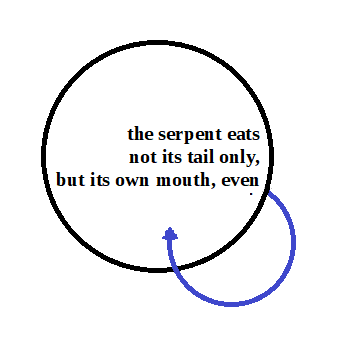
Oh, and for Ali Minai in particular, given that self-referential paradox must be an issue in AGI — here’s a board for the self-referential one-move game, with one of my poems in it:
Wanna try?
**

Enough — until next time..
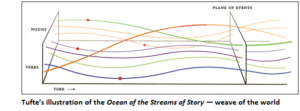
Contemplating the weave of the world

    [ exploring various versions of how the world of concepts can itself be conceptualized ]

.

**

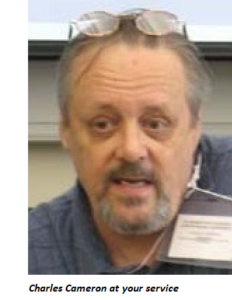
Have patience with me: Omar Ali has invited me to post here, an honor I greatly appreciate, and I am introducing myself.

I’m an outsider. I’m your guest, and I only just arrived.. To be precise, I’m a Brit, resident in the United States:

If I’m to write on BrownPundits, I need to you know how ignorant I am in many respects, before I shed some of what knowledge I do possess — and also to focus myself in the Brown direction, because this place is devoted to “a discussion of things brown” — and while I’ll no doubt wander far afield as I post, I want to acknowledge and honor the purpose of this blog as I introduce myself here.

**

My interest, my fascination, my obsession even, is with the weave of the world. And indeed, if my friends Omar Ali, Ali Minai, and Hasan Asif can be any indication, the Punditry of Brown extends intellectually across all of history, geography and genius, to encompass the world of ideas and the world world to which the ideas refer in their combined entirety..

And thus the weave of the thing. That’s how the Kathasaritsagara, or Ocean of the Streams of Story, comes in to my story. Somadeva Bhatta’s concept of the oceanic streams of story caught Salman Rushdie’s eye, and Rushdie reference to it —

He looked into the water and saw that it was made up of a thousand thousand thousand and one different currents, each one a different colour, weaving in and out of one another like a liquid tapestry of breathtaking complexity; and Iff explained that these were the Streams of Story, that each coloured strand represented and contained a single tale. Different parts of the Ocean contained different sorts of stories, and as all the stories that had ever been told and many that were still in the process of being invented could be found here, the Ocean of the Streams of Story was in fact the biggest library in the universe. And because the stories were held here in fluid form, they retained the ability to change, to become new versions of themselves, to join up with other stories and so become yet other stories; so that unlike a library of books, the Ocean of the Streams of Story was much more than a storeroom of yarns. It was not dead, but alive.

— it’s a universal mapping of the sort that enchants the likes of Jorge Luis Borges and Umberto Eco, librarians both, encompassing the realm of human thought in narrative terms. And it’s one subcontinewntal form of the universal map, or model, or metaphor — the Net of Indra in the Avataṃsaka Sutra would be another.

Outside the subcontinent — but well within the compass of Brown Punditry– there are other such metaphors for the whole of the whole. Teilhard de Chardin’s oosphere is another, as is Sir Tim Berners-Lee’s >World Wide Web, in which complex weave of thoughts we now find ourselves.

But for my own purposes, the most interesting figure of the whole, the universe as we are able to think and name it, conceptually speaking, is the Glass Bead Game as described by Hermann Hesse in his Nobel-winning novel of that name

**

My own personal predilections run from cultural anthropology through comparative religion to depth psychology, and from violence to peace-making. But that’s a huge sprawl at best, and to bring all that into some kind of focus, to learn how to map that immense territory, and the vaster universe beyond it, I turn not just to strong>Hesse’s novel, but particularly to the Game which he describes in that book:

The Glass Bead Game is thus a mode of playing with the total contents and values of our culture; it plays with them as, say, in the great age of the arts a painter might have played with the colors on his palette. All the insights, noble thoughts, and works of art that the human race has produced in its creative eras, all that subsequent periods of scholarly study have reduced to concepts and converted into intellectual values the Glass Bead Game player plays like the organist on an organ. And this organ has attained an almost unimaginable perfection; its manuals and pedals range over the entire intellectual cosmos; its stops are almost beyond number. Theoretically this instrument is capable of reproducing in the Game the entire intellectual content of the universe.

You’ll see how that description covers much the same ground as Rushdie’s description of the Kathasaritsagara, and Edward Tufte’s image of the Ocean of Story which I’ve placed at the top of this post could also be a depiction of Hesse’s great Game.

There are many voices in the Ocean, and many voices in the Game, and they are interwoven: they form which a musician would recognize as a polyphony — their concepts and narratives at times clashing as in musical counterpoint, at times resolving, at least temporarily, in a refreshing harmony.

And what better model of the world can we contemplate at this moment, that one in which a multitude of at times discordant voices wind their ways to concord?

**


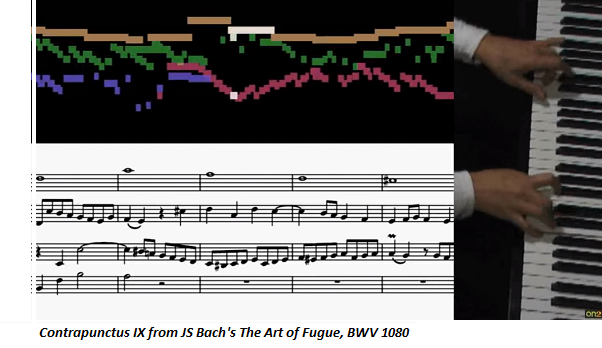
[ above: conventional score, bar-graph score and keyboard recordings of JS Bach, contrapunctus ix

Johann Sebastian Bach is the master of contrapuntal music, and, be it noted, a great composer for and improviser on the organ. And it is Bach whose music I listen to as I approach the business of modeling the world of ideas.

My mantram ca 1999/2000 was:<To hold the mind of Bach..

Where Bach devises and holds in mind melodies that collide and cohere, I want us to hold thoughts in mind — at times clashing thoughts — and learn to weave them into a coherent whole..

That’s my approach to making the Glass Bead Game which Hesse conceptualized, playable. And my playable variants on Hesse’s Game, the HipBone family of games, will be the topic of my next few posts — thanks to the kind inquiries of my BrownPundit friends, and Omar’s generous invitation to me to post here.

And perhaps, if you’re interested, we’ll play a few rounds of my games, or explore across the world of ideas and your and my interests, what I’ve come to think of as the HipBone style of thinking..

___________________________________________________

Charles Cameron is a poet and game designer, managing editor of the Zenpundit blog, and now an invited guest at BrownPundits. You can hear a discussion of the overlap between the Glass Bead Game and Artificial Intelligence featuring Omar Ali, Ali Minai and myself on this BrownPundits podcast — with an appreciative bow to Razib Khan.

Brown Pundits