Islam is not a race

Update: A reader points out my example may not indicate what I assumed. Another reason why Twitter sucks: easy to misunderstand. The general point though stands.

End update

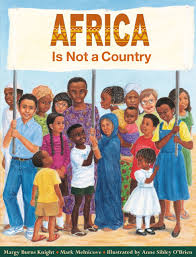
Over the past generation or so there has been a meme, “Africa Is Not a Country”, which reflects the reality that many well-meaning people don’t know much about Africa, to the point where they confuse a diverse continent for a country.

There is a similar reflex though which to me is redolent of the same intuitions and confusions: making Islam into a racial identity. This is particularly common among two groups:

– the type of people who have Greek statue images in their Twitter profiles

– the type of people who have pink-hair avatars and rainbows flags in their Twitter profiles

I won’t say much about the former.

But the latter is interesting and curious to me personally. Many in my immediate family are Muslims (e.g, parents, the vast majority of my cousins). I come from a line of ulems and Sufi mystics.Ā  The law of the Hanafi tradition is deeply embedded in my family’s culture. Though never a big believer myself in the religion, I had a vaguely Muslim identity until my tweens, and know a bit about the religion intellectually.

To illustrate the phenomenon I’m talking about, recently an Asian American comedian made fun of Catholicism in a sacrilegious manner (I didn’t think it as very funny since it was derivative and unoriginal). In response, some people asked him to insult Islam. To this, he said ā€œhow bout you make fun of ISLAM?ā€ (yikes) to straight up rampant racism (yikes).

In other words, engaging in blasphemy against Islam is racism to him (which is blasphemy to a progressive).

It has gotten to the point where progressives have accused me of being an anti-Muslim racist when I suggest that many Muslims are Creationists. Progressives are of course being stupid but note these progressives are often white secular types who in their lives don’t encounter believing Muslims. They have the idea of what Muslims represent to them. It’s about them, not Muslims.

Perhaps others have different experiences, but the way I was raised as a Muslim, the idea that Muslims are a race would be deeply offensive since Islam was presented as the most antiracist and egalitarian of religions. Believing Muslims assert they have a deep connection to the Ground of all Being, not that they are a corporeal identity-group. In contrast, many secular progressives are taking the far-right racialization of Muslims and enshrining it into their understanding of the religion, so that Islam, the belief-system, becomes a “protected class.”

Of course, the reality of what Muslims believe and how they live their life might not comport with progressive expectations, which seem to involve someone just like them, but with a headscarf on. From the perspective of an Islam-skeptic person though the lesson is clear: Islam is now the progressive party at prayer. Though real Muslims often have major issues with progressives and their modern cultural projects, progressives have embraced their idea of Islam and Muslims in the fight against the Greek statue profiles.

We live in a really strange world.

Addendum: As an atheist from a Muslim background I have looked dimly upon Muslims and the Islamic project for much of my life. But progressive revolutionary rhetoric and action have softened my heart toward the religion and the people. It turns out that religion is not the root of all evil.

Hindu nationalism amongst the nationalisms

Much of the discussion over the last few weeks on this weblog (see “Open Thread”) has involved the internal politics of India, and its clearer trajectory in regards to a Hindu sense of self. Most of the comments are not really worth reading, as they repeat platitudes. I have said little because I know very little which would add much to the discussion.

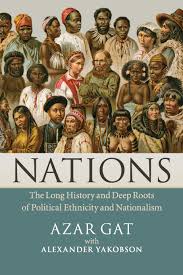
That being said, let me take a break from pre-Christmas activities, and just express the framework or “filter” which I use to understand what’s going on in India (and elsewhere) today. I am not someone who believes that to understand modern social-political ideologies in post-colonial nations all you need to do is understand the colonial experience. On the contrary, I lean toward the position that many national identities have deep roots and histories (e.g., China, Iran, and England, to name three). For more on this perspective, see Azar Gat’s Nations.

But, neither is it true colonial, Western, and international, currents are irrelevant in understanding notionally primal and indigenous nationalists and pan-nationalisms. To give three examples. Chinese nationalism in the early 20th-century explicitly looked to the West, and east toward the success of Japan, in attempting to create a post-imperial identity. Iran in the early 20th-century coalesced around a resurgent Persian national identity in a multi-ethnic society which had heretofore been bound together by Shia Islam (imposed on Iran by Turkic Safavids in the 16th and 17-century). Finally, the emergence of the German nation-state under the Kleindeutschland vision is hard to understand without the French Revolution, and the shock it imposed on German elites, and in particular the Prussians.

These three instances are clear, distinct, and organic nationalisms. In many ways, elements and configurations of these nationalisms were preexistent to the 19th/20th-century variety. The Safavid state under Shah Abbas I to me served as a template for the Pahlavi project. There were inchoate elements of German nationalism in various polities of the Holy Roman Empire, in particular in the Habsburg domains, where aristocratic cosmopolitanism was always balanced with the hegemony of German culture around Vienna. Finally, the imperial Chinese state in various forms was already proto-modern quite early. I would emphasize the Northern Song period, around 1000 A.D.

But there are other nationalisms developed in the 20th-century which created something de novo in a very real sense. Kemal Ataturk attempted to fashion a form of Turkish post-Ottoman identity explicitly modeled on a Western European template. Though Ottoman Turks did have an ethnic identity, and some level of ethnic chauvinism, the reality is that the Ottoman identity was primarily one of religion. Modern Turkish is written in a Roman alphabet. This means that modern Turks are detached psychologically from the literature of the Ottoman period, which is written in Arabic script. This was clearly a conscious attempt by Ataturk to fashion something new and unmoored from the past.

Even more nebulously, Pan-Turkism and Pan-Arabism appealed to an ethnonationalism more organically suited to the European context and history.Ā  Though Pan-Turkism never became much more than moral and logistical support by the Turkish government for various national resistance movements (Turkey has long supported a community of Uighurs), Pan-Arabism was influential in much of the Arab world in the middle of the 20th-century.

Pan-Arabism was closely connected to Arab Nationalism and in particular the Ba’ath parties.Ā  A reductive way to describe Ba’athism is that it was a escape valve for religious minorities to espouse a form of nationalism that united them with Muslims, and often Sunni, majorities. But Ba’athism became popular for a reason. The rationale for Ba’athism may have some connection to the discomfort with majoritarianism by minority elites in the Arab world, but the 20th-century demanded a form of social cohesion beyond what Sunni Islam had earlier provided (the radical Leftism of some Arab nationalist movements is another path).

Because of Arab opposition to Western imperialism in the early 20th-century, it is not surprising that Ba’athism has been connected in some way to fascism. The problem with our understanding of fascism and right-wing nationalism in the early 20th-century is that Nazism has overshadowed all other forms. But movements to challenge Communism’s appeal to the young and radical were diverse and widespread. For example, right-wing Zionism of the Revisionist school (the ideological ancestors of the Likud party) had connections to these broader trends.

Which brings me to three ideologies which also arose in the modern period: Hindu nationalism, Pan-Islamism, and the “Two-nation theory.” Hindu nationalism and Pan-Islamism arose at the same time, as notables and intellectuals within Hindu and Muslim traditions reacted to the shock of Western modernity. Both these traditions have a mythos of being primal, but the reality is that many elements are quite modern.

To illustrate this, the Iranian Islamic Republic was an explicit attempt to turn back toward indigenous forms and values, but it retains a broad democratic system of governance (democracy being Western). The Shia movement in Iran clearly had resonances with earlier Pan-Islamists, in particular in its early ambitions, and over the past few centuries had integrated and reacted to stimuli from the West far more extensively that modern traditionalist Shia establishments.

Hindu nationalism is in a similar boat. On the one hand, its roots are ancient, and it reflects a vision with deep local roots. But it has had to adapt and develop tools which are quite modern, and only comprehensible in the modern context. Which brings us back to some associations of right-wing Hindus with right-wing movements elsewhere…and a connection to Nazis and genocide.

You could present the case that Hindu nationalism is particularly pernicious at the root. It is brown Nazism of a sort. I am very skeptical of this take, because Hindu nationalism has a rationale of its own, and must be viewed as an indigenous reaction to Western imperialism. Palestine’s Zionist Revisionists associated with Italian fascists in the 1930s. If you know the history of Italian fascism this is not so peculiar. Similarly, various Arab notables and nationalists expressed pro-fascist, and later even pro-Nazi views. Some of this is due to shared affinity because of common enemies, while some are purely mercenary and situational.

This brings me to the “Two Nation Theory.” As above, this is based on a myth. The collapse of Ashraf hegemony, the rise of Indian Muslims, reconfigured the social and political landscape. Muhammed Ali Jinnah was the grandson of a Hindu merchant of ambiguous sectarian affiliation who was personally not particularly pious. The idea of an Indian Muslim nation makes sense for such a man, but not the Turco-Persian grandees of yore.

For various reasons, the Indian republic rejected this vision. I believe that in doing so they rejected the march of history, which has been toward greater sectarian identity and passion. Western commentators attempt to understand Hindu Nationalism on their terms, but just like the rise of an indigenous Indian Muslim identity is now stripped of West Asian accretions in the substance*, Hindu Nationalism is not comprehensible without understanding the interests and foci of native elites.

Where does this leave us? Everywhere and nowhere. In the past and looking to the future. Extracted out of the context of world history over the past 200 years Hindu Nationalism can seem uniquely invidious. But I doubt it is so unique at all. Rather, it is a novel cultural complex that draws deeply on indigenous atavisms. It is part of a broader waxing of local movements the world over.

* Pakistanis may claim West Asian origins or associations, but the national language is Urdu and Indo-Aryan dialect. The Ashraf of yore would have enshrined Persian as the national language.

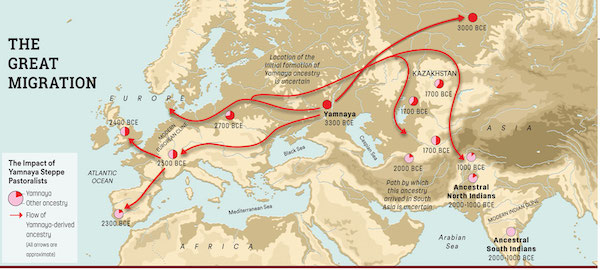
Why Aryan Migration Theory (“AMT”) is probably true, but it might not matter

People now and then ask me why JR contributes to this weblog when I think he’s profoundly wrong on some issues. First, being wrong is no sin. Even being offensive is no sin. I am a traditionalist in regards to expression.

Second, JR presents what I believe to be the wrong position with a reasonable command of the sources and in a logical and coherent manner. He has not convinced me, but I have sharpened my own views (and to be frank, I believe that both of us have changed positions over the last four years as new data has emerged). Unfortunately, this is in contrast with the bluster, ad hominem and incoherence of many opponents of the idea of the exogenous origins of the Indo-Aryans. I used to think these people were malicious, but I think a lot of them are just stupid. So I hold it less against them.

JR presents what strikes me as an Indocentric view. He is quite clear that he sees his project as compensatory and reactive to the traditional Eurocentric view. My own position is quite naively positivistic, and I attempt to be cross-cultural. Of course in the details, I fail because to be subjective is to be human (my own view is going to be Eurocentric because my cultural orientation is American). Knowledge of the empirical world accumulates despite our shortcomings. JR has made an appeal to me as a person of subcontinental origin on occasion, but this lever is pulling on a string of emptiness. I am one of the Last Men who are weak in regards to racial self-conception.

Sometimes you really know what people are about by what they don’t talk about. Americans don’t talk directly about money, but we care about it a great deal. Indians don’t talk about caste directly in personal detail, but clearly they care about it a great deal. And the converse is also true. Much of my bluster about R1a1a-Z93 is that I find lineage to be a humorous and frivolous fixation, though I am latitudinarian is accepting that others may differ with me on this. It is a matter of disposition for me, not a deep principle. AMT or OIT has little emotional valence for me.

Finally, I have to admit that I have become disillusioned with the calm and conscious lying and obfuscation which I know to occur in sciences with which I am familiar. When Westerners have strong ideological priors and beliefs at stake, scholars abandon fidelity to the truth so as to tack to the winds and align themselves with the regnant ideologies of the age. They are servile creatures who bend to power. I do not have it within me to look down upon Indians for their bias and motivated reasoning when I know that Janus reigns supreme in Western academia. I thought “we” were better than this. I know now that that was a delusion. The courage of men fails. They will forsake friends and break bonds of fellowship. The truth is nothing next to these betrayals.

But I still vainly hold to the ideals of the old religion. Truth above all, strive for it even when it discomfits, and when you miss the mark so often. Knowledge is its own regard.

JR’s post, The Unravelling of the AMT, consists primarily of marshaling evidence from archaeology and linguistics (genetics being secondary). The contention is that the lack of archaeological disruption during the period between 2000 BC and 1000 BC, as well as no evidence in the extant literature of Indo-Aryan recollections of foreign homeless, should argue against an exogenous origin for Indo-Aryans. As I have no deep knowledge of these two fields, let us grant these assertions.

The reason that JR’s extensive argumentation does not convince me is that even granting the low probability of AMT conditional on the facts which he brings to the table, the probability of OIT is even lower conditional on the facts we know about other Indo-European societies. Alone, and isolated, if I grant the level of archaeological disruption to be minor, and if I grant that indeed Indian oral history does not record an external homeland, the model of mass migration in the period between 2000 and 1000 BC does strike me as unlikely (let’s put the genetics to the side).

But, if you reject AMT for this period, then we must explain Indo-Europeans in Europe and in the Near East. Logically the rejection of AMT entails OIT, and OIT presents far greater problems to me than AMT. From a cross-cultural perspective, a model that explains the current distribution of Indo-European languages must explain all of the different branches and their locations as parsimoniously as possible. There will be errors and loose ends in the model, but we have to iterate from a plausible starting point. AMT resolves more problems than it creates. OIT creates more problems than it resolves.

And yet to be entirely frank…I do think JR’s arguments will gain more and more traction with Indians. Indians are entirely Indocentric quite often, so arguments that operate within this framework will be persuasive. I find this personally uncongenial, but I am getting the sense as I get older that I have an abnormal interest in a disparate array of cultures and societies (some commentators, who may or may not have low IQs, express frustration that I refer to other societies and cultures since they are clearly ignorant of things beyond their shores). Here in the United States, there are “Ethnic Studies” departments that seem to exist so that people of a particular ethnicity can study their own history. They are quite popular and ideologically motivated.

The broad world out there is fading for the positivist vision. The age of science is giving way to the age of magic. The time for public discussion and calm inquisition of the facts has probably passed us by. Truth, understanding the shape of reality for its own sake, is a small cultic affair. And yet do well to remember, the lies that give you comfort are lies nevertheless!

Why Indian Muslims are in India not of India

Reading Seshat History of the Axial Age chapters on India was a bit unsatisfying due to a lack of detail. But if you are looking for high-level historiography, it’s not a bad volume. It’s most definitely a good “sourcebook” on the literature.

Because of its general and cross-cultural focus, I began considering why Indian Muslims seem so immiscible. This is, in contrast to various other groups that moved into India. One might bring up “Scythians”, but more appropriate I think might be the Ahom of Assam. They were originally Buddhists of a sort, but eventually, they became Hindu, though they retain some Buddhist rituals.

So what’s the difference? Clearly one simple difference is that Buddhism and Hinduism are both Dharmic, so the barriers between the two traditions are lower and the boundary more fluid than between Islam and Dharmic traditions. This obvious in Sri Lanka, and also in Myanmar, where the remaining Indians of Hindu origin have mostly switched their religious affiliation to Buddhism, and in Thailand, where there are native Brahmins who perform rituals at the royal court.

But I think there’s a bigger difference: India was a land of opportunity for Muslims from West and Central Asia. The constant stream of officials, soldiers, and religious eminences mean that attempts to synthesize and assimilate Indian Muslims in the same way possible with earlier peoples were going to run into the counter-force of immigrants and transplants who would constantly demanding that Indian Muslims conform to world normative Islamic practices and beliefs. One illustration of this is the role of the Naqshbandi order in demanding that Muslim rulers not stray and that Hindus and Muslims should not mix excessively.

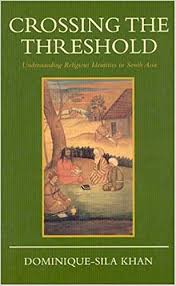
The only work that addresses the possibility of assimilation and synthesis in detail that I know of is Dominique-Sila Khan’s Crossing the Threshold: Understanding Religious Identities in South Asia. In the wake of the mass migration of Muslim Turks and Afghans under the Delhi Sultanate, a large number of Indians became Muslim, of various sorts. But with the decay of the Delhi Sultanate, and the decentralization of power and rule, Dominique-Sila Khan outlines her thesis that many Muslim and Hindu groups experimented with beliefs and practices which were synthetic, creating liminal identities. With the rise of the Mughal Empire and its integrative tendency, as well its excellent connections to the “Islamic international,” the liminal groups were forced into more standard and distinct confessional identities.

One unsurprising aspect of this is that demands for orthodoxy from the Sunni Muslims hit various Shia groups, in particular, ghulat sects among the Ismailis, particularly hard. Though forced conversions of Hindus no doubt occurred, we know for a fact that there was a systematic campaign to convert whole groups of Ismailis in regions such as Gujarat to Sunni Islam. These campaigns were on the whole successful.

Can we test my hypothesis that exogenous interaction and contact explain the relative lack of assimilation of Muslims into the Indian-Hindu identity? Yes. But not with India. Rather, there were multiple instances in China where small Muslim groups lost contact with the “outside world” (that is, Muslims in Central Asia). These groups at the elite levels became strongly influenced by Confucianism, and at the popular level took elements resembling Pure Land Buddhism. Though some Muslims were absorbed into Chinese folk religious milieu, the heterodox sects never became a new religion on the Chinese scene. Why? Because periodically contact would be reestablished with Muslims from Central Asia (again, the Naqshbandi order played a big role here), and deviations would be purged.

There is a final example that illustrates what happens to distinctive religions when they are totally isolated. In the early 17th-century, Japan banned Christianity and isolated itself from the rest of the world. But small groups of Catholic Christians maintained their identity in secret. These “Hidden Christians” were rediscovered in the 19th-century. The majority became conventional Catholics…but a minority remained “Hidden Christians”, and had taken on many elements of Japanese folk religion, as well as Pure Land Buddhism.

Can Islam than ever be indigenized in South Asia? Ask the Persians how easy it is to take Arabicity out of Islam…

Update: I suggest in the comments below that the foreign dominance among South Asia’s Muslim elites served to prevent the conversion of native elites.

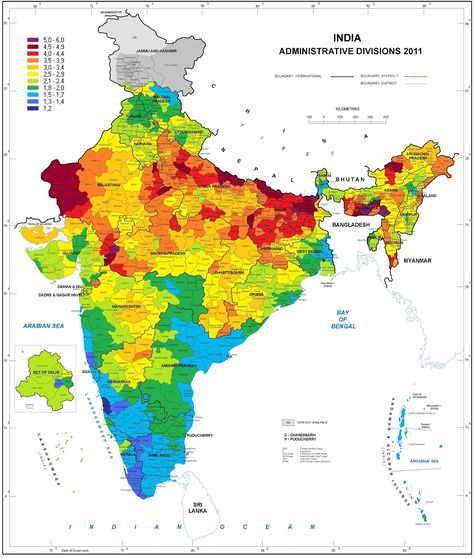
India’s massive fertility gradient


I’m pretty sure I’ve posted this map before. It’s not surprising, as it shows fertility differences across the nation.

But, what I just realized is that the fertility rate gradient between West Bengal and Bihar is one of the largest in the world. Bihar’s TFR is about 3.3, West Bengal’s 1.6. For comparison, Mexico has a TFR of 2.1, and the USA 1.7. Yemen has a TFR of 4.0, and Saudi Arabia 2.5. Perhaps analogous are Iran and Pakistan. TFR’s of 1.7 and 3.5, respectively.

All that matters is which way you are punching

I have little value to add on the many comments around “Modi is bad to the bone” piece in The New Yorker, except that this passage jumped out at me:

Other coverage on Republic TV showed people dancing ecstatically, along with the words ā€œJubilant Indians celebrate Modi’s Kashmir masterstroke.ā€ A week earlier, Modi’s government had announced that it was suspending Article 370 of the constitution, which grants autonomy to Kashmir, India’s only Muslim-majority state. The provision, written to help preserve the state’s religious and ethnic identity, largely prohibits members of India’s Hindu majority from settling there. Modi, who rose to power trailed by allegations of encouraging anti-Muslim bigotry, said that the decision would help Kashmiris, by spurring development and discouraging a long-standing guerrilla insurgency. To insure a smooth reception, Modi had flooded Kashmir with troops and detained hundreds of prominent Muslims—a move that Republic TV described by saying that ā€œthe leaders who would have created troubleā€ had been placed in ā€œgovernment guesthouses.ā€

From the broadly Left/liberal internationalist perspective, Hindu nationalists express a majoritarian and ethnoreligious self-consciousness. They don’t want what in India is termed “secularism” to be ascendant. I believe that some Hindu nationalists do want for India what was the original vision of Pakistan, a nation-state that has at its core a particular ethnoreligious identity (I believe this is distinct from a “Islamic fundamentalist” vision properly understood in the modern context).

And yet this passage simply glosses over the fact that legal fiat was preserving a particular sub-national identity, that of Kashmiris, the vast majority of whom are Muslims.

Browncast episode 75: Indian in Suomi


Another BP Podcast is up. You can listen onĀ Libsyn,Ā iTunes,Ā Spotify,Ā  andĀ Stitcher. Probably the easiest way to keep up the podcast since we don’t have a regular schedule is toĀ subscribeĀ at one of the links above.

You can also support the podcast as aĀ patron. The primary benefit now is that you get the podcasts considerably earlier than everyone else.

Would appreciate moreĀ positiveĀ reviews! Alton Brown’sĀ ā€œBrowncastā€Ā has 30 reviews on Stitcher alone! Help make us the biggest browncast there is!

Today Razib talks to Sagar Dubey about being a cosmopolitan world-traveling brown. Sagar lived in eight countries (North and South America) before finally settling down (for now) in Finland.

Razib also asks about Sagar’s impressions of India, while they also talk about how the online world has evolved over the past generation.

Brown Pundits