The reign of {{{Sundar Pichai}}}

Where Will Sundar Pichai Take Google?:

There were louder executives at Google. There were brainier ones. There were more aggressive ones and those who were doubtlessly better at throwing a sharp elbow, too. And many more political ones — even if those who have been running one of the world’s most powerful companies continued to think of themselves as benign, long after it was clear to everyone else that they were many things but that.

Most of them are gone. Most are as rich as Croesus. But they’re not at the pinnacle of one of the mightiest companies on the planet.

Because in the end, the nice guy — Sundar Pichai — finished first. Mr. Pichai on Tuesday was named chief executive of Alphabet, the company chassis under which the unbeatable and wildly profitable search engine lives, along with a number of other less impressive initiatives. The soft-spoken executive, who was born in India, had worked his way up a long ladder from product manager to vice president to chief executive of Google. Now this big announcement.

Page and Brin will still control the company. Pichai is the public face. A friend who used to work at Google says

– He’s not too bright
– He’s not too courageous
– He lacks deep vision

This is probably what you would expect from someone who is there to take Page and Brin’s implied marching orders.

Pichai gets compared to Satya Nadella of Microsoft. But at least Nadella has pivoted Microsoft in many new directions, fundamentally transforming the OS and productivity application company into something much more diverse.

Westernmost India

On this weblog, there is sometimes a silly debate between Hindu nationalists and anti-Hindu anti-nationalists about the scope and size of Indian and Hindu cultural spheres (the terms “Indian” and “Hindu” being interchangeable for much of history). I stumbled onto this comment from Isidorus of Charax (a Greek subject of the Parthian Empire) in his Parthian Stations:

19. Beyond is Arachosia, 36 schoeni. And the Parthians call this White India; there are the city of Biyt and the city of Pharsana and the city of Chorochoad and the city of Demetrias; then Alexandropolis, the metropolis of Arachosia; it is Greek, and by it flows the river Arachotus. As far as this place the land is under the rule of the Parthians.

Here Isidorus is alluding to the Indo-Greeks who were dominant in much of Afghanistan and Bactria to the north. “White India” in the first few centuries A.D. seems to have meant the Helmand Valley, modern southern Afghanistan.

Apparently in the Avesta this region is asserted to be staunchly Zoroastrian. Either there is confusion and misrepresentation, or, Zoroastrianism retreated during this period. Though this specific case can be dismissed, it does seem to be a fact that under the Parthians and Sassanids the eastern and northeastern fringe of the Iranian world was coming under strong Buddhist influences. In the early period, Buddhism was, of course, the “Indian religion” (just as Islam was and is the “Arab religion”), so presumably, it was a vector for Indian cultural influence.

The Burmese frontier of Bengal

I am reading Thant Myint-U’s The Hidden History of Burma: Race, Capitalism, and the Crisis of Democracy in the 21st Century. In it, he mentions the legends and oral history of some Burmese that much of Bengal was once inhabited by people like the modern Burmese: Buddhist, and East Asian in appearance.

I don’t know what to think about these sorts of memories, but after spending a day (for various reasons) looking at mtDNA (direct maternal) and Y (direct paternal) ancestry in various groups: I am more and more convinced it is plausible that much of Bengal was inhabited by a Tibeto-Burman people.

The reason is that in Bangladesh it looks to be that ~10% of the mtDNA and ~10% of the Y chromosomes are East Asian. This is in line with the genome-wide ancestry. To the west and south of Bengal, there are peoples with even more East Asian ancestry, the various Munda tribes. But these groups have a different profile. 30% of their ancestry is East Asian. But 60% of their Y chromosomes are East Asian, while 0% of their mtDNA is East Asian.

One thing we know about the Munda is that they speak Austro-Asiatic languages. Genetically their East Asian component seems to have mixed with people deeply related to the Andaman Islanders, before mixing again with a people with affinities to South Indian tribal people. Additionally, the Munda have almost no “steppe” affinity.  This is curious because this occurs only among some South Indian tribal groups. Even among non-Indo-Aryan South Indian populations, such as the Reddy of Andhara Pradesh, there is some steppe ancestry.

Genetically it seems that the earliest mixing of East Asian and “indigenous” ancestry in the Munda dates to the period between 4,000 and 4,500 years ago. I am now open to the possibility that the Munda arrived in the Indian subcontinent via the Bay of Bengal. And that the northern Munda languages are actually expansions from a southern expanse.

In any case, the situation in Bengal seems to be different. If there were Munda in Bengal, they didn’t leave much of an imprint from what I can tell. The admixture into the Bangladeshi genomes dates to about 1,500 years ago. Rather than an intrusion of Tibeto-Burman people into the plains of Bengal, this may indicate an expansion of Indo-Aryan agriculturalists into the lands of slash and burn Tibeto-Burman agriculturalists.

Some admixture coefficients for South Asian Genotype Project members

I decided to run qpAdmin on a large number of the South Asian Genotype Project members. The codes should be self-evident for the individuals. The Indus Periphery samples are from the Reich dataset. The steppe is all Sintashta samples from the recent publication (I removed outliers). The Andamanese hunter-gatherers are from the Andamans.

Some of the populations are not good fits on the India cline. Adding Dai as East Asian improves the fit for the Bengali Kayastha. But it messes it up for most of the others.

Please note that these are individuals. There is going to be variance within populations.

Continue reading Some admixture coefficients for South Asian Genotype Project members

A model runs through it

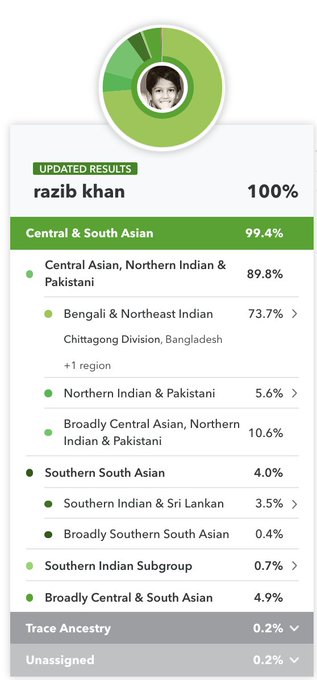
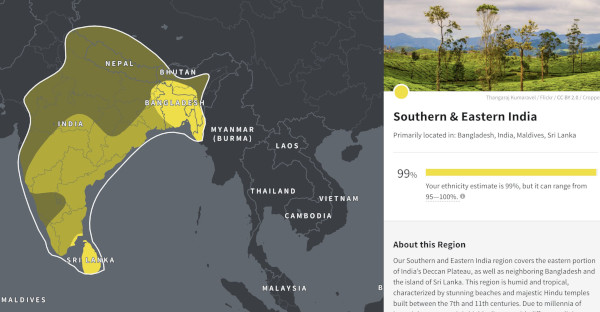
Recently I made a comment that I appreciate what 23andMe and Ancestry have done with their South Asian ancestry updates. My own results came into sharper focus. The algorithms did what they were supposed to do.
Both of the companies found that I’m probably Bengali. 23andMe, with its massive database, and SVM framework, even narrowed down where in Bangladesh my family is from.

Both my parents are from Comilla. More specifically, my mother’s family is from Homna (though her maternal grandfather was from Noakhali by origin). When I was small I was sent to stay with my mother’s relatives in Sreemudi village, which I can now find on Google maps! My father’s family is from just outside of Chandpur. Basically, my family hails from the lower reaches of the Meghna river. And more precisely, the eastern shore of the Meghna.

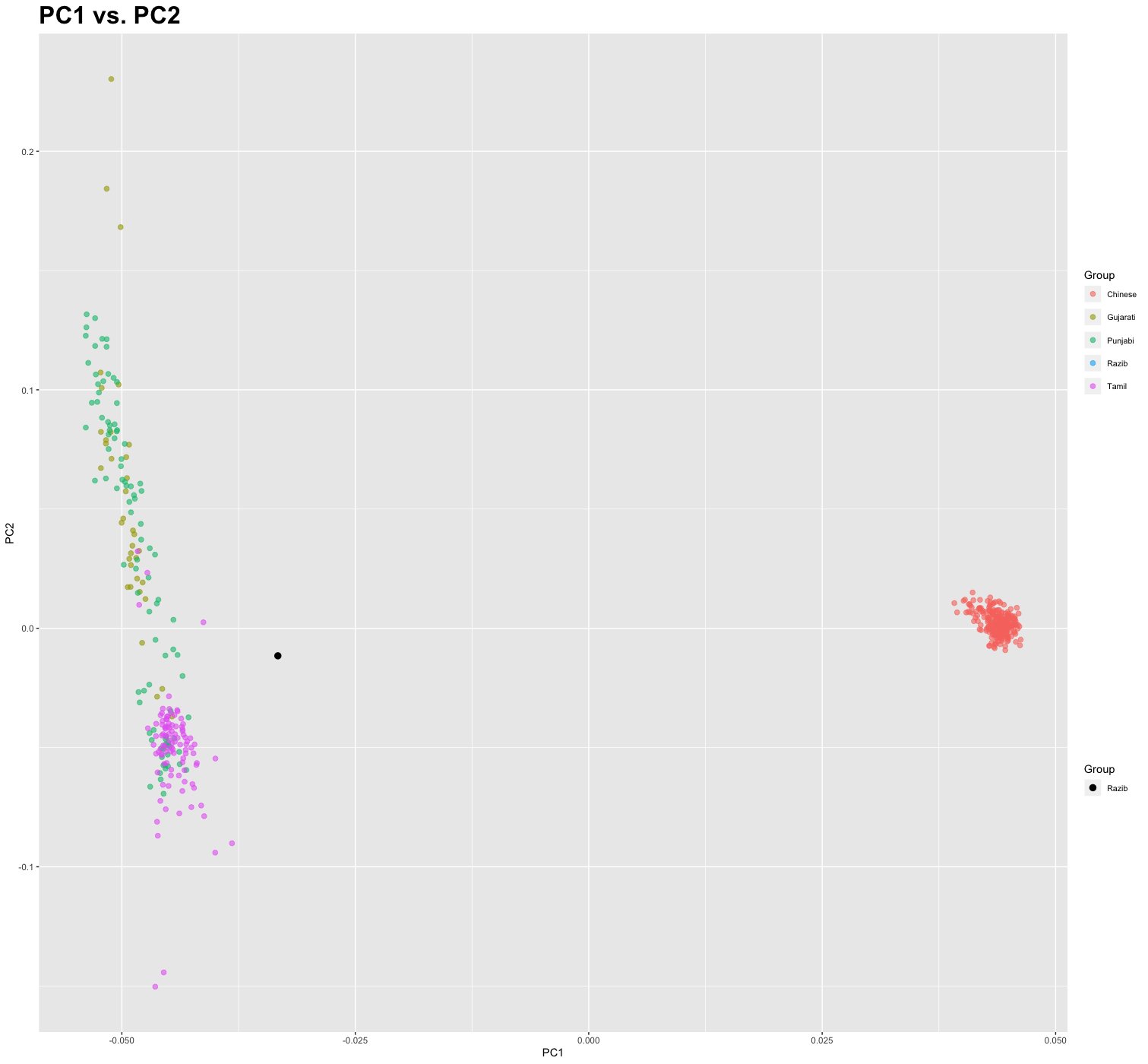
And yet this analysis is missing something. The term and category “Bengali” has implicit within it other phenomena. I generated a PCA which illustrates this well:

You can see I’m pretty clearly shifted toward East Asians. That’s because that’s common in Bengalis. That seems like it’s interesting information people would like to know. But simply creating a “Bengali” category masks all that.

Speaking of genetics, I finally got around to playing around with qpAdmin. People keeping asking me Bengali percentages of the various ancestral components in the recent Reich lab India paper. Well, I ran the same model (mostly, not exactly sure of all the samples….), and got some results.

  IndusValley Steppe AHG/AASI EastAsian Birhror (Munda)
Bengali 0.448 0.126 0.301 0.125  
Punjabi – Lahore 0.58 0.2 0.192 0.03  
Tamil – Sri Lanka 0.57 0.07 0.38 -0.025  
Gujarati 0.59 0.18 0.21 0.03  
Telugu 0.595 0.085 0.33 0  
Birhor 0.27 0 0.49 0.24  
Bengali -0.163 0.142 -0.86 -0.364 2.25
Bengali 0.264 0.136 -0.075   0.675

The “Bengali” sample is from the 1000 Genomes. You can see that 12.5% of the ancestry is “East Asian”. These are Dai. The AHG are modeled as being related to the Andamanese as per the Reich lab paper, and Indus Valley are the pooled IndPe samples. Steppe are Sintashta.

I ran the other 1000 Genomes samples with the same model. The -0.025% for Tamils for East Asian is that this model is really not necessary for them. I kept the East Asian in there to compare apples to apples with the Bengalis.

I also looked at Munda population, the Birhor. The results align perfectly with what we know. The Munda have no steppe ancestry. But, they have a lot of East Asian ancestry. One hypothesis for Bengalis is that they have Munda ancestry. But when I add them to the model you can see the results are crazy. If I swap out the East Asians with the Munda the results make some sense, but standard errors are way higher than in the model with the Dai/East Asians.

Basically, Bengali (Dhaka) samples have East Asian ancestry that’s more like populations to their east, and not like the Munda to their south and west.

O2a and Munda


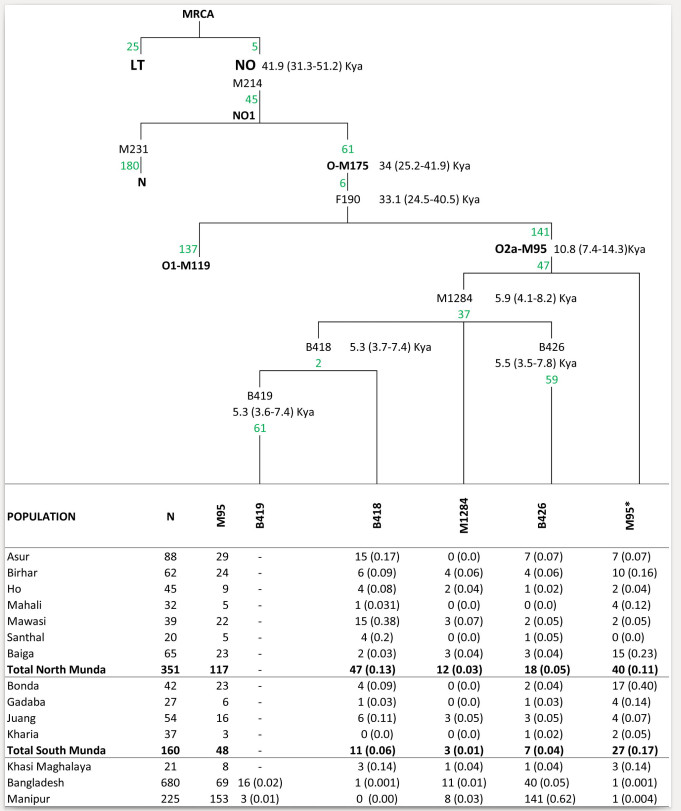
Counting the paternal founders of Austroasiatic speakers associated with the language dispersal in South Asia:

The phylogenetic analysis of Y chromosomal haplogroup O2a-M95 was crucial to determine the nested structure of South Asian branches within the larger tree, predominantly present in East and Southeast Asia. However, it had previously been unclear how many founders brought the haplogroup O2a-M95 to South Asia. On the basis of the updated Y chromosomal tree for haplogroup O2a-M95, we analysed 1,437 male samples from South Asia for various downstream markers, carefully selected from the extant phylogenetic tree. With this increased resolution, we were able to identify at least three founders downstream to haplogroup O2a-M95 who are likely to have been associated with the dispersal of Austroasiatic languages to South Asia. The fourth founder was exclusively present amongst Tibeto-Burman speakers of Manipur and Bangladesh. In sum, our new results suggest the arrival of Austroasiatic languages in South Asia during last five thousand years.

From the discussion:

The diverse founders as well as the large number of unclassified samples (41% for Mundari, 38% for Khasi and 1% for Tibeto-Burmans) suggest that the migration of Austroasiatic speakers to South Asia was not associated with the migration of a single clan or a drifted population. Neither does the contrasting distribution of various founders discovered in this study amongst both Mundari and Tibeto-Burman populations support the assimilation of the former to the latter.

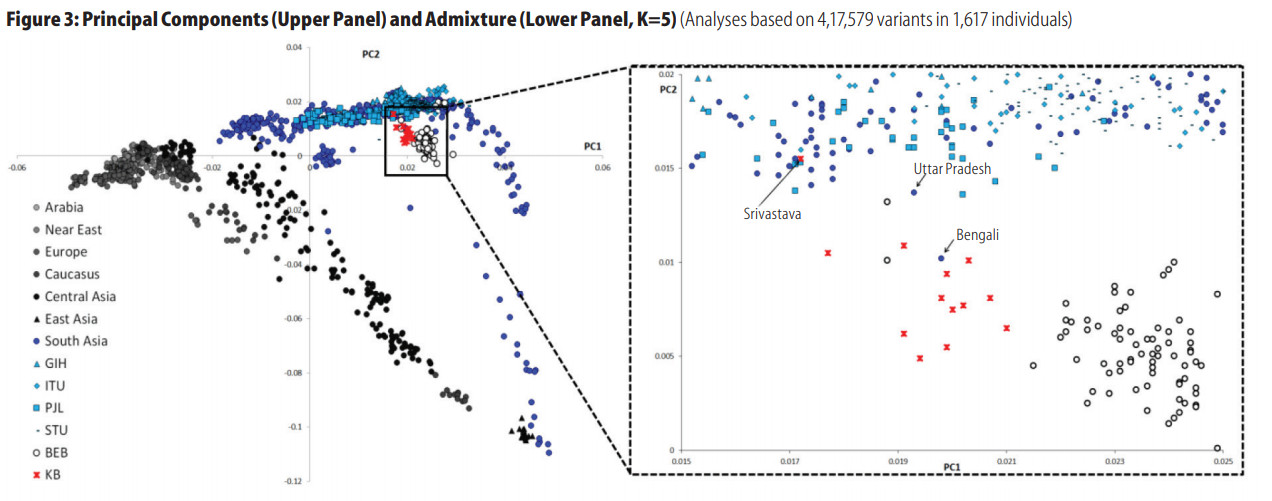
West Bengal Kayasthas are heterogeneous paternally and conventional Bengalis overall


A few years ago there was a short paper that analyzed genotypes from some Kulin Kayasthas from West Bengal. The plot above illustrates what you really need to know. The Kayasthas are positioned on the PCA right between East Bengalis and people from the main India cline, with a slight shift toward more ANI.

I’ve looked at a few West Bengal Kayasthas myself, and that’s what I always see. When I look at individuals from Bangladesh, the ones with the most East Asian ancestry are invariably from the furthest east. So it looks like going from eastern Bengal to western Bengal there is progressively less East Asian ancestry. And, unlike Bengali Brahmins, Bengali Kayasthas do not seem to be that different from generic Bengalis as such. In contrast, Bengali Brahmins tend to have a strong shift toward Uttar Pradesh populations and look very similar to Uttar Pradesh Brahmins with a minority non-Brahmin Bengali admixture.

Finally, take a look at the Y and mtDNA. Though R1a is overrepresented, one of the Kayasthas has both male and female East Asian uniparental lineages.

Brown Pundits