Browncast Episode 69, You’re Southern South Asian!

Another BP Podcast is up. You can listen on Libsyn,Ā iTunes,Ā Spotify,Ā  andĀ Stitcher. Probably the easiest way to keep up the podcast since we don’t have a regular schedule is toĀ subscribeĀ at one of the links above.

You can also support the podcast as aĀ patron. The primary benefit now is that you get the podcasts considerably earlier than everyone else. I am toying with the idea of doing a patron Youtube Livestream chat, if people are interested, in the next few weeks.

Would appreciate moreĀ positive reviews!

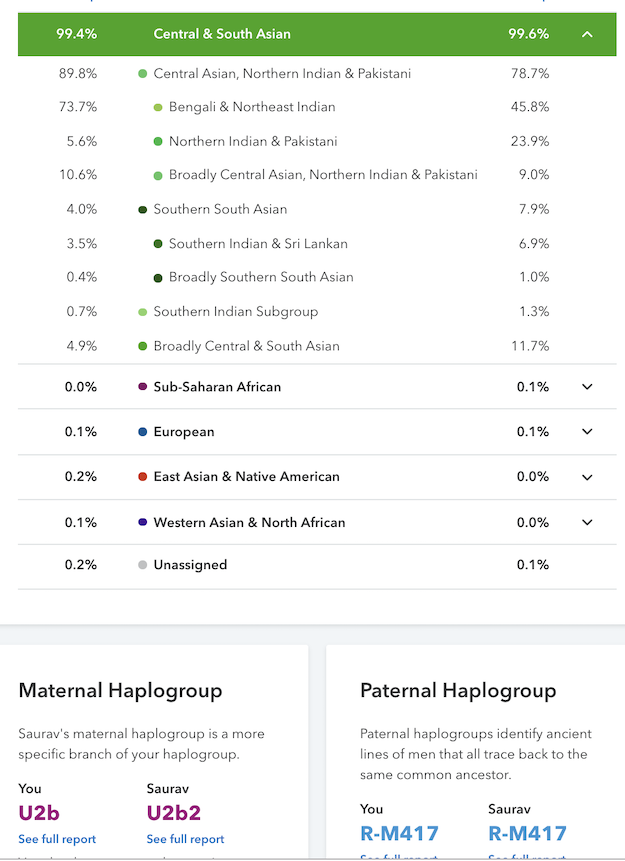
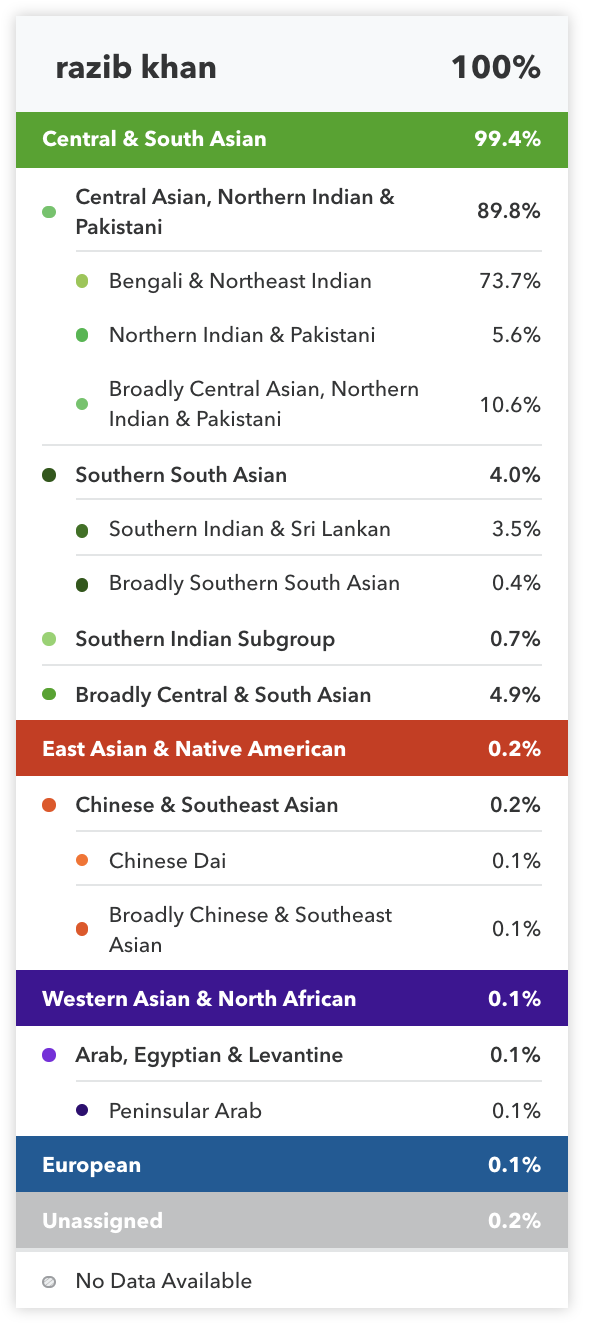
This episode Razib and previous guest Surya Yalamanchili talk about the updated ancestry composition for South Asians from 23andMe. For nearly a decade we’ve all been 95% “Broadly South Asian.” Now most of you are part Bengali!

23andMe says Bangladeshis are more Bengali than West Bengalis!

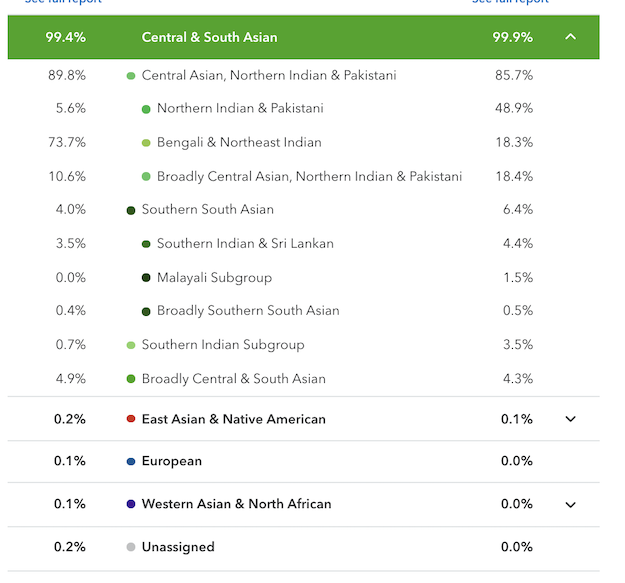
As some of you may know 23andMe updated its South Asian ancestry panel. On the whole, I’ll give it a thumbs up, but, you need to be aware of the way they’re framing things. For example, pretty much every Bangladeshi has more “Bengali” ancestry than people from West Bengal.

The profile above on the left is mine. On the right is a friend whose background is West Bengali, of the Kayastha caste. Basically, 23andMe seems to be taking the East Asian enriched ancestry of Bangladeshi Bengalis as more diagnostic of being Bengali.

Now, compare me to a Bengali Brahmin (on the right):

So in all likelihood, Tagore’s ancestry composition would result in not so much “Bengali”….

Hindutva need a Tariq Ramadan (without the rape allegations!)

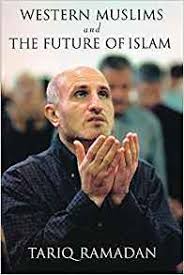
Before his career was destroyed by multiple allegations of rape and sexual abuse, the philosopher and Islamic scholar Tariq Ramadan was an intellectual superstar who spanned the world of conservative Islam and Western academia. If you read a book like Western Muslims and the Future of Islam you see why: Ramadan could operate the language of the West on the terrain of Western secular philosophy, despite promoting a traditionalist view of Islam. Ramadan was a conservative European Muslim, but one fluent in the traditions of Continental philosophy.

In an even more academic manner, the conservative Protestant philosopher Alvin Plantinga forces the secular analytic tradition to take him somewhat seriously, rather than dismiss him out of hand as a third-rate apologist. You may remain skeptical of the ontological argument for the existence of God (I do remain unconvinced), but when Plantinga deploys modal logic and extents Norman Malcolm’s arguments, you can’t say that he hasn’t put some thought into the matter.

On the whole, I remain unconvinced by the argument that all Hindu nationalists are somehow genocidal Nazis* (just like I don’t think all conservative Muslims are jihadis).Ā  But, I do think that one of the problems that Hindu nationalists face is the lack of voices who can articulate a vision that is uncompromising, but also fluent in the lexical currency and the rhetorical style of the West.

To be entirely frank, running this weblog, and engaging Hindu nationalists on Twitter has brought home to me how parochial many Indians and Hindus remain in their concerns and their broader vision. That is fine insofar as India as a nation of over one billion. It is a world in and of itself. But if conservative Hindus do want to be taken seriously by the outside world, they need to start being able to present themselves in a manner that is both intelligible and persuasive, as opposed to engaging in blusters for the amen choir.

* I am now becoming convinced that non-Western social and political movements are too often connected to Western ones that add no value to the discussion.

Xinjiang and Kashmir, China and India

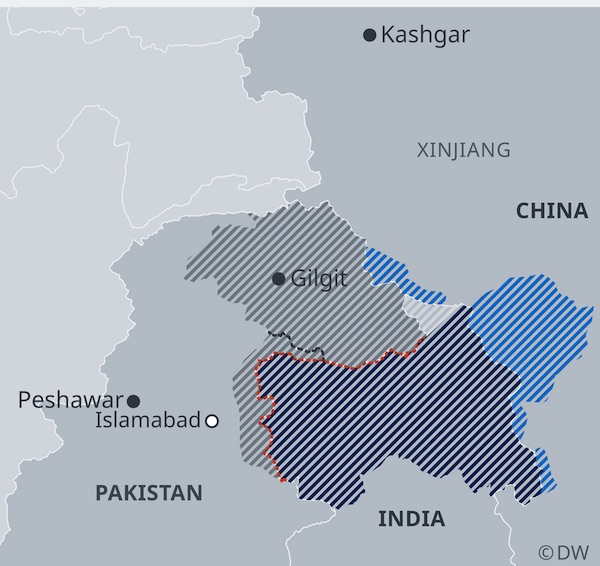
This post isn’t really to state something unequivocal…it’s just to observe that Kashmir and Xinjiang are not that far apart geographically.Ā  The great translator of Buddhist works into Chinese, KumārajÄ«va, may have been the son of a princess from Kucha (on the southern fringe of the Tarim basin) and a Kashmiri.

What is happening to the Uyghurs is being extensively covered in the Western media. But from what I can tell Kashmir has become a major cause on the Left in the West, while Xinjiang is far less. “Solidarity with Xinjiang” returns 300,000 results for me on Google, while “Solidarity with Kashmir” returns 6,000,000.

There are major differences of course. The magnitude of what’s happening Xinjiang seems to be far greater than what’s happening in Kashmir. And, India is a democratic nation, while China is most definitely not.

Indian Twitter shows why a “universal translator” wouldn’t work

India is one of the top countries on Twitter. And, since many Indians have some command of English, they interact somewhat with the English-speaking Twitter crowd which is mostly based in the USA and UK.

But, the differences in style, idiom, and cultural references, make conversations often very difficult and totally incomprehensible. Despite the fact that two interlocutors may speak the same language, with only minor syntactical and semantic differences. The difference exists between British and Americans as well, but the cultural gap here is much smaller, and some of the confusions I see with conversations with Indian Twitter happen far less.

This is not a function of how much similar British English is to American English. It is a function of the uniqueness of Indian culture and expectations, and particular idioms and frames. The usage of English allows for Americans to be exposed to this, but there is a level of opacity that is novel and surprising.

To me, my engagement with Indian Twitter is more a matter of anthropological curiosity than dialogue. Twitter lacks the nuance and density to puncture the incommensurable aspects easily.

A tale of two Pakistans

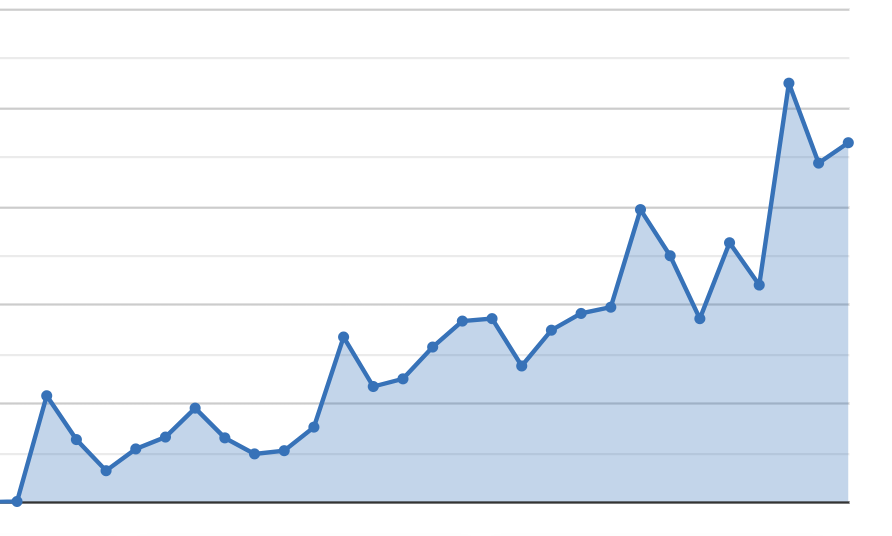
Bangladesh to clock highest growth in Asia this year.

Pakistan’s growth to be lowest in South Asia in current fiscal.

8% vs. 3%. From a geopolitical perspective at current rates of relative stagnation India’s Pakistani problem will “solve” itself as the Islamic Republic is turning into a macroeconomic midget. All of the geopolitical posturing will be irrelevant if the Pakistani polity doesn’t get its structural house in order (e.g., shift away from the oligarchy).

“OBC” in West Bengal a social construct?

Recent population history inferred from more than 5,000 high-coverage South Asian genomes:

Next, we developed a novel method for estimating the genome-wide average divergence time between a single individual and a focal group. This method focuses on extremely rare variants, which should be the most informative about very recent demographic events, and is robust to demographic events affecting the particular individual studied. We focused this work on samples from Birbhum district, West Bengal due to the presence of additional metadata on caste and religion. We used 704 general-caste individuals from Birbhum as the focal group, and estimated divergence times for all other individuals. Mean divergence times ranged from ~2,600 years for the Santal, an Austro-Asiatic language speaking tribal group, to 850 years for ā€œscheduled castesā€ (i.e., Dalits), 625 years for Bangladeshis and 225 years for ā€œOther Backward Castesā€ (OBC) individuals. The recent divergence times for OBC individuals confirms that this category is more of a political construct than a long-lived social grouping, while the other divergence times suggest a substantial amount of gene flow between groups. Finally, we extended our approach to thousands of other genomes from around the world. We show how patterns of rare variation can be used to detect asymmetrical migration, and document evidence for more migration from East Asia into Bengal than the converse.

Browncast Episode 68, Conversation with Pratik Chougule

Another BP Podcast is up. You can listen on Libsyn,Ā iTunes,Ā Spotify,Ā  andĀ Stitcher. Probably the easiest way to keep up the podcast since we don’t have a regular schedule is toĀ subscribeĀ at one of the links above.

You can also support the podcast as aĀ patron. The primary benefit now is that you get the podcasts considerably earlier than everyone else. I am toying with the idea of doing a patron Youtube Livestream chat, if people are interested, in the next few weeks.

Would appreciate moreĀ positive reviews!

This episode we talked toĀ  Pratik Chougle, a conservative and a proud globalist. From being on Trump’s policy team, Chougle has become a critic and envisions a future conservatism sharply at odds with parochial nationalism.

Brown Pundits