For TL;DR jump to My reasons for this position today are
Yesterday I tweeted about how OIT is becoming an Article of Faith on the Hindutva Wing in a thread related to Ruchir Sharma podcast where he dodged the AIT question. I further tweeted the change in my position of one supporting OIT (till 2018) to AIT by 2018 especially in face of the recent genetic evidence and following the work by Razib Khan. I was contacted by BP regular guest and host of the Carvaka podcast – Kushal Mehra and we had a long (3 hours) chat. His reading of the issue (Archeology and Rgveda) is much more robust than mine and I felt as Hemu’s army would’ve felt battling Babur’s projectiles. (though I am still not convinced by his argument). Hence I write this piece to evaluate my evolution with the Aryan question and also putting my current position & its defense in digital ink.
Like most Indians, I had read about the Aryan invasion theory as a historic fact and only got introduced to the inherent racism in the initial framing of the AIT after my schooling. In 2008 the paper, Reconstructing Indian Population History came out and the terms ANI and ASI got popularized. The media commentary on the paper (as with the Rakhigarhi paper) seemed to suggest the genetic data had refuted the AIT. Influential public figures like Subramanian Swamy (who appeared a lot more respectable to me in 2008-09) and few lesser-known Marathi influencers and others championed the debunking of the AIT myth in the public sphere which was not refuted except well enough except by historians like Romila Thapar (in whom I have low trust around politically charged topics as proven in Babri case). Things started getting heated in Indian Media around 2013-14 with after the publication of Genetic Evidence for Recent Population Mixture in India. But my interest in the Aryan issue came due to this article by scientist and influencer Anand Ranganathan on newslaundry (before then I had been largely ignored the arguments and counterarguments). I had some instinctive unease with these ANI/ASI argument against AIT but chose to ignore my doubts as Geneticists from India & commentators like Anand Ranganathan (who is a scientist), Sanjeev Sanyal, even anti-Hindutva Shashi Tharoor chose to concur with the views refuting the AIT.
In the following year or two, I read the following
- Romila Thapar on Ancient History (small bands of herders)
- Upinder Singh (who is non-committal)
- Michael Daninos Lost River (the most reverent Sarasvati)
- Free Papers on Academia – especially the Michael Witzel and Shrikant Talegeri debate.
- Koenraad Elst’s blogs.
- Edwin Bryant’s Indo Aryan controversy book.
- Sections of Mallory’s book
- Ambedkar’s book on Shudras
I particularly saw the linguistic arguments for AIT to be weak largely attributable to my ignorance of the field. I see myself as extremely ignorant about history in general around then, for my interest in non-fiction is very recent (2015 onwards). In some ways, I am still not well-read compared to most authors/commentators here. I haven’t read any history from outside India other than British, American, and WW2.
Hence I was moderately convinced by Danino’s Sarasvati argument back then. Additionally following the Witzel-Talageri debate I found a lot of criticism of Talageri ad-hominem and patronizing. The dismissal of Talageri’s work as a bank clerk’s revisionist Hindutva did not seem scholarly to me (I mean Witzel’s criticism did not appear scholarly but ad-hominem). In my view, Edwin Bryant’s book confuses as it doesn’t take a position after 500+ pages. However in the end the lack of Archeological support for AIT (no significant change in material culture) made me convinced that the AIT was flawed. As I see this as a binary problem i.e either AIT or OIT has to be true to explain the spread of Indo-European languages, my position was that of OIT. I also felt AMT is a workaround for the problematic parts and holes in the AIT.
In 2017-18, around the time The Genomic Formation of South and Central Asia hit the biorxiv and created quite a few waves in the Indian media, articles by Tony Joseph, Shoaib Daniyal, and Hartosh Bal made enough noise on my twitter timeline to make me take a renewed interest in the controversy. Around that time David Reich’s book was published and most AIT guys used Reich’s book to bolster their claims. By the time I had completed Reich’s book I was almost convinced of the AIT yet I made an effort to cross-check the counterviews. I reached out to Anand Ranganathan who sort of dodged my cross-questions. I also reached out to Swarajya Magazine (of whom I was a subscriber in 2018/19) and was not at all convinced by the explanation given by them here and here. On reading work by Razib & other genome bloggers who got a shout out in David Reich’s book I was even more convinced by their arguments. I read Tony Joseph’s Early Indians and it does a good job of laying out the data IMO. However one always notices the author’s political biases coming up especially around his handling of Caste( I find it extremely stupid to look back at events that are speculated 2000 years ago with today’s moral compass and use it making political points calling the Brahmins in 100 AD the original Tukde-Tukde gang.)
I have since, also read David Anthony’s book, Narsimhan and Shinde papers, read most BP blogs (including JR’s pieces) and comments on AIT/OIT, followed a small bit of linguistics, and listened to the views of Niraj Rai, Shrikant Talageri (on Carvaka), Koenrad Elst. I still continue to hold the view that AIT probably happened and more importantly OIT seems highly implausible.
My reasons for this position today are:
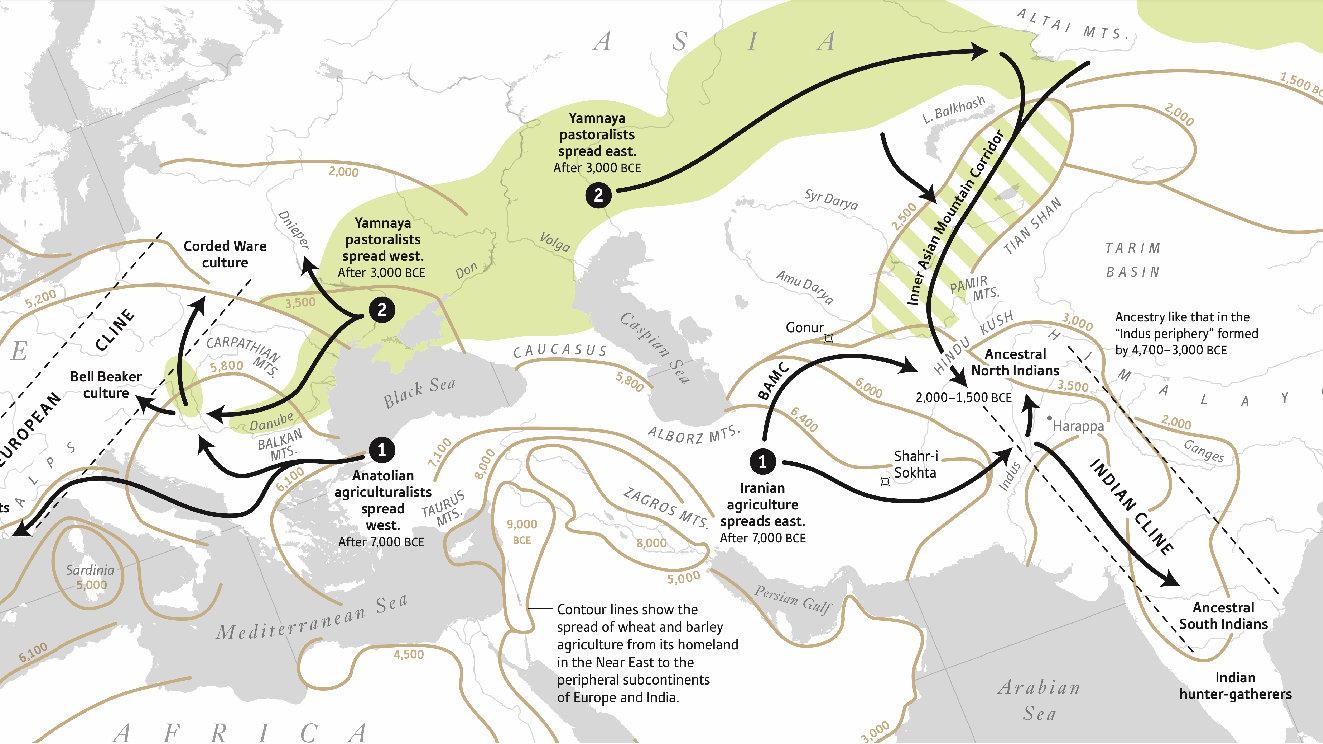
- I am partial to the view that Genes and Languages are moderately correlated. There are exceptions as readers of this blog would know, but they are exceptions. As the genetic data points out that 10-20% of Indian ancestry comes from Bronze Age Steppe, I find it highly implausible that such large changes wouldn’t result in some language change – especially given the gradients of Steppe wrt North/South and Caste. Additionally, the complete absence of AASI like genetic ancestry beyond the boundaries of the Mauryan & Mughal empires at their zenith is big deal. If any kind of OIT that doesn’t explain satisfyingly falls short. (Roma Gypsies have AASI)
- On the whole, I find the Steppe hypothesis works well linguistically and archaeologically to an exceptional degree in my reading – for Europe. By Occam’s razor, it would be fair to assume India isn’t an outlier among regions speaking Indo-European. Small objections like this don’t debunk the entire Steppe hypothesis IMO.
- The lack of material culture change associated with AIT is a problem, but the same objection is also present for OIT. Lack of evidence isn’t the absence of evidence. At best archaeologically the AIT/OIT debate is a Tie.
- I find Talageri’s work lays excessive claim on his interpretation of Rgveda and Avesta. I find the Rgveda has no memory of invasion argument weak. What we know of the Rgveda might just the memory preserved post the Bharata victory in the Dasarajna (Victor’s memory). It would be plausible that memories of invasion may be lost by accident of history. I am no expert on either Rgveda or Linguistics (I have read only 4-5% of Ralph T.H. Griffith translation) but I still find the lack of scholarly approval of Talageri’s work a problem from believing his work. However, on Kushal’s advice, I am going to read his entire work – 3 books hopefully by sometime next year.
- I take the Horse argument seriously. The paucity of equid bones IVC itself is significant. Especially if you compare them to Steppe sites. (The Botai & other steppe sights are extreme in the sheer quantity of horse bones). On the whole, I find Anthony’s horse hypothesis holds in face of the data we have today.
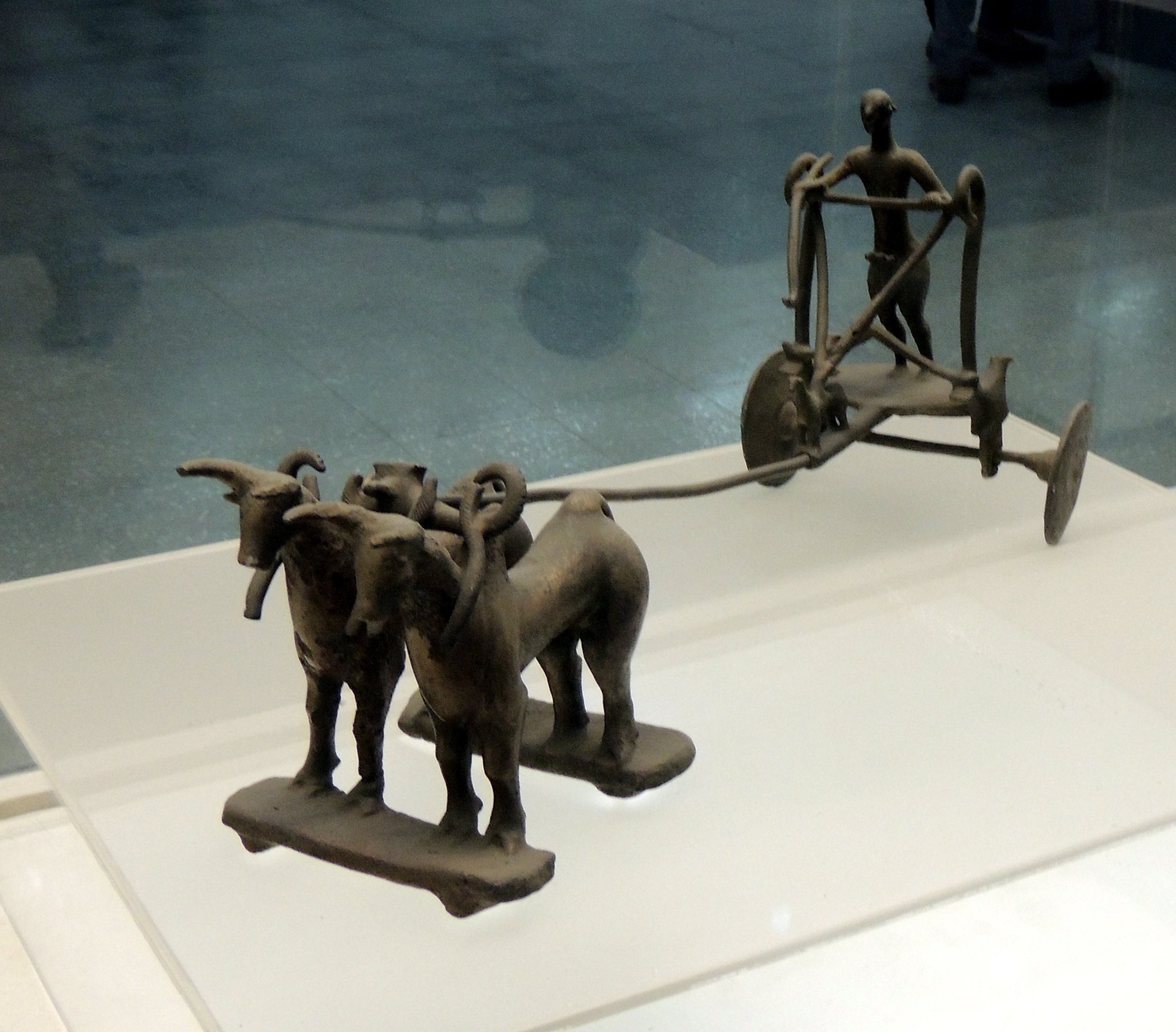
- I don’t see the Sanuali find as a game-changer. The Daimabad hoard Bull drawn cart/chariot has been known for decades. I don’t think the argument for Sanauli chariot being Horse-drawn is convincing yet. Also, the lack of spoked wheels would make the chariot less agile which would make it not a War-chariot like Sintasta. Anthony had to fight a lot for years before even his finds (which are far more impressive than Sanauli) at Sintasta were taken seriously as a war chariot by the community. His chariots were disproved by peers for things like width, length, etc. At the least, it’s premature to call the Sanauli chariot as a deal-breaker for AIT. Additionally latest the dating of Sanauli at 1800BCE isn’t far enough from the 1500+-200 date given for AIT. Rather the 1800BCE dating appears consistent with Asko Parpola’s first Pre Rgvedic Arya migration theory.
- I have heard Slapstik’s BP podcast, read his comments, and also those of some others who know linguistics along with some light reading of linguistics. The linguistic argument appears robust enough for my non-expert ears.
- In historic times, since the Persian invasion during the time of Bimbisara to the invasion of Abdali – the flow of invasions has been Strictly One Way – from the Bolan/Khyber pass to the Subcontinent. (in some cases as speculated with some Hunas – via Kashmir). Examples of these being Persians, Greeks, Sakas, Parthians, Kushanas, Hunas, Arabs, Turko Afghans, Mongols, Mughals, Persians, and Afghans. These invasions have a concrete economy to them – the fertile and prosperous lands of the Indo-Gangetic plains. So it begs the question – why would Indo-Aryans go out if they were indigenous. Many reasons for coming IN & almost no for going out.
- I find the arguments over Sarasvati which convinced me once unconvincing today. I think the argument comes from the position of reverence to the holy Sarasvati from the Rgveda & laying excessive emphasis on it. I am convinced by the general argument of the same names being used for rivers by migrating people and we have many examples of that in the country. Additionally, the Shtich that the Yamuna changed course and dried up Sarasvati made famous by Amish’s fiction appears on its face – an extraordinary claim with almost no concrete evidence.
Closing comments:
- It’s fair to say both sides in India are fairly motivated by politics. I don’t find the OIT arguments as ridiculous as some AIT supporters find, but one can’t ignore the identity politics and question of Islam being catalytic in the debate. Personally, I don’t think this is a coherent position, I supported the OIT while being a Liberal opponent of Hindutva for almost 2-3 years and even today I am open to change my mind in face of new evidence. However, I think it’s unlikely that I will be easily convinced without some genetic data or more archaeological data (more chariots around 2500 BCE with horses).
- A salient point made by Talegiri is worth noticing. He claims that the Indians who continue to support AIT are Brahmins who have not yet given up their supremacist mindset. He also conjectures such support for AIT goes hand in hand with the defense of Varna. Growing up as a Chitpavan Brahmin I know this argument has some truth to it, though Maharashtrian Brahmin communities have given up those supremacist ideas in 2020. In a way, Hindutva has united what Varna/Jati had divided.
- A version of OIT seems to be too fantastic to be true but works with genetics and archaeological findings. This theory being Aryas composed the Vedas before 3000 BCE, some of them settled in IVC cities, some went out into the Steppe. And then these Steppe people spread the languages and a pulse came back around 1500 BCE and composed the latter Rgveda. I naturally don’t buy this 🙂
- In the end, the difference is what kind of evidence people are willing to buttress their arguments on. Most of the time such opposing views would talk past each other. I get a feeling no amount of Ancient DNA will convince OIT folks who take the Rgvedic & archeological arguments over Genetics/Linguistics. Personally, I am partial to Genetics\Linguistics as I find it more Sciency than Reconstruction from texts & archaeology (or lack thereof).
Postscript:
I plan to read Talageri’s books, Asko Parpola’s Roots of Hinduism, Mallory’s book again in the coming years as I find the issue fascinating. I guess that Razib, Slapstik, and others who have been at this topic for years on the blog might be finding the topic boring by now. Still, I would urge them to comment and point out any inconsistencies or blindspots I may have had in my summary above. Same for OIT guys – as already mentioned I will be reading Talegiri – is he the main guy you rely on? How many of you are patrons of Kushal’s AIT/OIT work ? which appears to be very extensive.
I said above that Talageri is not Hindutva but have been corrected by Kushal made the change in the blogpost.

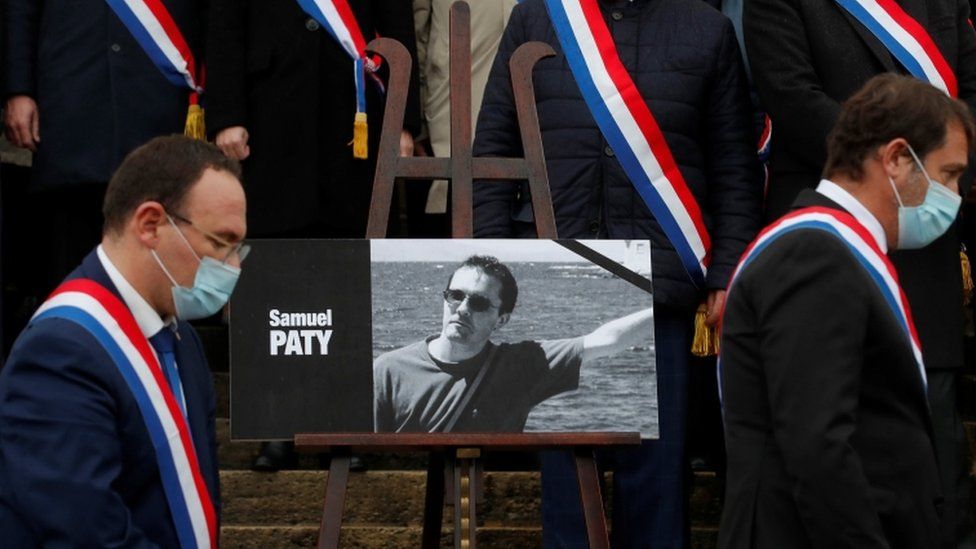
 There is some discussion on “Hindu Twitter” and elsewhere about the French response to the murder of