
Category: Razib Khan
Unheard objections
Lots of response to my piece, How Brahmins lead the fight against white privilege. I’m trying to do less Twitter and more blogging, so here I go with some responses to reactions
Q: “Why are you picking on Brahmins?”
A: The only groups white people know about in regards to caste are Brahmins and Dalits. So Brahmins went in the title. That being said, 25% of Indian Americans are Brahmin. The highest proportion Brahmins are in and around UP (in the hills as well), but very few immigrants to the USA came from this region (proportionately). So Brahmins seem about 10x overrepresented.
Q: “Why are you mentioning caste, no one cares about in the USA….”
A: Totally correct in my opinion that caste is not an issue. But Indian Americans are very unrepresentative. In a private survey of 2,000 Indian Americans, 400 stated they were Brahmin. How many stated they were Scheduled Caste or Dalit? 5. This is an underestimate because some people won’t admit it, and some parents may not have told their children. But ~15% of Indians are Scheduled Caste. 0.25% of Indian Americans. This seems notable. I could have used a different term obviously, and if the audience was India I would have. But I wanted to get across to the Western audience that Indian Americans are not your typical Indian.
Q: “Why does this matter?”
A: I used Saira Rao as an example, but she’s an extreme caricature of a type. For several years people I know in academia and media have been privately complaining me (that’s what I’m here for!) about “social justice posturing” of Indian Americans. Particular, to be frank, young Indian American women. These are often very self-righteous, very vocal, and, very privileged. I haven’t done a survey, but most of these individuals aren’t the children of cabbies, but hail from well-heeled suburbs. There is no shame necessarily in being a Leftist from a prosperous background, but what people tell me (and I have seen on Twitter), is that many of these individuals co-opt narratives of colonialist and racist oppression. Of course, being a brown American most of them have experienced racism, but obviously the history of the United States before World War II is not their family’s history, and being more privileged than typical, American Desis, on the whole, are not crushed of the earth.
But due to the ignorance of Americans of many aspects of international culture, everything and everyone gets bracketed into a “postcolonial narrative.”
When language replacement occurs with minority demographic impact
Instead of posting a comment, I’ll just do a ‘core dump’ on a post.
Continue reading When language replacement occurs with minority demographic impact
On the Great Mughals: Indian or not?
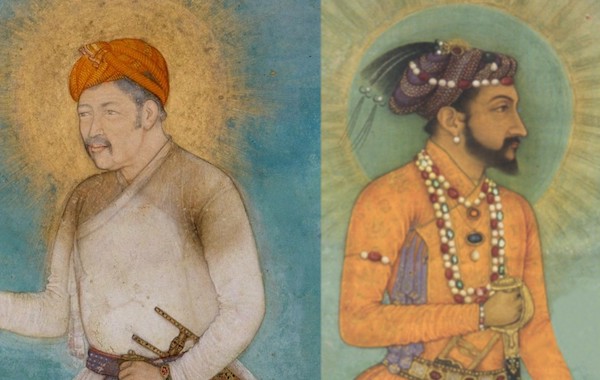
The above are portraits of Akbar the Great and his grandson Shah Jahan that date to about 1630. Akbar had died about 25 years before the portrait, but its likeness seems close to how he was described by his relatives; fair-skinned and with a definite East Asian cast to his features. Akbar’s mother was ethnically Persian, while his father was mostly of Turco-Mongol background. Shah Jahan, in contrast, looks typical for a North Indian noble. This is reasonable because three of his grandparents were Hindu Rajputs. Only Akbar himself was not ethnically Indian.
But they say do not judge a book by its cover. A stylized fact of the Mughals at their peak is that from Akbar, to Jehangir, to Shah Jahan and finally Aurangzeb, there was a progressive ratcheting up in the power and influence of Sunni orthodoxy in the inner circle of the court. The 100 years after the reign of Akbar can be seen a series of victories by international Sunni institutions like the Naqsbandi order. This integration into a broader Islamic world can even be seen in Shah Jahan’s choice of Muntaz Mahal, an ethnic Persian of recent immigrant background, as his primary consort.
I think of these things sometimes because periodically there are outbreaks of argument about whether the Mughals were Indian or colonizers on the internet, and the two sides are extremely reductive and stark. This makes sense since it’s all rhetoric. But often they collapse and erase the texture.
One thing that is important to note is that it does seem clear that the Mughal conquest of India saw a deeper integration of India into the Islamic world than the period of the Delhi Sultanate and its successor states. Though many of these states were of Turco-Iranian origin, and cultivated Persian high culture, they were not as coherent or focused in their ideology as the Mughal Empire that succeeded them (during the Bengal Sultanate that Bengali did become a language at court). India had long been seen as a land of opportunity for Muslim adventures, but the Mughals systematized it, encouraging the migration of Iranians, especially Sunnis fleeing a newly Shia state, into its civil administration and Afghans and Turkic Central Asians into its military.
Talking points re: caste
The “caste in America” issue just isn’t going away, and I keep having to resurface on social media. This post will be placeholder until I can set aside time to publish something more thorough and polished (between my startup and substack I can’t spare the marginal cycles on a piece about caste).
First, why do I care about caste? Though I have an intellectual interest in the topic, mostly it’s just that I get asked about it, a lot. Mostly this is driven by Indian American journalists writing about the pervasiveness of caste in tech, which I think is pretty much manufactured mostly out of a few incidents. If you are a subcontinental-looking person in the US in professional class situations you will be asked. This is why I have started to refer to myself as a Dalit online. Why not? Who is going to know? Some online Indian Leftists do accuse me of being an “upper caste Muslim,” but despite my origin from eastern Bengal’s rural landholder class my “lived experience” is that of a brown American.
Second,
Open Thread – 12/5/2024
Merry Christmas!
Open Thread – 11/5/2024 – Brown Pundits
Open Thread. Someone is getting elected as US president today.
Open Thread – 10/04/2024 – Brown Pundits
What’s going on?
I have a new podcast, the Khanversation.
Bengalis are not totally Burmese in their East Asian ancestry
Though Burmese are a good donor for the Tibeto-Burman in Burmese, it seems pretty clear now that I have Tibetan samples that the Bangladeshi samples are a bit more Tibetan-skewed than these Burmese samples. It may be that the early admixture into Bengal was from a Burmese population that had admixed less with the Austro-Asiatic substrate of Burma.
Note that this confirms the Austro-Asiatic populations have a totally different (more southern) East Asian ancestry source.

Open Thread – 8/27/2024 – Brown Pundits
What’s going on?