The Parsis of Bombay

I just finished reading Michael Axworthy’s Iran: Empire of the Mind, one of Razib Khan’s recommended reads on Iran. The book serves as a useful primer on Iranian history for novices (such as myself), covering over 3,000 years of history in less than 300 pages. It lacks the literary flair and flourish of Tim Mackintosh-Smith’s magisterial Arabs. I found myself skimming through the latter parts of the book- the Pahlavi era and the subsequent Islamic Revolution- as I am broadly familiar with the events of the modern period.

 Pre-Islamic Persia was an advanced and sophisticated civilisation. Axworthy provides a good overview of the Achaemenid, Parthian and Sassanid periods of Iranian history. Ancient Iranians developed a complex and nuanced theology centred around the teachings of the prophet Zoroaster. Zoroastrianism was the predominant religion of the Sassanid Empire, one of the superpowers of the pre-Islamic world. All of this was to change with the arrival of Islam in the seventh century. The armies of Islam burst out of the Arabian Peninsula like a supernova and reduced the Sassanid Empire to dust. The Zoroastrian religion was swept away in this upheaval.

 One group of Zoroastrians escaped and sought refuge in Gujarat in Western India. These Zoroastrians are commonly known as the Parsis (from Pars or Persia). The essay below is a personal account of the Parsis of Mumbai. I had written it a decade ago. Reading Axworthy’s book brought some of those sweet memories back.  

Continue reading The Parsis of Bombay

Major Amin’s Summing up of the 3 Major Indo-Pak Wars

From Major Amin’s book on the history of the Pakistan army..

The First 1947-48 Indo-Pak War
The British started with a strategic plan having Britishers dominating the key posts in both the newly created countries! The war was fought largely by individuals on the Pakistani side and by the British Governor General and senior army commanders on the Indian side! Gilgit was won by Pakistan simply because the British officers of Gilgit scouts and the Gilgit Scouts VCOs acted with remarkable unison! No credit to the Pakistani Government, which had no clue about what was happening in Gilgit in September-October 1947. The Indians were doomed in this case since their Dogra Governor made plain his intentions to do away with the Gilgit Scouts! The VCOs of the Gilgit Scouts acted tactically but while doing so achieved a great strategic victory for Pakistan! It was a fairly even contest. There were two non- Muslim Companies in the 6 J and K at Bunji against two non-Muslim Companies! There was an airfield at Gilgit just like there was one at Sringar! The Indians lost the Northern Areas because of outright strategic incompetence! The Pakistanis have proved equally strategically barren! No statue at Islamabad commemorates what the VCOs of the Gilgit Scouts led by the indomitable Scott Major W.A Brown achieved for Pakistan in October November 1947! Without Gilgit or Baltistan what would have been Pakistan’s China policy! There was a Dogra Governor in Gilgit in 1947! Today the Northern Area still does not have a Gilgiti Muslim Governor! Continue reading Major Amin’s Summing up of the 3 Major Indo-Pak Wars

Looking back at COVID-19

(A few additional comments added on 02/21/21)

COVID-19 is still a menace that is affecting thousands of people every day across the globe. However, vaccination and palliative therapies indicate that there is less of it ahead of us than behind us. I am training in pathology at a hospital in Texas and do not have the required qualifications to talk about the nitty gritty of COVID virus and its structure. However, I was involved in management of patients with COVID who were in intensive care and before that, in procuring convalescent plasma for COVID patients. I want to write about the policy and public health side of managing COVID and not the clinical perspective, which is not my primary specialty. This piece was inspired by two articles in the New Yorker, the first is a long-read from Lawrence Wright (here) and the second is from Charles Duhigg (here).

When news about COVID started trickling at the end of December 2019, I was not alarmed. I thought of SARS, Swine flu, Ebola and MERS, which were mostly containable viral diseases and their human impact was not global. I was at a conference in Dallas at the end of January, where a presentation was on memories of dealing with the first Ebola case in the US. I remember sitting in the back row of the auditorium and listening to the lengths that a particular hospital in Dallas went, to quarantine the said Ebola patient. By February, there was news of how Chinese state was hiding things about the mysterious viral infection and whistleblowers were shedding more light on the disease. It was in late January-early February that first cases of the mystery virus were discovered in Seattle suburbs and suppression of data/news about COVID started in the US (the Trump administration). I was at another conference in Los Angeles at the end of February and saw the news that cases of COVID had been diagnosed near San Francisco.

Upon my return to work in the first week of March, I was required by the hospital to report travel to the employee health clinic, which I did. Prior to arrival of COVID, I was going to travel to Ohio for an elective rotation and to New York to present at a conference. With COVID, all plans had to be cancelled. Since March of last year, COVID has affected millions of people across the globe and disrupted life as it used to be. One of my friends refers to any year before 2020 as “X years B.C.” (before COVID).  Moving from my personal story to a bird’s eye view, what can we learn from COVID moving forward? I have tried to distill my thoughts about the pandemic, pandemic response and best practices.

Based on what we know now, here are a few things about COVID response, with relevant exceptions:

1. Island nations have generally done better, with exception of Britain and to an extent, Vietnam. At the start of the pandemic, there were fears that autocratic governments will prevail better because dictators don’t have to worry about human rights, laws or courts. That fear has not come true, generally. Australia, New Zealand, Taiwan, Sri Lanka or Vietnam are mostly democratic nations.
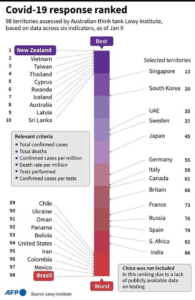
2. Things have been better when scientists and public health officials have been allowed to be at the forefront, except in the case of Sweden, where the top epidemiologist wanted to test his “herd immunity” theory.  The New Yorker story from Charles Duhigg that I mention above, refers to a significant difference in COVID cases and deaths between New York, where politicians were at the forefront of COVID response, versus Washington state, where public health officials made the rules.

3. African nations have done better at managing COVID than most ‘first-world’ countries, in my opinion, due to their experience in dealing with Ebola, MERS and similar viral illnesses. There has been a recent second wave and a South-African variant that is more resistance to the mRNA vaccines than the OG COVID-19 or the UK variant. There was a recent story in the BBC about the second wave (here) and earlier, about the low rates of infection and mortality in the African continent (here).

4. It is incredibly hard to restrict what constitutes “daily life” even in the face of a deadly pandemic. Human beings are social animals and severing that connection from others, whether in form of closing offices or bars and restaurants, cannot be reliably depended on for long periods. Travel has become another necessity in this day and age, for business or pleasure. Airlines and the hospitality industry as a whole will be running losses for years to come. I traveled three times during the last year, twice domestically and once on an international route. I tried to be cautious and got tested before/after each of these journeys, which, admittedly is not a perfect way of being safe from COVID. There were multiple studies about spread of COVID on airplanes and I was constantly in fear of contracting it while flying, despite all precautionary measures.

I do not frequent bars/clubs in general so i didn’t miss them much. However, I did miss spending time at the library and our nearby Barnes and Noble.  If one were to look at the graphs of cases and deaths in the US, there are peaks around memorial day, 4th of July, Labor day, Halloween, Thanksgiving, Christmas and New Year. Around Christmas, close to a million people were flying every day in the U.S. Graphics from the Washington Post tracker.
5. China, not completely culpable but deserves blame for its early missteps and obfuscation (a la Great leap forward) when it comes to COVID. We still don’t know if COVID transmission started at a wet market or somewhere else. Wuhan is back to pre-COVID times while the rest of world keeps suffering. Chinese authorities have tried to strong arm the WHO and any outside effort to investigate the origin of transmission of COVID. I do not subscribe to the conspiracy theory that COVID is a “China virus” or that it was manufactured in a Chinese laboratory.

6. Vaccines. I consider the development of COVID vaccines a modern day miracle. The fastest that a vaccine had been previously prepared was close to three years. The severity of disease, mounting death rate and irresponsible behavior by the general public, made the timeline for introduction of a vaccine shorter than ever. Fortunately, the mRNA type platform vaccines had been in development for years and this was the right moment for them. The journey started in January 2020, when COVID genome was first shared by Chinese scientists and culminated in November/December 2020, when two major candidate vaccines was ready to be administered. Since mid-December, more than 73 million doses of either of these vaccines has been distributed in the US. This is a graphic from the Washington Post tracking vaccine distribution in the US:

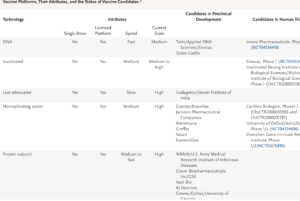
I got vaccinated in January and feel fortunate to have that immunity. However,  the mRNA vaccines have a 66% response to the South-African variant (versus 90-95% against the OG COVID).  The AstraZeneca vaccine has a 23% immune response to the South African variant. There is very little good data on vaccines developed by Russia, China and India. From what we know about their mechanisms of action, Russian vaccine is similar in mechanism to the AstraZeneca vaccine (uses inactivated Adenovirus), while the Chinese vaccine is based on inactivated virus and the Indian (serum institute version) uses live attenuated virus. Graphic from NEJM.
7.  Viruses don’t care about state or national boundaries. The Sturgis motorcycle rally in South Dakota in August led to increased cases in neighboring Minnesota (here). A single conference in Boston in Feb 2020 lead to almost 300,000 cases (here). COVID has reached Antarctica, the last bastion of human presence without infection (here).

8. Disinformation spreads faster than the truth. The famous line that “A lie can travel halfway around the world before the truth can get its boots on” was truer during the COVID pandemic than any other modern peacetime event. Since I have a medical degree and had some exposure to COVID response, I was asked by many family members and friends from across the globe about various conspiracy theories circulating regarding COVID. The top hits included COVID vaccine altering your DNA, different cocktails for treating COVID (the whole hydroxychloroquine debacle), herd immunity, exaggerated vaccine side effects, masks, Vitamin D, COVID vs Flu, PCR vs rapid testing and their predictive values, various miracle cures etc. Many of these lies and misinformed views were spearheaded by medical personnel (doctors, nurses, nurse practitioners etc) which made it incredibly hard for a layperson to know what was the truth and what was just a fanciful conspiracy theory. To top it all off, many people initially (and still) refuse to believe that COVID is real.

9. Masks work but not all masks are the same. This is related to point 4 from earlier (human nature cannot be suppressed for long). It is hard to wear a mask all the time. I work at the hospital and that being a high-risk area, everyone has to be masked almost all the time. But, due to strict masking requirement, infection rate of workers (both medical and non-medical) at our hospital stayed less than 1% even when the infection rate was close to 10% in the community that we serve. N95s which should be worn by individuals who are at the highest risk of getting COVID provide better protection than a regular surgical mask (efficacy close to 65%), which is better than a regular cloth mask (efficacy less than 50% and needs to be washed regularly). I have seen innumerable number of people wearing their masks incorrectly (i.e. nose not covered) but I think that at least they are wearing a mask. One reason that east asian nations did better at controlling the pandemic is because mask-wearing is normalized at a larger societal level, compared to “freedom from tyranny” type attitudes seen in the US. According to estimates, if 90% people in the US had worn masks at the beginning of COVID, we could have averted millions of cases and thousands of deaths.

In Arizona, there were dramatic improvements in case numbers once mask mandates were enforced. (paper from CDC here).

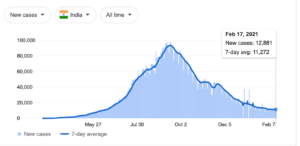
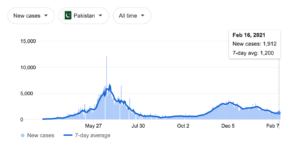
10. The curious case of Pakistan and India. Early in the pandemic, while COVID was running rampant through most of Europe, North America and South America, India and Pakistan had very few cases compared to their populations. While India has caught up with the rest of the world lately, Pakistan is still reporting less cases than any major city in the US per day. What is causing this divergence? There are many theories and until it is studied methodically, I don’t have a clear answer. Even people who got COVID in Pakistan, got a mild disease. Many people pointed to BCG vaccination as being semi-protective against COVID. Some commentators proposed immunity due to earlier sub-clinical viral infections. Are there genetic factors causing this? My hypothesis is that Pakistan is not as exposed to the outside world as lets say the United States is. Secondly, testing in Pakistan is at a much lower level than anywhere else. At one point last year, the state of Punjab, with a population larger than Germany, was doing close to 15,000 COVID tests a day. If you don’t test, you can’t diagnose. Cases in Pakistan and India, graphs from the Johns Hopkins dashboard.
11.Personal Responsibility. The mantra of personal responsibility has been used throughout the pandemic by mostly right-wing politicians, trying to avert blame from themselves, resulting in a terrible failure. Anyone who has ever worked in customer relations can tell you that most people don’t really care about other people (knowingly or unknowingly). Public health does not work that way. One can argue that even economics doesn’t work that way either, but that is a separate debate.

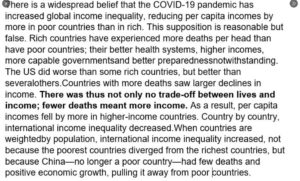
12. One heard the phrase “how many lives can you save by closing the economy” or variations of it since the early days of the pandemic. The lives versus economy rubric was debated over and over, without much evidence. Countries in the EU and Australia/NZ paid people to stay home. That approach is paying them off in the long run. In a paper titled “COVID-19 and global income equality” (here), Angus Deaton showed that saving lives has a positive impact on long-term economic outlook of a country.
13. Is the “office space” dead? Are we going to have a different economy after the pandemic? Would there be mass migration from major cities towards smaller towns and suburbs? I don’t have these answers as I am not an economist or a public planner. But these questions interest me and I am always trying to read about them.

14. Lastly, I cannot predict what is going to happen with COVID. When the pandemic started, my hope was that it would die down within six months. With a sharp decline in case numbers and increase in vaccinated individuals, I have hope that COVID would be under control by the end of the year. Would new variants disrupt this timeline and everyone will have to get a booster vaccine at some point in time? It is quite likely.

Comments and suggestions welcome!



Capsule Review: Homeland Elegies by Ayad Akhtar

This is a very well written book and Ayad Akhtar has clearly come a long way from his debut novel (American Dervish) in terms of style and writing skill. The story is OK but did not really work for me. The book is said to be semi-autobiographical and I found that hard to get past. Is this his story or not? We are not supposed to ask that question, but somehow i kept getting stuck on it (perhaps because I have lived in Brookfield and have some vague notion of where he is from). But mostly I was disappointed by the narrator’s somewhat sophisticated but still very “inside the bubble wokeness”. He presents himself as someone willing to “go there” and talk about (and intelligently criticize/analyze) everything but it turns out that he is skeptical of everything but “super-elite wokeness”, which he seems to accept as just the not-so-simple truth about our world. I expect that well-off second generation desi kids will identify with a lot of what the narrator goes through (real or imagined) but that seems to be a rather narrow demographic. For the rest of us, the insights are less than advertised.
Still, he is, as you might expect from Ayad Akhtar, ready to get into hot topics (including Islam, oral sex, parent problems, racism) with all guns blazing, which can be fun. And his summary of partition and Pakistan is pretty good, and some of the other essay-like digressions (such as his explanation for the ills of late capitalism and what Robert Bork had to do with it) are also interesting; whether they are true (or useful) is not equally clear. if you are a second generation desi or are so intensely woke that think-pieces in “The Guardian” generally seem wise to you, then this is your book. But even if you are not, it is worth a quick read.

Clash of two Jats in the Indian army

From Dr Hamid Hussain

Many folks asked me about recent news item about conflict between two senior Indian army officers.  It was simply personality clash & nothing significant.  However, pedigree of both officers and some interesting historical facts were too tempting for the story teller like me.

Regards,

Hamid

Clash of Two Jats

Hamid Hussain

Recently, conflict between General Officer Commanding-in-Chief of South- Western Command (Sapta Shakti) of Indian army Lieutenant General Alok Singh Kler and his Chief of Staff (COS) Lieutenant General Kamal Kumar Repswal became public.  Chief of Army Staff (COAS) General M. M. Naravane ordered a Court of Inquiry (COI) and Respwal was posted out as COS of Eastern Command. The nature of conflict is not clear, but some suggest that it relates to command decisions and administrative matters.  There is no evidence that there was any financial irregularity or moral lapse. Continue reading Clash of two Jats in the Indian army

Some notes on the accession of Junagadh vs. Kashmir

Whenever there is a debate on Kashmir, there is often a parallel drawn, particularly in Pakistan, between the accession of Junagadh to India, and the accession of Kashmir (also to India).

The narrative in Pakistan typically goes –

In the case of Kashmir, a predominantly Muslim state acceded to India, as its Maharaja was Hindu. While in Junagadh, India insisted on a plebiscite and eventual accession to India though its Muslim ruler had acceded to Pakistan. 

While this criticism may seem superficially sound, it is very specious and misleading as it ignores how different the case of Junagadh was from that of Kashmir. It is worthwhile to reflect on the circumstances surrounding the accession of the two states.

A few things –

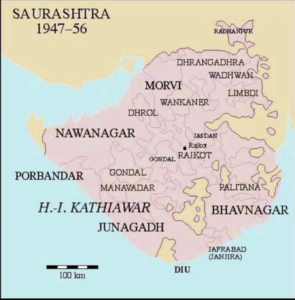
1. Junagadh was not contiguous at all with Pakistan. In contrast J&K in its entirety was contiguous with India.  The Nawab’s accession to Pakistan was in violation of the contiguity principle. Here’s a map locating Junagadh in Southern Gujarat.

On the other hand, all of Jammu and Kashmir in its entirety was and is contiguous to the rest of India. So the “contiguity principle” was very much adhered to in the Maharaja’s accession to India


Image Source : wiki

2. Junagadh, with its population of 700K, was ~85% Hindu. The Nawab’s decision to accede to Pakistan was clearly in violation of the wishes of his subjects. In the plebiscite that succeeded the Nawab’s Pakistan accession, well over 95% of the voters chose to accede to India

In contrast, J&K was about 75% Muslim. Also unlike in Junagadh, where Hindus dominated the whole state, in J&K, the Muslim predominance was mainly in the Kashmir valley, while the Hindus were numerous in Jammu and Buddhists in Ladakh.

3. Junagadh’s Hindu population revolted strongly and vocally against the Muslim Nawab’s decision to accede to India. Close to 100K Hindus fled the state in the fall of 1947 as per VP Menon, leading to a near collapse of Kathiawar economy.

The plebiscite in Feb 1948 was prompted by this revolt against the Nawab’s decision. Which ofcourse settled the matter in favor of India. In contrast, in J&K, there was no major clamor among the Muslim population in favor of Pakistan. The major Muslim political body National Conference supported the Maharaja’s decision to accede to India notwithstanding its differences with the Hindu princely ruler. So it was a situation fundamentally different from that of Junagadh.

4. The Nawab of Junagadh unilaterally and hastily decided to join Pakistan, under the influence of his Dewan – Shahnawaz Bhutto (father of Pak PM Zulfikar Ali Bhutto) without even the common decency of letting the Indian govt know of the decision through proper channels.

In fact, Sardar Patel and VP Menon learnt about the decision through the media in late Aug 1947, and later got it confirmed by the Nawab. The Nawab had gone back on the word of his earlier Dewan Abdul Kadir, who had assured Gujarati press as late as April 1947, that the state won’t join Pakistan.

In sharp contrast to the indecent haste and reneging of promise by the Nawab, the Maharaja of Kashmir, Hari Singh, was deeply conscious of the fact that 70% of his subjects were Muslim. He did not accede to India in a hurry.

The accession happened only as late as 26 October 1947, following the invasion of Kashmir by “irregulars” and tribal militias sent from Pakistan. So Hari Singh’s sensitivity and judiciousness was tested to the limits and his hand was forced by Pakistan’s aggression.

5.  Next, let’s examine the attitude of India and Pakistan in either case – radically different approaches.

In Junagadh, Muslim league politicians tried to “force” the hand of the Nawab through Shahnawaz, though the Nawab ruled over a Hindu province with no borders with mainland Pakistan.

While in the case of Kashmir, Sardar Patel and VP Menon assured Hari Singh throughout 1947 that they would be okay if he chose to accede to Pakistan. So the Indian attitude was a cool-headed dispassionate one that acknowledged whatever decision Hari Singh would take.

Pakistan in contrast tried to force the issue militarily in Kashmir, not just using its Army and its “irregular” agents, but by cutting off supplies and transport to Jammu from Pakistan, in an attempt to intimidate the Maharaja into acceding to Pakistan.

So these are five major ways in which the case of Junagadh differed from that of Kashmir. Clearly there is no parallel.

There is no ideological contradiction in the way India handled both cases. The Indian reaction was pragmatic and philosophically consistent.

References for the thread :

  1. TCA Raghavan, The People Next Door: The Curious History of India’s Relations with Pakistan
  2.  On Kashmir Demographic history –http://cpsindia.org/dl/Blogs/Blog%2015%20J&K.pdf

Post-script : 

In the first draft of this piece, it was mentioned that Hindus were predominant in Jammu in 1947. I have corrected this to “Hindus were numerous in Jammu”, though maybe not in a majority. The census numbers of 1941 are unreliable on account of WW2, and also the Jammu specific numbers may have been impacted in the course of 1947 on account of both the riots against Muslims in Oct 1947 and against Hindus / Sikhs in Mirpur / Rajouri the following month.

Also the % share of Muslims in the state of J&K has been edited from ~70% to ~75%, as the latter number is a fairer estimate based on 1931 census, while the former number stems from the 1961 census

Farmers vs Government: The Benefits and Limits of Democratic Redistribution

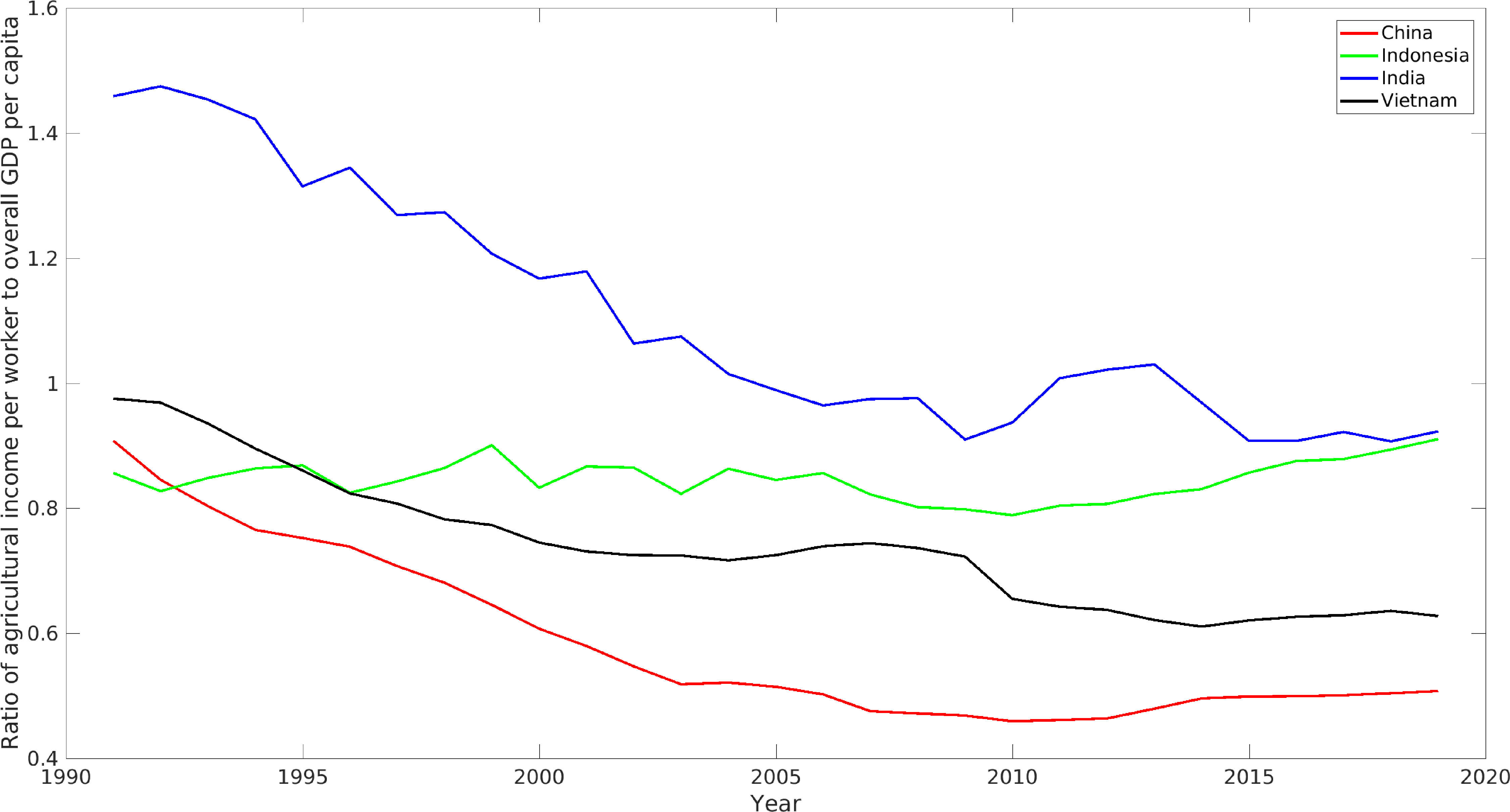
In its period of rapid economic growth, Indian democracy was successful in redistributing gains from urban centered, globalization led growth to the rural agrarian economy. The redistribution of available economic and administrative resources among competing groups is a primary concern of democratic politics. The situation is very different in non-democratic polities. In the figure below, we see that during globalization led growth, the ratio of per worker agrarian income to overall per capita GDP drops to less than a half in China and Vietnam, while it remained above or close to one in India and Indonesia. In other words, agrarian workers in one-party China and Vietnam became relatively poorer while their country became richer, agrarian workers in India and Indonesia did not incur a relative disadvantage.

Ratio of agricultural income per worker to overall GDP per capita for four Asian countries. In democratic, farmer majority India, the rural populace could always command a major share of the state’s redistributive efforts. After an initial decline from 1.4 to 1.0, the ratio in India stabilizes. In one-party China and Vietnam, the emphasis is on efficient agricultural production, not producers, and resources are invested heavily in urban areas.

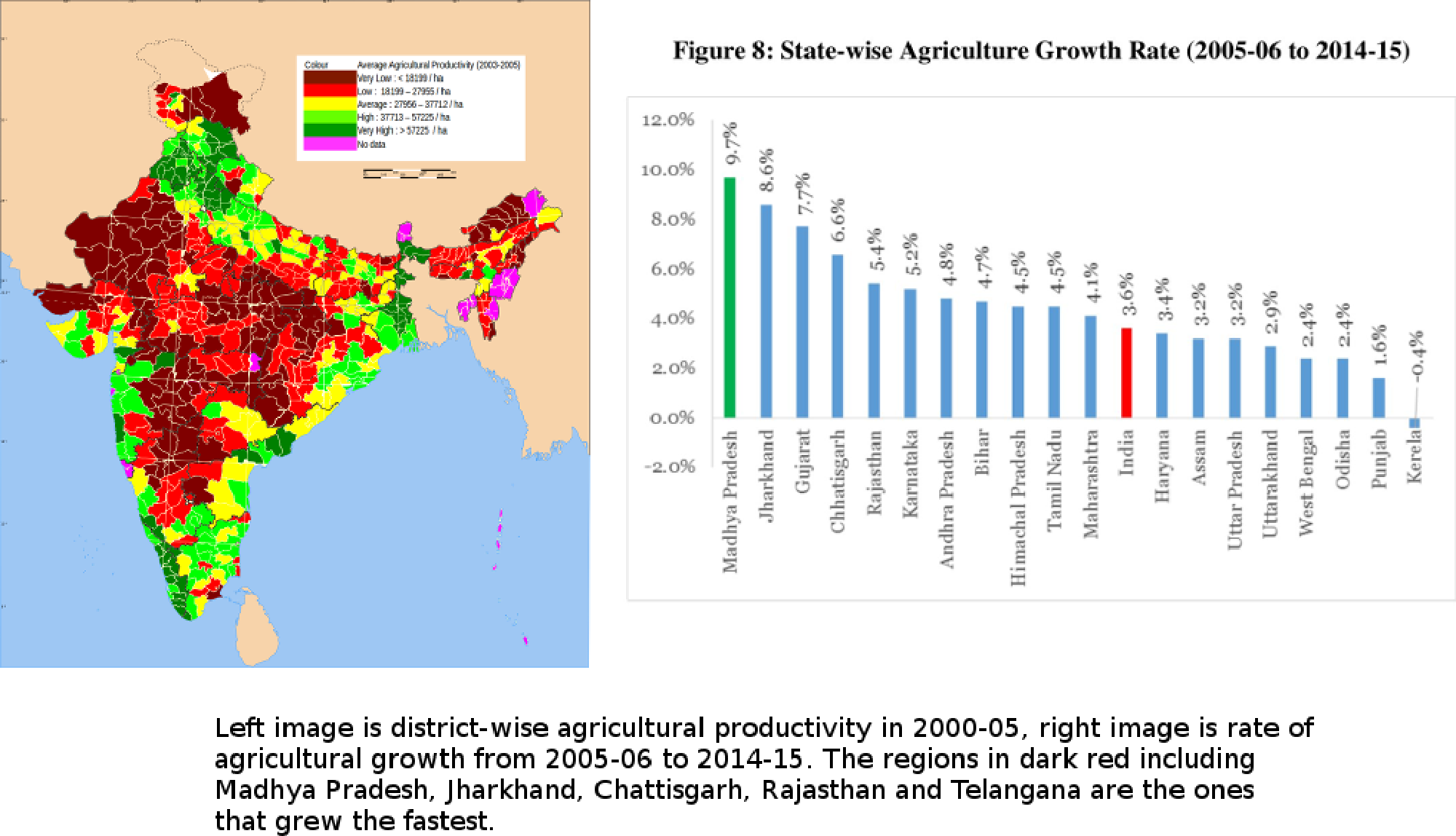
In India the vast rural population with more than a century long experience in political mobilization, has pushed governments to spend money in rural areas. Redistribution has occurred via irrigation projects, rural roads, NREGA, subsidies, loan waivers and recently, direct income transfers. Any negative externality arising from agrarian activity has been borne by urban residents (eg: Delhi smog) but farmers were not penalized. Aside from rural-urban dynamics, democratic redistribution has led to a spatial equalization of agricultural productivity across the country.

Left image is district wise agricultural productivity in 2005. Since then, as the right image shows, agricultural growth has been concentrated in the most backward areas (dark red on left). The primary drivers have been irrigation projects and rural roads.

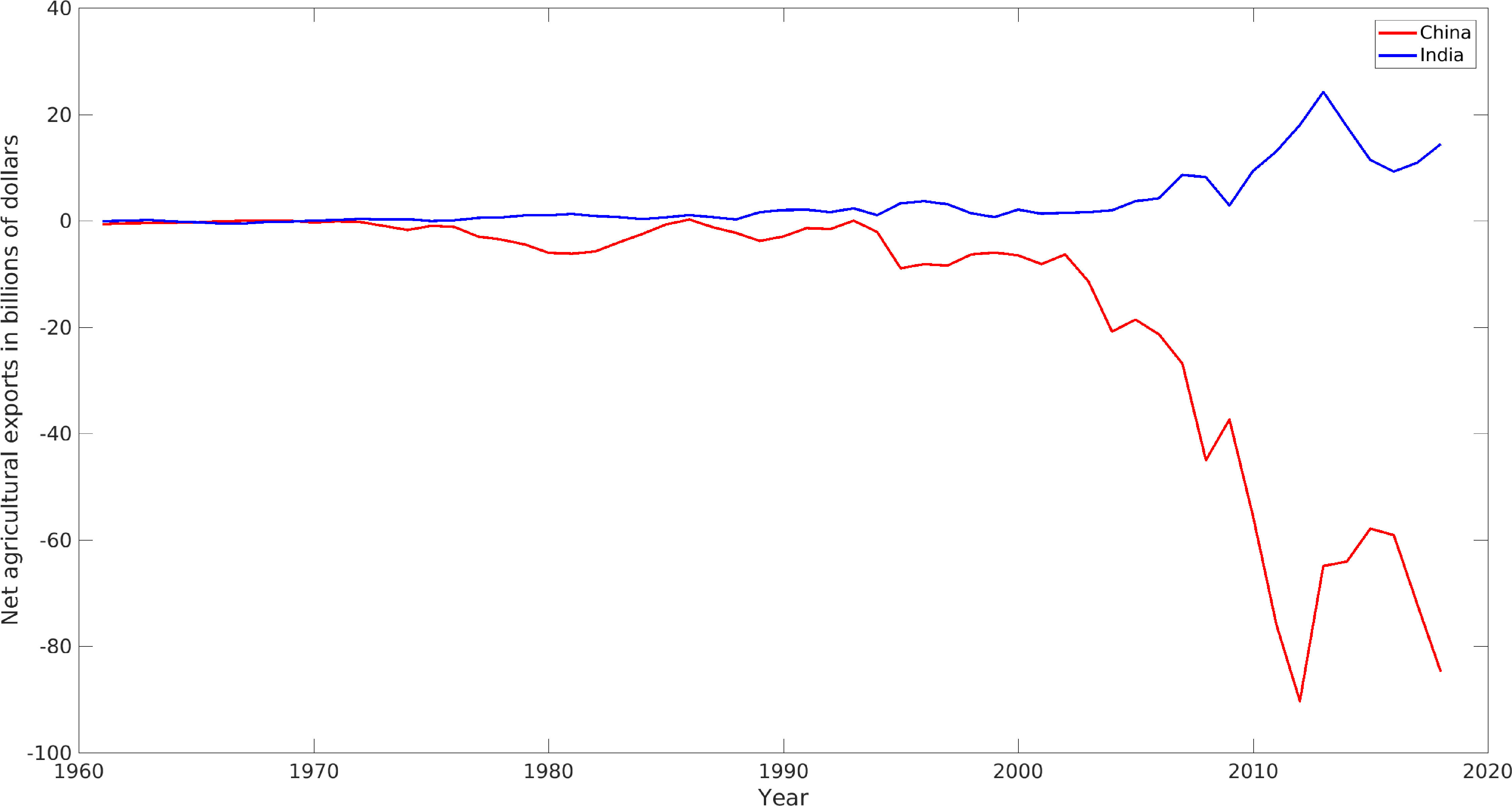
Though the condition of Indian cities is depressing, the upshot of a democracy dominated by the rural majority is comfortable food security. In fact, even though India’s use of pesticide is quite low by global standards, and its agricultural yields, cold-chain infrastructure sub-par, it has become a major net agricultural exporter. This is in huge contrast to China which has become a massive net importer of food. This is an important strategic advantage for India.

Net agricultural trade balance for India and China since 1961. China reverts to a net import situation as soon as its economy starts booming in the 1990s. in contrast India’s exports zoom in its period of economic growth.

There are signs, though, that India’s redistribution toolkit might be reaching the limits of its efficiency. Concurrently, a more reformist Indian government, awash with surplus grain, wants to re-orient farmers towards higher return crops or even an exit from farming. An urbanising electorate may also not be as willing to redistribute their hard earned tax monies towards their rural co-citizens.

The reorientation of the Punjab-Haryana farmer away from rice and wheat will require tact and persuasion, not ordinance fiat. The set patterns are very comfortable from the economic (MSP + diaspora remittances + armed forces recruitment) and psychological (we feed and secure the nation) perspective. The simple promise of higher incomes might not convince historically agrarian communities who havent fully embraced the money economy.

The Prime Minister has proven to be a masterful communicator. We have not yet seen the same skill in his dealings with the farmers. The approach there has oscillated between genuflection and disregard. The potential is there for the 200000 sq. km tract of well irrigated, fertile land in India’s north west to become the new California Central Valley (47,000 sq km). India can then become the land that greatly increases global access to premium agro-products like fresh, dry fruits and vegetarian protein. The latter (beef-mukt world) will also resonate with many urban supporters of the government and even the farmers themselves.

The Confluence of Two Seas: India and Arabia

Centuries ago, the Mughal Prince, Dara Shikoh wrote a treatise on the similarities of Hinduism and Islam – Majma-ul-Bahrain or The Confluence of Two Seas. Wading through the songs of sages born on holy riverbanks, Dara discovered striking similarities in Vedic verses with his beloved Sufi stanzas. Dara attempted to bridge Indian and Arab minds to not only bring material peace to communities in strife but also achieve inner peace by uncovering a quintessential spiritual unity.

Dara’s quest would be cut short by his fanatic brother, Aurangzeb, who would usurp the throne and execute Dara for apostasy. A reign of religious terror followed as Aurangzeb’s extremism left permanent scars on the subcontinent until the sparks of saffron would strike back as the upstart Marathas upended the Mughals into obscurity.

Yet, this is just a part of a much more ancient interaction. Before Islam galloped across the world, Arabs were aware of the subcontinent, al-Hind, and an interesting set of interactions played out. There is no grand trend or narrative here, but I want to tell you the story of an Arabia before and after Islam and how it spoke to an India that was eternally Hindu.

Continue reading The Confluence of Two Seas: India and Arabia

Brown Pundits